
Circular Economy Market 2025
By Type (Clothing And Textile Waste, Electronic Waste, Food Waste, Glass Waste, Plastic Waste, Wood Waste), By Enterprise Size (Large Enterprises, Small And Medium Enterprises (SMEs)), By Industry Vertical (Manufacturing Industry, Consumer Goods, Waste Management And Recycling, Construction And Building Materials, Automotive And Transportation, Food And Agriculture, Other Industry Verticals), And By Region, Opportunities And Strategies – Global Forecast To 2035
circular economy Market Definition
The circular economy is an economic model designed to minimize waste and maximize resource efficiency by keeping products, materials, and resources in use for as long as possible. It emphasizes reuse, repair, remanufacturing, recycling, and sustainable design. The primary purpose of the circular economy is to create a sustainable system that reduces environmental impact, conserves natural resources, and fosters economic growth. The circular economy market consists of sales, by entities (organizations, sole traders, or partnerships), of circular economic services focusing on creating closed-loop systems where waste and resource input are minimized. The circular economy represents a shift towards a more sustainable and regenerative economic model that benefits businesses, consumers and the environment by emphasizing efficiency, longevity and resource recovery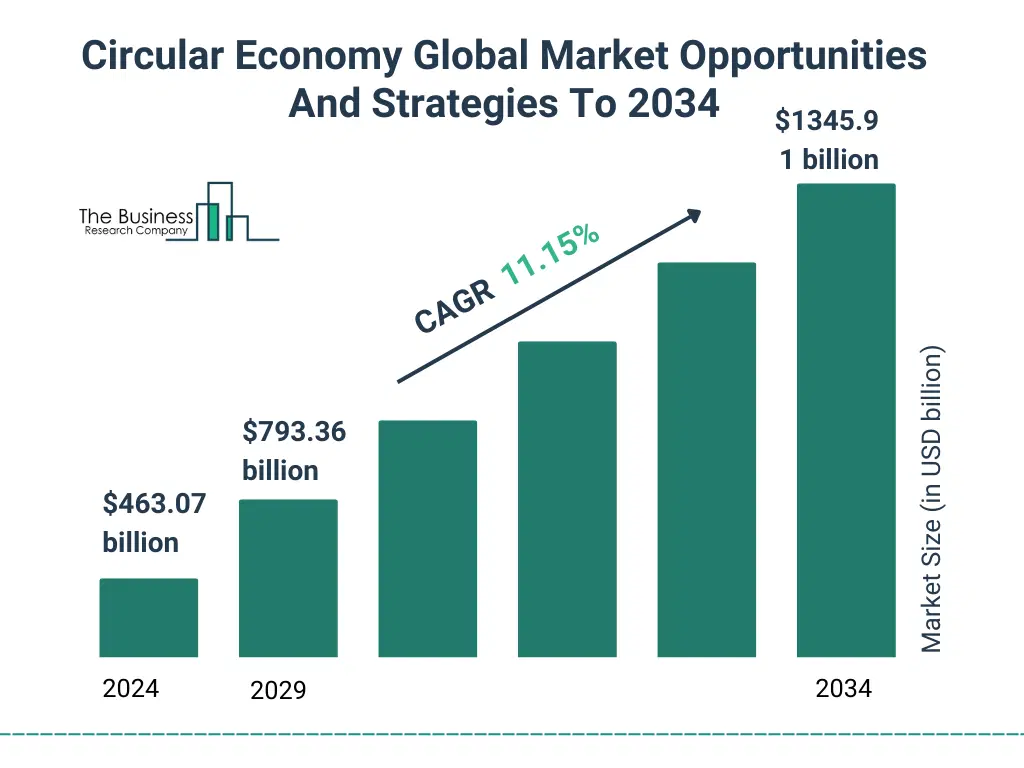
circular economy Market Size
The global circular economy market reached a value of nearly $463,070.00 million in 2024, having grown at a compound annual growth rate (CAGR) of 7.78% since 2019. The market is expected to grow from $463,070.00 million in 2024 to $793,364.60 million in 2029 at a rate of 11.37%. The market is then expected to grow at a CAGR of 11.15% from 2029 and reach $1,345,906.07 million in 2034. Growth in the historic period resulted from stringent environmental regulations and government policies, increasing digital resale platforms, increasing efficient waste management, rise of smart cities and rising environmental concerns. Factors that lack of standardization and design and technological limitations in material recovery. Going forward, investment in recycling infrastructure, ai-powered circular intelligence and design, expansion of remanufacturing and refurbishment markets and growing consumer demand for sustainability will drive growth. Factors that could hinder the growth of the circular economy market in the future include limited infrastructure for recycling and reverse logistics, high upfront investment costs and impact of trade war and tariff.Circular Economy Market Drivers
The key drivers of the circular economy market include: Investment In Recycling Infrastructure During the forecast period, the investment in recycling infrastructure will propel the growth of the circular economy market. Investment in recycling infrastructure enhances the ability to efficiently collect, sort and process waste materials, turning them into reusable resources. This reduces dependence on virgin raw materials, lowers production costs and minimizes environmental pollution. Advanced recycling facilities also enable innovation in material recovery and product redesign, supporting sustainable manufacturing practices. As businesses gain access to more reliable and cost-effective recycled inputs, circular business models become more viable. Overall, such investments strengthen the transition toward a resource-efficient economy and promote long-term sustainability. The investment in recycling infrastructure during the forecast period in 2024 is 1.19%.Circular Economy Market Restraints
The key restraints on the circular economy market include: Limited Infrastructure For Recycling And Reverse Logistics During the forecast period, the limited infrastructure for recycling and reverse logistics is expected to hinder the growth of the circular economy market. The lack of adequate recycling and reverse logistics infrastructure restricts efficient collection, sorting and processing of used products. Companies face higher costs and operational challenges in reclaiming materials for reuse or refurbishment. This inefficiency slows the adoption of circular practices, lowers material recovery rates and limits the effectiveness of sustainability initiatives, making it harder to achieve a fully closed-loop system in production and consumption. Additionally, insufficient infrastructure discourages investment in circular solutions and reduces consumer participation in recycling programs, further impeding progress toward sustainability goals. Growth affected by limited infrastructure for recycling and reverse logistics during the forecast period in 2024 is -1.57%.Circular Economy Market Trends
Major trends shaping the circular economy market include: Companies in the market are focused on improving the recycling processes of textiles and fibers to promote sustainability. These projects typically target two main goals: first, recycling high-performance fibers such as carbon and glass to make them reusable in industrial applications; and second, converting regular textile waste into high-quality yarns through innovative mechanical, physical, and chemical methods. For instance, in August 2025, The German Institutes of Textile and Fiber Research Denkendorf (DITF) is Europe's largest textile research center, has launched two recycling projects worth over €4.2 million to promote a circular economy in the textile industry. The HiPerReF project focuses on recycling high-performance fibers like carbon and glass for industrial-scale production of composite materials, while CYCLOTEXUM aims to convert textile waste into high-quality yarns using combined mechanical, physical, and chemical processes. These initiatives support sustainable practices and improve material recyclability in the textile sector. Strategic Investment Initiatives To Combat Plastic Pollution Companies in the circular economy are investing in recycling technologies, waste-to-resource solutions and startups to drive sustainability and resource efficiency. These strategic investments help scale circular practices, strengthen supply chains and create new economic opportunities. For example, in July 2025, Circulate Capital, a US-based investment management firm closed its Latin America and Caribbean (LAC) Fund at over US$75.8 million to advance circular economy solutions and combat plastic pollution in the region. The fund brings together global investors, to support scalable recycling initiatives. It aims to transform over 100,000 tons of plastic waste annually into high-value recycled materials, strengthen regional supply chains and create more than 800 direct jobs. By investing in innovative circular economy projects, the fund promotes sustainable practices, reduces environmental impact and fosters economic growth in Latin America and the Caribbean.Opportunities And Recommendations In The Circular Economy Market
Opportunities – The top opportunities in the circular economy market segmented by type will arise in the electronic waste segment, which will gain $107,628.32 million of global annual sales by 2029. The top opportunities in the circular economy market segmented by enterprise size will arise in the large enterprises segment, which will gain $195,525.77 million of global annual sales by 2029. The top opportunities in the circular economy market segmented by industry vertical will arise in the waste management and recycling segment, which will gain $87,894.85 million of global annual sales by 2029. The circular economy market size will gain the most in the USA at $65,699.87 million. Recommendations- To take advantage of the opportunities, the business research company recommends the circular economy focus on advancing textile and fiber recycling to strengthen circular economy growth, focus on strategic investments to scale circular economy solutions, focus on developing assessment tools to integrate circularity in product design, focus on converting operational waste into value-added products, focus on advancing e-waste recovery to strengthen resource circularity, focus on investing in and supporting sustainability-focused startups, focus on developing digital platforms to enhance compliance and resource efficiency, focus on expanding recycling infrastructure for renewable energy materials, focus on expanding operations in the electronic waste segment, focus on expanding operations in the electronic waste segment, focus on expanding operations in the waste management and recycling sector, expand in emerging markets, continue to focus on developed markets, focus on expanding large-scale food waste recycling and community partnerships, focus on building strategic partnerships to accelerate circular innovation, focus on developing value-based and cost-efficient pricing strategies, focus on strengthening consumer awareness and education campaigns, focus on expanding partnerships and digital engagement channels, focus on building skilled workforce and stakeholder collaboration.
Circular Economy Market Segmentation
The circular economy market is segmented by type, by enterprise size, and by industry vertical.By Type –
The circular economy market is segmented by type into:
- a) Clothing And Textile Waste
- b) Electronic Waste
- c) Food Waste
- d) Glass Waste
- e) Plastic Waste
- f) Wood Waste
By Enterprise –
The circular economy market is segmented by enterprise into:
- a) Large Enterprises
- b) Small And Medium Enterprises (SMEs)
By Industry Vertical –
The circular economy market is segmented by industry vertical into:
- a) Manufacturing Industry
- b) Consumer Goods
- c) Waste Management And Recycling
- c) Construction And Building Materials
- c) Automotive And Transportation
- c) Food And Agriculture
By Geography - The circular economy market is segmented by geography into:
- • China
- • India
- • Japan
- • Australia
- • Indonesia
- • South Korea
- • USA
- • Canada
- • Brazil
- • France
- • Germany
- • UK
- • Italy
- • Spain
- • Russia
-
o Asia Pacific
o Africa