
Climate Value-At-Risk Market Report 2026
Global Outlook – By Component (Software, Services ), By Risk Type (Physical Risk Assessment Tools, Transition Risk Assessment Tools, Liability Risk Assessment Tools, Combined Climate Risk Platforms ), By Deployment (Cloud Deployments, On-Premises Deployments, Hybrid Deployments ), By Application (Portfolio Management, Risk Assessment, Regulatory Compliance, Reporting And Disclosure, Other Applications ), By End-User (Asset Managers And Investment Firms, Banks And Financial Institutions, Insurance Companies, Pension Funds, Corporate Treasuries, Real Estate Investment Trusts, Government And Regulatory Agencies, Consulting And Advisory Firms ) – Market Size, Trends, Strategies, and Forecast to 2030
Climate Value-At-Risk Market Overview
• Climate Value-At-Risk market size has reached to $1.72 billion in 2025 • Expected to grow to $4.55 billion in 2030 at a compound annual growth rate (CAGR) of 21.6% • Growth Driver: Surging Demand For ESG Integration And Sustainable Investment Strategies Is Fueling The Growth Of The Market Due To The Rising Need To Quantify And Manage Climate-Related Financial Risks In Investment Portfolios • Market Trend: Integrated Climate Data Platforms Redefine Strategic And Regulatory Decision-Making • North America was the largest region in 2025 and Asia-Pacific is the fastest growing region.What Is Covered Under Climate Value-At-Risk Market?
Climate value-at-risk is a financial risk metric used to estimate the potential financial losses that a company, investment portfolio, or asset may incur due to climate-related factors such as regulatory changes, physical climate impacts, or the transition toward a low-carbon economy. Its purpose is to enable investors, insurers, and financial institutions to measure climate-related financial exposure and incorporate climate risks into investment strategies, risk management, and long-term decision-making. The main components of climate value-at-risk include software and services. Software provides platforms that enable physical risk assessment, transition risk assessment, liability risk assessment, and combined climate risk analysis. The risk types consist of physical risk assessment tools, transition risk assessment tools, liability risk assessment tools, and combined climate risk platforms and are deployed through cloud deployments, on-premises deployments, and hybrid deployments. The various applications involved are portfolio management, risk assessment, regulatory compliance, reporting and disclosure, and other applications, and they are used by several end users such as asset managers and investment firms, banks and financial institutions, insurance companies, pension funds, corporate treasuries, real estate investment trusts, government and regulatory agencies, and consulting and advisory firms.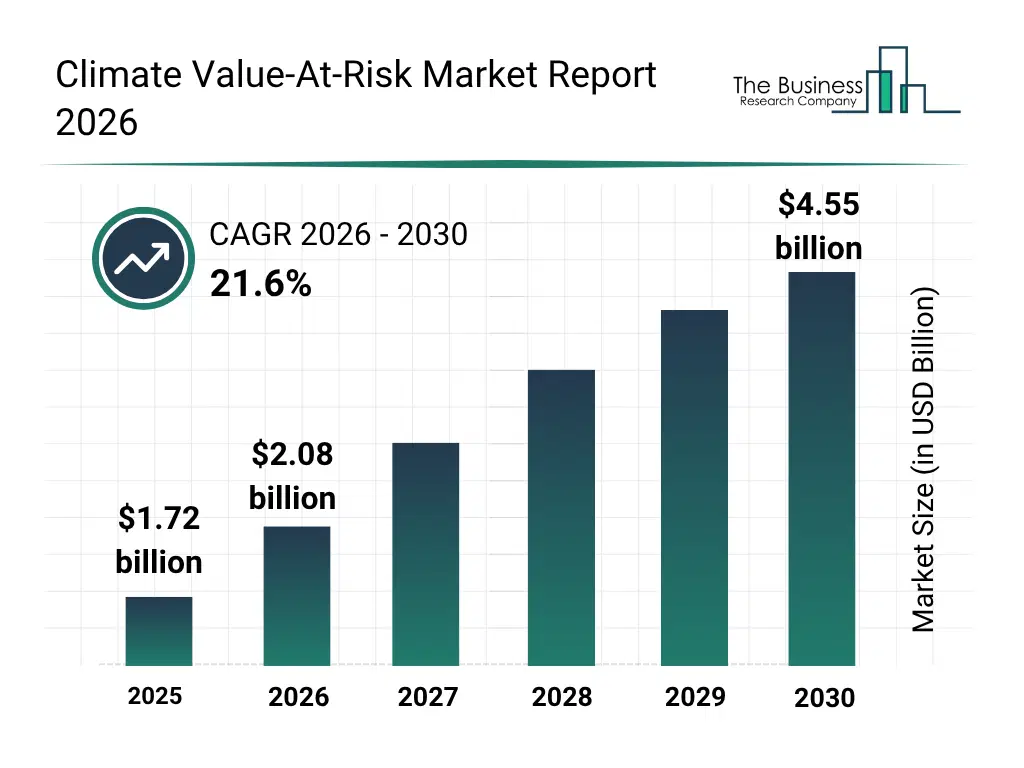
What Is The Climate Value-At-Risk Market Size and Share 2026?
The climate value-at-risk market size has grown exponentially in recent years. It will grow from $1.72 billion in 2025 to $2.08 billion in 2026 at a compound annual growth rate (CAGR) of 21.4%. The growth in the historic period can be attributed to increasing frequency of natural disasters impacting asset valuations, early adoption of insurance catastrophe models, rising awareness of physical asset vulnerability in banking systems, development of basic risk scoring models for infrastructure, growth of global reinsurance risk assessment practices.What Is The Climate Value-At-Risk Market Growth Forecast?
The climate value-at-risk market size is expected to see exponential growth in the next few years. It will grow to $4.55 billion by 2030 at a compound annual growth rate (CAGR) of 21.6%. The growth in the forecast period can be attributed to expansion of advanced scenario stress testing frameworks, increasing integration of non-traditional data sources for risk estimation, growing demand for portfolio-level risk quantification, rising use of real asset resilience scoring in lending decisions, increased institutional allocation adjustments based on physical risk exposure. Major trends in the forecast period include increasing use of catastrophe risk modeling for asset valuation, expansion of extreme event financial stress testing in banking portfolios, rising integration of geospatial hazard datasets in investment risk assessment, growing adoption of scenario-based macroeconomic risk simulations for infrastructure assets, increased focus on reinsurance-linked portfolio hedging strategies.
Global Climate Value-At-Risk Market Segmentation
1) By Component: Software, Services 2) By Risk Type: Physical Risk Assessment Tools, Transition Risk Assessment Tools, Liability Risk Assessment Tools, Combined Climate Risk Platforms 3) By Deployment: Cloud Deployments, On-Premises Deployments, Hybrid Deployments 4) By Application: Portfolio Management, Risk Assessment, Regulatory Compliance, Reporting And Disclosure, Other Applications 5) By End-User: Asset Managers And Investment Firms, Banks And Financial Institutions, Insurance Companies, Pension Funds, Corporate Treasuries, Real Estate Investment Trusts, Government And Regulatory Agencies, Consulting And Advisory Firms Subsegments: 1) By Software: Risk Assessment Modeling Software, Scenario Analysis Software, Portfolio Analytics Software, Emission Tracking Software, Reporting And Visualization Software, Data Management Software 2) By Services: Consulting And Advisory Services, Implementation And Integration Services, Training And Capacity Building Services, Monitoring And Reporting Services, Regulatory Compliance Services, Sustainability Strategy ServicesWhat Is The Driver Of The Climate Value-At-Risk Market?
The surging demand for ESG integration and sustainable investment strategies is expected to propel the growth of the climate value-at-risk market going forward. ESG integration and sustainable investment strategies refer to the systematic incorporation of environmental, social, and governance factors into investment analysis and portfolio management to achieve long-term financial and sustainability objectives. Adoption of ESG and sustainable strategies is rising due to growing regulatory expectations, stakeholder pressure, and the desire to mitigate climate-related financial risks. Climate Value-at-Risk platforms facilitate ESG-aligned investment decision-making by integrating climate risk data, carbon pricing impacts, and sustainability performance metrics into portfolio evaluation. For instance, in December 2025, according to the Sustainable Investment Forum, a US-based nonprofit membership association, 77% reported using ESG integration as their primary sustainable investment approach in 2025. Therefore, the surging demand for ESG integration and sustainable investment strategies is driving the growth of the climate value-at-risk industry.Key Players In The Global Climate Value-At-Risk Market
Major companies operating in the climate value-at-risk market are Munich Reinsurance Company, McKinsey & Company Inc., Bloomberg LP, S&P Global Inc., MSCI Inc., South Pole Group AG, Ortec Finance B.V., CubeLogic Limited, Cervest Limited, ZestyAI Inc., Jupiter Intelligence Inc., Clarity AI Inc., Climate X Ltd., ClimateAI Inc., Climate Analytics GmbH, Mitiga Solutions S.L., Entelligent Inc., Equarius Risk Analytics Pty Ltd, ClimateCheck Inc., XDI Systems Pty Ltd, Credibl Pte. Ltd., Climafin SAS.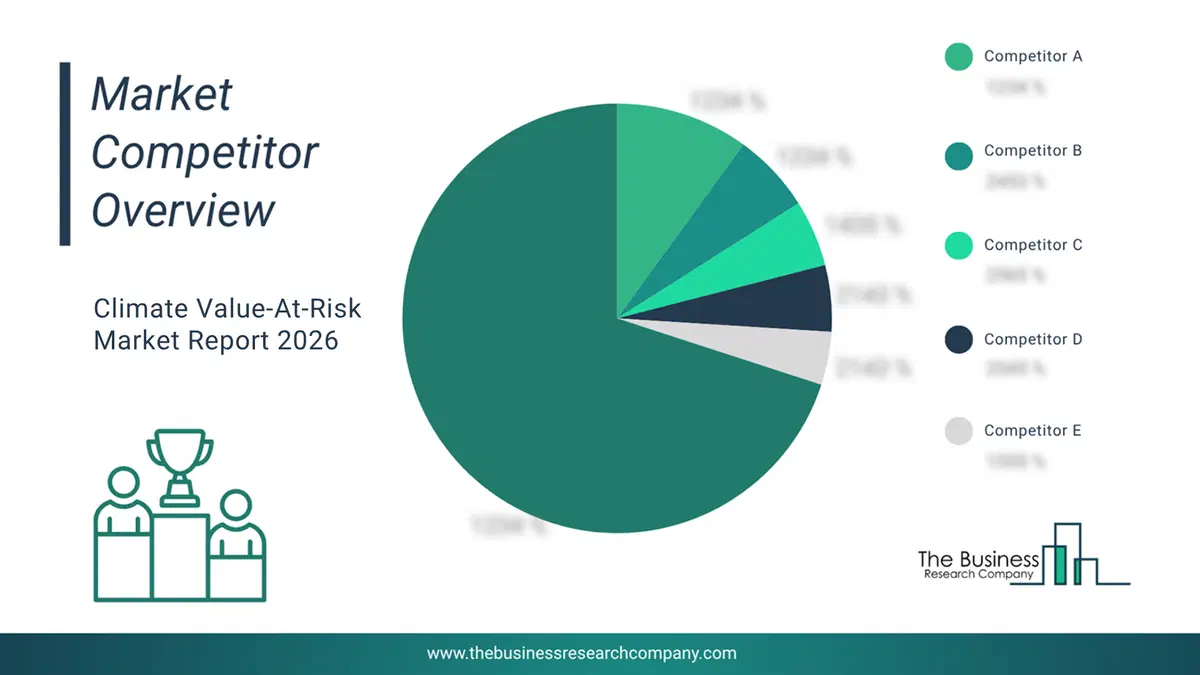
This chart is for illustrative purposes; the full report includes a detailed competitor analysis and comprehensive overview of the top 10 companies in the market.
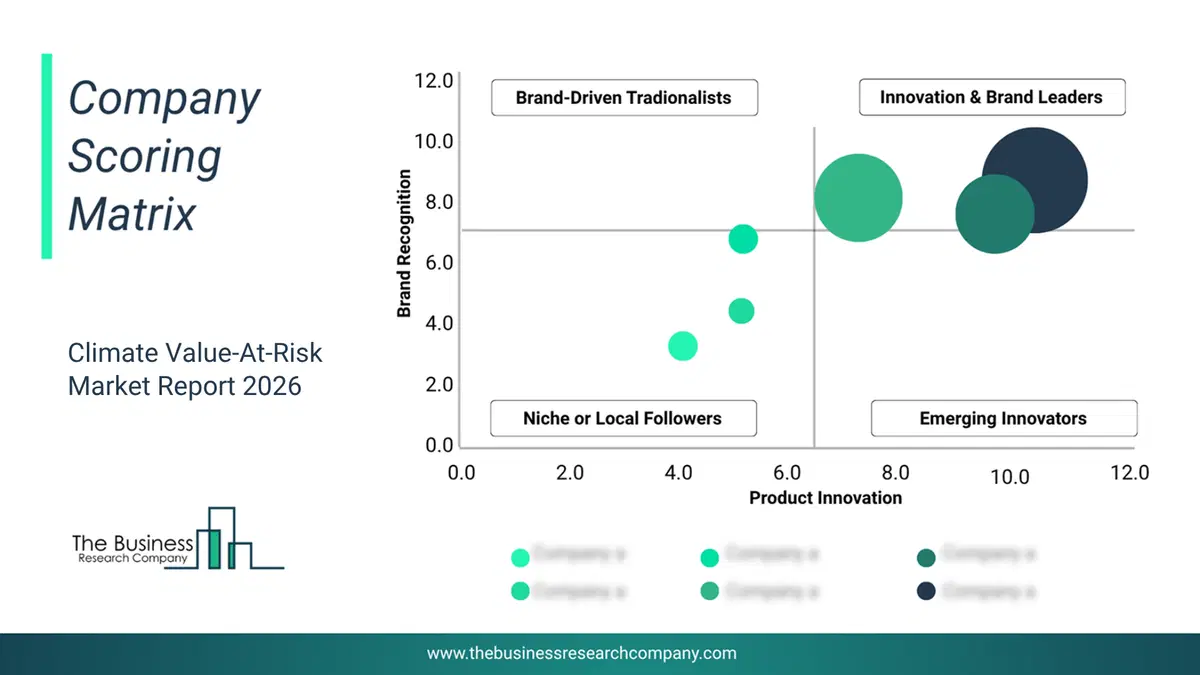
This chart maps companies by product innovation and brand strength, with bubble size indicating relative revenue, helping identify market leaders, challengers, and niche players. This is an illustrative chart; the full report provides a complete and accurate competitive analysis.
Global Climate Value-At-Risk Market Trends and Insights
Major companies operating in the climate value-at-risk market are focusing on developing technological advancements, such as multi-vendor climate data aggregation, to improve risk assessment accuracy and support better strategic and regulatory decision-making. Multi-vendor climate data aggregation is the process of integrating climate-related data from multiple providers into a single unified platform to enable consistent, comprehensive, and accurate climate risk analysis. For instance, in January 2024, Six Climate, a Switzerland-based financial services and market infrastructure provider, launched a new climate data offering as part of its 2024 ESG product expansion, aiming to become a “one-stop shop” for financial data and analytics. It aggregates climate-specific datasets via a multi-vendor single source from MSCI, Inrate, and CDP, covering over 33,000 companies. It includes historical and forward-looking climate metrics to support risk analysis, regulatory compliance, and portfolio assessment.What Are Latest Mergers And Acquisitions In The Climate Value-At-Risk Market?
In November 2023, Bloomberg LP, a US-based financial data and analytics company, partnered with Riskthinking.AI to launch a new physical climate risk data solution. Through this collaboration, Bloomberg aimed to enhance its climate financial analytics capabilities by integrating Riskthinking.AI’s climate modeling technology with Bloomberg’s extensive physical asset database to help investors and financial institutions assess exposure to climate-related physical risks and support climate risk–informed investment decisions. Riskthinking.AI is a Canada-based provider of solutions that support Climate Value-at-Risk (Climate VaR)–type analysis.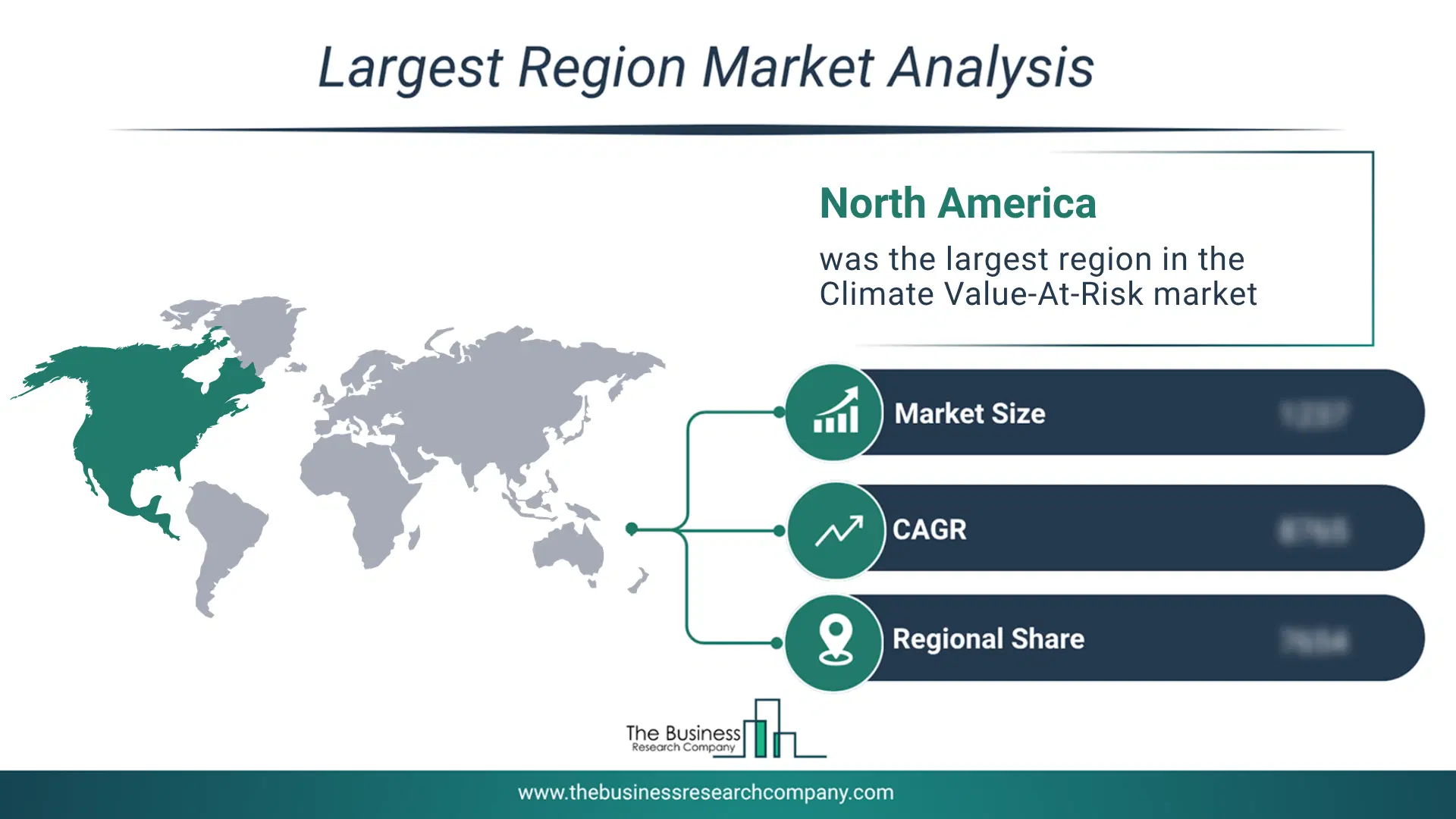
Regional Insights
North America was the largest region in the climate value-at-risk market in 2025. Asia-Pacific is expected to be the fastest-growing region in the forecast period. The regions covered in this market report are Asia-Pacific, South East Asia, Western Europe, Eastern Europe, North America, South America, Middle East, Africa. The countries covered in this market report are Australia, Brazil, China, France, Germany, India, Indonesia, Japan, Taiwan, Russia, South Korea, UK, USA, Canada, Italy, Spain.What Defines the Climate Value-At-Risk Market?
The climate value-at-risk consists of revenues earned by entities by providing services such as scenario analysis and climate stress testing, carbon footprint and emissions exposure analysis, climate transition risk modeling, physical climate risk mapping, and asset-level vulnerability analysis. The market value includes the value of related goods sold by the service provider or included within the service offering. Only goods and services traded between entities or sold to end consumers are included.How is Market Value Defined and Measured?
The market value is defined as the revenues that enterprises gain from the sale of goods and/or services within the specified market and geography through sales, grants, or donations in terms of the currency (in USD unless otherwise specified). The revenues for a specified geography are consumption values that are revenues generated by organizations in the specified geography within the market, irrespective of where they are produced. It does not include revenues from resales along the supply chain, either further along the supply chain or as part of other products.
This chart presents market attractiveness based on a quantitative evaluation of growth, competition, strategic alignment, and risk, offering a clear view of opportunity areas for decision-making. This chart is for illustrative purposes; the full report contains the complete analysis.

This chart highlights the Total Addressable Market (TAM) by estimating the maximum revenue opportunity using an assumption-driven approach, supporting strategic planning and opportunity sizing across markets. The chart is illustrative; the full report provides a more comprehensive analysis.
What Key Data and Analysis Are Included in the Climate Value-At-Risk Market Report 2026?
The climate value-at-risk market research report is one of a series of new reports from The Business Research Company that provides market statistics, including industry global market size, regional shares, competitors with the market share, detailed market segments, market trends and opportunities, and any further data you may need to thrive in the climate value-at-risk industry. The market research report delivers a complete perspective of everything you need, with an in-depth analysis of the current and future state of the industry.Climate Value-At-Risk Market Report Forecast Analysis
| Report Attribute | Details |
|---|---|
| Market Size Value In 2026 | $2.08 billion |
| Revenue Forecast In 2030 | $4.55 billion |
| Growth Rate | CAGR of 21.4% from 2026 to 2030 |
| Base Year For Estimation | 2025 |
| Actual Estimates/Historical Data | 2020-2025 |
| Forecast Period | 2026 - 2030 |
| Market Representation | Revenue in USD Billion and CAGR from 2026 to 2030 |
| Segments Covered | Component, Risk Type, Deployment, Application, End-User |
| Regional Scope | Asia-Pacific, Western Europe, Eastern Europe, North America, South America, Middle East, Africa |
| Country Scope | The countries covered in the report are Australia, Brazil, China, France, Germany, India, Indonesia, Japan, Taiwan, Russia, South Korea, UK, USA, Canada, Italy, Spain. |
| Key Companies Profiled | Munich Reinsurance Company, McKinsey & Company Inc., Bloomberg LP, S&P Global Inc., MSCI Inc., South Pole Group AG, Ortec Finance B.V., CubeLogic Limited, Cervest Limited, ZestyAI Inc., Jupiter Intelligence Inc., Clarity AI Inc., Climate X Ltd., ClimateAI Inc., Climate Analytics GmbH, Mitiga Solutions S.L., Entelligent Inc., Equarius Risk Analytics Pty Ltd, ClimateCheck Inc., XDI Systems Pty Ltd, Credibl Pte. Ltd., Climafin SAS. |
| Customization Scope | Request for Customization |
| Pricing And Purchase Options | Explore Purchase Options |