
Clinical Genomics Software Market Report 2026
Global Outlook – By Component (Software, Services), By Technology (Next Generation Sequencing, Whole Genome Sequencing, Whole Exome Sequencing, Ribonucleic Acid Sequencing, Multi Omics Platforms, Artificial Intelligence And Machine Learning Based Genomics, Bioinformatics Pipelines, Variant Interpretation Engines), By Deployment Model (Cloud Based, On Premises, Hybrid), By Application (Oncology, Rare Diseases, Infectious Diseases, Pharmacogenomics), By End User (Hospitals And Clinics, Diagnostic Laboratories, Research Institutes, Academic Institutions, Pharmaceutical And Biotechnology Companies, Government And Public Health Agencies) – Market Size, Trends, Strategies, and Forecast to 2030
Clinical Genomics Software Market Overview
• Clinical Genomics Software market size has reached to $2.85 billion in 2025 • Expected to grow to $5.7 billion in 2030 at a compound annual growth rate (CAGR) of 14.8% • Growth Driver: The Increasing Demand For Personalized Medicine Is Fueling The Market Growth Due To Advancements In Genomics • Market Trend: Technological Advancements In Integrated Clinical NGS Workflow Platforms Transforming Clinical Genomics Software • North America was the largest region in 2025 and Asia-Pacific is the fastest growing region.What Is Covered Under Clinical Genomics Software Market?
Clinical genomics software refers to digital platforms and analytical tools used to manage, interpret, and visualize genomic and molecular data for clinical and research applications. These software solutions support genomic sequencing workflows, variant analysis, data integration, and reporting processes to assist in understanding genetic information and improving precision medicine capabilities. They are designed to enhance data accuracy, workflow efficiency, and interoperability across genomic analysis environments. The main components of clinical genomics software include software and services. Software refers to advanced bioinformatics and clinical interpretation platforms used for analyzing genomic data to support precision medicine and disease diagnosis. These solutions are based on technologies such as next generation sequencing, whole genome sequencing, whole exome sequencing, ribonucleic acid sequencing, multi omics platforms, artificial intelligence and machine learning based genomics, bioinformatics pipelines, and variant interpretation engines and are deployed through cloud based, on premises, and hybrid models. The various applications involved are oncology, rare diseases, infectious diseases, and pharmacogenomics, and they are used by several end users such as hospitals and clinics, diagnostic laboratories, research institutes, academic institutions, pharmaceutical and biotechnology companies, and government and public health agencies.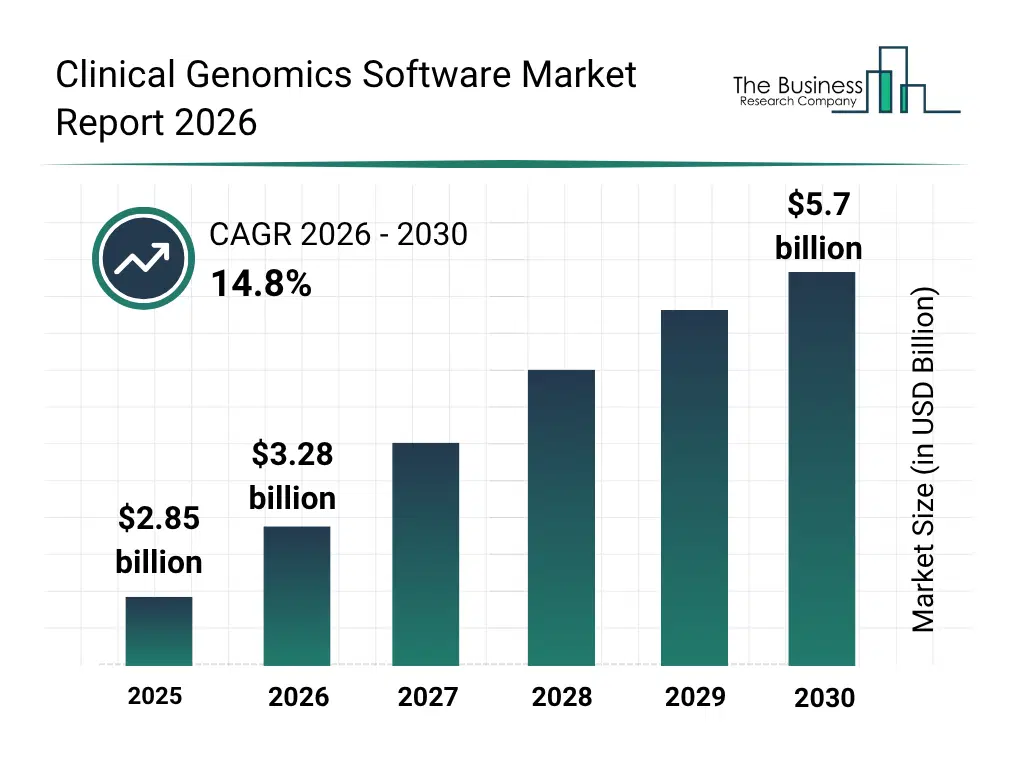
What Is The Clinical Genomics Software Market Size and Share 2026?
The clinical genomics software market size has grown rapidly in recent years. It will grow from $2.85 billion in 2025 to $3.28 billion in 2026 at a compound annual growth rate (CAGR) of 15.2%. The growth in the historic period can be attributed to declining cost of genome sequencing, expansion of clinical research in rare diseases, early adoption of bioinformatics tools in research institutes, rising prevalence of cancer driving genomic testing demand, development of basic laboratory information management systems.What Is The Clinical Genomics Software Market Growth Forecast?
The clinical genomics software market size is expected to see rapid growth in the next few years. It will grow to $5.7 billion in 2030 at a compound annual growth rate (CAGR) of 14.8%. The growth in the forecast period can be attributed to widespread adoption of precision medicine in healthcare systems, increasing integration of genomics into routine clinical diagnostics, growth in personalized drug development pipelines, expansion of cloud enabled genomic data platforms, rising investment in population scale genomic screening programs. Major trends in the forecast period include rising demand for standardized genomic data interoperability across clinical systems, increasing focus on regulatory compliant genomic reporting and validation frameworks, growing integration of electronic health records with genomic analysis platforms, expansion of patient centric precision diagnostic workflows in clinical environments, rising emphasis on secure genomic data storage and privacy preserving clinical analytics.
Global Clinical Genomics Software Market Segmentation
1) By Component: Software; Services 2) By Technology: Next Generation Sequencing; Whole Genome Sequencing; Whole Exome Sequencing; Ribonucleic Acid Sequencing; Multi Omics Platforms; Artificial Intelligence And Machine Learning Based Genomics; Bioinformatics Pipelines; Variant Interpretation Engines 3) By Deployment Model: Cloud Based; On Premises; Hybrid 4) By Application: Oncology; Rare Diseases; Infectious Diseases; Pharmacogenomics 5) By End User: Hospitals And Clinics; Diagnostic Laboratories; Research Institutes; Academic Institutions; Pharmaceutical And Biotechnology Companies; Government And Public Health Agencies Subsegments: 1) By Software: Genomic Data Analysis Software; Variant Interpretation Software; Clinical Decision Support Software; Bioinformatics Workflow Management Software; Genomic Data Visualization Software; Laboratory Information Management Software; Sequencing Data Management Software; Cloud Based Genomics Analytics Software 2) By Services: Implementation Services; Consulting Services; Technical Support Services; Maintenance And Upgrade Services; Cloud Hosting Services; Data Analysis Services; Training And Education ServicesWhat Is The Driver Of The Clinical Genomics Software Market?
The increasing demand for personalized medicine is expected to propel the growth of the clinical genomics software market going forward. Personalized medicine refers to a medical approach that tailors disease prevention, diagnosis, and treatment based on an individual’s genetic profile, lifestyle, and environmental factors to improve clinical outcomes. The demand for personalized medicine is increasing due to the growing prevalence of chronic and complex diseases that require targeted therapies and precise diagnostic approaches. Clinical genomics software supports personalized medicine by enabling healthcare providers and researchers to analyze genomic datasets, identify disease-associated variants, and generate clinically actionable insights with greater speed and accuracy. For instance, in February 2024, according to the Personalized Medicine Coalition, a US-based non-profit organization, in 2023, the FDA approved 16 new personalized therapies for patients with rare diseases, marking a substantial rise from the six approvals recorded in 2022. Therefore, the increasing demand for personalized medicine is driving the growth of the clinical genomics software industry.Key Players In The Global Clinical Genomics Software Market
Major companies operating in the clinical genomics software market are Google LLC; Microsoft Corporation; Amazon Web Services Inc.; NVIDIA Corporation; Thermo Fisher Scientific Inc.; Agilent Technologies Inc.; Illumina Inc.; Bio-Rad Laboratories Inc.; QIAGEN N.V.; Caris Life Sciences Inc.; BGI Genomics Co. Ltd.; Guardant Health Inc.; Veracyte Inc.; Tempus Labs Inc.; Oxford Nanopore Technologies plc; Benchling Inc.; Pacific Biosciences of California Inc.; SOPHiA GENETICS SA; Genomenon Inc.; Golden Helix Inc.Global Clinical Genomics Software Market Trends and Insights
Major companies operating in the clinical genomics software market are focusing on developing innovative solutions, such as integrated next-generation sequencing (NGS) workflow platforms, to enhance laboratory efficiency, workflow standardization, and accuracy in clinical genetic testing. Integrated NGS workflow platforms are advanced software-driven systems that combine sample preparation, sequencing management, bioinformatics analysis, quality control, and clinical reporting into a unified environment, reducing the fragmentation and manual coordination associated with traditional multi-system genomic testing workflows. For instance, in March 2026, BGI Genomics Co. Ltd., a China-based genomics and biotechnology company, launched SIROmics, an integrated solution designed to streamline clinical NGS workflows through laboratory automation and advanced data analysis capabilities. The platform combines wet-lab automation for sample processing, library preparation, and sequencing setup with a dry-lab analysis layer for bioinformatics interpretation and clinical reporting. It integrates hardware, software, validation protocols, and quality control frameworks to support standardized in-hospital genetic testing processes. The system is supported by GenSIRO, an automated sample preparation solution compatible with multiple sequencing instruments, enabling efficient high-throughput testing operationsWhat Are Latest Mergers And Acquisitions In The Clinical Genomics Software Market?
In February 2025, Tempus AI Inc., a US-based healthcare technology and artificial intelligence company, acquired Ambry Genetics Inc. for an undisclosed amount. With this acquisition, Tempus AI, Inc. aimed to strengthen its precision medicine platform by integrating Ambry Genetics, Inc.’s large-scale hereditary cancer and genetic testing capabilities, thereby expanding its genomic diagnostics portfolio and enhancing its ability to deliver AI-driven insights for personalized treatment decisions across oncology, cardiology, and rare disease applications. Ambry Genetics Inc. is a US-based genetic testing company that specializes in providing clinical genomics software capabilities.Regional Outlook
North America was the largest region in the clinical genomics software market in 2025. Asia-Pacific is expected to be the fastest-growing region in the forecast period. The regions covered in this market report are Asia-Pacific, South East Asia, Western Europe, Eastern Europe, North America, South America, Middle East, Africa. The countries covered in this market report are Australia, Brazil, China, France, Germany, India, Indonesia, Japan, Taiwan, Russia, South Korea, UK, USA, Canada, Italy, Spain.What Defines the Clinical Genomics Software Market?
The clinical genomics software market consists of revenues earned by entities by providing services such as genomic data analysis, sequence alignment, variant interpretation, clinical reporting, workflow management, cloud-based genomic computing, software licensing, maintenance and support, and integration with laboratory information systems. The market value includes the value of related goods sold by the service provider or included within the service offering. Only goods and services traded between entities or sold to end consumers are included.How is Market Value Defined and Measured?
The market value is defined as the revenues that enterprises gain from the sale of goods and/or services within the specified market and geography through sales, grants, or donations in terms of the currency (in USD unless otherwise specified). The revenues for a specified geography are consumption values that are revenues generated by organizations in the specified geography within the market, irrespective of where they are produced. It does not include revenues from resales along the supply chain, either further along the supply chain or as part of other products.What Key Data and Analysis Are Included in the Clinical Genomics Software Market Report 2026?
The clinical genomics software market research report is one of a series of new reports from The Business Research Company that provides market statistics, including industry global market size, regional shares, competitors with the market share, detailed market segments, market trends and opportunities, and any further data you may need to thrive in the clinical genomics software industry. The market research report delivers a complete perspective of everything you need, with an in-depth analysis of the current and future state of the industry.Clinical Genomics Software Market Report Forecast Analysis
| Report Attribute | Details |
|---|---|
| Market Size Value In 2026 | $3.28 billion |
| Revenue Forecast In 2030 | $5.7 billion |
| Growth Rate | CAGR of 14.8% from 2026 to 2030 |
| Base Year For Estimation | 2025 |
| Actual Estimates/Historical Data | 2020-2025 |
| Forecast Period | 2026 - 2030 |
| Market Representation | Revenue in USD Billion and CAGR from 2026 to 2030 |
| Segments Covered | Component, Technology, Deployment Model, Application, End User |
| Regional Scope | Asia-Pacific, Western Europe, Eastern Europe, North America, South America, Middle East, Africa |
| Country Scope | The countries covered in the report are Australia, Brazil, China, France, Germany, India, ... |
| Key Companies Profiled | Google LLC; Microsoft Corporation; Amazon Web Services Inc.; NVIDIA Corporation; Thermo Fisher Scientific Inc.; Agilent Technologies Inc.; Illumina Inc.; Bio-Rad Laboratories Inc.; QIAGEN N.V.; Caris Life Sciences Inc.; BGI Genomics Co. Ltd.; Guardant Health Inc.; Veracyte Inc.; Tempus Labs Inc.; Oxford Nanopore Technologies plc; Benchling Inc.; Pacific Biosciences of California Inc.; SOPHiA GENETICS SA; Genomenon Inc.; Golden Helix Inc. |
| Customization Scope | Request for Customization |
| Pricing And Purchase Options | Explore Purchase Options |