

Contact Us
  Search
The Business Research Company Logo
Clock Buffer Market 2025
Published :July 2025
Pages :348
Format :PDF
Delivery Time :2-3 Business Days
Why 2-3 days? We update the report with the latest data and news before delivery. Let us know if you need us to expedite.
Report Price :$4,490.00

Clock Buffer Market 2025

By Type (Differential Clock Buffer, Single-Ended Clock Buffer, Universal And Other Types ), By Application (Military And Defense, Industrial, Consumer Electronics, Information Technology (IT) And Telecommunication, Automotive, Mobile Devices, Server, Other Applications), By Number Of Output Units (1-4 Output Units, 5-8 Output Units, 9-16 Output Units, Above 16 Output Units) - Market Size, Trends, And Global Forecast 2025-2034
Clock_Buffer_Global_Market_Opportunities_And_Strategies_To_2034_Market_2025_Graph

Clock Buffer Market Definition

Clock buffer refers to an electronic device that amplifies and distributes clock signals within a digital system. It ensures that timing signals reach multiple components simultaneously without degradation. This helps maintain synchronization and reliable performance in complex electronic circuits. The clock buffer market consists of the sales of clock buffer by entities (organizations, sole traders, or partnerships) that develop, distribute, or integrate timing signal management solutions used to synchronize data transfers within electronic systems. These entities serve industries such as consumer electronics, automotive, telecommunications, aerospace and healthcare by offering components that help maintain timing accuracy and signal integrity.
Research Expert

Book your 30 minutes free consultation with our research experts

Clock Buffer Market Size

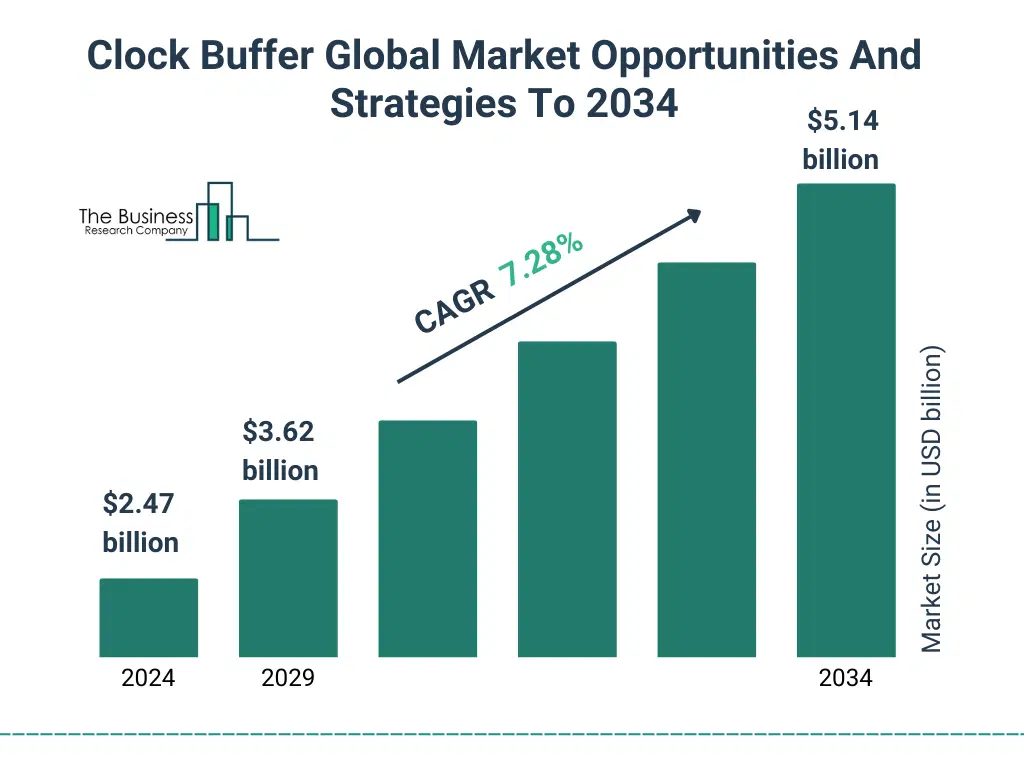
The global clock buffer market reached a value of nearly $2,474.04 million in 2024, having grown at a compound annual growth rate (CAGR) of 6.38% since 2019. The market is expected to grow from $2,474.04 million in 2024 to $3,617.70 million in 2029 at a rate of 7.90%. The market is then expected to grow at a CAGR of 7.28% from 2029 and reach $5,141.19 million in 2034. Growth in the historic period resulted from the increase in the adoption of smartphone devices, increasing number of internet of things (IoT)-linked devices, growth in cloud computing services and expansion of telecommunications infrastructure. Factors that negatively affected growth in the historic period were cybersecurity threats and regulatory compliance. Going forward, the favorable government initiatives, growth in autonomous vehicles, expansion of smart homes and rising demand for energy efficiency solutions will drive the growth. Factor that could hinder the growth of the clock buffer market in the future include pricing pressure from original equipment manufacturers (OEMs), high initial investment and impact of trade war and tariff.

Clock Buffer Market Drivers

The key drivers of the clock buffer market include: Growth In Autonomous Vehicles Growth in autonomous vehicles is expected to propel the growth of the clock buffer market going forward. Autonomous vehicles rely on multiple electronic control units (ECUs) and processors that require perfectly synchronized clock signals to process sensor data and execute commands accurately and without delay. Clock buffers play a critical role in distributing these signals while preserving timing integrity. With significantly higher electronic content compared to traditional vehicles, the demand for effective clock management—and consequently clock buffers—increases substantially. These buffers are essential for maintaining timing integrity and delivering jitter-free signals, which are critical for the safety and reliability of advanced features like real-time processing, machine learning, and vehicle-to-everything (V2X) communication. The growth in autonomous vehicles growth contribution during the forecast period in 2024 is 2.00%.

Clock Buffer Market Restraints

The key restraints on the clock buffer market include: Pricing Pressure From Original Equipment Manufacturers (OEMs) Pricing pressure from original equipment manufacturers (OEMs) is expected to hamper the growth of the clock buffer market. When OEMs demand lower prices, clock buffer manufacturers often face pressure to reduce profit margins, which can restrict funding for research, development, and innovation, thereby delaying the launch of advanced technologies. The high cost of specialized clock buffers, such as those with low power consumption or high-speed performance can deter investment in premium products. Additionally, cost-cutting measures may lead some suppliers to compromise on component quality or materials, affecting reliability and diminishing demand among quality-focused OEMs and end-users. Persistently high clock buffer prices may also drive OEMs to seek alternative timing solutions or integrated designs, reducing dependence on discrete clock buffers and constraining market growth. Growth affected by pricing pressure from original equipment manufacturers (OEMs) during the forecast period in 2024 is -2.00%.

Need data on a specific region in this market?

Opportunities And Recommendations In The Clock Buffer Market

Opportunities – The top opportunities in the clock buffer markets segmented by type will arise in the differential clock buffer segment, which will gain $631.06 million of global annual sales by 2029. The top opportunities in the clock buffer markets segmented by application will arise in the information technology (IT) and telecommunication segment, which will gain $397.27 million of global annual sales by 2029. The top opportunities in the clock buffer markets segmented by number of output units will arise in the 9–16 output units segment, which will gain $453.09 million of global annual sales by 2029. The clock buffer market size will gain the most in China at $279.82 million. Recommendations- To take advantage of the opportunities, The Business Research Company recommends the clock buffer to focus on developing integrated clock drivers for high-speed memory applications, focus on integrating clock buffers into DDR5 memory modules, focus on advancing DDR5 clock drivers for data center performance, focus on developing power-efficient clock buffers for high-speed consumer devices, focus on differential clock buffers to drive growth, focus on 9–16 output units to capture highest growth, expand in emerging markets, focus on expanding direct and digital distribution channels, focus on competitive and value-based pricing strategies, focus on targeted digital and industry-specific promotion, focus on building strategic partnerships and thought leadership and focus on it and telecommunications to maximize market growth.
Chat with us