
Clothing Attribute Recognition Analytics Market Report 2026
Global Outlook – By Component (Software, Hardware, Services), By Technology (Deep Learning And Neural Networks, Computer Vision And Object Detection, Semantic And Instance Segmentation, Natural Language Processing Integration), By Deployment Mode (Cloud Based Platforms, On-Premise Systems, Application Programming Interface Based Integration), By Application (Automated Product Tagging And Cataloging, Visual Search And Recommendation Engines, Trend Forecasting And Business Intelligence, Virtual Try On And Sizing Assistants, Inventory And Supply Chain Optimization), By End User (Retailers, Fashion Designers, E-Commerce Platforms, Security Agencies, Other End Users) – Market Size, Trends, Strategies, and Forecast to 2035
Clothing Attribute Recognition Analytics Market Overview
• Clothing Attribute Recognition Analytics market size has reached to $1.69 billion in 2025 • Expected to grow to $4.06 billion in 2030 at a compound annual growth rate (CAGR) of 19% • Growth Driver: Growing Demand For Personalized Shopping Experiences Fueling The Growth Of The Market Due To Increasing Adoption Of Online Retail And Data-Driven Customer Engagement • Market Trend: Innovations In Artificial Intelligence (AI) Technology Enhance Clothing Attribute Recognition Analytics • North America was the largest region in 2025 and Asia-Pacific is the fastest growing region.What Is Covered Under Clothing Attribute Recognition Analytics Market?
Clothing attribute recognition analytics is an artificial intelligence (AI)-based technology that identifies clothing attributes such as color, pattern, fabric, style, fit, and design from images or videos. It uses computer vision and deep learning techniques to classify apparel features. Clothing attribute recognition analytics is used to improve product categorization, visual search, personalized recommendations, inventory management, and fashion trend analysis. The main components of clothing attribute recognition analytics include software, hardware, and services. Software refers to digital solutions that analyze clothing images and identify attributes such as color, pattern, style, material, and design characteristics to support automated product classification and visual analysis. These solutions use deep learning and neural networks, computer vision and object detection, semantic and instance segmentation, and natural language processing integration, and are deployed through cloud based platforms, On-Premise systems, and application programming interface based integration. The various applications involved are automated product tagging and cataloging, visual search and recommendation engines, trend forecasting and business intelligence, virtual try on and sizing assistants, and inventory and supply chain optimization and they are utilized by end users including retailers, fashion designers, e-commerce platforms, security agencies, and others.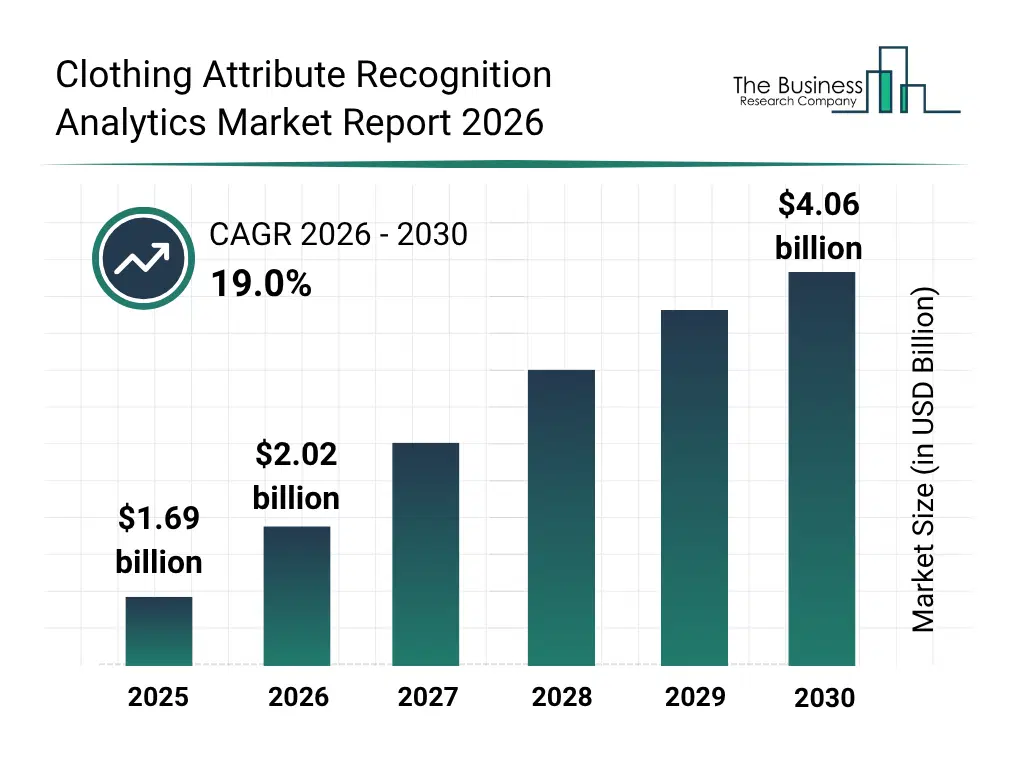
What Is The Clothing Attribute Recognition Analytics Market Size and Share 2026?
The clothing attribute recognition analytics market size has grown rapidly in recent years. It will grow from $1.69 billion in 2025 to $2.02 billion in 2026 at a compound annual growth rate (CAGR) of 19.4%. The growth in the historic period can be attributed to increasing demand for automated product categorization, rising e-commerce apparel sales, growing fashion product catalogs, need for efficient inventory classification, expanding use of image-based product discovery.What Is The Clothing Attribute Recognition Analytics Market Growth Forecast?
The clothing attribute recognition analytics market size is expected to see rapid growth in the next few years. It will grow to $4.06 billion in 2030 at a compound annual growth rate (CAGR) of 19.0%. The growth in the forecast period can be attributed to increasing demand for personalized apparel recommendations, rising adoption of virtual try-on applications, growing need for automated fashion intelligence, expanding use of real-time apparel attribute analysis, increasing demand for scalable visual analytics platforms. Major trends in the forecast period include increasing accuracy of clothing attribute classification, growing adoption of automated apparel cataloging, rising use of attribute-based visual search, expanding demand for automated fashion trend analysis, increasing integration of clothing attribute analytics with e-commerce platforms.Tariff Impact On Clothing Attribute Recognition Analytics Market
Tariffs are impacting the clothing attribute recognition analytics market by increasing the cost of imported cameras, GPUs, servers, storage devices, edge computing equipment, and other hardware used to support image and video analytics systems. This is raising deployment costs for retailers, e-commerce platforms, fashion companies, and technology providers, particularly in regions dependent on imported electronics such as Asia-Pacific and Latin America. Hardware-intensive segments such as cameras, GPUs, servers, and edge computing devices are most affected due to global electronics supply chain dependencies. However, tariffs are also encouraging regional sourcing, local hardware procurement, cloud-based deployment, and greater investment in domestic AI and computer vision infrastructure, supporting long-term market resilience.
Global Clothing Attribute Recognition Analytics Market Segmentation
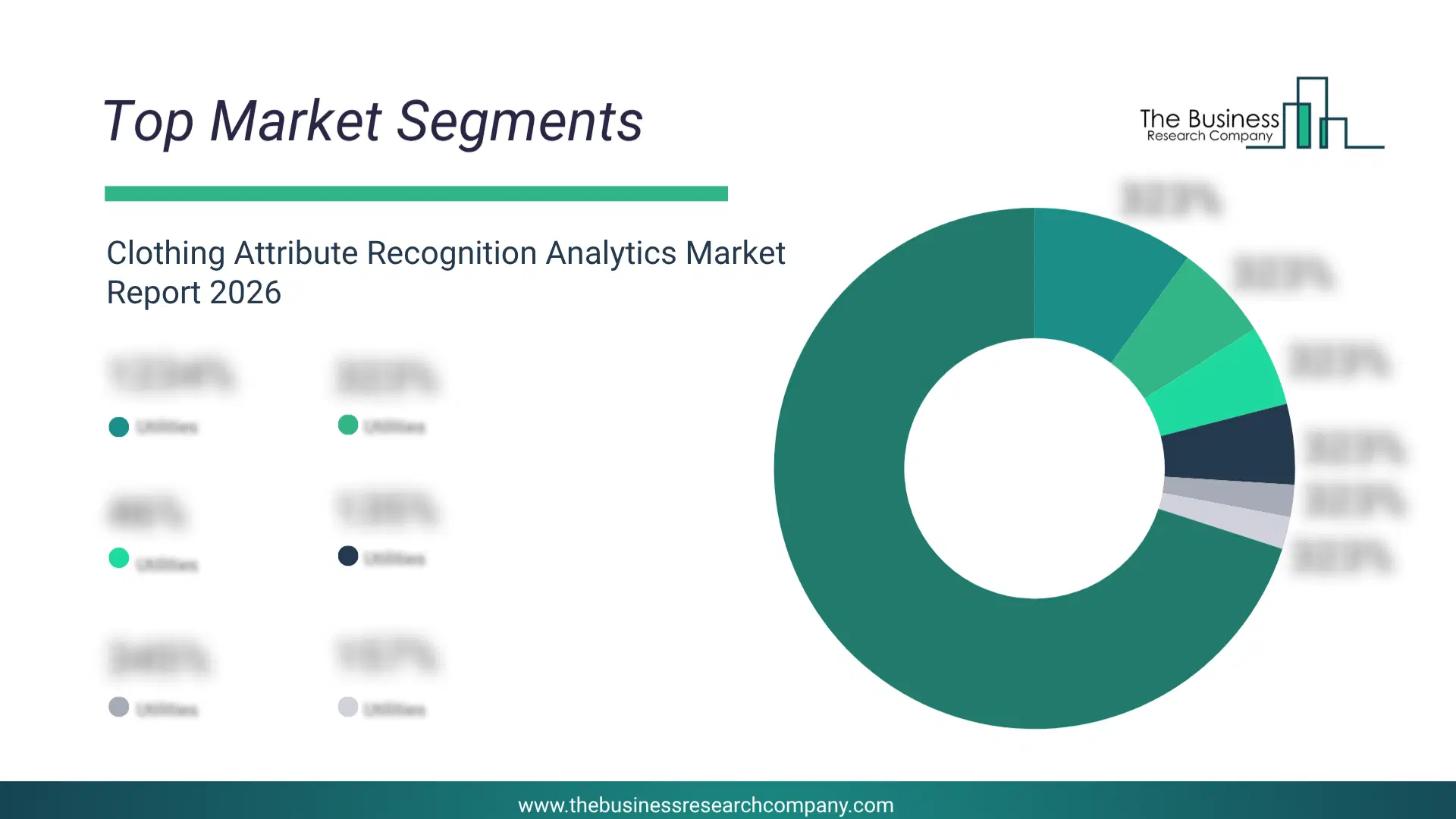
2) By Technology: Deep Learning And Neural Networks, Computer Vision And Object Detection, Semantic And Instance Segmentation, Natural Language Processing Integration 3) By Deployment Mode: Cloud Based Platforms, On-Premise Systems, Application Programming Interface Based Integration 4) By Application: Automated Product Tagging And Cataloging, Visual Search And Recommendation Engines, Trend Forecasting And Business Intelligence, Virtual Try On And Sizing Assistants, Inventory And Supply Chain Optimization 5) By End User: Retailers, Fashion Designers, E-Commerce Platforms, Security Agencies, Other End Users Subsegments: 1) By Software: Image Recognition Software, Apparel Classification Software, Pattern Detection Software, Color Recognition Software, Video Analytics Software, Data Management Software, Cloud-Based Analytics Software, Artificial Intelligence-Based Recognition Software 2) By Hardware: Cameras, Sensors, Edge Computing Devices, Servers, Storage Devices, Graphics Processing Units, Smart Surveillance Systems, Wearable Detection Devices 3) By Services: Consulting Services, Integration Services, Deployment Services, Support And Maintenance Services, Managed Services, Training Services, Data Annotation Services, Cloud Hosting ServicesWhat Is The Driver Of The Clothing Attribute Recognition Analytics Market?
The growing demand for personalized shopping experiences is expected to propel the growth of the clothing attribute recognition analytics market going forward. Personalized shopping experiences refer to customized retail interactions in which products, recommendations, and services are tailored according to individual consumer preferences, behaviors, and purchasing patterns. The growing demand for personalized shopping experiences is increasing due to the rapid expansion of online retail platforms that encourage businesses to deliver more targeted and engaging customer interactions. The growing demand for personalized shopping experiences supports clothing attribute recognition analytics by enabling retailers to analyze apparel features, deliver tailored product recommendations, and improve customer engagement and purchase satisfaction. For instance, in January 2026, according to RIVO.io, a US-based bootstrapped retention platform, companies that deliver personalized experiences generate up to 40% more revenue than their competitors, while personalized product recommendations account for as much as 31% of total e-commerce revenue, underscoring the growing importance of personalization in driving business performance. Therefore, the growing demand for personalized shopping experiences is driving the growth of the clothing attribute recognition analytics industry.Key Players In The Global Clothing Attribute Recognition Analytics Market
Major companies operating in the clothing attribute recognition analytics market are Amazon Web Services Inc., Google LLC, Microsoft Corporation, International Business Machines Corporation, Adobe Inc., True Fit Corporation, ViSenze Pte. Ltd., Vue.ai, Heuritech SAS, Perfect Corp., Style Arcade Pty Ltd, Impact Analytics Inc., Lily AI Inc., Syte - Visual AI Ltd., Hypotenuse AI Pte. Ltd., Pixyle AI B.V., Streamoid Technologies Private Limited, YesPlz AI Inc., Intelistyle Ltd., Lykdat Inc., FindMine Inc., Ximilar s.r.o.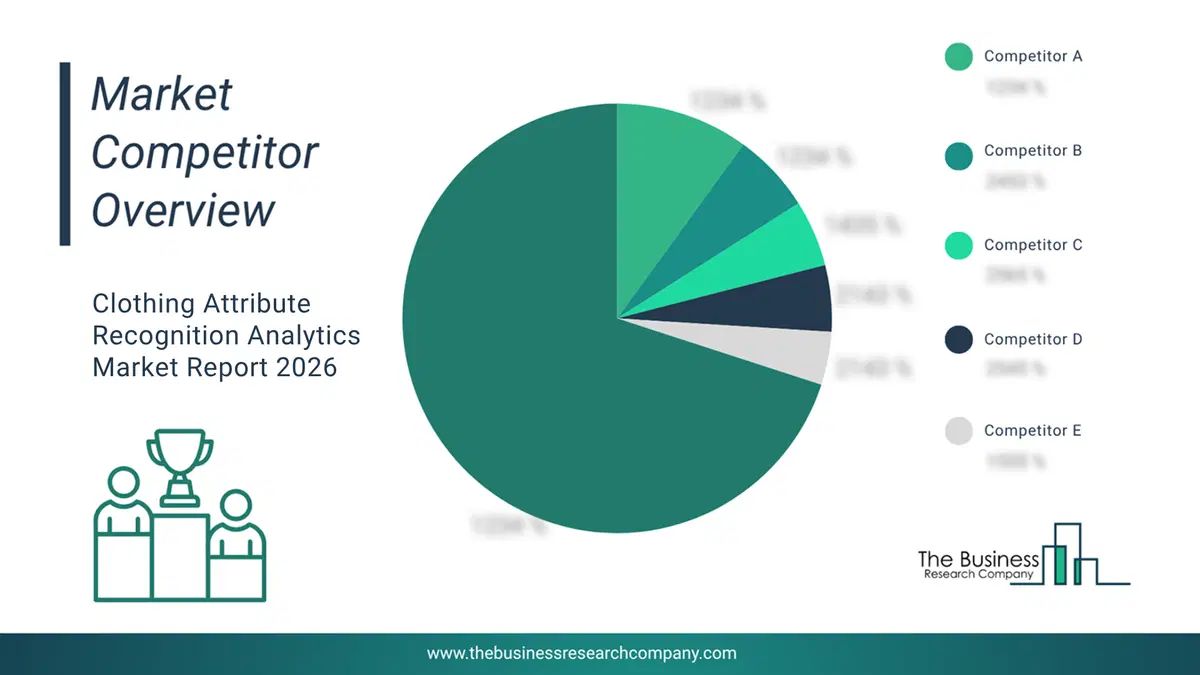
This chart is for illustrative purposes; the full report includes a detailed competitor analysis and comprehensive overview of the top 10 companies in the market.
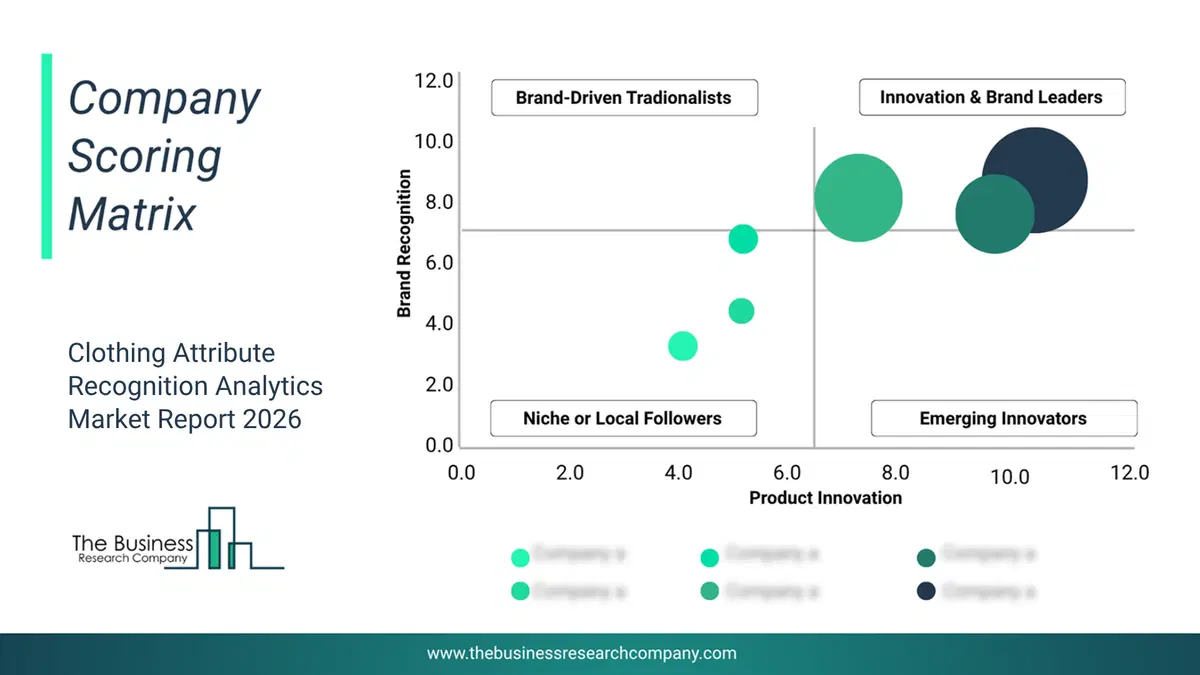
This chart maps companies by product innovation and brand strength, with bubble size indicating relative revenue, helping identify market leaders, challengers, and niche players. This is an illustrative chart; the full report provides a complete and accurate competitive analysis.
Global Clothing Attribute Recognition Analytics Market Trends and Insights
Major companies operating in the clothing attribute recognition analytics market are focusing on developing innovative solutions, such as visual search with AI attribute filtering, to enhance product discovery, improve search accuracy, and deliver more personalized shopping experiences. Visual Search with AI Attribute Filtering is an artificial intelligence-powered shopping technology that enables users to find visually similar clothing items by uploading an image or selecting a product while refining results using attributes such as color, pattern, fabric, sleeve length, fit, neckline, and brand. For instance, in August 2025, OpenEye, a US-based provider of cloud video management and intelligent video analytics solutions, launched AI-powered attribute filters and similarity search to enhance visual search accuracy, streamline product discovery, and enable more efficient identification of clothing items based on visual attributes and similarities. The solution combines AI-powered attribute filtering with visual similarity search, allowing users to quickly locate clothing items based on characteristics such as color, style, pattern, and other visual attributes instead of relying solely on text-based queries. It also identifies visually similar products from large image datasets, improving search precision, product discovery, and personalized shopping experiences.What Are Latest Mergers And Acquisitions In The Clothing Attribute Recognition Analytics Market?
In January 2025, Syte, a US-based AI-powered product recommendation technology company, partnered with Tally Weijl to transform Tally Weijl's online shopping experience through AI-driven product recommendations and discovery. With this partnership, Syte aims to help Tally Weijl deliver personalized product recommendations, increase conversions and average order value, reduce out-of-stock challenges, and maximize revenue per user across its eCommerce channels. Tally Weijl is a Switzerland-based fast-fashion retailer offering trend-driven and accessible fashion for young women through more than 800 stores worldwide.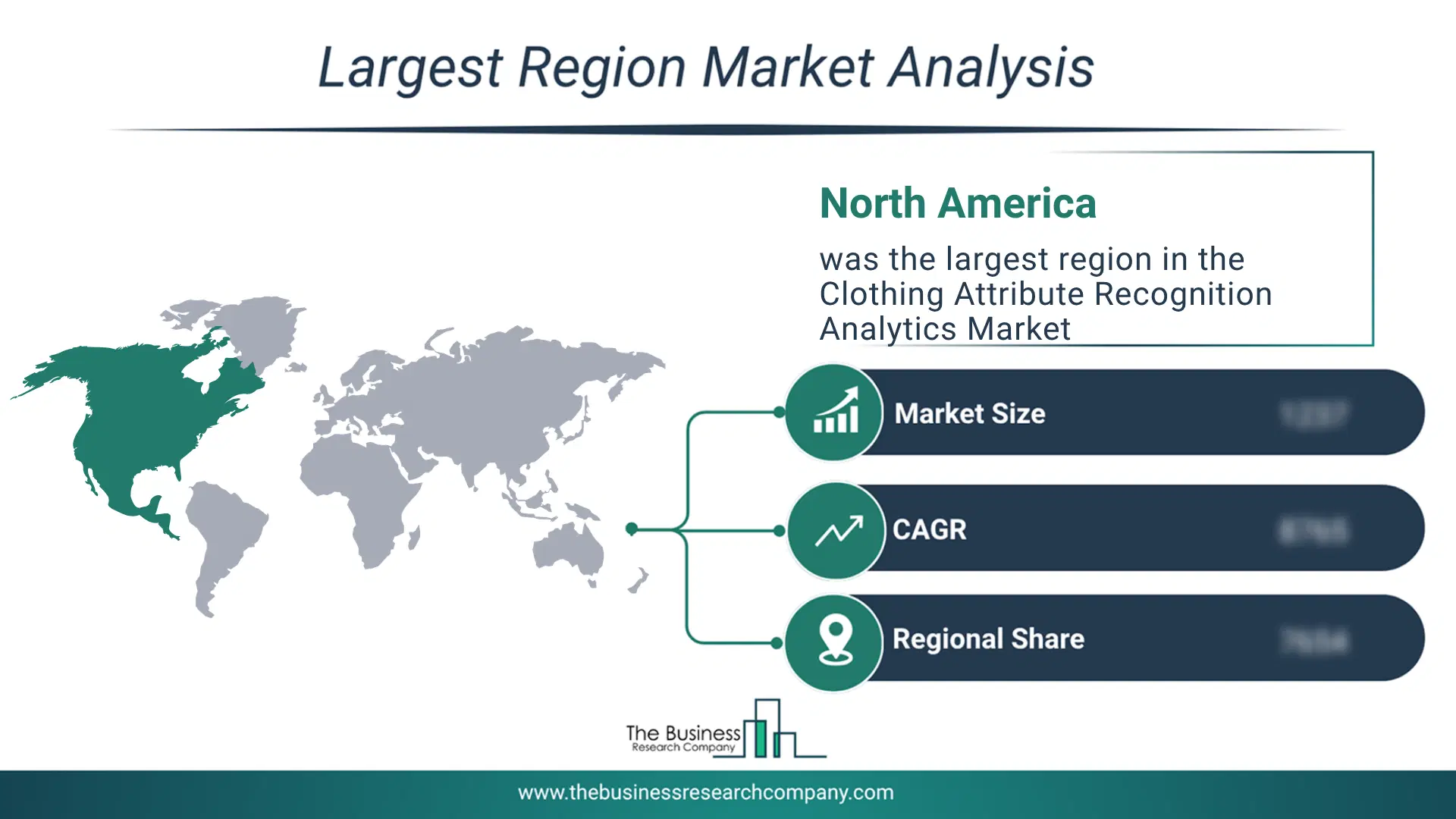
Regional Outlook/Insights
North America was the largest region in the clothing attribute recognition analytics market in 2025. Asia-Pacific is expected to be the fastest-growing region in the forecast period. The regions covered in this market report are Asia-Pacific, South East Asia, Western Europe, Eastern Europe, North America, South America, Middle East, Africa. The countries covered in this market report are Australia, Brazil, China, France, Germany, India, Indonesia, Japan, Taiwan, Russia, South Korea, UK, USA, Canada, Italy, Spain.What Defines the Clothing Attribute Recognition Analytics Market?
The clothing attribute recognition analytics market consists of revenues earned by entities by providing services such as apparel detection analytics, clothing attribute classification, garment pattern recognition, color and texture recognition, garment-type classification, clothing visual feature extraction, and clothing appearance analysis software. The market value includes the value of related goods sold by the service provider or included within the service offering. The clothing attribute recognition analytics market also includes sales of cameras, servers, smart surveillance systems, and edge computing devices. Values in this market are ‘factory gate’ values, that is the value of goods sold by the manufacturers or creators of the goods, whether to other entities (including downstream manufacturers, wholesalers, distributors and retailers) or directly to end customers. The value of goods in this market includes related services sold by the creators of the goods.How is Market Value Defined and Measured?
The market value is defined as the revenues that enterprises gain from the sale of goods and/or services within the specified market and geography through sales, grants, or donations in terms of the currency (in USD unless otherwise specified). The revenues for a specified geography are consumption values that are revenues generated by organizations in the specified geography within the market, irrespective of where they are produced. It does not include revenues from resales along the supply chain, either further along the supply chain or as part of other products.
This chart presents market attractiveness based on a quantitative evaluation of growth, competition, strategic alignment, and risk, offering a clear view of opportunity areas for decision-making. This chart is for illustrative purposes; the full report contains the complete analysis.

This chart highlights the Total Addressable Market (TAM) by estimating the maximum revenue opportunity using an assumption-driven approach, supporting strategic planning and opportunity sizing across markets. The chart is illustrative; the full report provides a more comprehensive analysis.
What Key Data and Analysis Are Included in the Clothing Attribute Recognition Analytics Market Report 2026?
The clothing attribute recognition analytics market research report is one of a series of new reports from The Business Research Company that provides market statistics, including industry global market size, regional shares, competitors with the market share, detailed market segments, market trends and opportunities, and any further data you may need to thrive in the clothing attribute recognition analytics industry. The market research report delivers a complete perspective of everything you need, with an in-depth analysis of the current and future state of the industry.Clothing Attribute Recognition Analytics Market Report Forecast Analysis
| Report Attribute | Details |
|---|---|
| Market Size Value In 2026 | $2.02 billion |
| Revenue Forecast In 2030 | $4.06 billion |
| Growth Rate | CAGR of 19.0% from 2026 to 2035 |
| Base Year For Estimation | 2025 |
| Actual Estimates/Historical Data | 2020-2025 |
| Forecast Period | 2026 - 2030 |
| Market Representation | Revenue in USD Billion and CAGR from 2026 to 2030 |
| Segments Covered | Component, Technology, Deployment Mode, Application, End User |
| Regional Scope | Asia-Pacific, Western Europe, Eastern Europe, North America, South America, Middle East, Africa |
| Country Scope | The countries covered in the report are Australia, Brazil, China, France, Germany, India, Indonesia, Japan, Taiwan, Russia, South Korea, UK, USA, Canada, Italy, Spain. |
| Customization Scope | Request for Customization |
| Pricing And Purchase Options | Explore Purchase Options |