
Clothing Retail Market Report 2026
Global Outlook – By Product Type ( Casual Wear, Formal Wear, Sportswear And Activewear, Ethnic Wear, Innerwear And Loungewear, Luxury Apparel), By Price Range ( Economy, Mid-Range, Premium), By Distribution Channel ( Online Stores, Supermarkets Or Hypermarkets, Specialty Stores, Other Distribution Channels), By End User ( Women, Men, Children, Unisex) – Market Size, Trends, Strategies, and Forecast to 2030
Clothing Retail Market Report 2026 Market Overview
• Clothing Retail Market Report 2026 market size has reached to $1399.41 billion in 2025 • Expected to grow to $1974.78 billion in 2030 at a compound annual growth rate (CAGR) of 7% • Growth Driver: Expansion Of E-Commerce Platforms Driving Market Growth Due To Rising Digital Retail Adoption And Online Purchasing Behavior • Market Trend: Youth-Oriented Value Fashion Chains Redefining Fast, Affordable And Tech-Enabled Shopping Experiences • Asia-Pacific was the largest region and fastest growing region.What Is Covered Under Clothing Retail Market?
Clothing retail refers to the business of selling ready-made garments and apparel directly to end consumers through physical stores or online platforms. It involves purchasing clothing from manufacturers or wholesalers and offering it to customers for personal use based on demand, style preferences, and seasonal trends. The main product types of clothing retail include casual wear, formal wear, sportswear and activewear, ethnic wear, innerwear and loungewear, and luxury apparel. Casual wear refers to everyday clothing designed for comfort and regular use across different consumer preferences and lifestyle needs. These products are available across price ranges including economy, mid-range, and premium. They are distributed through online stores, supermarkets or hypermarkets, specialty stores, and others and end users including women, men, children, and unisex consumers.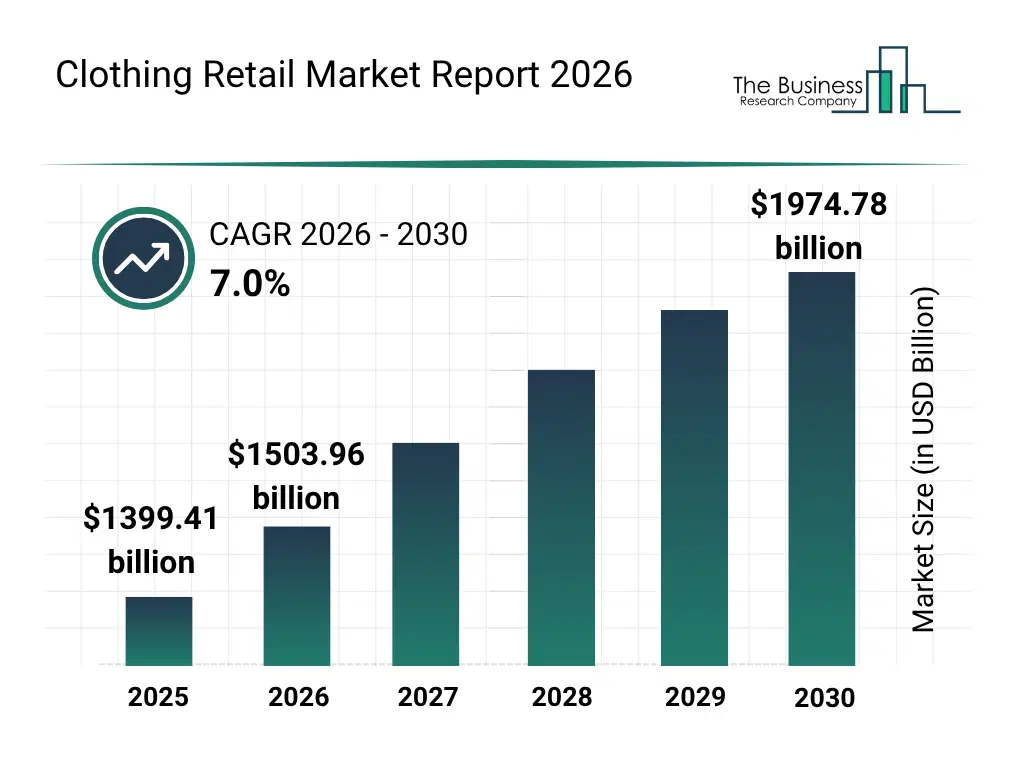
What Is The Clothing Retail Market Size and Share 2026?
The clothing retail market size has grown strongly in recent years. It will grow from $1399.41 billion in 2025 to $1503.96 billion in 2026 at a compound annual growth rate (CAGR) of 7.5%. The growth in the historic period can be attributed to expansion of brick and mortar retail stores, growth of global apparel manufacturing industry, rising consumer demand for branded clothing, increasing urbanization and disposable income levels, development of organized fashion retail chains.What Is The Clothing Retail Market Growth Forecast?
The clothing retail market size is expected to see strong growth in the next few years. It will grow to $1974.78 billion in 2030 at a compound annual growth rate (CAGR) of 7.0%. The growth in the forecast period can be attributed to growth of e commerce fashion platforms, rising influence of digital marketing and social media fashion trends, increasing demand for sustainable apparel consumption, expansion of AI driven personalized shopping experiences, growth of omnichannel retail infrastructure. Major trends in the forecast period include growing adoption of omnichannel retail models integrating physical stores with online platforms for seamless customer experience, increasing use of personalized recommendation systems based on consumer purchase behavior and style preferences, rising demand for fast fashion and trend responsive apparel collections driven by social media influence, expansion of sustainable and ethical clothing retail practices focusing on eco friendly sourcing and circular fashion, increasing integration of smart inventory management systems to optimize stock availability and reduce overstocking in retail outlets.
Global Clothing Retail Market Segmentation
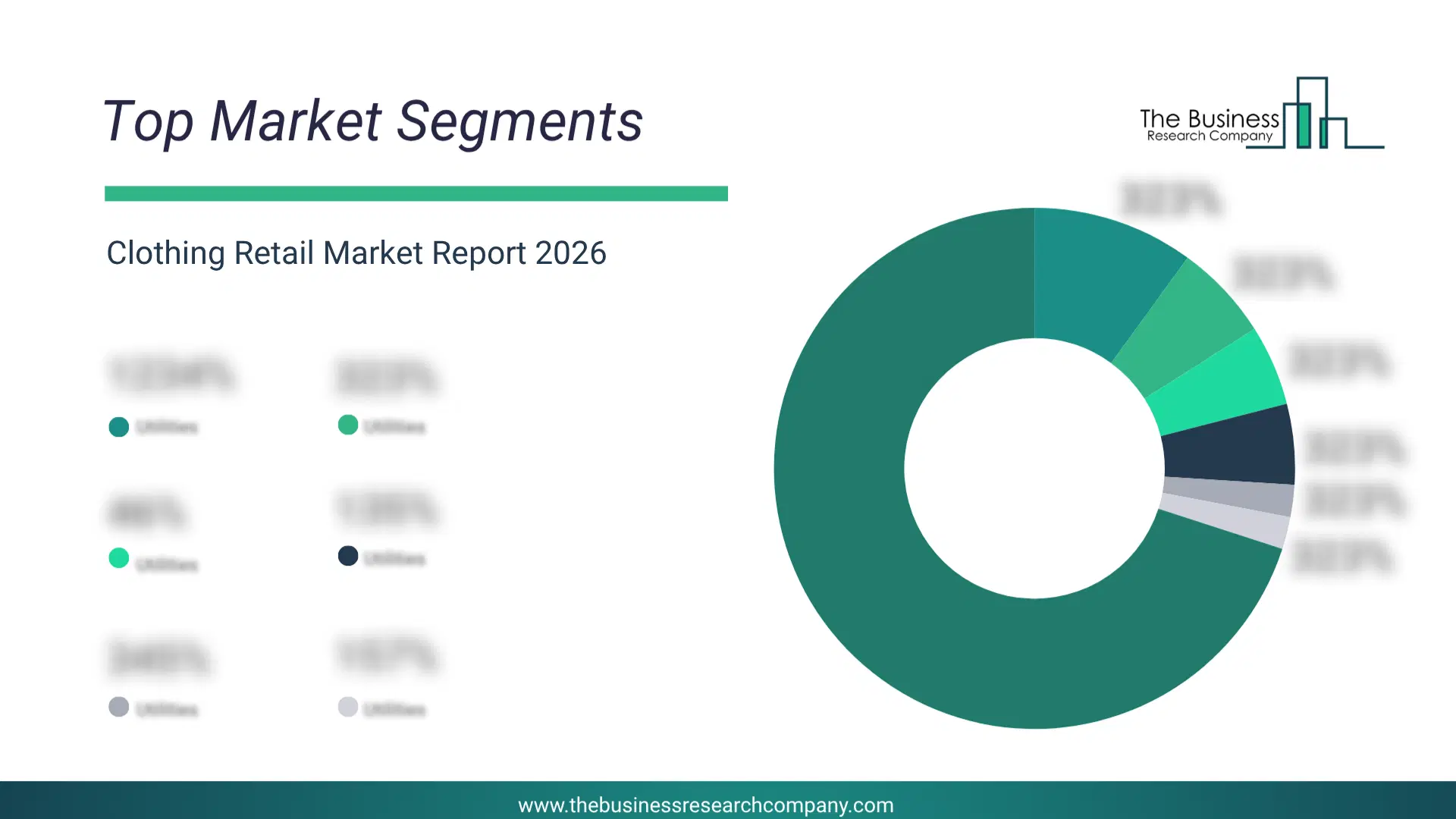
1) By Product Type: Casual Wear, Formal Wear, Sportswear And Activewear, Ethnic Wear, Innerwear And Loungewear, Luxury Apparel 2) By Price Range: Economy, Mid-Range, Premium 3) By Distribution Channel: Online Stores, Supermarkets Or Hypermarkets, Specialty Stores, Other Distribution Channels 4) By End User: Women, Men, Children, Unisex Subsegments: 1) By Casual Wear: T Shirts, Polo Shirts, Casual Shirts, Jeans, Casual Trousers 2) By Formal Wear: Formal Shirts, Formal Trousers, Business Suits, Blazers, Formal Skirts 3) By Sportswear And Activewear: Active T Shirts, Track Pants, Compression Wear, Sports Jackets, Yoga Wear 4) By Ethnic Wear: Traditional Dresses, Ethnic Suits, Tunics, Ethnic Skirts, Traditional Shirts 5) By Innerwear And Loungewear: Undergarments, Sleepwear, Lounge Pants, Robes, Thermal Wear 6) By Luxury Apparel: Designer Dresses, Premium Suits, Luxury Outerwear, Couture Apparel, Premium KnitwearWhat Is The Driver Of The Clothing Retail Market?
The expansion of e-commerce platforms is expected to propel the growth of the clothing retail market going forward. E-commerce platforms are digital marketplaces that enable the buying and selling of goods and services over the internet through websites or mobile applications. E-commerce platforms are rising due to increasing internet penetration, which enables more people to access online shopping services easily and conveniently. Expansion of e-commerce platforms is transforming the clothing retail industry by enabling brands to reach a wider customer base, offer seamless shopping experiences, and drive higher sales through personalized digital marketing and convenient doorstep delivery. For instance, in February 2025, according to the Census Bureau, a US-based government agency, total e-commerce sales in the fourth quarter of 2024 increased by 9.4% compared to the fourth quarter of 2023, while total retail sales increased by 3.8% during the same period, highlighting continued expansion in online retail activity. Therefore, the expansion of e-commerce platforms is driving the growth of the clothing retail marker market.Key Players In The Global Clothing Retail Market
Major companies operating in the clothing retail market report are Abercrombie & Fitch Co., Amazon.com Inc., American Eagle Outfitters Inc., Aritzia Inc., ASOS plc, Associated British Foods plc, Boohoo Group plc, Fast Retailing Co. Ltd., Gap Inc., Hennes & Mauritz AB, Inditex S.A., JD Sports Fashion plc, Lululemon Athletica Inc., Macy's Inc., Marks and Spencer Group plc, Next plc, Nike Inc., Punto Fa S.L., PVH Corp., Ross Stores Inc., Target Brands Inc., The Buckle Inc., The TJX Companies Inc., Urban Outfitters Inc., Walmart Inc., Zalando SE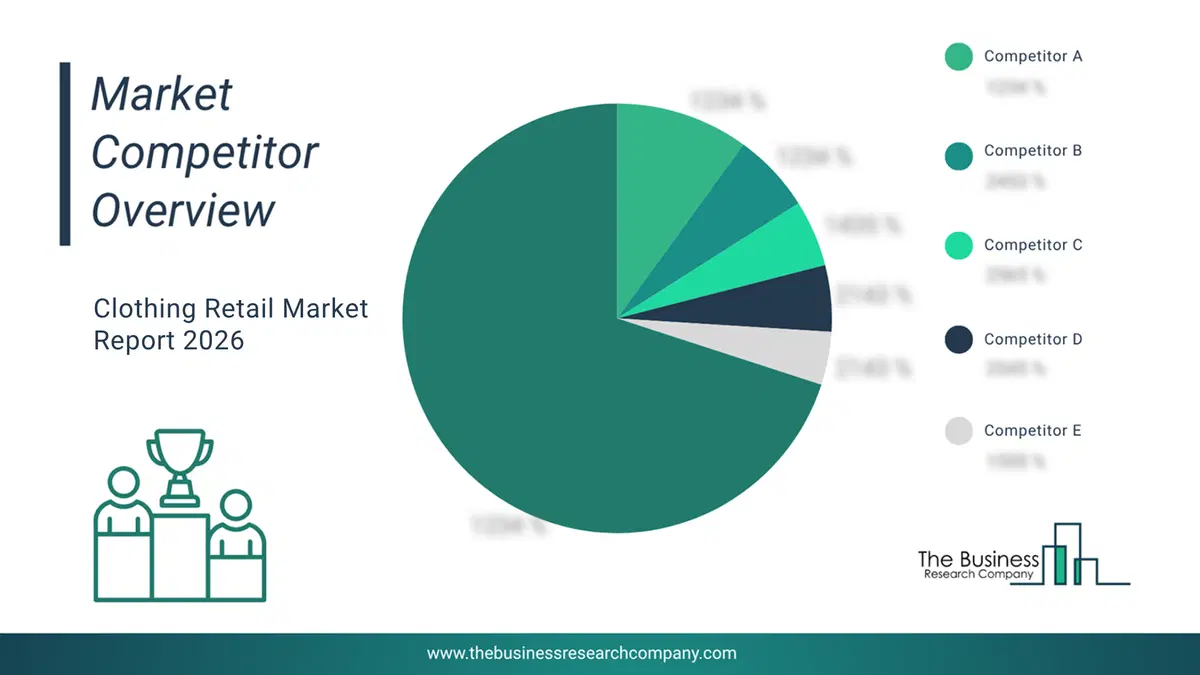
This chart is for illustrative purposes; the full report includes a detailed competitor analysis and comprehensive overview of the top 10 companies in the market.
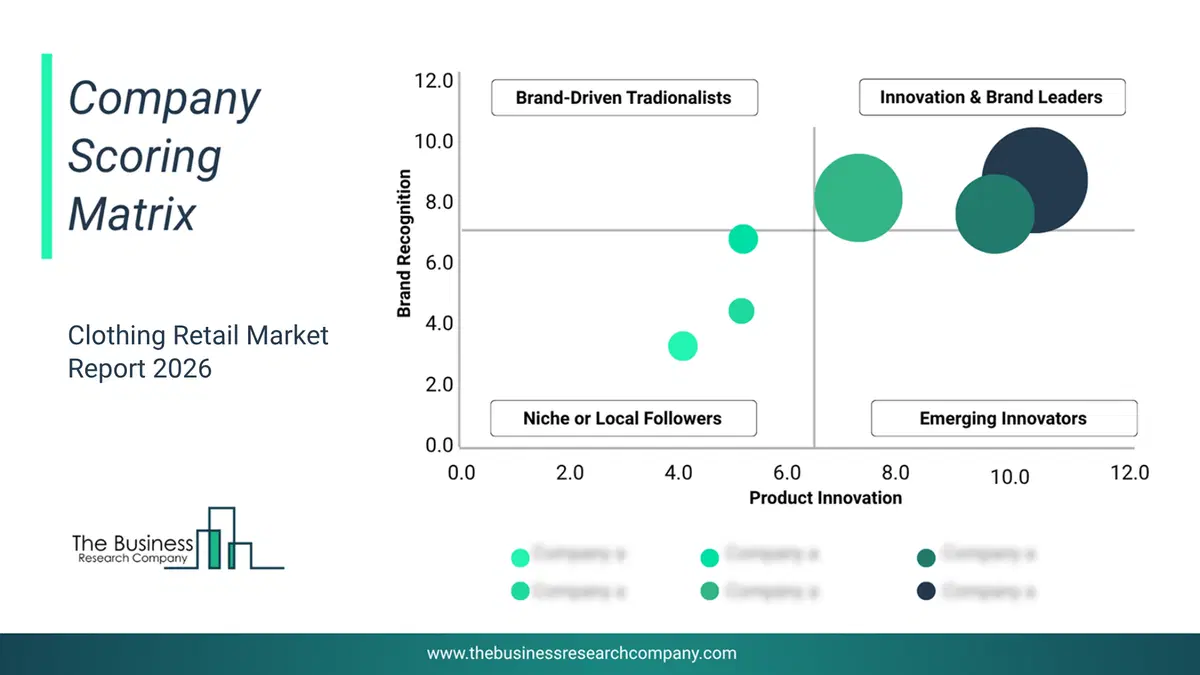
This chart maps companies by product innovation and brand strength, with bubble size indicating relative revenue, helping identify market leaders, challengers, and niche players. This is an illustrative chart; the full report provides a complete and accurate competitive analysis.
Global Clothing Retail Market Trends and Insights
Major companies operating in the clothing retail market are focusing on developing innovative solutions, such as youth-focused value fashion retail chains, to attract Gen Z consumers through affordable, trend-driven apparel; rapid fashion refresh cycles and digitally enabled in-store shopping experiences. Youth-focused value fashion retail chains are retail formats that sell affordable, trend-driven clothing specifically designed for young consumers, often combining fast-changing styles with budget-friendly pricing and a strong digital or experiential shopping environment. For instance, in August 2023, Reliance Retail, an India-based diversified retail company, launched Yousta, an innovative youth-focused value fashion retail chain. Yousta is designed as a fast-moving, trend-driven apparel format targeting Gen Z and young consumers with highly affordable pricing, where most products are priced below ₹999 and many under ₹499, enabling mass-market accessibility. It features weekly Starring Now capsule drops that refresh outfits frequently, ensuring constant alignment with emerging fashion trends and reducing inventory stagnation compared to conventional seasonal retail cycles. The stores also incorporate tech-enabled experiences such as QR-based product information access, self-checkout counters, free Wi-Fi, and charging stations, creating a seamless blend of physical and digital retail. This combination of affordability, rapid fashion turnover, and digital integration allows the format to compete effectively in India’s fast-expanding value fashion segment and improve conversion among digitally native consumers.What Are Latest Mergers And Acquisitions In The Clothing Retail Market?
In November 2023, Stern Partners Inc., a Canada-based diversified private investment and holding company, acquired Grafton Apparel for an undisclosed amount. With this acquisition, Stern Partners aims to strengthen its presence in Canada’s apparel and retail sector by expanding Grafton Apparel’s retail footprint and accelerating its e-commerce growth strategy. Grafton Apparel Ltd. is a Canada-based provider of apparel manufacturing, wholesale distribution, and retail clothing products.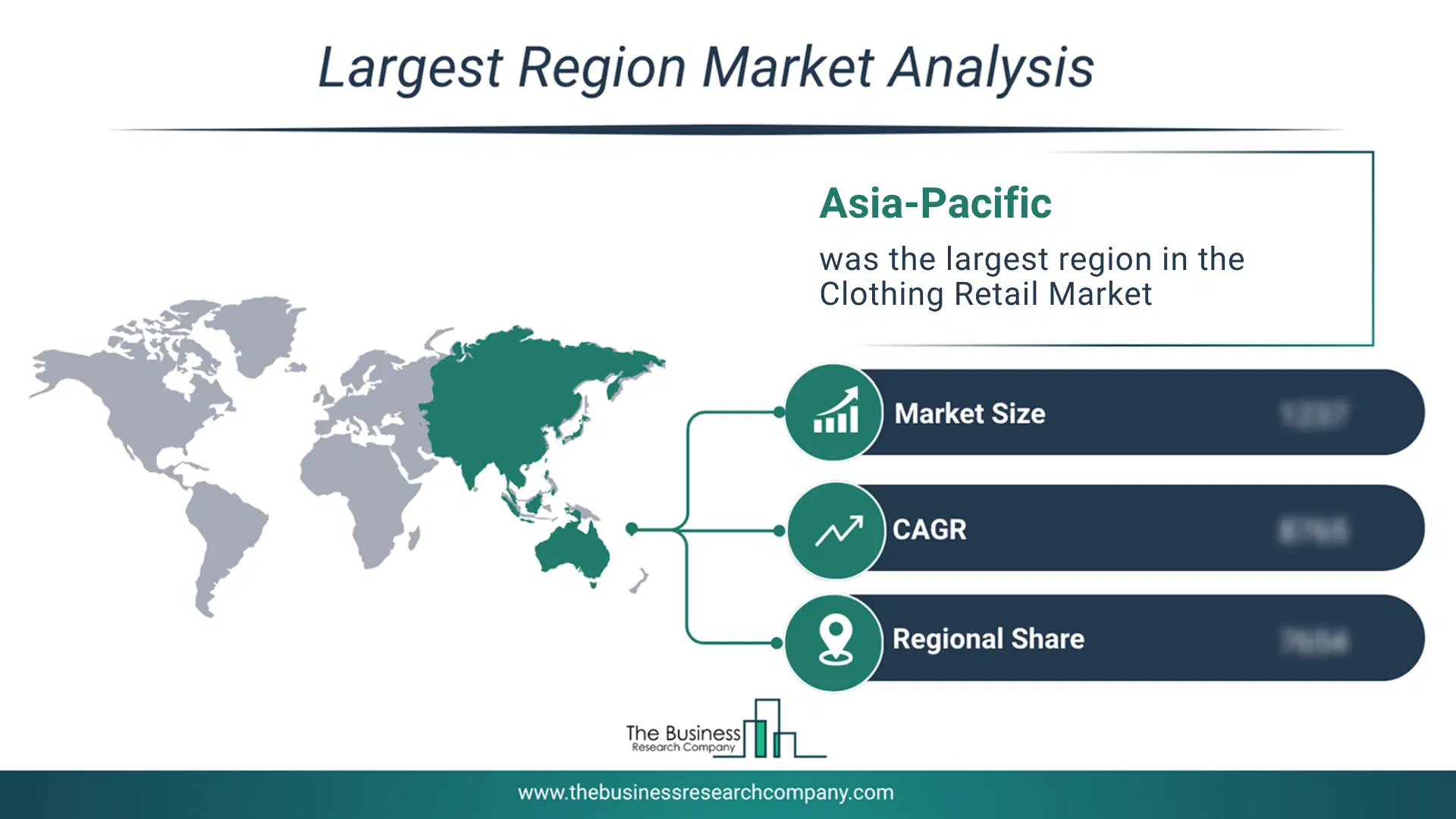
Regional Outlook
Asia-Pacific was the largest region in the clothing retail market in 2025. Asia-Pacific is expected to be the fastest-growing region in the forecast period. The regions covered in this market report are Asia-Pacific, South East Asia, Western Europe, Eastern Europe, North America, South America, Middle East, Africa. The countries covered in this market report are Australia, Brazil, China, France, Germany, India, Indonesia, Japan, Taiwan, Russia, South Korea, UK, USA, Canada, Italy, Spain.What Defines the Clothing Retail Market?
The clothing retail market includes revenues earned by entities by providing services such as apparel sales, franchise operations, discount and promotional sales, and clothing rental subscriptions. The market value includes the value of related goods sold by the service provider or included within the service offering. Only goods and services traded between entities or sold to end consumers are included.How is Market Value Defined and Measured?
The market value is defined as the revenues that enterprises gain from the sale of goods and/or services within the specified market and geography through sales, grants, or donations in terms of the currency (in USD unless otherwise specified). The revenues for a specified geography are consumption values that are revenues generated by organizations in the specified geography within the market, irrespective of where they are produced. It does not include revenues from resales along the supply chain, either further along the supply chain or as part of other products.
This chart presents market attractiveness based on a quantitative evaluation of growth, competition, strategic alignment, and risk, offering a clear view of opportunity areas for decision-making. This chart is for illustrative purposes; the full report contains the complete analysis.

This chart highlights the Total Addressable Market (TAM) by estimating the maximum revenue opportunity using an assumption-driven approach, supporting strategic planning and opportunity sizing across markets. The chart is illustrative; the full report provides a more comprehensive analysis.
What Key Data and Analysis Are Included in the Clothing Retail Market Report 2026?
The clothing retail market research report is one of a series of new reports from The Business Research Company that provides market statistics, including industry global market size, regional shares, competitors with the market share, detailed market segments, market trends and opportunities, and any further data you may need to thrive in the clothing retail industry. The market research report delivers a complete perspective of everything you need, with an in-depth analysis of the current and future state of the industry.Clothing Retail Market Report Forecast Analysis
| Report Attribute | Details |
|---|---|
| Market Size Value In 2026 | $1503.96 billion |
| Revenue Forecast In 2030 | $1974.78 billion |
| Growth Rate | CAGR of 7% from 2026 to 2030 |
| Base Year For Estimation | 2025 |
| Actual Estimates/Historical Data | 2020-2025 |
| Forecast Period | 2026 - 2030 |
| Market Representation | Revenue in USD Billion and CAGR from 2026 to 2030 |
| Segments Covered | Product Type, Price Range, Distribution Channel, End User |
| Regional Scope | Asia-Pacific, Western Europe, Eastern Europe, North America, South America, Middle East, Africa |
| Country Scope | The countries covered in the report are Australia, Brazil, China, France, Germany, India, Indonesia, Japan, Taiwan, Russia, South Korea, UK, USA, Canada, Italy, Spain. |
| Key Companies Profiled | Abercrombie & Fitch Co., Amazon.com Inc., American Eagle Outfitters Inc., Aritzia Inc., ASOS plc, Associated British Foods plc, Boohoo Group plc, Fast Retailing Co. Ltd., Gap Inc., Hennes & Mauritz AB, Inditex S.A., JD Sports Fashion plc, Lululemon Athletica Inc., Macy's Inc., Marks and Spencer Group plc, Next plc, Nike Inc., Punto Fa S.L., PVH Corp., Ross Stores Inc., Target Brands Inc., The Buckle Inc., The TJX Companies Inc., Urban Outfitters Inc., Walmart Inc., Zalando SE |
| Customization Scope | Request for Customization |
| Pricing And Purchase Options | Explore Purchase Options |