
Cloud-Based ERP Market Report 2026
Global Outlook – By Component (Solution, Service), By Organization Size (Small And Medium-sized Enterprises, Large Enterprises), By Development Model (Private Cloud, Public Cloud, Hybrid Cloud), By End-Use Industry (Automotive, Aerospace And Defense, Retail, Banking And Financial Services, IT And Telecommunication, Education, Government And Public Sectors, Other End-Use Industries) – Market Size, Trends, Strategies, and Forecast to 2030
Cloud-Based ERP Market Overview
• Cloud-Based ERP market size has reached to $45.86 billion in 2025 • Expected to grow to $81.9 billion in 2030 at a compound annual growth rate (CAGR) of 12.4% • Growth Driver: Surge In Tech Sector Investments Fuels Explosive Growth In Cloud-Based Erp Market • Market Trend: Advancement In AI Powered Cloud-Based Erp Market Growth • North America was the largest region in 2025.Market Gains By 2030 – Top Opportunities By Segment
Market Gain identifies the most promising market opportunities by highlighting the segments or products expected to generate the highest incremental revenue growth over the next five years.
What Is Covered Under Cloud-Based ERP Market?
The cloud-based ERP refer to an enterprise resource planning (ERP) system that runs on a cloud platform, allowing organizations to access it over the internet as opposed to an on-premises network. Integrates various departments in an organization and automates essential financial and operational business functions for the smooth flow of communication and information by providing a central database. The main components of cloud-based ERP are solutions and services. Cloud-based ERP solutions meet the requirements of clients while saving time and money. A cloud-based ERP solution, along with reduced cost, allows users across the globe to access business information by connecting to the internet. The different organization sizes include small and medium-sized enterprises and large enterprises. Private cloud, public cloud, and hybrid clouds are the various cloud-based ERP development models used by various end-use industries such as automotive, aerospace, and defense, retail, banking and financial services, IT and telecommunication, education, government and public sectors, and other end-use industries.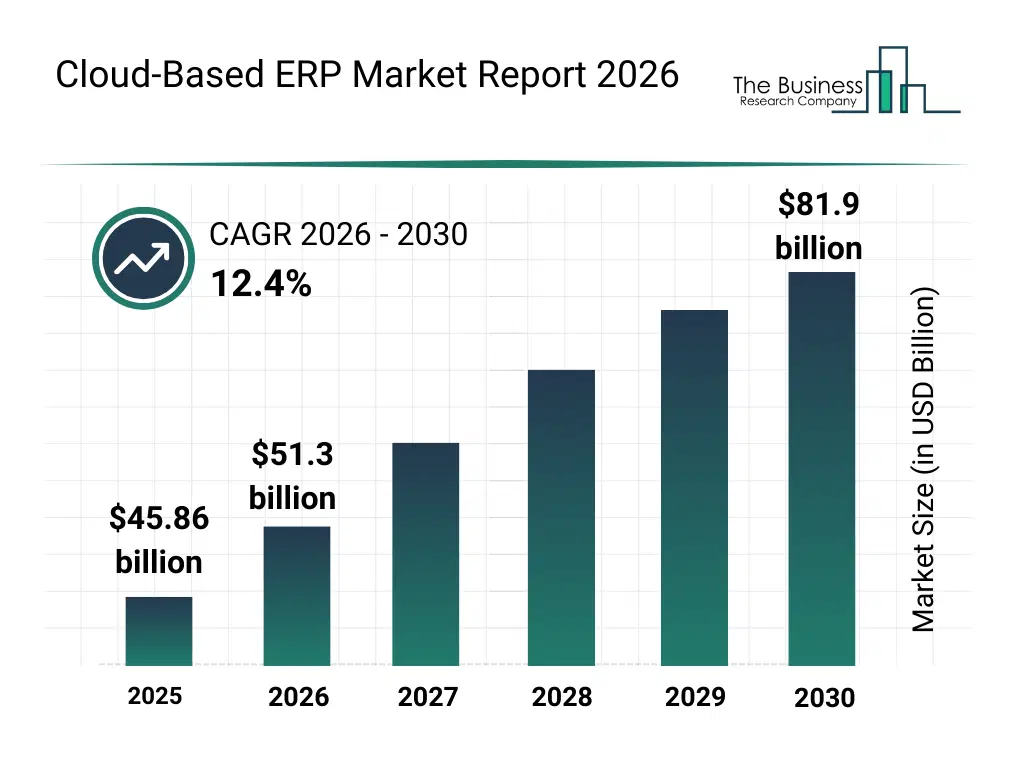
What Is The Cloud-Based ERP Market Size and Share 2026?
The cloud-based erp market size has grown rapidly in recent years. It will grow from $45.86 billion in 2025 to $51.3 billion in 2026 at a compound annual growth rate (CAGR) of 11.9%. The growth in the historic period can be attributed to enterprise shift from on-premise erp systems, growing demand for operational efficiency, expansion of digital transformation initiatives, increased adoption among small and medium enterprises, rising need for centralized data management.What Is The Cloud-Based ERP Market Growth Forecast?
The cloud-based erp market size is expected to see rapid growth in the next few years. It will grow to $81.9 billion in 2030 at a compound annual growth rate (CAGR) of 12.4%. The growth in the forecast period can be attributed to growing adoption of ai-enabled erp functionalities, increasing demand for real-time business insights, expansion of cloud-native erp deployments, rising focus on integration with third-party applications, growing investments in enterprise automation. Major trends in the forecast period include increasing adoption of modular cloud erp platforms, rising integration of erp with analytics and bi tools, growing demand for scalable erp solutions, expansion of industry-specific cloud erp offerings, enhanced focus on remote accessibility.
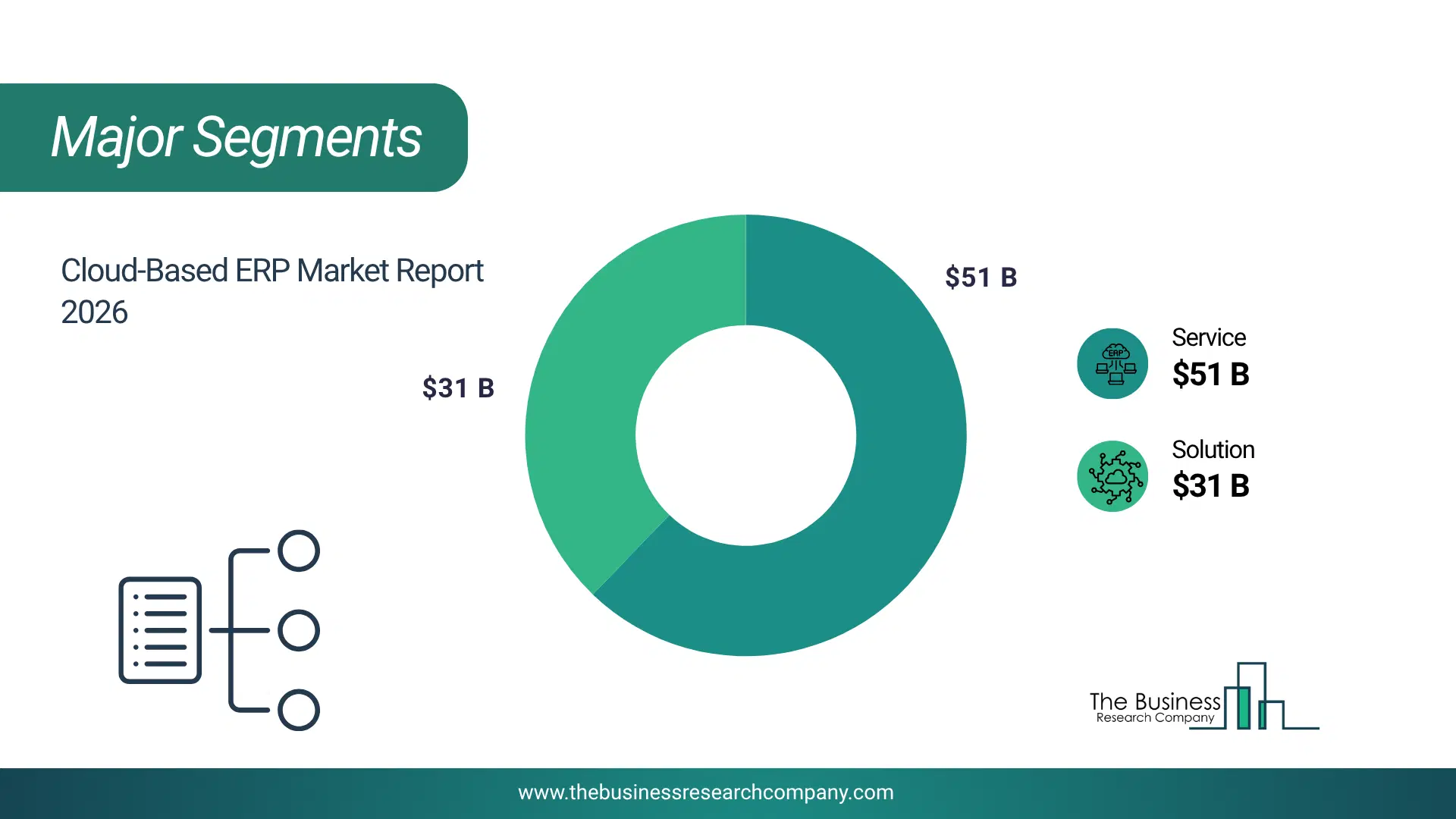
Global Cloud-Based ERP Market Segmentation
1) By Component: Solution, Service 2) By Organization Size: Small And Medium-sized Enterprises, Large Enterprises 3) By Development Model: Private Cloud, Public Cloud, Hybrid Cloud 4) By End-Use Industry: Automotive, Aerospace And Defense, Retail, Banking And Financial Services, IT And Telecommunication, Education, Government And Public Sectors, Other End-Use Industries Subsegments: 1) By Solution: ERP Software, Business Intelligence And Analytics Tools, Customer Relationship Management (CRM) Integration, Inventory And Asset Management Solutions 2) By Service: Implementation Services, Training And Support Services, Consulting Services, Maintenance And Upgrades The top segments in the cloud-based erp market will be: • Service will reach $50.61 Billion by 2030. • Solution will reach $30.73 Billion by 2030.What Is The Driver Of The Cloud-Based ERP Market?
The rising investment in the technology sector will propel the growth of the cloud-based ERP market. Investment in the technology sector refers to allocating funds to acquire or support businesses and assets related to technology, such as software development, hardware manufacturing, and innovative startups, with the expectation of future financial returns. Investments are used in cloud-based Enterprise Resource Planning (ERP) systems to modernize and transform business operations, streamline processes, and enhance overall efficiency. For instance, in February 2025, according to GOV.UK, a U.K.-based government agency reported that, in 2023, the public sector spent around £26 billion on technology. Therefore, the rising investment in the technology sector will contribute to the growth of the cloud-based ERP industry.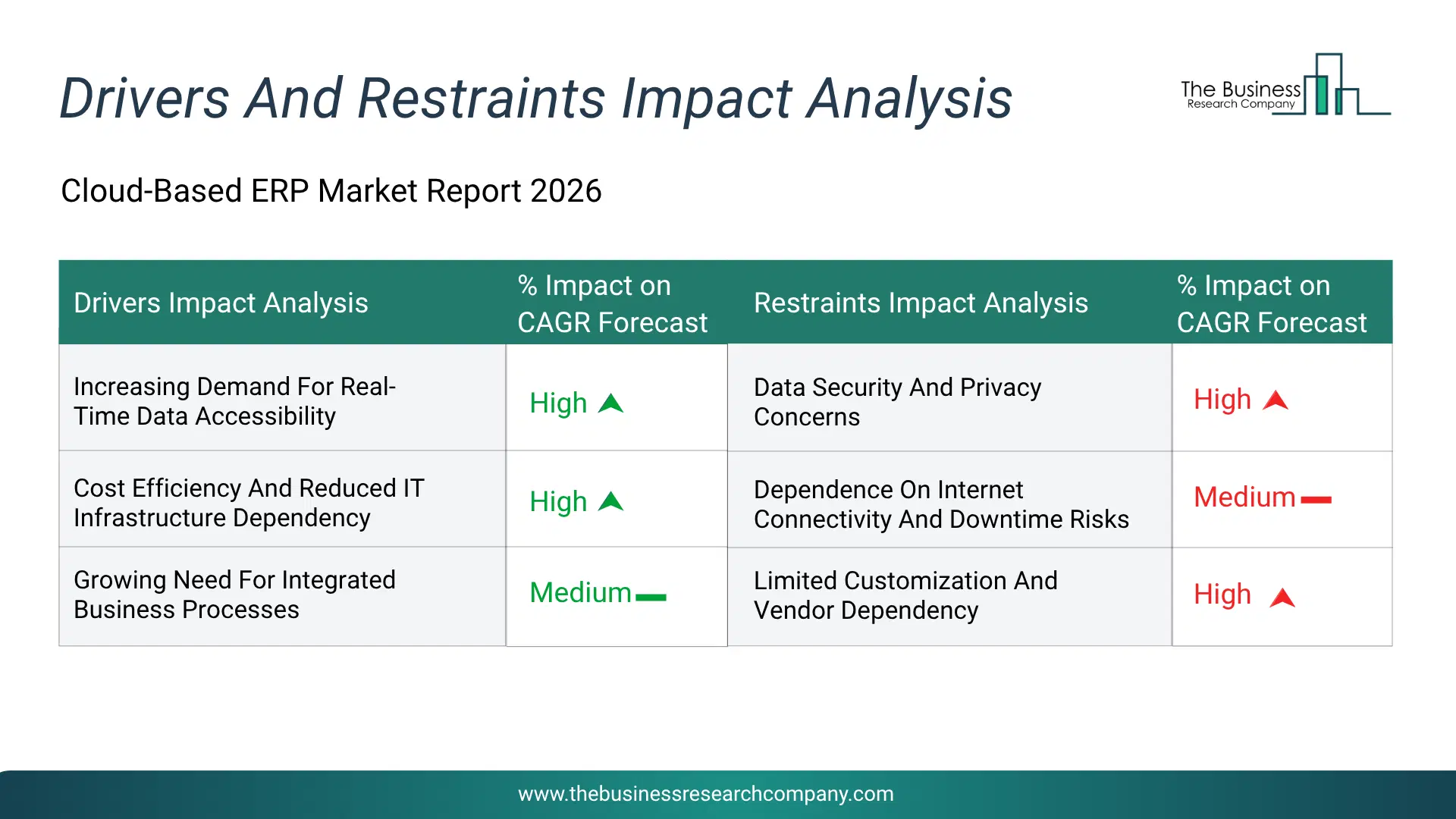
Infographic Chart Showing Key Market Drivers Analysis And Restraints For Cloud-Based Erp Market
The chart presents an impact analysis of key drivers and restraints, quantifying their relative influence on the market's growth rate and helping assess the balance between growth enablers and limiting factors. This chart offers a high-level perspective; the full report contains more detailed insights.
How Will The Drivers Impact Growth In The Global Cloud-Based ERP Market?
• Increasing Demand For Real-Time Data Accessibility (High) – During the forecast period, the increasing demand for real-time data accessibility is expected to become a key growth driver for the cloud-based ERP market by 2030. Organizations are increasingly prioritizing instant access to business-critical information across finance, supply chain, human resources, and operations to enhance agility and responsiveness. Cloud-based ERP platforms enable centralized data management and real-time analytics, allowing enterprises to make faster and more informed decisions. This capability is particularly important in dynamic business environments where timely insights directly impact competitiveness and operational efficiency. Vendors are continuously enhancing data visualization and reporting features to meet evolving enterprise requirements. • Cost Efficiency And Reduced IT Infrastructure Dependency (High) – During the forecast period, cost efficiency and reduced IT infrastructure dependency are expected to emerge as major factors driving the expansion of the cloud-based ERP market by 2030. Enterprises are shifting from on-premise systems to cloud-based solutions to eliminate high upfront capital expenditures associated with hardware, maintenance, and upgrades. Subscription-based pricing models and scalable deployment options provide flexibility and lower total cost of ownership, especially for small and medium-sized enterprises. Additionally, cloud ERP reduces the burden on internal IT teams by outsourcing system management and maintenance to service providers. This transition enables organizations to focus on core business activities while ensuring system reliability and performance. • Growing Need For Integrated Business Processes (Medium) – During the forecast period, the growing need for integrated business processes is expected to act as a key growth catalyst for the cloud-based ERP market by 2030. Organizations are increasingly seeking unified platforms that seamlessly integrate various functions such as finance, procurement, inventory management, and customer relationship management. Cloud-based ERP systems enable cross-functional collaboration and streamline workflows, reducing data silos and improving operational transparency. This integration enhances productivity, minimizes errors, and supports standardized processes across geographically dispersed operations. As businesses continue to expand and diversify, the demand for cohesive and scalable enterprise systems is rising significantly.How Will The Restraints Impact Growth In The Global Cloud-Based ERP Market?
• Data Security And Privacy Concerns (High) – During the forecast period, data security and privacy concerns are significantly restricting the growth of the cloud-based ERP market. Increasing risks of cyberattacks, data breaches, and regulatory compliance requirements are creating hesitation among enterprises, particularly in highly regulated industries, thereby slowing cloud ERP adoption. • Dependence On Internet Connectivity And Downtime Risks (High) – During the forecast period, dependence on internet connectivity and downtime risks are significantly restricting the growth of the cloud-based ERP market. Reliance on stable network infrastructure exposes organizations to operational disruptions during outages or connectivity failures, impacting business continuity and reducing confidence in cloud-based systems. • Limited Customization And Vendor Dependency (Medium) – During the forecast period, limited customization and vendor dependency are restricting the growth of the cloud-based ERP market. Standardized cloud ERP solutions may not fully meet specific enterprise requirements, while reliance on vendors for updates, support, and system modifications increases operational dependency and reduces flexibility for end users.Key Players In The Global Cloud-Based ERP Market
Major companies operating in the cloud-based erp market are SAP SE; Microsoft Corporation; Oracle Corporation; IBM Corporation; Infor Inc.; Sage Group plc; Aptean; Epicor Software Corporation; Acumatica Inc.; Ramco Systems Limited; Deltek Inc.; Plex Systems Inc.; Syspro; Unit4 N. V.; QAD Inc.; Workday Inc; Netsuite Inc; Certinia; IQMS; Rootstock Software; IFS AB; Genius Solutions Inc.; OpenPro Inc.; Sapphire Systems; Brahmin Solutions LLC; Method Integration Inc.; Deskera Holdings Limited; Blue Link Associates Limited; Brightpearl Limited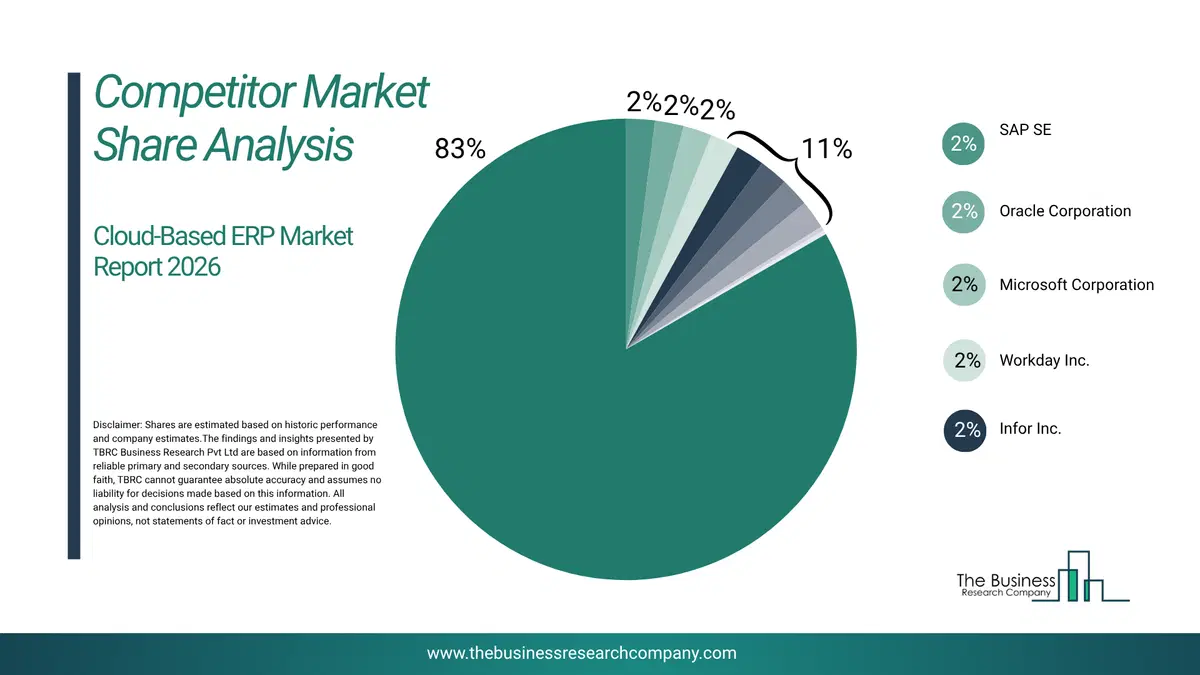
This chart is for illustrative purposes; the full report includes a detailed competitor analysis and comprehensive overview of the top 10 companies in the market.
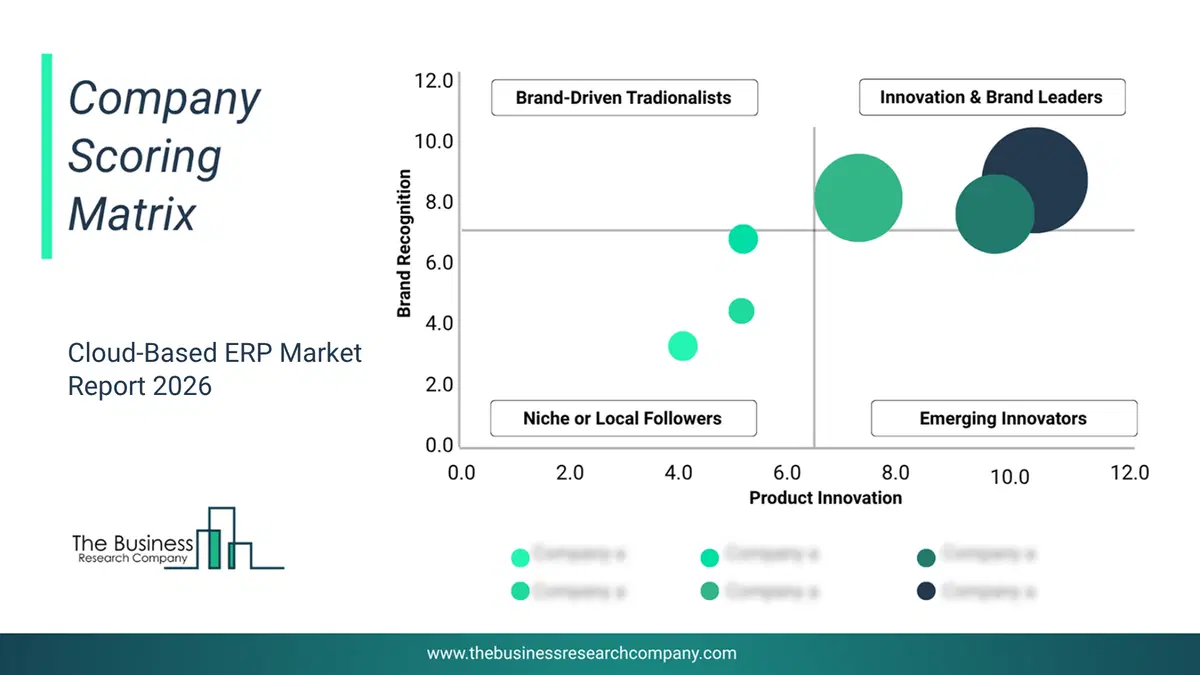
This chart maps companies by product innovation and brand strength, with bubble size indicating relative revenue, helping identify market leaders, challengers, and niche players. This is an illustrative chart; the full report provides a complete and accurate competitive analysis.
Global Cloud-Based ERP Market Trends and Insights
Major companies operating in the cloud-based ERP market focus on technological advancements, such as the new Microsoft Dynamics 365 Copilot, to enhance efficiency, precision, and sustainability in processes and gain a competitive advantage. Microsoft Dynamics 365 Copilot refers to an AI-driven virtual assistant designed to assist users with business tasks and decision-making within the Dynamics 365 suite. For instance, in March 2023, Microsoft Corporation, a US-based technology company, launched the new Microsoft Dynamics 365 Copilot, providing interactive, AI-powered assistance across business functions. It takes advantage of recent advancements in generative AI to automate these tedious tasks and unlock the full creativity of the workforce. Dynamics 365 Copilot puts customer relationship management (CRM) and enterprise resource planning (ERP) to work for business users to accelerate their pace of innovation and improve business outcomes in every line of business.What Are Latest Mergers And Acquisitions In The Cloud-Based ERP Market?
In May 2025, Vista Equity Partners Management, LLC, a U.S.-based investment firm focused on enterprise software, acquired Acumatica, Inc., for an undisclosed amount. Through this acquisition, Vista Equity Partners Management, LLC aims to strengthen its portfolio of cloud-based ERP solutions for small- and mid-sized businesses by leveraging Acumatica’s cloud-native platform that integrates financial management, operations, CRM, and industry-specific functionalities. Acumatica, Inc. is a U.S.-based provider of cloud ERP solutions that enables SMBs to digitally manage and automate mission-critical processes through a unified system.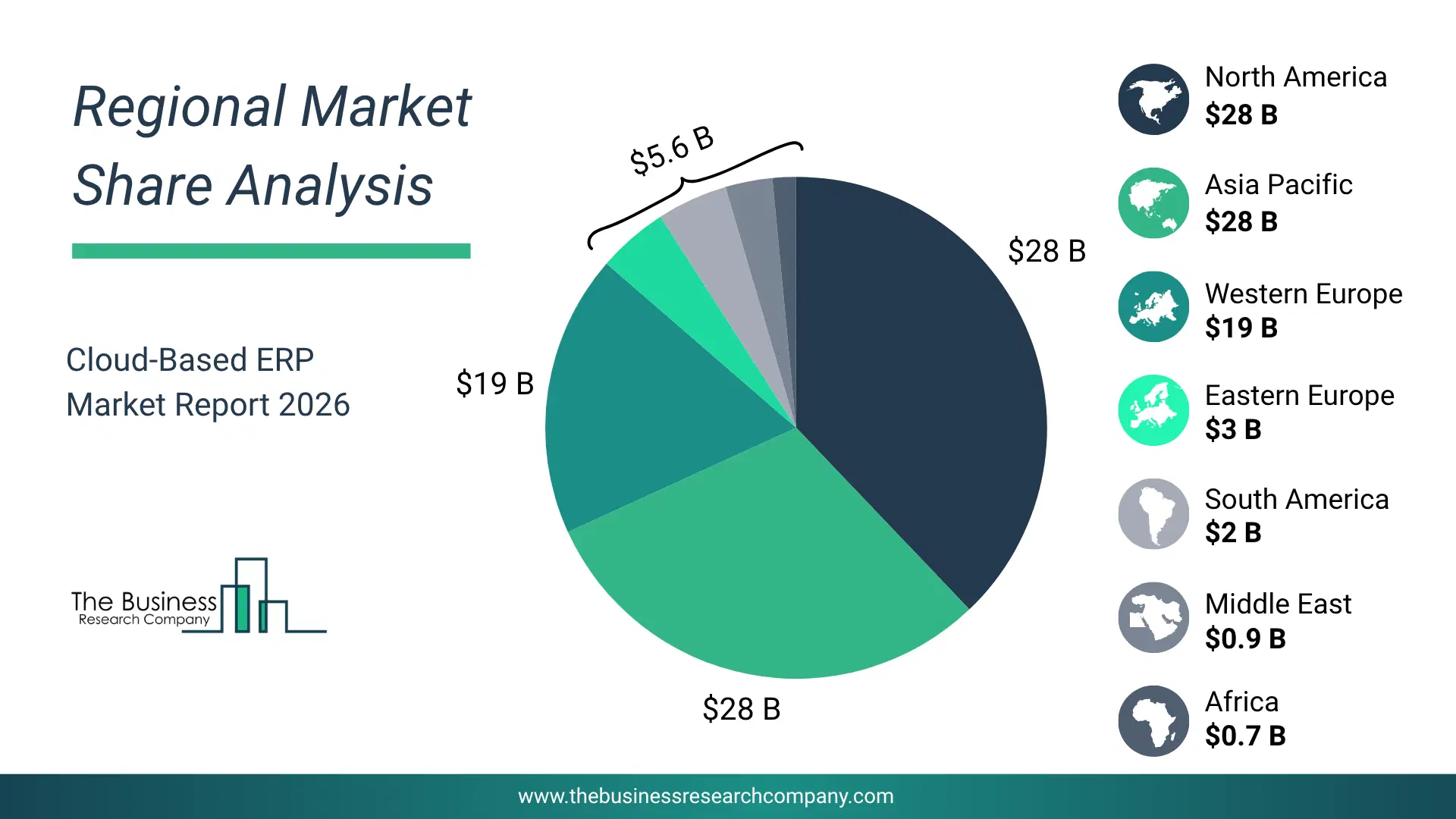
Regional Insights
North America was the largest region in the cloud-based ERP market in 2025. The regions covered in this market report are Asia-Pacific, South East Asia, Western Europe, Eastern Europe, North America, South America, Middle East, Africa. The countries covered in this market report are Australia, Brazil, China, France, Germany, India, Indonesia, Japan, Taiwan, Russia, South Korea, UK, USA, Canada, Italy, SpainWhat Defines the Cloud-Based ERP Market?
The cloud-based ERP market includes revenues earned by entities by providing software tools to an organization with access to their business-critical applications at any time from any location and provides analytical capabilities, customizable dashboards and reports, vendor-generated updates, and enterprise-level security. The market value includes the value of related goods sold by the service provider or included within the service offering. Only goods and services traded between entities or sold to end consumers are included.How is Market Value Defined and Measured?
The market value is defined as the revenues that enterprises gain from the sale of goods and/or services within the specified market and geography through sales, grants, or donations in terms of the currency (in USD unless otherwise specified). The revenues for a specified geography are consumption values that are revenues generated by organizations in the specified geography within the market, irrespective of where they are produced. It does not include revenues from resales along the supply chain, either further along the supply chain or as part of other products.
This chart presents market attractiveness based on a quantitative evaluation of growth, competition, strategic alignment, and risk, offering a clear view of opportunity areas for decision-making. This chart is for illustrative purposes; the full report contains the complete analysis.

This chart highlights the Total Addressable Market (TAM) by estimating the maximum revenue opportunity using an assumption-driven approach, supporting strategic planning and opportunity sizing across markets. The chart is illustrative; the full report provides a more comprehensive analysis.
What Key Data and Analysis Are Included in the Cloud-Based ERP Market Report 2026?
The cloud-based erp market research report is one of a series of new reports from The Business Research Company that provides market statistics, including industry global market size, regional shares, competitors with the market share, detailed market segments, market trends and opportunities, and any further data you may need to thrive in the cloud-based erp industry. The market research report delivers a complete perspective of everything you need, with an in-depth analysis of the current and future state of the industry.Cloud-Based ERP Market Report Forecast Analysis
| Report Attribute | Details |
|---|---|
| Market Size Value In 2026 | $51.3 billion |
| Revenue Forecast In 2030 | $81.9 billion |
| Growth Rate | CAGR of 11.9% from 2026 to 2030 |
| Base Year For Estimation | 2025 |
| Actual Estimates/Historical Data | 2020-2025 |
| Forecast Period | 2026 - 2030 |
| Market Representation | Revenue in USD Billion and CAGR from 2026 to 2030 |
| Segments Covered | Component, Organization Size, Development Model, End-Use Industry |
| Regional Scope | Asia-Pacific, Western Europe, Eastern Europe, North America, South America, Middle East, Africa |
| Country Scope | The countries covered in the report are Australia, Brazil, China, France, Germany, India, Indonesia, Japan, Taiwan, Russia, South Korea, UK, USA, Canada, Italy, Spain. |
| Key Companies Profiled | SAP SE; Microsoft Corporation; Oracle Corporation; IBM Corporation; Infor Inc.; Sage Group plc; Aptean; Epicor Software Corporation; Acumatica Inc.; Ramco Systems Limited; Deltek Inc.; Plex Systems Inc.; Syspro; Unit4 N. V.; QAD Inc.; Workday Inc; Netsuite Inc; Certinia; IQMS; Rootstock Software; IFS AB; Genius Solutions Inc.; OpenPro Inc.; Sapphire Systems; Brahmin Solutions LLC; Method Integration Inc.; Deskera Holdings Limited; Blue Link Associates Limited; Brightpearl Limited |
| Customization Scope | Request for Customization |
| Pricing And Purchase Options | Explore Purchase Options |