
Cloud Business Phone Systems Market Report 2026
Global Outlook – By Component (Software, Hardware, Services), By Deployment Model (Public Cloud, Private Cloud, Hybrid Cloud), By User Type (Small Enterprises, Medium Enterprises, Large Enterprises), By End-User (Banking, Finance Services And Insurances (BFSI), Healthcare, Retail, Information Technology (IT) And Telecommunications, Education, Government, Other End-Users) – Market Size, Trends, Strategies, and Forecast to 2030
Cloud Business Phone Systems Market Overview
• Cloud Business Phone Systems market size has reached to $17.54 billion in 2025 • Expected to grow to $33.19 billion in 2030 at a compound annual growth rate (CAGR) of 13.5% • Growth Driver: Growing Adoption Of Remote Work Driving The Market Growth Due To Rising Demand For Seamless Cloud-Based Communication Solutions • Market Trend: Improving Customer Experience Through Intelligent Call Routing • North America was the largest region in 2025 and Asia-Pacific is the fastest growing region.Market Gains By 2030 – Top Opportunities By Segment
Market Gain identifies the most promising market opportunities by highlighting the segments or products expected to generate the highest incremental revenue growth over the next five years.
What Is Covered Under Cloud Business Phone Systems Market?
Cloud business phone systems, also known as cloud-based phone systems or cloud telephony, are business phone solutions that operate over the internet rather than through traditional landlines or on-premises hardware. These systems use voice over internet protocol (VoIP) technology to route calls over the internet and often include advanced features such as call forwarding, auto-attendants, voicemail-to-email, video conferencing, analytics, and integrations with customer relationship management (CRM) and collaboration tools. The main components of cloud business phone systems include software, hardware, and services. Cloud business phone systems software refers to internet-based telephony solutions that enable businesses to make, receive, and manage calls, messages, and other communication services without traditional on-premises phone hardware. These systems can be deployed through public, private, or hybrid cloud models and cater to various user types, including small, medium, and large enterprises. They serve end-users across industries such as banking, financial services and insurance (BFSI), healthcare, retail, information technology (IT) and telecommunications, education, government, and others.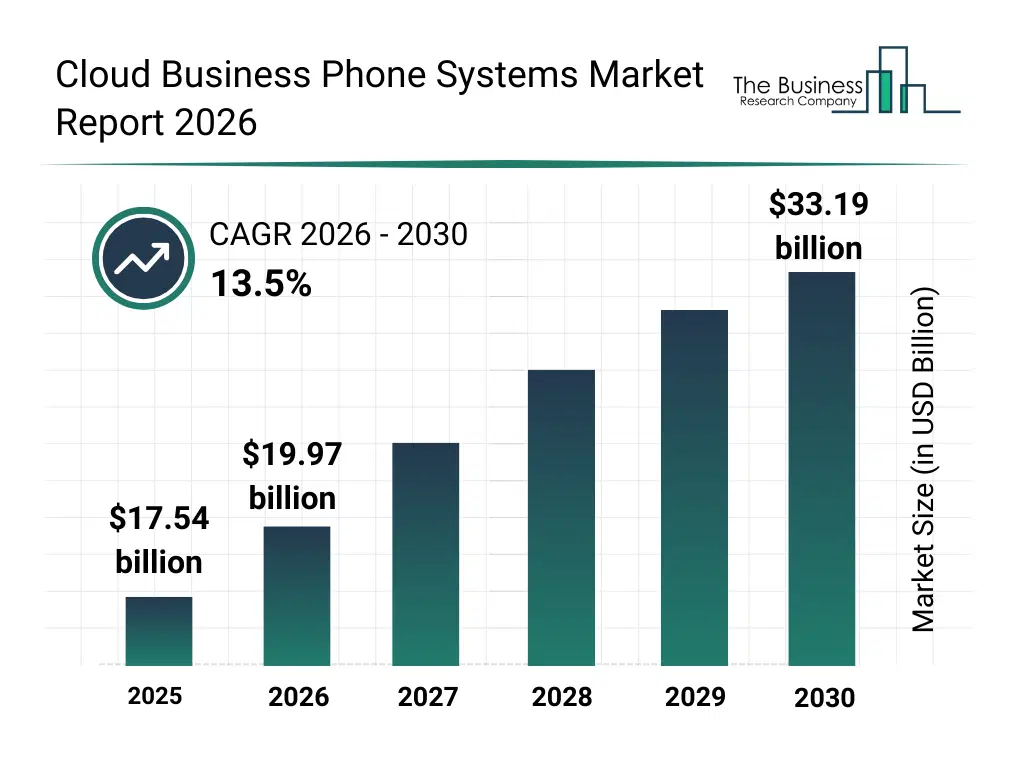
What Is The Cloud Business Phone Systems Market Size and Share 2026?
The cloud business phone systems market size has grown rapidly in recent years. It will grow from $17.54 billion in 2025 to $19.97 billion in 2026 at a compound annual growth rate (CAGR) of 13.8%. The growth in the historic period can be attributed to growth of VoIP adoption in enterprises, need to reduce costs of on-premises PBX systems, expansion of remote and hybrid work models, increasing demand for scalable business communication, rise in customer service and contact center modernization.What Is The Cloud Business Phone Systems Market Growth Forecast?
The cloud business phone systems market size is expected to see rapid growth in the next few years. It will grow to $33.19 billion in 2030 at a compound annual growth rate (CAGR) of 13.5%. The growth in the forecast period can be attributed to higher adoption of AI voice assistants in calling, increased demand for video conferencing add-ons, growth in security and compliance for cloud telephony, expansion of mobile-first business communication, greater investment in advanced call routing and automation. Major trends in the forecast period include unified communications as a service (ucaas) expansion, AI-powered call analytics and coaching, omnichannel voice and messaging integration, cloud pbx migration from legacy telephony, crm and collaboration tool integrations.
Global Cloud Business Phone Systems Market Segmentation
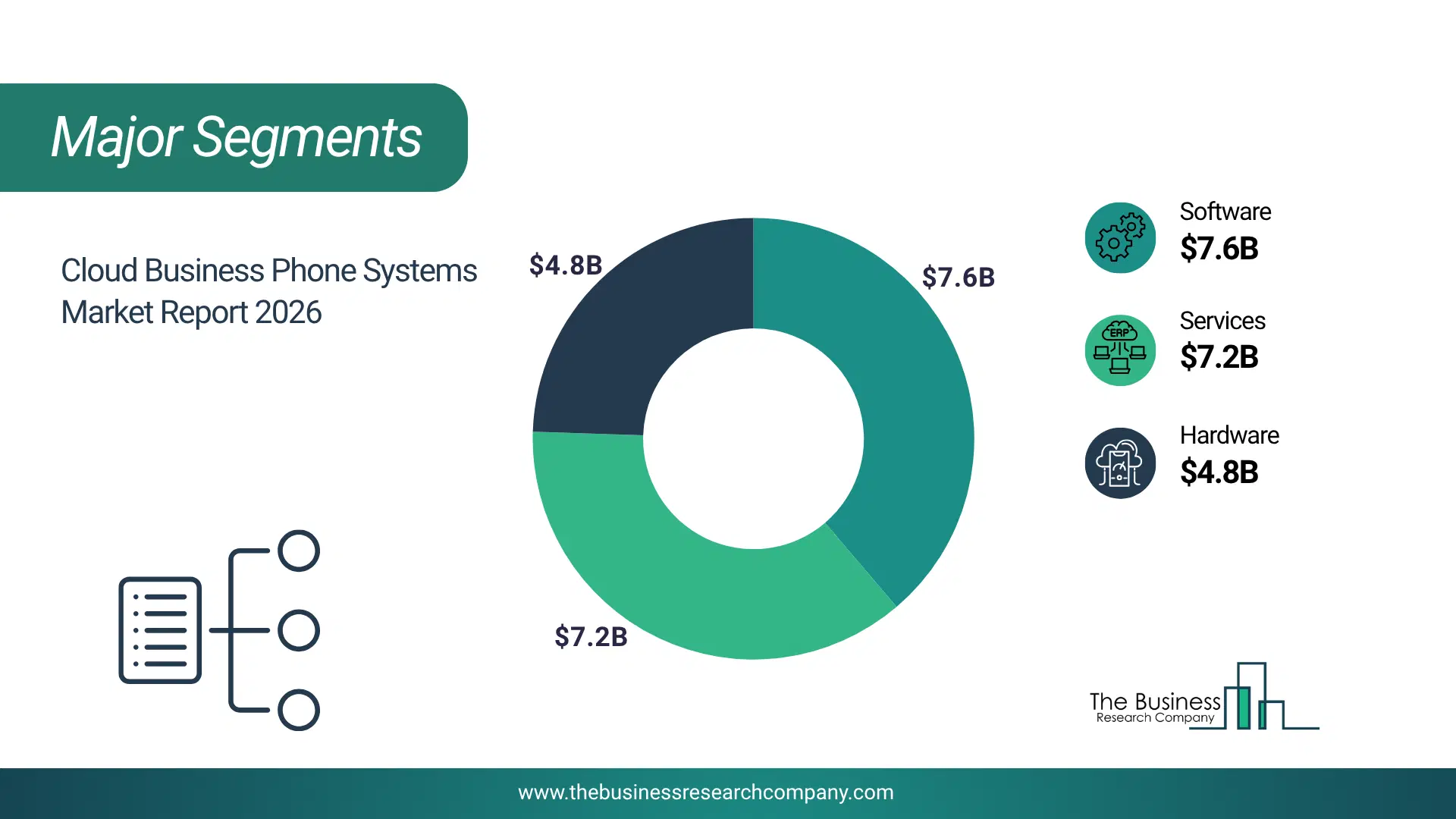
1) By Component: Software, Hardware, Services 2) By Deployment Model: Public Cloud, Private Cloud, Hybrid Cloud 3) By User Type: Small Enterprises, Medium Enterprises, Large Enterprises 4) By End-User: Banking, Finance Services And Insurances (BFSI), Healthcare, Retail, Information Technology (IT) And Telecommunications, Education, Government, Other End-Users Subsegments: 1) By Software: Hosted Private Branch Exchange, Voice Over Internet Protocol Software Applications, Unified Communications As A Service, Call Management Software, Collaboration And Messaging Tools 2) By Hardware: Internet Protocol Telephones, Headsets And Handsets, Gateways And Adapters, Network Routers And Network Switches, Conference Telephones 3) By Services: Installation And Deployment Services, Maintenance And Support Services, Cloud Migration Services, Training And Consulting Services, Managed Communication Services The top segments in the cloud business phone systems market will be: • Software will reach $7.59 billion by 2030. • Services will reach $7.19 billion by 2030. • Hardware will reach $4.7 billion by 2030.What Is The Driver Of The Cloud Business Phone Systems Market?
The increasing adoption of remote work is expected to propel the growth of the cloud business phone systems market going forward. Remote work refers to a work arrangement where employees perform their job duties from locations outside a traditional office, typically using digital communication and collaboration tools. The adoption of remote work is growing due to advancements in cloud-based technologies that enable seamless communication, collaboration, and access to organizational resources from any location. Cloud business phone systems support remote work by enabling employees to make, receive, and manage business calls from anywhere using internet-connected devices, ensuring seamless communication and collaboration. For instance, in March 2025, according to the U.S. Bureau of Labor Statistics, a US-based principal fact-finding agency, in 2024, 35.5 million people teleworked or worked from home for pay in the first quarter, an increase of 5.1 million from the previous year, accounting for 22.9% of the workforce, up from 19.6% a year earlier. Therefore, increasing adoption of remote work is driving the growth of the cloud business phone systems industry.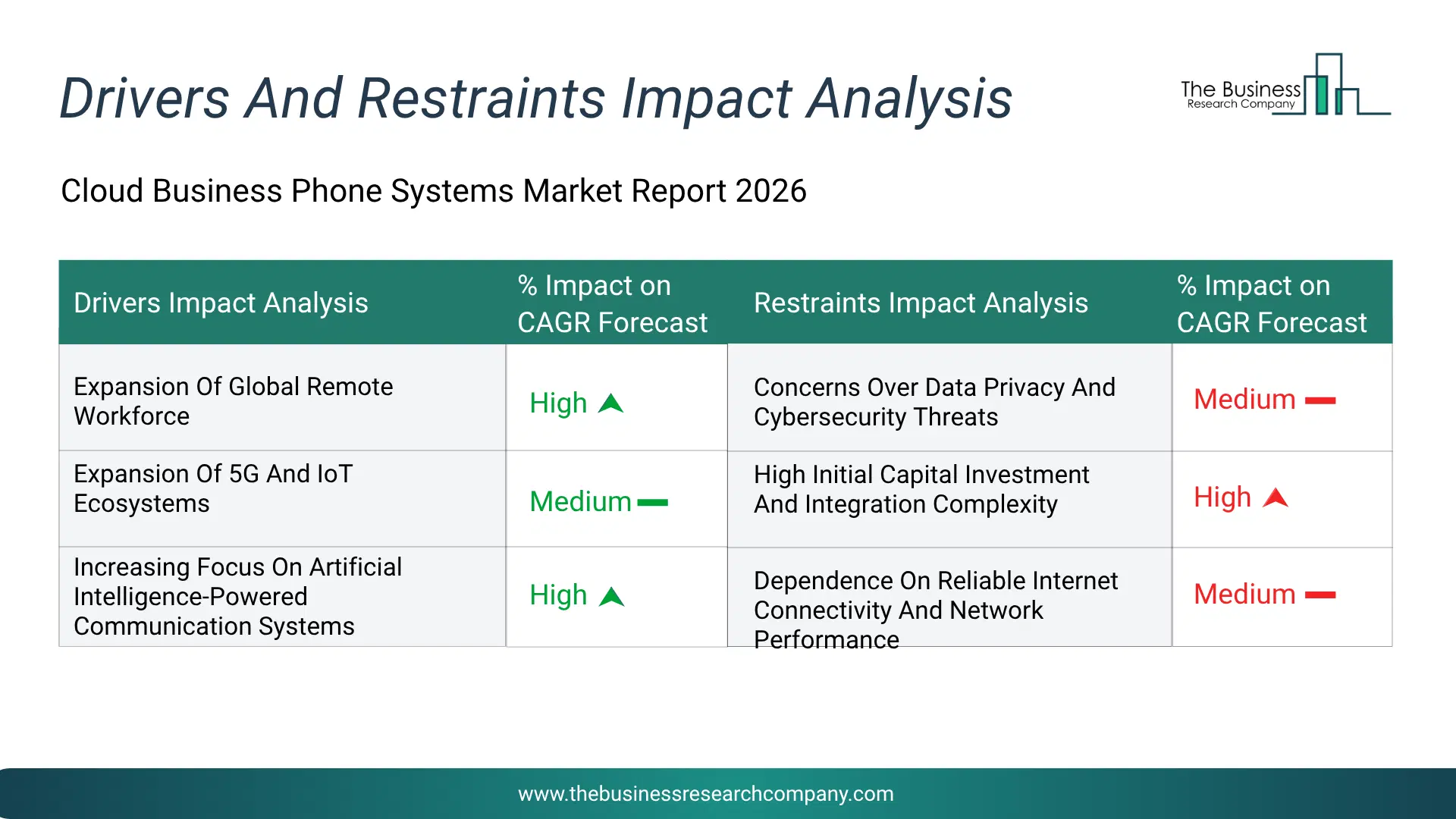
Infographic Chart Showing Key Market Drivers Analysis And Restraints For Cloud Business Phone Systems Market
The chart presents an impact analysis of key drivers and restraints, quantifying their relative influence on the market's growth rate and helping assess the balance between growth enablers and limiting factors. This chart offers a high-level perspective; the full report contains more detailed insights.
How Will The Drivers Impact Growth In The Global Cloud Business Phone Systems Market?
• Expansion Of Global Remote Workforce (High) – During the forecast period, the expansion of the global remote workforce is expected to become a key growth driver for the cloud business phone systems market by 2030. Organizations across industries are increasingly adopting remote and hybrid work models, creating strong demand for cloud -based communication solutions that enable employees to connect and collaborate from any location. Cloud business phone systems allow seamless integration of voice, messaging, video conferencing, and mobile applications, enabling consistent communication across distributed teams. These systems also reduce reliance on traditional on -premise telephony infrastructure while improving flexibility, scalability, and operational efficiency. As businesses continue to prioritize digital workplace strategies and workforce mobility, demand for cloud -based communication platforms is expected to rise significantly. • Expansion Of 5G And IoT Ecosystems (Medium) – During the forecast period, the expansion of 5g and iot ecosystems is expected to emerge as a major factor driving the growth of the cloud business phone systems market by 2030. The deployment of high-speed 5g networks is improving network reliability, reducing latency, and enhancing the performance of cloud-based voice and unified communication platforms. At the same time, the increasing adoption of iot-enabled devices in workplaces is creating new opportunities for integrated communication systems that support real-time data exchange and connected enterprise environments. Businesses are leveraging cloud telephony platforms to manage communication across smart devices, connected offices, and distributed operational systems. This technological convergence is accelerating the transition toward fully cloud-native communication infrastructures. • Increasing Focus On Artificial Intelligence-Powered Communication Systems (High) – During the forecast period, the increasing focus on artificial intelligence-powered communication systems is expected to act as a key growth catalyst for the cloud business phone systems market by 2030. Enterprises are increasingly integrating ai capabilities into cloud telephony platforms to improve call routing, automate customer interactions, generate conversation insights, and enhance decision-making processes. Ai-powered features such as voice recognition, automated transcription, predictive call analytics, and intelligent virtual assistants are helping organizations improve customer engagement and operational efficiency. These technologies also enable businesses to streamline support operations and deliver personalized communication experiences. As enterprises continue to invest in ai-driven communication platforms, demand for advanced cloud business phone systems is expected to expand.How Will The Restraints Impact Growth In The Global Cloud Business Phone Systems Market?
• Concerns Over Data Privacy And Cybersecurity Threats (Medium) – During the forecast period, the data privacy and cybersecurity concerns act as a major restraint for the cloud business phone systems market by limiting the confidence of organizations in migrating their communication infrastructure to the cloud. As these systems rely on internet connectivity for voice and data transmission, they are vulnerable to threats such as data breaches, hacking, and unauthorized access. Enterprises handling sensitive customer information face compliance challenges with evolving data protection regulations, such as gdpr and hipaa. Ensuring end-to-end encryption, secure authentication, and regular system monitoring adds to operational costs. Overall, persistent concerns about data security and privacy hinder large-scale adoption, particularly among security-sensitive industries such as finance, healthcare, and government sectors. • High Initial Capital Investment And Integration Complexity (High) – During the forecast period, the high initial capital investment and integration complexity act as significant restraints for the cloud business phone systems market by increasing the overall cost and technical burden of deployment. Transitioning from traditional telecommunication setups to cloud-based systems often requires substantial expenditure on infrastructure upgrades, software licenses, and employee training. Integrating new cloud solutions with existing it systems, legacy hardware, and third-party applications can be time-consuming and technically challenging. Smaller enterprises, in particular, face difficulties in justifying these costs given limited budgets and in-house expertise. Overall, the need for high upfront investment and complex integration processes slows down adoption, especially among cost-sensitive and resource-constrained organizations. • Dependence On Reliable Internet Connectivity And Network Performance (Medium) – During the forecast period, the cloud business phone systems rely heavily on stable internet connections for voice communication, call routing, and collaboration features. Network outages, bandwidth limitations, or poor connectivity can negatively impact call quality and business operations. Organizations operating in regions with unreliable internet infrastructure may experience service disruptions and reduced productivity. This dependence on network performance can limit adoption and create concerns regarding service reliability.Key Players In The Global Cloud Business Phone Systems Market
Major companies operating in the cloud business phone systems market are Microsoft Corporation, Cisco Systems Inc., Telefonaktiebolaget LM Ericsson, Zoom Video Communications Inc., Twilio Inc., Tata Communications Limited, NICE Ltd., RingCentral Inc., 8x8 Inc., Bandwidth Inc., Freshworks Inc., Nextiva Inc., Talkdesk Inc., Ooma Inc., Aircall SAS, OpenPhone Inc., Ozonetel Communications Private Limited, CloudTalk s.r.o., Dialpad Inc., Phone.com Inc., Simplicity VoIP, 3CX Ltd.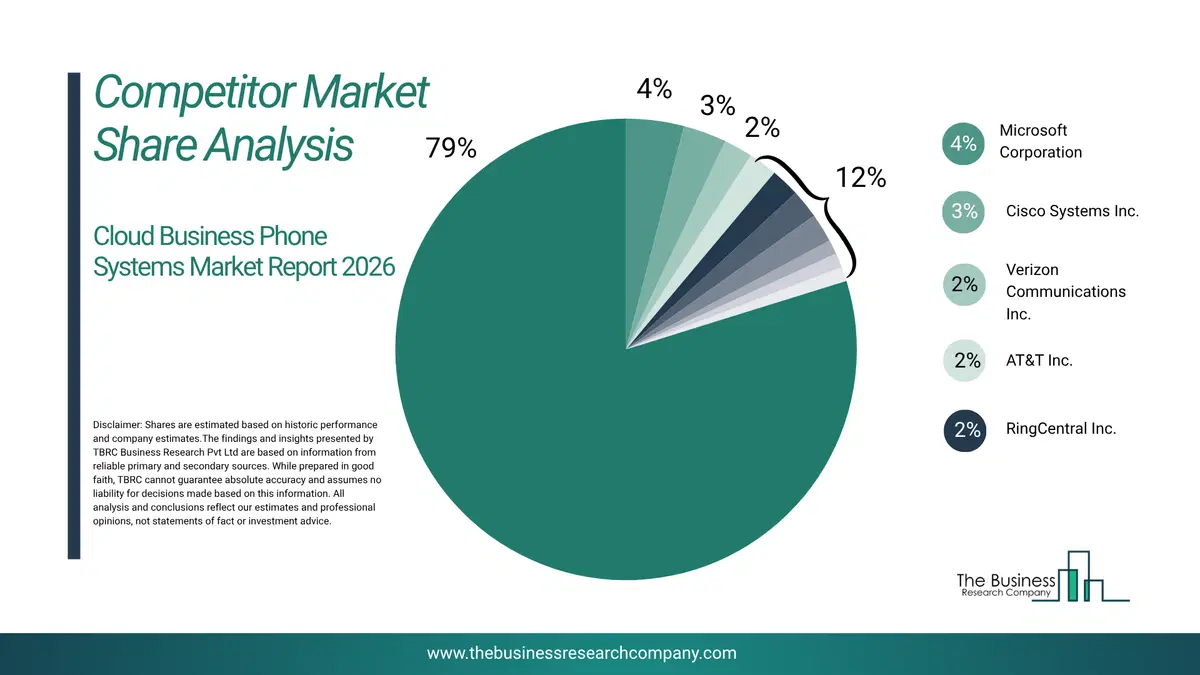
This chart is for illustrative purposes; the full report includes a detailed competitor analysis and comprehensive overview of the top 10 companies in the market.
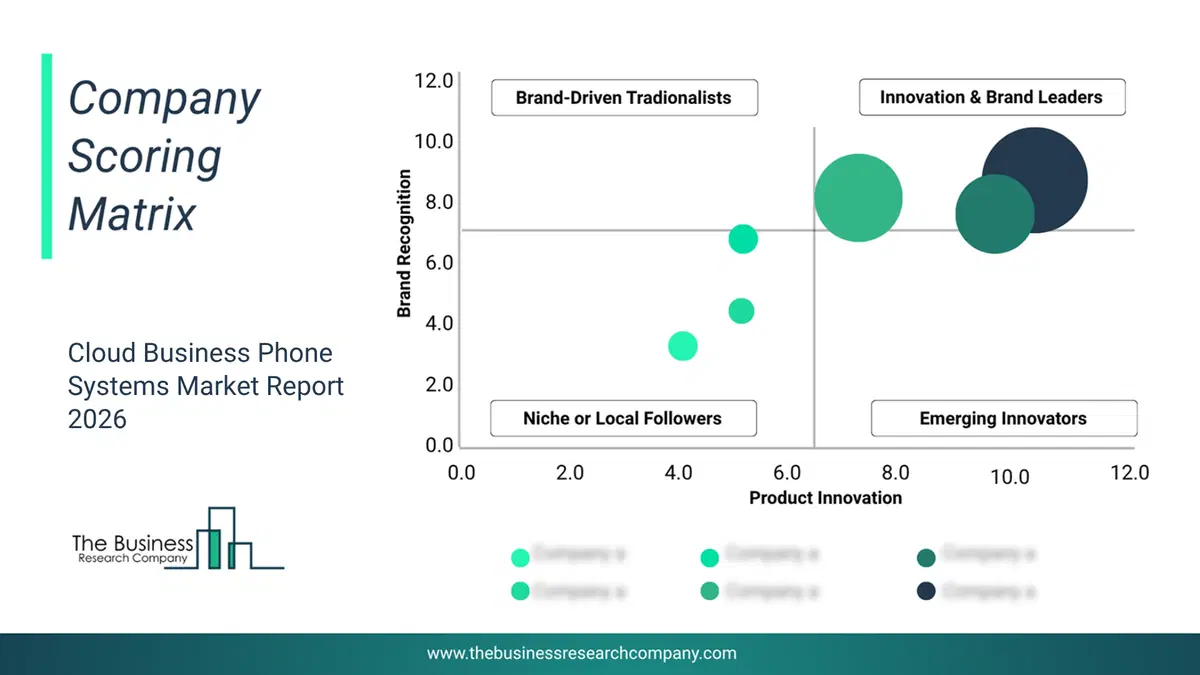
This chart maps companies by product innovation and brand strength, with bubble size indicating relative revenue, helping identify market leaders, challengers, and niche players. This is an illustrative chart; the full report provides a complete and accurate competitive analysis.
Global Cloud Business Phone Systems Market Trends and Insights
Major companies operating in the cloud business phone systems market are focusing on technological innovations, such as artificial intelligence (AI)-driven cloud technology, to enhance call quality, automate workflows, provide intelligent call routing, improve customer experience, and deliver advanced analytics for better decision-making. Artificial intelligence (AI)-driven cloud technology refers to the integration of artificial intelligence (AI) capabilities with cloud computing infrastructure to deliver smarter, more efficient, and automated digital services. For instance, in October 2024, Zoom Video Communications Inc., a US-based provider of a unified communications and collaboration platform, launched Zoom Phone in India. This system features an integrated artificial intelligence (AI) companion for automated call summaries, advanced noise suppression for clearer audio, and a local infrastructure model to meet data residency requirements. A potential challenge involves navigating varied telecommunications regulations across different regions.What Are Latest Mergers And Acquisitions In The Cloud Business Phone Systems Market?
In December 2024, Zadarma, a Bulgaria-based VoIP provider, acquired VoIPVoIP for an undisclosed amount. Through this acquisition, Zadarma aimed to strengthen its presence in the North American market by leveraging VoIPVoIP’s cloud business phone systems and VoIP solutions to expand its service offerings and enhance customer experience. VoIPVoIP is a US-based company that provides cloud business phone systems and VoIP services, enabling businesses to manage voice communications efficiently through cloud-based platforms.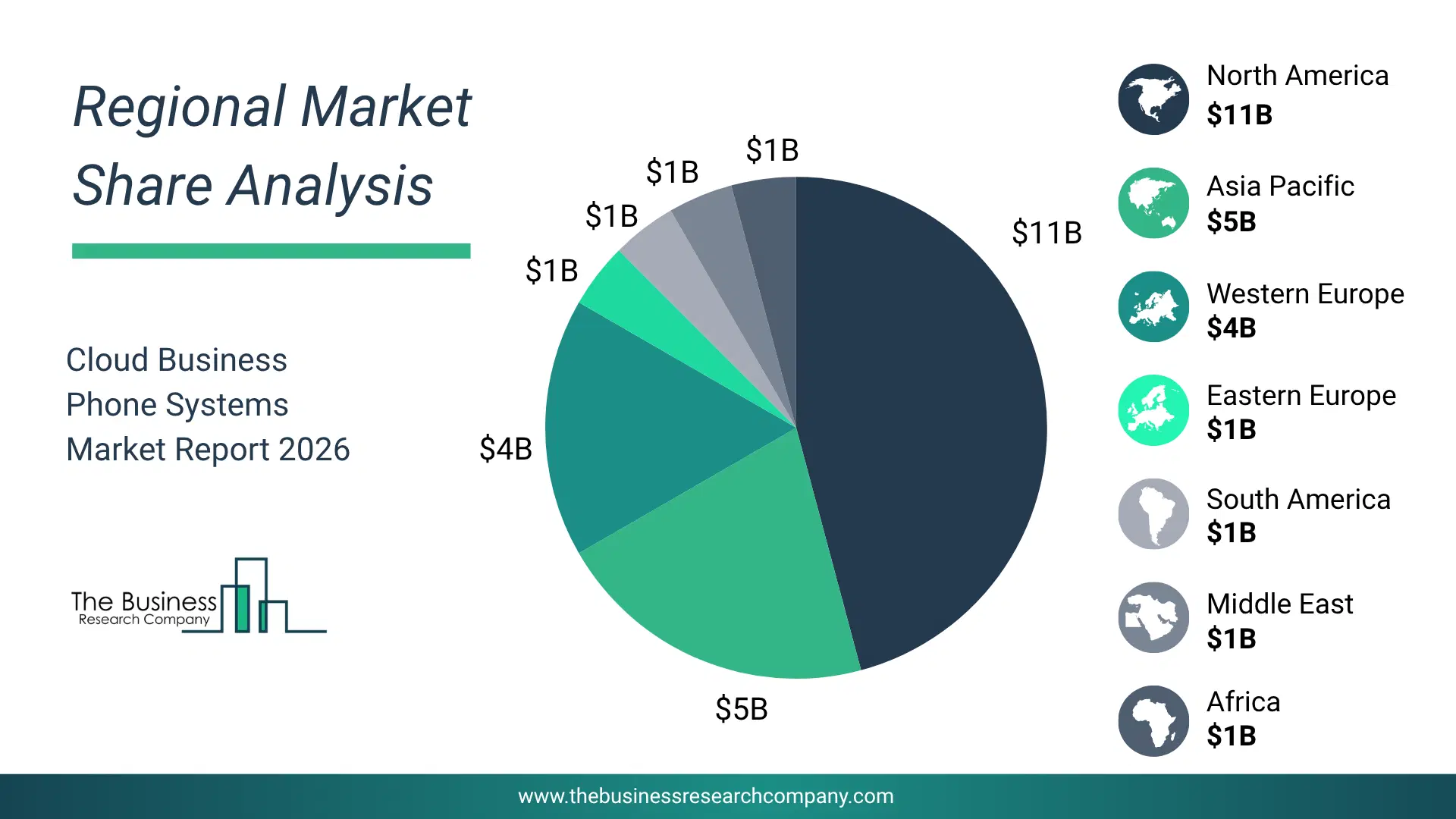
Regional Insights
North America was the largest region in the cloud business phone systems market in 2025. Asia-Pacific is expected to be the fastest-growing region in the forecast period. The regions covered in this market report are Asia-Pacific, South East Asia, Western Europe, Eastern Europe, North America, South America, Middle East, Africa. The countries covered in this market report are Australia, Brazil, China, France, Germany, India, Indonesia, Japan, Taiwan, Russia, South Korea, UK, USA, Canada, Italy, Spain.What Defines the Cloud Business Phone Systems Market?
The cloud business phone systems market consists of revenues earned by providing services such as number porting and provisioning services, customization services, white-label telephony services, latency and bandwidth assessment services, and compliance-as-a-service. The market value includes the value of related goods sold by the service provider or included within the service offering. The cloud business phone systems market also includes sales of softphones and mobile apps, WebRTC-based calling solutions, edge AI devices, dynamic bandwidth optimization tools, and AI noise suppression and voice enhancement tools. Values in this market are ‘factory gate’ values; that is, the value of goods sold by the manufacturers or creators of the goods, whether to other entities (including downstream manufacturers, wholesalers, distributors, and retailers) or directly to end customers. The value of goods in this market includes related services sold by the creators of the goods.How is Market Value Defined and Measured?
The market value is defined as the revenues that enterprises gain from the sale of goods and/or services within the specified market and geography through sales, grants, or donations in terms of the currency (in USD unless otherwise specified). The revenues for a specified geography are consumption values that are revenues generated by organizations in the specified geography within the market, irrespective of where they are produced. It does not include revenues from resales along the supply chain, either further along the supply chain or as part of other products.
This chart presents market attractiveness based on a quantitative evaluation of growth, competition, strategic alignment, and risk, offering a clear view of opportunity areas for decision-making. This chart is for illustrative purposes; the full report contains the complete analysis.

This chart highlights the Total Addressable Market (TAM) by estimating the maximum revenue opportunity using an assumption-driven approach, supporting strategic planning and opportunity sizing across markets. The chart is illustrative; the full report provides a more comprehensive analysis.
What Key Data and Analysis Are Included in the Cloud Business Phone Systems Market Report 2026?
The cloud business phone systems market research report is one of a series of new reports from The Business Research Company that provides market statistics, including industry global market size, regional shares, competitors with the market share, detailed market segments, market trends and opportunities, and any further data you may need to thrive in the cloud business phone systems industry. The market research report delivers a complete perspective of everything you need, with an in-depth analysis of the current and future state of the industry.Cloud Business Phone Systems Market Report Forecast Analysis
| Report Attribute | Details |
|---|---|
| Market Size Value In 2026 | $19.97 billion |
| Revenue Forecast In 2030 | $33.19 billion |
| Growth Rate | CAGR of 13.5% from 2026 to 2030 |
| Base Year For Estimation | 2025 |
| Actual Estimates/Historical Data | 2020-2025 |
| Forecast Period | 2026 - 2030 |
| Market Representation | Revenue in USD Billion and CAGR from 2026 to 2030 |
| Segments Covered | Component, Deployment Model, User Type, End-User |
| Regional Scope | Asia-Pacific, Western Europe, Eastern Europe, North America, South America, Middle East, Africa |
| Country Scope | The countries covered in the report are Australia, Brazil, China, France, Germany, India, ... |
| Key Companies Profiled | Microsoft Corporation, Cisco Systems Inc., Telefonaktiebolaget LM Ericsson, Zoom Video Communications Inc., Twilio Inc., Tata Communications Limited, NICE Ltd., RingCentral Inc., 8x8 Inc., Bandwidth Inc., Freshworks Inc., Nextiva Inc., Talkdesk Inc., Ooma Inc., Aircall SAS, OpenPhone Inc., Ozonetel Communications Private Limited, CloudTalk s.r.o., Dialpad Inc., Phone.com Inc., Simplicity VoIP, 3CX Ltd. |
| Customization Scope | Request for Customization |
| Pricing And Purchase Options | Explore Purchase Options |