

Cloud Computing In Education Market Report 2026
Global Outlook – By Service Model (Software As A Service (SaaS), Platform As A Service (PaaS), Infrastructure-As-A-Service), By Deployment Type (Public Cloud, Private Cloud, Hybrid Cloud), By Delivery Mode (Online, In-Person, Hybrid), By Application (Learning Management Systems (LMS), Virtual Classrooms, Collaboration Tools, Administrative Management, Assessment And Evaluation Tools), By End-User (Higher Education Institutions, K-12 Educational Institutions, Training And Certification Providers) – Market Size, Trends, Strategies, and Forecast to 2030
Cloud Computing In Education Market Overview
• Cloud Computing In Education market size has reached to $42.76 billion in 2025 • Expected to grow to $108.83 billion in 2030 at a compound annual growth rate (CAGR) of 20.5% • Growth Driver: Growing Demand For Remote And Hybrid Learning Drives The Market Growth Due To Flexibility And Accessibility • Market Trend: Advancements In Cloud-Based Education Solutions For Digital Transformation • North America was the largest region in 2025 and Asia-Pacific is the fastest growing region.What Is Covered Under Cloud Computing In Education Market?
Cloud computing in education refers to using cloud-based technologies and services to deliver educational resources, tools, and applications over the internet. It allows students, educators, and institutions to access learning materials, collaborate, and store data without physical infrastructure, enabling flexible, scalable, and cost-effective learning environments. Cloud computing supports various educational activities, from online courses and virtual classrooms to administrative management and data analysis. The main types of the service model of cloud computing in education are software as a service (SaaS), platform as a service (PaaS), and infrastructure as a service. Software as a service (SaaS) enhances cloud computing in education by offering cloud-based apps like learning management systems, virtual classrooms, and collaboration tools, enabling easy access, scalability, and reduced IT maintenance. The deployment types encompassed are public cloud, private cloud, and hybrid cloud, with various delivery modes such as online, in-person, and hybrid. It is applicable in several applications including learning management systems (LMS), virtual classrooms, collaboration tools, administrative management, assessment and evaluation tools, and is used by various end users such as higher education institutions, K-12 educational institutions, and training and certification providers.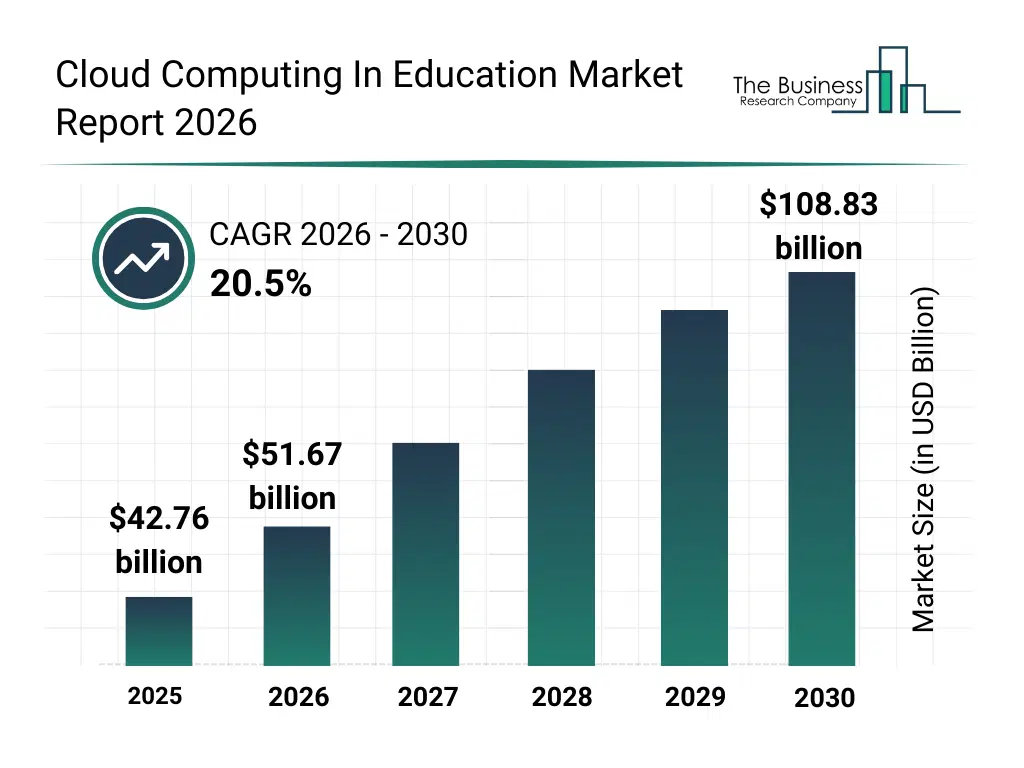
What Is The Cloud Computing In Education Market Size and Share 2026?
The cloud computing in education market size has grown exponentially in recent years. It will grow from $42.76 billion in 2025 to $51.67 billion in 2026 at a compound annual growth rate (CAGR) of 20.8%. The growth in the historic period can be attributed to growth of online education platforms, early cloud adoption by universities, increasing internet accessibility, demand for remote learning solutions, digitization of academic content.What Is The Cloud Computing In Education Market Growth Forecast?
The cloud computing in education market size is expected to see exponential growth in the next few years. It will grow to $108.83 billion in 2030 at a compound annual growth rate (CAGR) of 20.5%. The growth in the forecast period can be attributed to AI powered personalized education, expansion of hybrid learning models, growth in global online certifications, increasing education data analytics usage, rising cloud security investments. Major trends in the forecast period include cloud based learning management systems, virtual classroom adoption, scalable education IT infrastructure, collaborative cloud learning tools, data driven academic analytics.
Global Cloud Computing In Education Market Segmentation
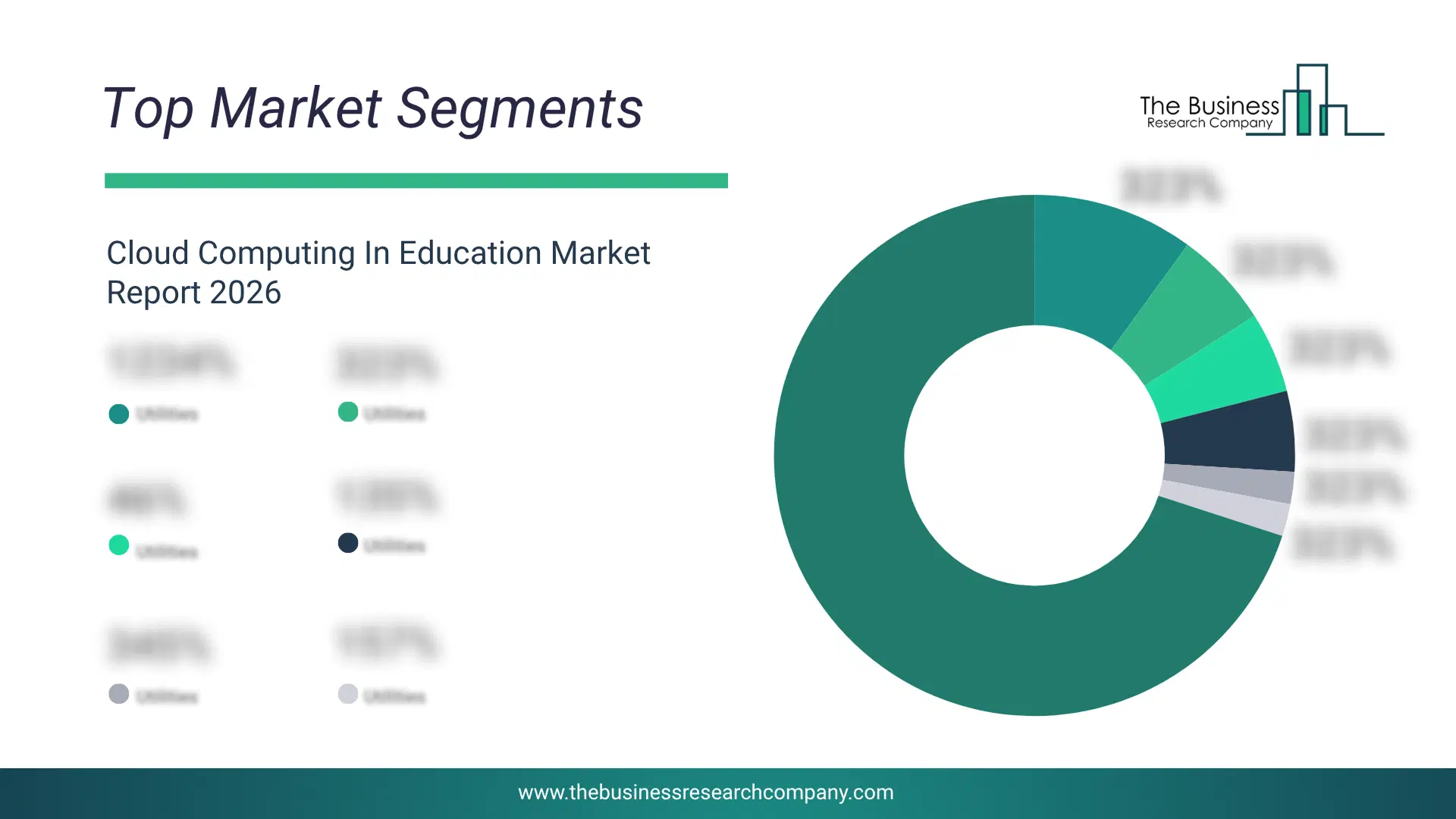
1) By Service Model: Software As A Service (SaaS), Platform As A Service (PaaS), Infrastructure-As-A-Service 2) By Deployment Type: Public Cloud, Private Cloud, Hybrid Cloud 3) By Delivery Mode: Online, In-Person, Hybrid 4) By Application: Learning Management Systems (LMS), Virtual Classrooms, Collaboration Tools, Administrative Management, Assessment And Evaluation Tools 5) By End-User: Higher Education Institutions, K-12 Educational Institutions, Training And Certification Providers Subsegments: 1) By Software As A Service (SaaS): Virtual Classroom Solutions, Student Information Systems (SIS), Collaboration Tools And Communication Platforms, Assessment And Evaluation Tools 2) By Platform As A Service (PaaS): Application Development And Hosting Platforms, Data Analytics And Big Data Solutions, Artificial Intelligence And Machine Learning Platforms, Cloud-Based Database Solutions, Integration And Middleware Solutions 3) By Infrastructure As A Service (IaaS): Cloud Storage And Backup Solutions, Cloud Hosting And Compute Resources, Virtualization Platforms, Network Infrastructure SolutionsWhat Is The Driver Of The Cloud Computing In Education Market?
The increase in demand for remote and hybrid learning is expected to propel the growth of cloud computing in the education market going forward. Remote learning is a fully online education model where students and instructors interact virtually, while hybrid learning combines online and in-person instruction, offering flexibility in how lessons are delivered and attended. The rise of remote and hybrid learning is driven by their flexibility, enabling students to learn at their own pace and from anywhere, accommodating varied schedules. Cloud computing is helpful for remote and hybrid learning to reduce infrastructure costs, geographical barriers, and scheduling constraints in education by improving accessibility and flexibility through digital solutions. For instance, in September 2024, according to VdoCipher, a US-based video security and streaming solutions company, in 2022, 46.3% of learners engaged in both online and offline learning, while 38.8% preferred online education. By 2023, the preference for online learning grew to 47.8%, with a significant rise in interest in AI-guided education. Therefore, the increasing demand for remote and hybrid learning drives cloud computing in the education market.Key Players In The Global Cloud Computing In Education Market
Major companies operating in the cloud computing in education market are Google LLC, Microsoft Corporation, Verizon Communications Inc., Dell Technologies Inc., Amazon Web Services Inc., IBM Corporation Co Ltd., Oracle Corporation, SAP SE, Salesforce Inc., NEC Corporation, Tencent Cloud Ltd., Adobe Systems Inc., VMware Inc., Netapp Inc., Snowflake Inc., Rackspace Technology Inc., Ellucian Company L.P., Ethio Telecom, Pluralsight LLC, Docebo Inc., Bromcom Computers Plc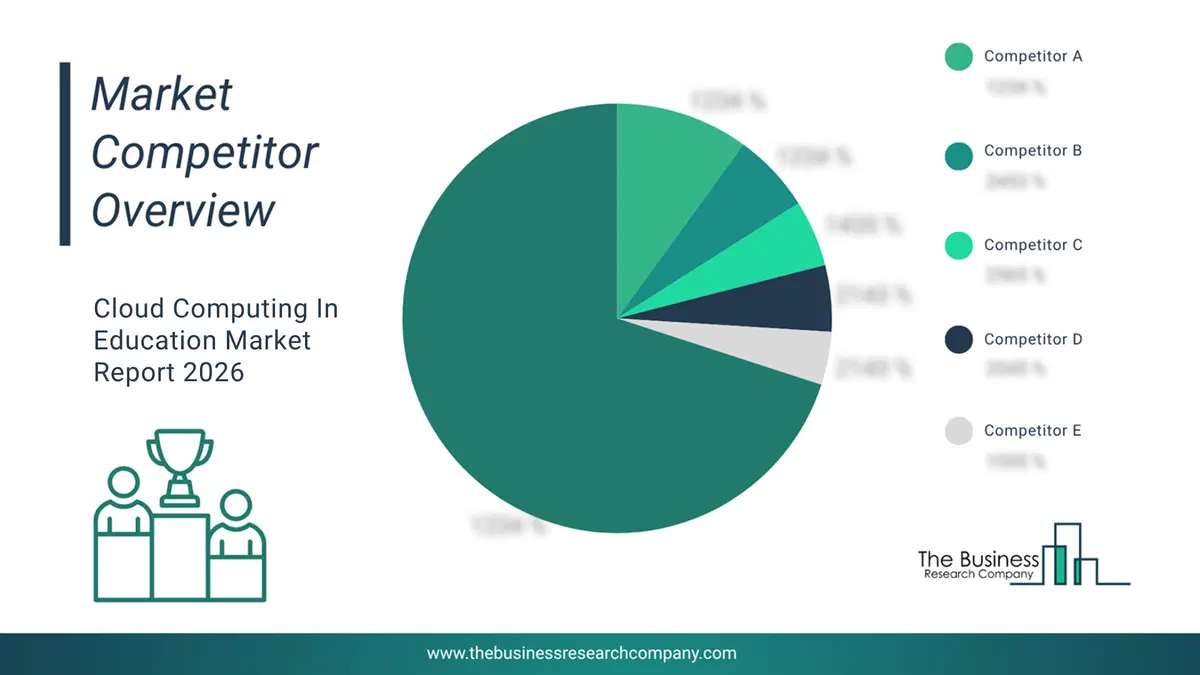
This chart is for illustrative purposes; the full report includes a detailed competitor analysis and comprehensive overview of the top 10 companies in the market.
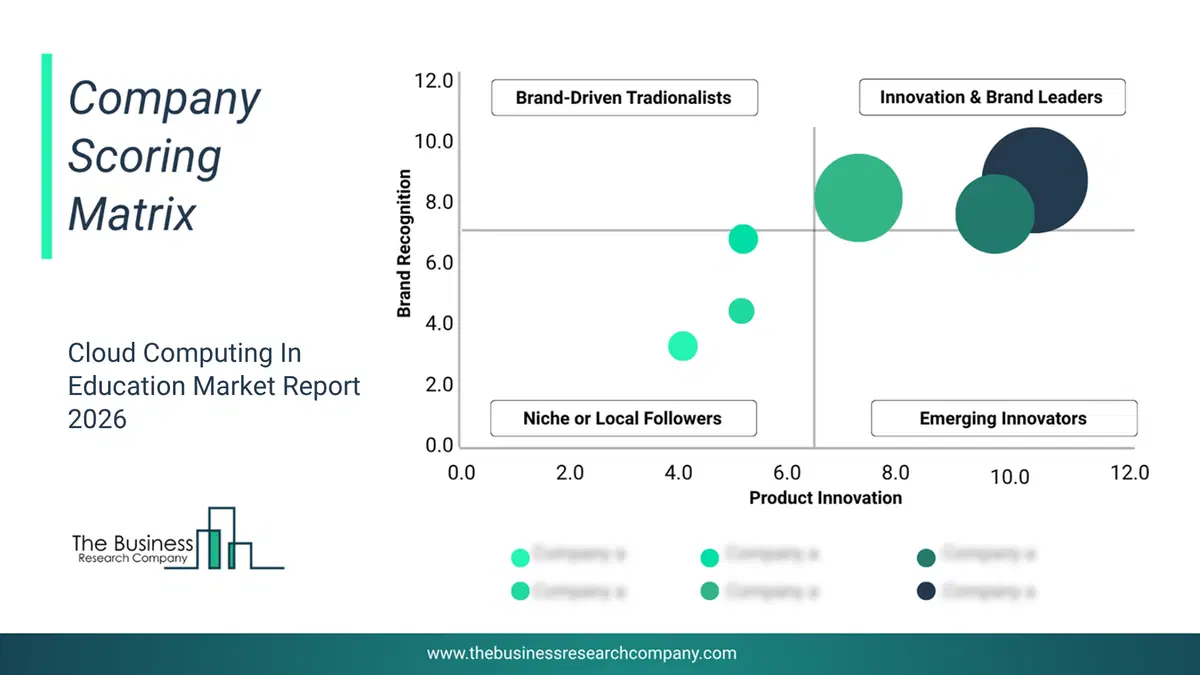
This chart maps companies by product innovation and brand strength, with bubble size indicating relative revenue, helping identify market leaders, challengers, and niche players. This is an illustrative chart; the full report provides a complete and accurate competitive analysis.
Global Cloud Computing In Education Market Trends and Insights
Major companies operating in cloud computing in education market are focusing on developing advanced solutions such as learning management software (LMS) to support personalized education through data-driven insights and collaborative tools. Learning management software (LMS) is a digital platform that enables the delivery, tracking, and management of educational content, courses, and training programs. It allows instructors to organize materials while learners access resources, complete assignments, and monitor their progress. For instance, in March 2025, Ethio Telecom, an Ethiopia-based telecommunications company, launched a cloud-based education management system (EMS) as part of its seven new enterprise solutions to drive digital transformation in Ethiopia. The EMS centralizes school operations, automating tasks like student record management and grading while enhancing communication between students, parents, and teachers. It also integrates telebirr for seamless fee payments, improving efficiency and engagement in educational institutions.What Are Latest Mergers And Acquisitions In The Cloud Computing In Education Market?
In October 2024, Bain Capital L.P., a US-based investment company, acquired PowerSchool Holdings Inc. for US$ 5.6 billion. With this acquisition, Bain Capital aims to accelerate innovation, particularly around PowerSchool’s generative-AI initiatives (such as PowerBuddy), and to scale its global reach in delivering cloud-based K-12 education software. PowerSchool Holdings Inc. is a US-based provider of cloud-native SaaS for K–12 education that offers cloud computing in education.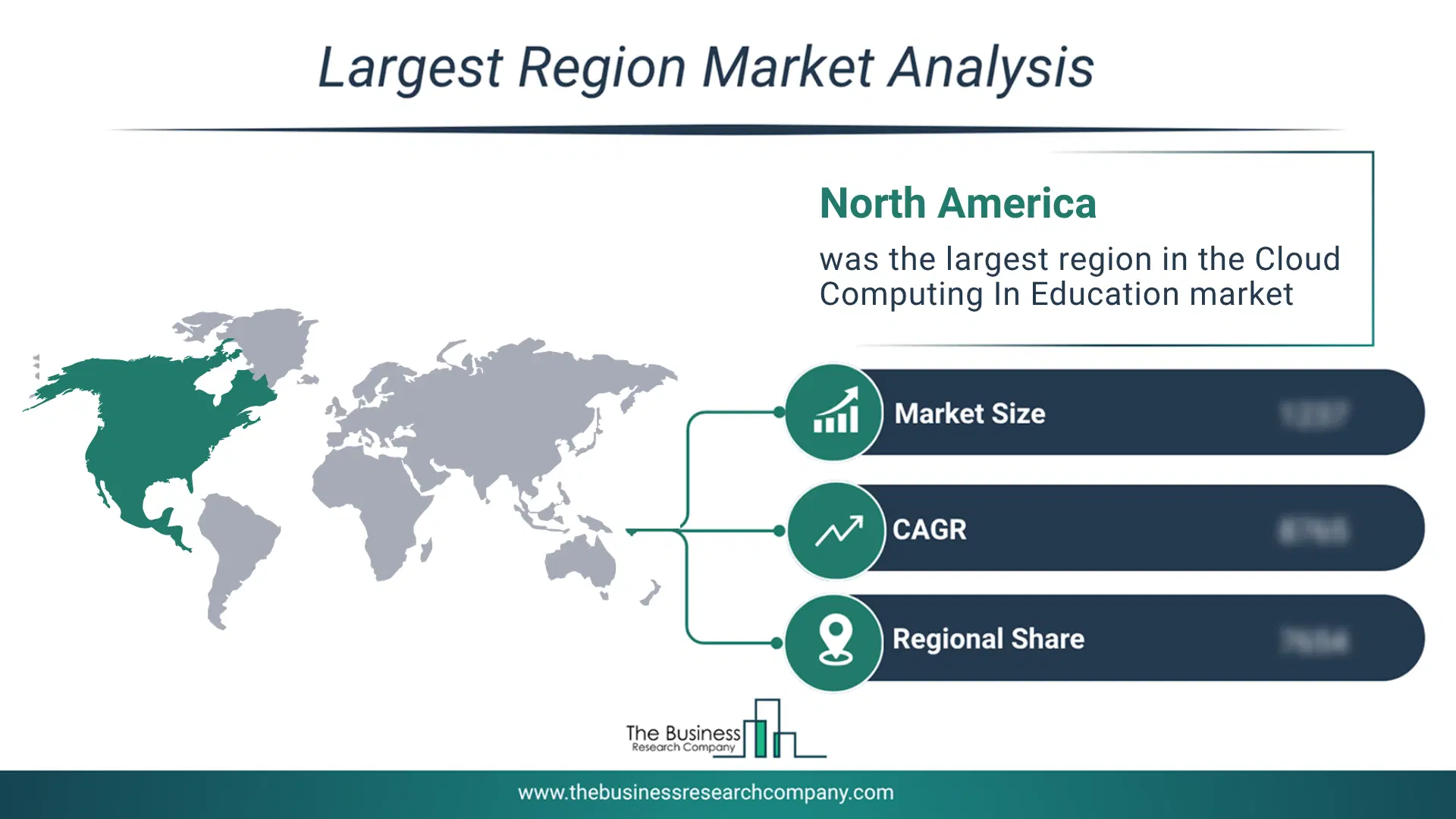
Regional Insights
North America was the largest region in the cloud computing in education market in 2025. Asia-Pacific is expected to be the fastest-growing region in the forecast period. The regions covered in this market report are Asia-Pacific, South East Asia, Western Europe, Eastern Europe, North America, South America, Middle East, Africa. The countries covered in this market report are Australia, Brazil, China, France, Germany, India, Indonesia, Japan, Taiwan, Russia, South Korea, UK, USA, Canada, Italy, Spain.What Defines the Cloud Computing In Education Market?
The cloud computing in education market includes revenues earned by entities through data storage and backup, remote access and mobility, data analytics and insights. The market value includes the value of related goods sold by the service provider or included within the service offering. Only goods and services traded between entities or sold to end consumers are included.How is Market Value Defined and Measured?
The market value is defined as the revenues that enterprises gain from the sale of goods and/or services within the specified market and geography through sales, grants, or donations in terms of the currency (in USD unless otherwise specified). The revenues for a specified geography are consumption values that are revenues generated by organizations in the specified geography within the market, irrespective of where they are produced. It does not include revenues from resales along the supply chain, either further along the supply chain or as part of other products.
This chart presents market attractiveness based on a quantitative evaluation of growth, competition, strategic alignment, and risk, offering a clear view of opportunity areas for decision-making. This chart is for illustrative purposes; the full report contains the complete analysis.

This chart highlights the Total Addressable Market (TAM) by estimating the maximum revenue opportunity using an assumption-driven approach, supporting strategic planning and opportunity sizing across markets. The chart is illustrative; the full report provides a more comprehensive analysis.
What Key Data and Analysis Are Included in the Cloud Computing In Education Market Report 2026?
The cloud computing in education market research report is one of a series of new reports from The Business Research Company that provides market statistics, including industry global market size, regional shares, competitors with the market share, detailed market segments, market trends and opportunities, and any further data you may need to thrive in the cloud computing in education industry. The market research report delivers a complete perspective of everything you need, with an in-depth analysis of the current and future state of the industry.Cloud Computing In Education Market Report Forecast Analysis
| Report Attribute | Details |
|---|---|
| Market Size Value In 2026 | $51.67 billion |
| Revenue Forecast In 2030 | $108.83 billion |
| Growth Rate | CAGR of 20.5% from 2026 to 2030 |
| Base Year For Estimation | 2025 |
| Actual Estimates/Historical Data | 2020-2025 |
| Forecast Period | 2026 - 2030 |
| Market Representation | Revenue in USD Billion and CAGR from 2026 to 2030 |
| Segments Covered | Service Model, Deployment Type, Delivery Mode, Application, End-User |
| Regional Scope | Asia-Pacific, Western Europe, Eastern Europe, North America, South America, Middle East, Africa |
| Country Scope | The Countries Covered In This Market Report Are Australia, Brazil, China, France, Germany, India, Indonesia, Japan, Taiwan, Russia, South Korea, Uk, Usa, Canada, Italy, Spain. |
| Key Companies Profiled | Google LLC, Microsoft Corporation, Verizon Communications Inc., Dell Technologies Inc., Amazon Web Services Inc., IBM Corporation Co Ltd., Oracle Corporation, SAP SE, Salesforce Inc., NEC Corporation, Tencent Cloud Ltd., Adobe Systems Inc., VMware Inc., Netapp Inc., Snowflake Inc., Rackspace Technology Inc., Ellucian Company L.P., Ethio Telecom, Pluralsight LLC, Docebo Inc., Bromcom Computers Plc |
| Customization Scope | Request for Customization |
| Pricing And Purchase Options | Explore Purchase Options |