
Cloud Data Center Market Report 2026
Global Outlook – By Service Model (Infrastructure As A Service Model, Platform As A Service-Model, Software As A Service-Model), By Deployment Model (Public, Private, Hybrid), By Organization Size (Small And Medium Enterprise, Large Enterprises), By End-Users (Banking, Financial Services And Insurance (BFSI), Colocation, Energy, Government, Healthcare, Manufacturing, Information Technology (IT) And Telecommunication, Other End-Users) – Market Size, Trends, Strategies, and Forecast to 2030
Cloud Data Center Market Overview
• Cloud Data Center market size has reached to $30.96 billion in 2025 • Expected to grow to $59.55 billion in 2030 at a compound annual growth rate (CAGR) of 14% • Growth Driver: Cloud Services Fuel Expansion In The Cloud Data Center Market • Market Trend: Cyber Cloud Data Centers Redefining Security And Efficiency In The Market • North America was the largest region in 2025 and Asia-Pacific is the fastest growing region.Market Gains By 2030 – Top Opportunities By Segment
Market Gain identifies the most promising market opportunities by highlighting the segments or products expected to generate the highest incremental revenue growth over the next five years.
What Is Covered Under Cloud Data Center Market?
Cloud data centers refer to centralized facilities equipped with a network of servers, storage, and computing resources that are accessed remotely over the Internet. They provide scalable and on-demand computing services, allowing users to store, process, and manage data and applications without the need for on-site physical infrastructure. The main types of cloud data centers are infrastructure as a service model, platform as a service model, and software as a service model. Infrastructure as a Service is a cloud computing service category that delivers virtualized computing resources via the Internet. These are deployed in public, private, and hybrid deployment models. These are used by various organizational sizes, including small and medium enterprises and large enterprises, and are used by several end-users, such as banking, financial services and insurance (BFSI), colocation, energy, government, healthcare, manufacturing, information technology (IT) and telecommunication, and others.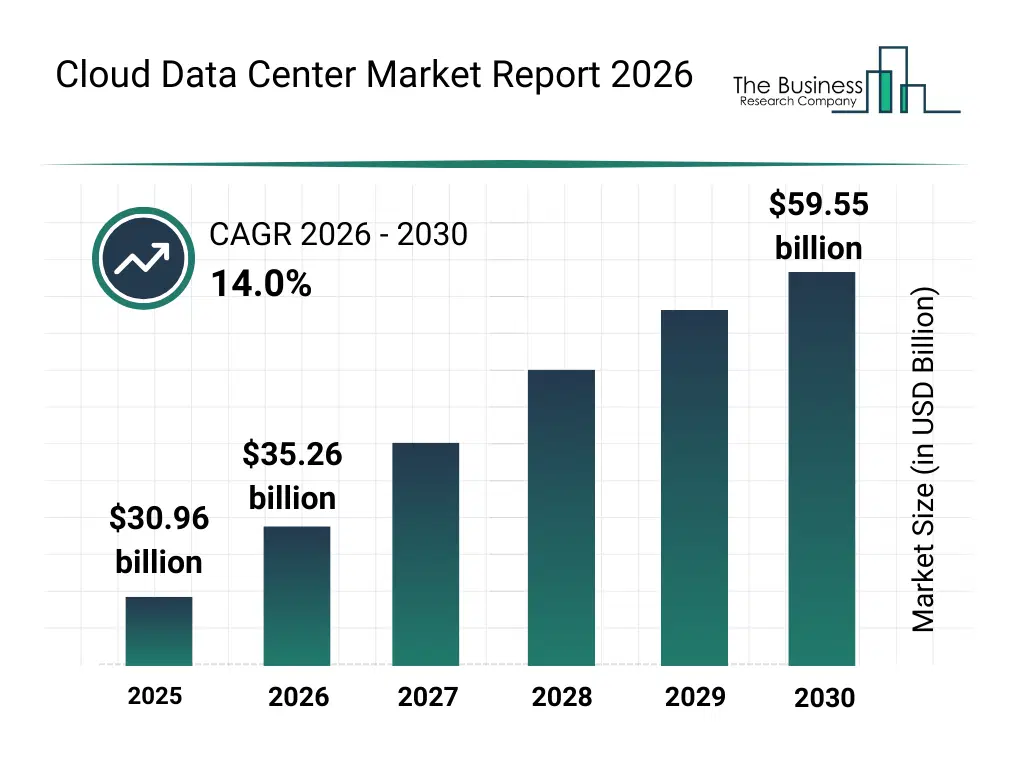
What Is The Cloud Data Center Market Size and Share 2026?
The cloud data center market size has grown rapidly in recent years. It will grow from $30.96 billion in 2025 to $35.26 billion in 2026 at a compound annual growth rate (CAGR) of 13.9%. The growth in the historic period can be attributed to growing demand for digital services, adoption of cloud-based solutions by enterprises, expansion of large-scale data centers, increasing focus on IT cost optimization, rising need for remote data access.What Is The Cloud Data Center Market Growth Forecast?
The cloud data center market size is expected to see rapid growth in the next few years. It will grow to $59.55 billion in 2030 at a compound annual growth rate (CAGR) of 14.0%. The growth in the forecast period can be attributed to growth in hybrid and multi-cloud adoption, advancements in data center networking technologies, increasing investments in sustainable and green data centers, rising adoption of enterprise SaaS solutions, expansion of IaaS and PaaS offerings. Major trends in the forecast period include cloud infrastructure scalability, multi-cloud and hybrid deployments, energy-efficient data center operations, disaster recovery and business continuity, advanced collaboration and enterprise applications.
Global Cloud Data Center Market Segmentation
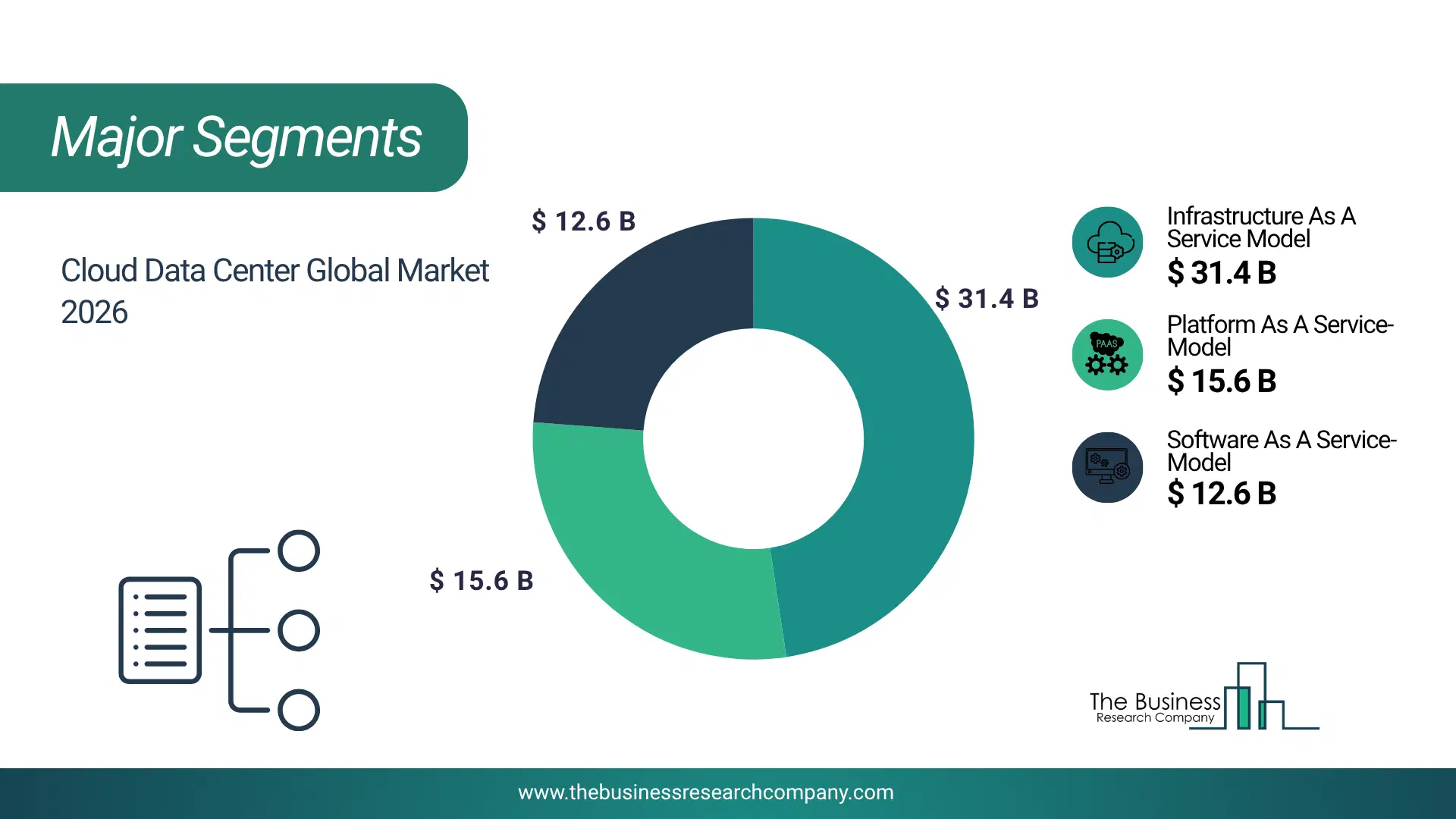
1) By Service Model: Infrastructure As A Service Model, Platform As A Service-Model, Software As A Service-Model 2) By Deployment Model: Public, Private, Hybrid 3) By Organization Size: Small And Medium Enterprise, Large Enterprises 4) By End-Users: Banking, Financial Services And Insurance (BFSI), Colocation, Energy, Government, Healthcare, Manufacturing, Information Technology (IT) And Telecommunication, Other End-Users Subsegments: 1) By Infrastructure As A Service (IaaS): Compute, Storage, Networking 2) By Platform As A Service (PaaS): Development Tools, Middleware, Database Management 3) By Software As A Service (SaaS): Enterprise Applications, Collaboration Tools, Content Management Systems, Communication And Email Services The top segments in the cloud data center market will be: • Infrastructure As A Service Model will reach $31.39 billion by 2030. • Platform As A Service-Model will reach $15.57 billion by 2030. • Software As A Service-Model will reach $12.6 billion by 2030.What Is The Driver Of The Cloud Data Center Market?
The increase in demand for cloud services is expected to propel the growth of the cloud data center market going forward. Cloud services encompass a wide range of computing resources and applications that are readily available, on-demand, and delivered via the Internet. The demand for cloud services is increasing due to their scalability, accessibility, and security benefits. A cloud data center supports cloud services, offering the essential infrastructure and resources for hosting, processing, and delivering on-demand computing capabilities via the Internet. For instance, in December 2023, according to the European Commission (EC), a Belgium-based executive body of the European Union (EU), 42.5% of enterprises in the European Union (EU) bought cloud computing services. Primarily utilized for email, file storage, and office software, this marked a 4.2% increase compared to 2021. Therefore, the increase in demand for cloud services is driving the growth of the cloud data center industry.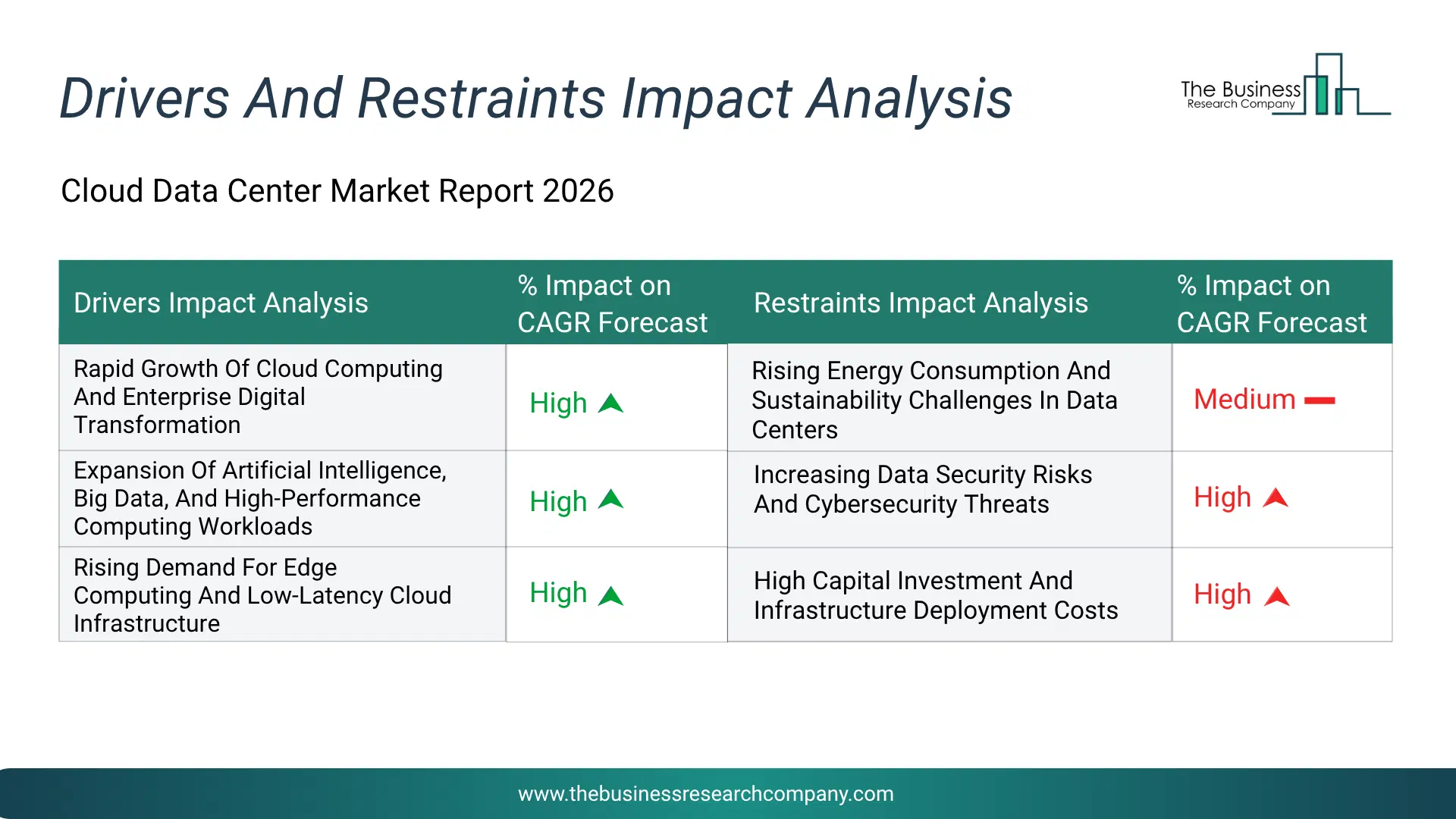
Infographic Chart Showing Key Market Drivers Analysis And Restraints For Cloud Data Center Market
The chart presents an impact analysis of key drivers and restraints, quantifying their relative influence on the market's growth rate and helping assess the balance between growth enablers and limiting factors. This chart offers a high-level perspective; the full report contains more detailed insights.
How Will The Drivers Impact Growth In The Global Cloud Data Center Market?
• Rapid Growth Of Cloud Computing And Enterprise Digital Transformation (High) – During the forecast period, the rapid growth of cloud computing and enterprise digital transformation is expected to become a key growth driver for the cloud data center market by 2030. The increasing adoption of cloud computing across enterprises is a major factor supporting the expansion of the cloud data center market. Organizations are shifting workloads from conventional on -premise infrastructure to cloud platforms to enhance scalability, operational flexibility, and cost efficiency. This transition is driving strong demand for hyperscale cloud data centers capable of supporting extensive computing and storage requirements. As companies continue to advance digital transformation strategies, the need for resilient and scalable cloud infrastructure is expected to grow significantly. • Expansion Of Artificial Intelligence, Big Data, And High-Performance Computing Workloads (High) – During the forecast period, the expansion of artificial intelligence, big data, and high-performance computing workloads is expected to emerge as a major factor driving the growth of the cloud data center market by 2030. The rapid advancement of ai, machine learning, and big data analytics is generating substantial demand for high-performance cloud data center infrastructure. Ai model training and real-time analytics require considerable processing power, extensive storage capacity, and low-latency networking environments. Cloud data centers provide the necessary computational resources to support these workloads while allowing organizations to scale infrastructure dynamically. As ai adoption continues to accelerate across industries, demand for specialized gpu-enabled data centers is expected to increase. • Rising Demand For Edge Computing And Low-Latency Cloud Infrastructure (High) – During the forecast period, the rising demand for edge computing and low-latency cloud infrastructure is expected to act as a key growth catalyst for the cloud data center market by 2030. The growing adoption of iot devices, autonomous technologies, and real-time digital services is accelerating the need for edge computing infrastructure. Edge-enabled cloud data centers enable data processing closer to end users, reducing latency and improving overall application performance. Industries including autonomous transportation, smart cities, and industrial automation increasingly depend on distributed cloud infrastructure to process large volumes of data efficiently. This trend is expanding the global presence and network coverage of cloud data center facilities.How Will The Restraints Impact Growth In The Global Cloud Data Center Market?
• Rising Energy Consumption And Sustainability Challenges In Data Centers (Medium) – During the forecast period, the energy consumption and environmental concerns are becoming critical challenges for cloud data center operators. Large-scale facilities require significant electricity for servers, cooling systems, and network equipment. Governments and environmental organizations are placing pressure on data center providers to adopt renewable energy sources and energy-efficient designs. While sustainability initiatives are improving efficiency, high power costs and environmental regulations may slow expansion in certain regions. • Increasing Data Security Risks And Cybersecurity Threats (High) – During the forecast period, the growing reliance on cloud infrastructure has increased exposure to cybersecurity threats, including data breaches, ransomware attacks, and unauthorized access to sensitive enterprise information. Cloud data centers host vast amounts of critical business and customer data, making them attractive targets for cybercriminals. As organizations migrate more workloads to the cloud, ensuring robust security frameworks, encryption protocols, and compliance mechanisms becomes essential. Security concerns may slow cloud adoption among highly regulated industries such as finance, healthcare, and government sectors. • High Capital Investment And Infrastructure Deployment Costs (High) – During the forecast period, the high capital investment and infrastructure deployment costs act as a restraint for the cloud data center market by increasing the financial burden on service providers and new entrants. Building hyperscale data centers requires significant spending on land acquisition, construction, servers, networking equipment, and advanced cooling systems. Additionally, ongoing investments are needed for upgrades, redundancy systems, and capacity expansion to meet growing demand. These high upfront and operational costs limit market entry for smaller players and slow down expansion in cost-sensitive regions.Key Players In The Global Cloud Data Center Market
Major companies operating in the cloud data center market are Alphabet Inc.; Microsoft Corporation; Amazon Web Services Inc.; International Business Machines Corporation IBM; Oracle Corporation; Tencent Cloud; Alibaba Cloud; Google Cloud; Equinix Inc.; Lumen Technologies; KDDI Telehouse; China Unicom; China Telecom Americas Inc.; Cyxtera Technologies Inc.; QTS Realty Trust Inc.; Flexential Corp.; AT&T Inc.; OVHcloud; CoreWeave; NTT Global Data Centers; GDS Holdings; Kamatera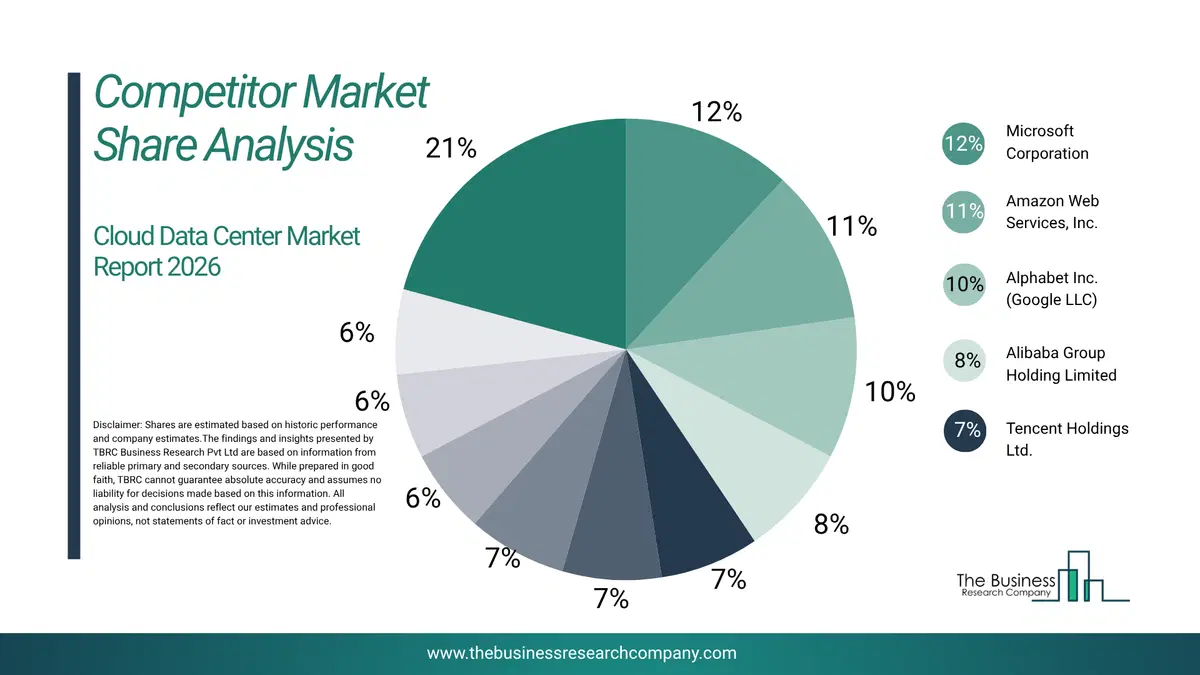
This chart is for illustrative purposes; the full report includes a detailed competitor analysis and comprehensive overview of the top 10 companies in the market.
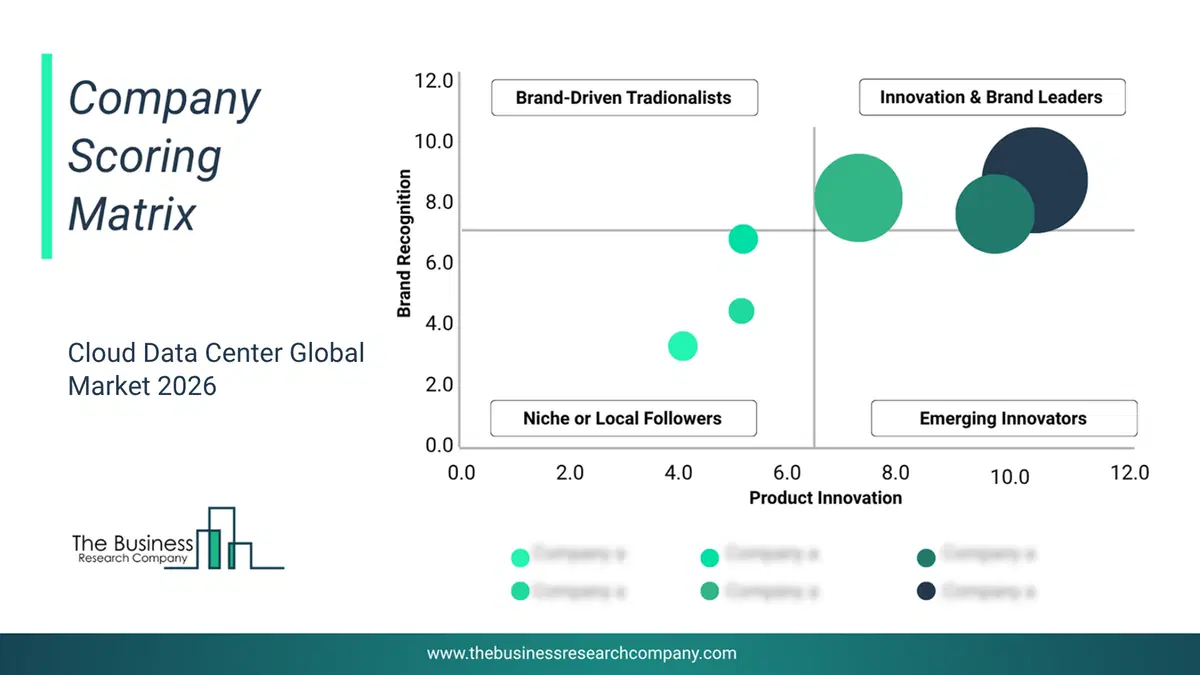
This chart maps companies by product innovation and brand strength, with bubble size indicating relative revenue, helping identify market leaders, challengers, and niche players. This is an illustrative chart; the full report provides a complete and accurate competitive analysis.
Global Cloud Data Center Market Trends and Insights
Major companies operating in the cloud data center market are focused on introducing new data center facilities, such as cyber cloud data centers, to boost their revenues in the market. Cyber cloud data centers refer to a data center infrastructure that integrates cloud computing services and emphasizes robust cybersecurity measures. For instance, in March 2023, Acronis International GmbH, a Switzerland-based software company, opened a new cyber cloud data center in Toronto, Canada. This is one of more than fifty cyber-cloud data centers in Acronis' global network. The Toronto data center provides Acronis partners with access to a wide range of cyber protection solutions, giving them the ability to create new services and offerings that can more efficiently and effectively manage their clients' data protection needs with faster access, continuous data availability, and the added benefit of data sovereignty.What Are Latest Mergers And Acquisitions In The Cloud Data Center Market?
In January 2023, DIF Capital Partners, a Netherlands-based private equity company acquired Tonaquint Data Centers LLC for an undisclosed amount. The acquisition is expected to help DIF Capital Partners further grow in the digital infrastructure space in North America. Tonaquint Data Centers LLC is a US-based cloud data center company that provides cloud hosting, colocation, disaster recovery, and backup services.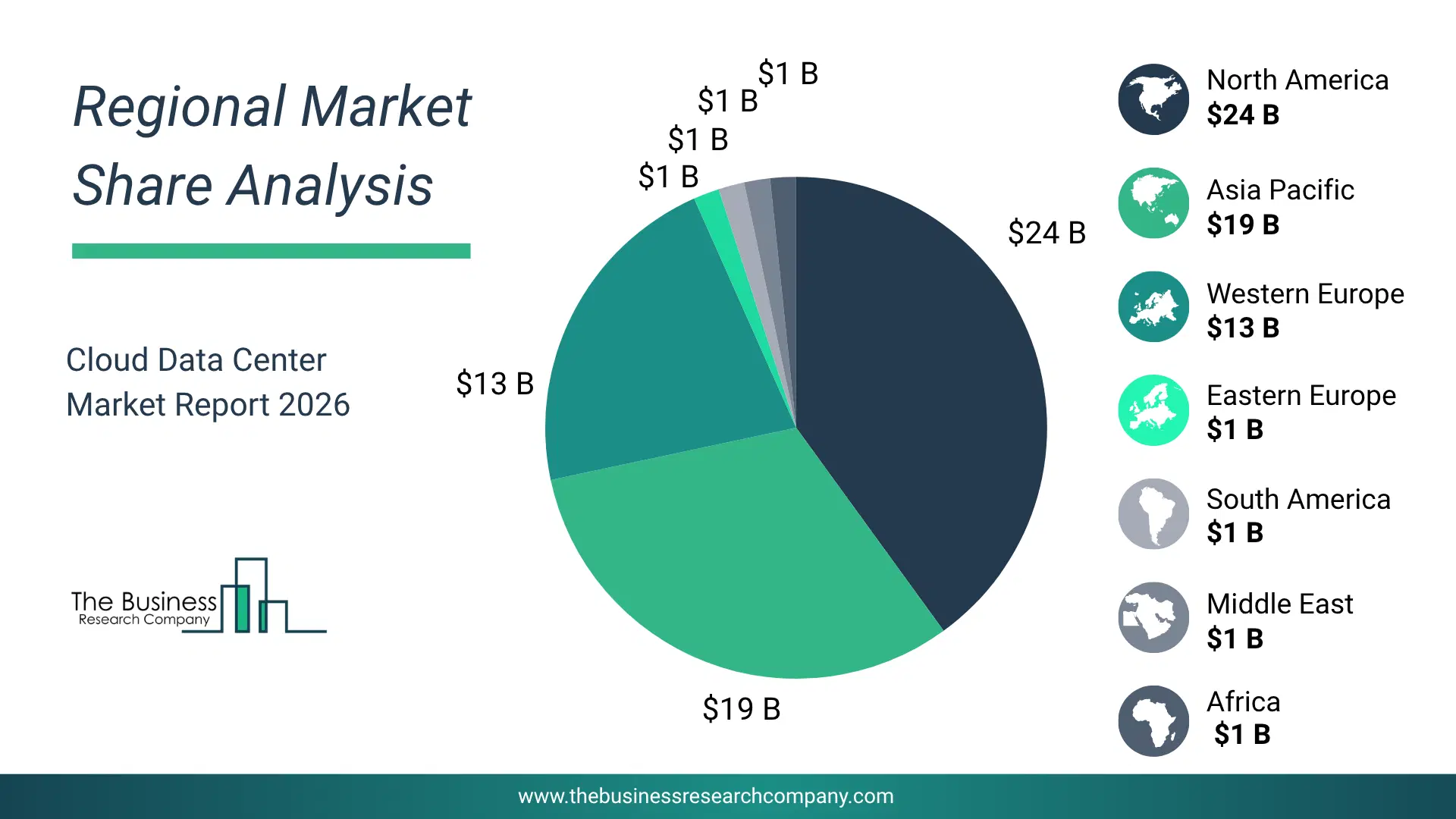
Regional Insights
North America was the largest region in the cloud data center market in 2025. Asia-Pacific is expected to be the fastest-growing region in the forecast period. The regions covered in this market report are Asia-Pacific, South East Asia, Western Europe, Eastern Europe, North America, South America, Middle East, Africa. The countries covered in this market report are Australia, Brazil, China, France, Germany, India, Indonesia, Japan, Taiwan, Russia, South Korea, UK, USA, Canada, Italy, SpainWhat Defines the Cloud Data Center Market?
The cloud data center market consists of revenues earned by entities by providing services such as database services, networking services, and security services. The market value includes the value of related goods sold by the service provider or included within the service offering. The cloud data center market also includes sales of virtual machines, storage solutions, and servers. Values in this market are ‘factory gate’ values, that is the value of goods sold by the manufacturers or creators of the goods, whether to other entities (including downstream manufacturers, wholesalers, distributors and retailers) or directly to end customers. The value of goods in this market includes related services sold by the creators of the goods.How is Market Value Defined and Measured?
The market value is defined as the revenues that enterprises gain from the sale of goods and/or services within the specified market and geography through sales, grants, or donations in terms of the currency (in USD unless otherwise specified). The revenues for a specified geography are consumption values that are revenues generated by organizations in the specified geography within the market, irrespective of where they are produced. It does not include revenues from resales along the supply chain, either further along the supply chain or as part of other products.
This chart presents market attractiveness based on a quantitative evaluation of growth, competition, strategic alignment, and risk, offering a clear view of opportunity areas for decision-making. This chart is for illustrative purposes; the full report contains the complete analysis.

This chart highlights the Total Addressable Market (TAM) by estimating the maximum revenue opportunity using an assumption-driven approach, supporting strategic planning and opportunity sizing across markets. The chart is illustrative; the full report provides a more comprehensive analysis.
What Key Data and Analysis Are Included in the Cloud Data Center Market Report 2026?
The cloud data center market research report is one of a series of new reports from The Business Research Company that provides market statistics, including industry global market size, regional shares, competitors with the market share, detailed market segments, market trends and opportunities, and any further data you may need to thrive in the cloud data center industry. The market research report delivers a complete perspective of everything you need, with an in-depth analysis of the current and future state of the industry.Cloud Data Center Market Report Forecast Analysis
| Report Attribute | Details |
|---|---|
| Market Size Value In 2026 | $35.26 billion |
| Revenue Forecast In 2030 | $59.55 billion |
| Growth Rate | CAGR of 13.9% from 2026 to 2030 |
| Base Year For Estimation | 2025 |
| Actual Estimates/Historical Data | 2020-2025 |
| Forecast Period | 2026 - 2030 |
| Market Representation | Revenue in USD Billion and CAGR from 2026 to 2030 |
| Segments Covered | Service Model, Deployment Model, Organization Size, End-Users |
| Regional Scope | Asia-Pacific, Western Europe, Eastern Europe, North America, South America, Middle East, Africa |
| Country Scope | The countries covered in the report are Australia, Brazil, China, France, Germany, India, Indonesia, Japan, Taiwan, Russia, South Korea, UK, USA, Canada, Italy, Spain. |
| Key Companies Profiled | Alphabet Inc.; Microsoft Corporation; Amazon Web Services Inc.; International Business Machines Corporation IBM; Oracle Corporation; Tencent Cloud; Alibaba Cloud; Google Cloud; Equinix Inc.; Lumen Technologies; KDDI Telehouse; China Unicom; China Telecom Americas Inc.; Cyxtera Technologies Inc.; QTS Realty Trust Inc.; Flexential Corp.; AT&T Inc.; OVHcloud; CoreWeave; NTT Global Data Centers; GDS Holdings; Kamatera |
| Customization Scope | Request for Customization |
| Pricing And Purchase Options | Explore Purchase Options |