

Cloud Services Market Report 2026
Global Outlook – By Type (Software As A Service (Saas), Platform As A Service (Paas), Infrastructure As A Service (Iaas), Business Process As A Service (Bpaas)), By Deployment Model (Public Cloud, Private Cloud, Hybrid Cloud), By Organisation Size (Large Enterprises, Small And Medium Enterprises), By Application (Storage, Backup, And Disaster Recovery, Application Development And Testing, Database Management, Business Analytics, Integration And Orchestration, Customer Relationship Management, Other Applications), By End-user Industry (Banking, Financial Services, And Insurance, Media And Entertainment, It And Telecommunications, Energy And Utilities, Government And Public Sector, Retail And Consumer Goods, Manufacturing, Other End User Industries) – Market Size, Trends, Strategies, and Forecast to 2030
Cloud Services Market Overview
• Cloud Services market size has reached to $617.22 billion in 2025 • Expected to grow to $948.98 billion in 2030 at a compound annual growth rate (CAGR) of 9.2% • Growth Driver: Online Gaming Fuels Surge In Cloud Services Demand • Market Trend: Innovative GenAI Platforms Driving Operational Efficiency And Digital Transformation In Cloud Services Emerging Tools In The Cloud Services Market • North America was the largest region in 2025 and Western Europe is the fastest growing region.What Is Covered Under Cloud Services Market?
Cloud service refers to a wide range of on-demand services offered to businesses and customers over the Internet. These services are designed to provide easy and affordable access to applications and resources without needing internal infrastructure or hardware. It refers to the servers accessed over the internet and the software and databases on those servers. The main types of cloud services are software as a service (SaaS), platform as a service (PaaS), infrastructure as a service (IaaS), and business process as a service (BPaaS). Software as a service (SaaS) refers to providing complete applications over the Internet. It is also called web-based software, on-demand software, or hosted software. Establishments providing SaaS offer access to their software and hardware, managing access to the application, its security, availability, and performance. Users only need to think about the usage of the service provided and not about how the service is provided or maintained or how the underlying infrastructure is managed. The deployment method used includes public cloud, private cloud, hybrid cloud and large enterprises, small and medium enterprises size organizations utilize them. The cloud services are mainly used for storage, backup, disaster recovery, application development and testing, database management, business analytics, integration and orchestration, customer relationship management, and others and are used in industries including BFSI, media and entertainment, IT and telecommunications, energy and utilities, government and public sector, retail and consumer goods, manufacturing, and others.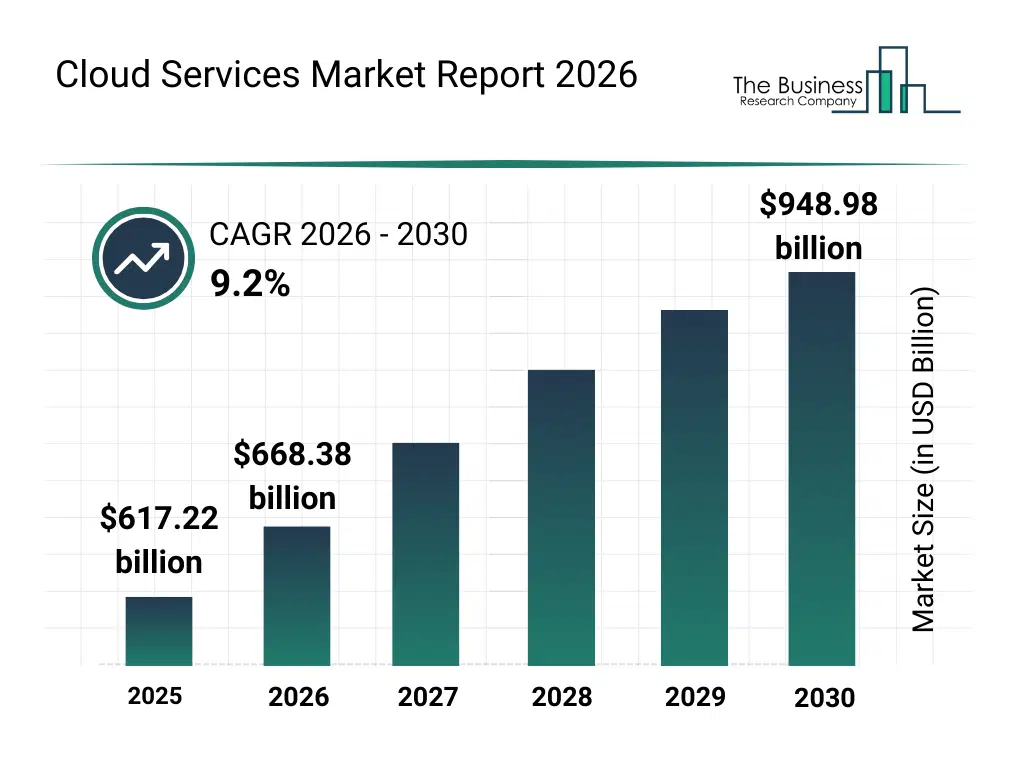
What Is The Cloud Services Market Size and Share 2026?
The cloud services market size has grown strongly in recent years. It will grow from $617.22 billion in 2025 to $668.38 billion in 2026 at a compound annual growth rate (CAGR) of 8.3%. The growth in the historic period can be attributed to rising demand for it cost optimization, growth of internet connectivity, increasing enterprise digitization, adoption of virtualization technologies, need for scalable computing resources.What Is The Cloud Services Market Growth Forecast?
The cloud services market size is expected to see strong growth in the next few years. It will grow to $948.98 billion in 2030 at a compound annual growth rate (CAGR) of 9.2%. The growth in the forecast period can be attributed to growth of AI driven cloud workloads, expansion of remote work models, increasing adoption of saas platforms, rising focus on data analytics, demand for flexible it infrastructure. Major trends in the forecast period include hybrid cloud adoption, cloud native application development, scalable on demand infrastructure, multi cloud management strategies, cloud based business process automation.
Global Cloud Services Market Segmentation
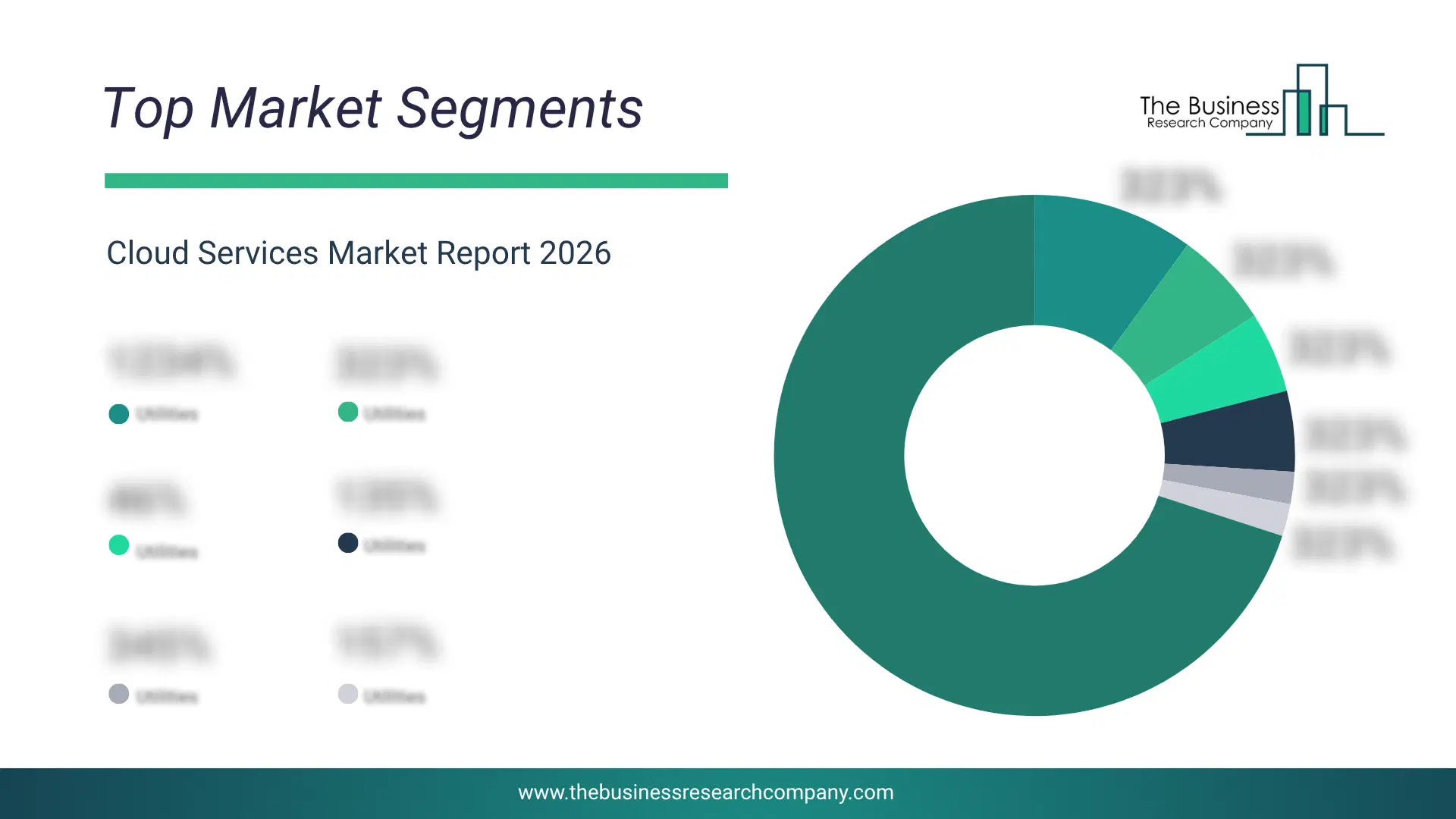
1) By Type: Software As A Service (Saas), Platform As A Service (Paas), Infrastructure As A Service (Iaas), Business Process As A Service (Bpaas) 2) By Deployment Model: Public Cloud, Private Cloud, Hybrid Cloud 3) By Organisation Size: Large Enterprises, Small And Medium Enterprises 4) By Application: Storage, Backup, And Disaster Recovery, Application Development And Testing, Database Management, Business Analytics, Integration And Orchestration, Customer Relationship Management, Other Applications 5) By End-user Industry: Banking, Financial Services, And Insurance, Media And Entertainment, It And Telecommunications, Energy And Utilities, Government And Public Sector, Retail And Consumer Goods, Manufacturing, Other End User Industries Subsegments: 1) By Software as a Service (SaaS): Customer Relationship Management (CRM) Software, Enterprise Resource Planning (ERP) Software, Human Resource Management (HRM) Software, Collaboration and Productivity Tools, Content Management Systems (CMS) 2) By Platform as a Service (PaaS): Application Development Platforms, Database Management Systems, Middleware Solutions, Integration Platforms, Analytics and Business Intelligence Platforms 3) By Infrastructure as a Service (IaaS): Virtual Servers, Storage Solutions, Networking Services, Backup and Disaster Recovery Solutions, Bare Metal Servers 4) By Business Process as a Service (BPaaS): Financial and Accounting Services, Human Resources Outsourcing, Customer Service and Support Solutions, Supply Chain Management Services, IT Management and Support ServicesWhat Is The Driver Of The Cloud Services Market?
The growing adoption of online gaming is expected to propel the growth of the cloud services market going forward. Online gaming refers to video games that are played over the internet or any other computer network available. Cloud services are used in online gaming to provide platform-independent gaming, accessibility, scalability, cost-effectiveness, convenience, and an improved gaming experience. For instance, in October 2025, according to the American Gaming Association, a US-based trade group, commercial gaming generated $51.14 billion in revenue by August 2025, representing an 8.9% rise from the corresponding period a year earlier. Over the same months, iGaming revenue totaled $6.86 billion, showing a 29.0% increase compared to last year’s figures. Therefore, the growing adoption of online gaming is driving the growth of the cloud services industry.Key Players In The Global Cloud Services Market
Major companies operating in the cloud services market are Amazon; Microsoft Corporation; IBM Corporation; Oracle Corporation; Dell Technologies Inc.; Salesforce; SAP; Alibaba Group Holding Limited; Nippon Telegraph And Telephone Corp; Kingsoft Corporation; UCloud Information Technology; Tencent Cloud; KingCloud; Fujitsu Ltd.; Hitachi Ltd.; KDDI Corporation; Infosys Technologies Ltd.; Tata Consultancy Services; Cisco Systems; DigitalOcean, Inc.; Wipro Ltd; NetApp India Pvt Ltd.; SAVVIS Australia Pty Ltd; OVH; CloudSigma AG; Capgemini SE; Castleton Technology PLC; Caretower Ltd; Niu Solutions; HPE United Kingdom; SiteGround; CROC Incorporated; Servionica; Comarch; Onlanta Ltd; Red Hat, Inc.; Google LLC; Adobe Inc.; Claro; Locaweb; AllCloud Platforms Ltd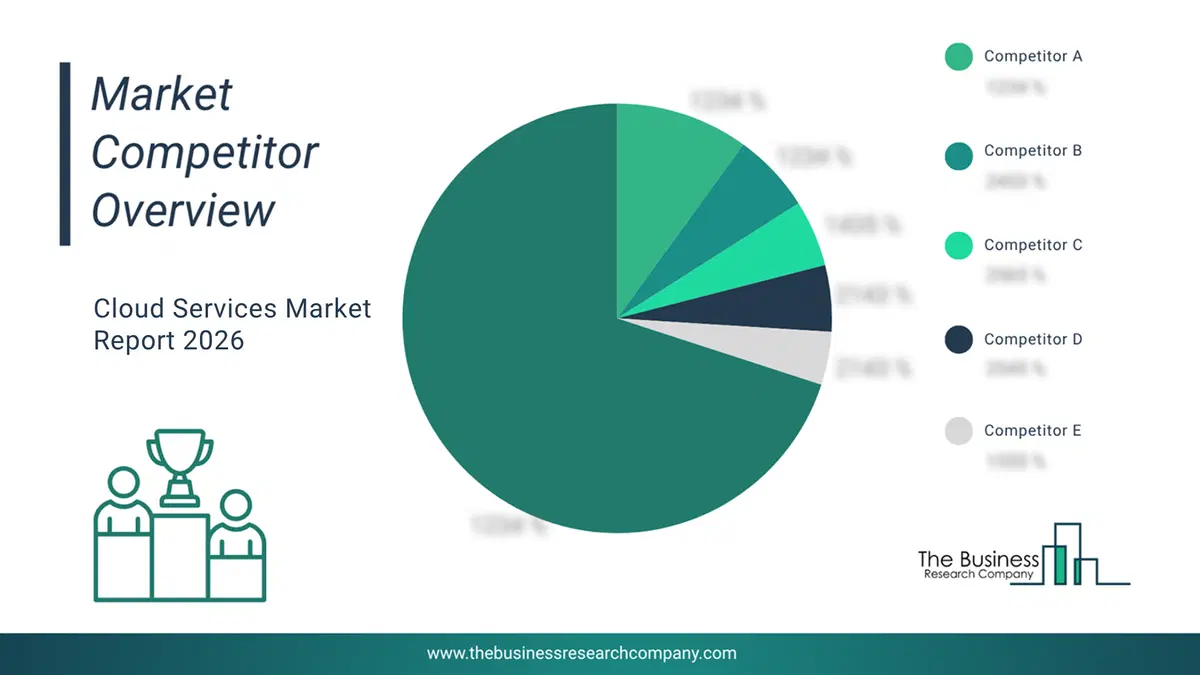
This chart is for illustrative purposes; the full report includes a detailed competitor analysis and comprehensive overview of the top 10 companies in the market.
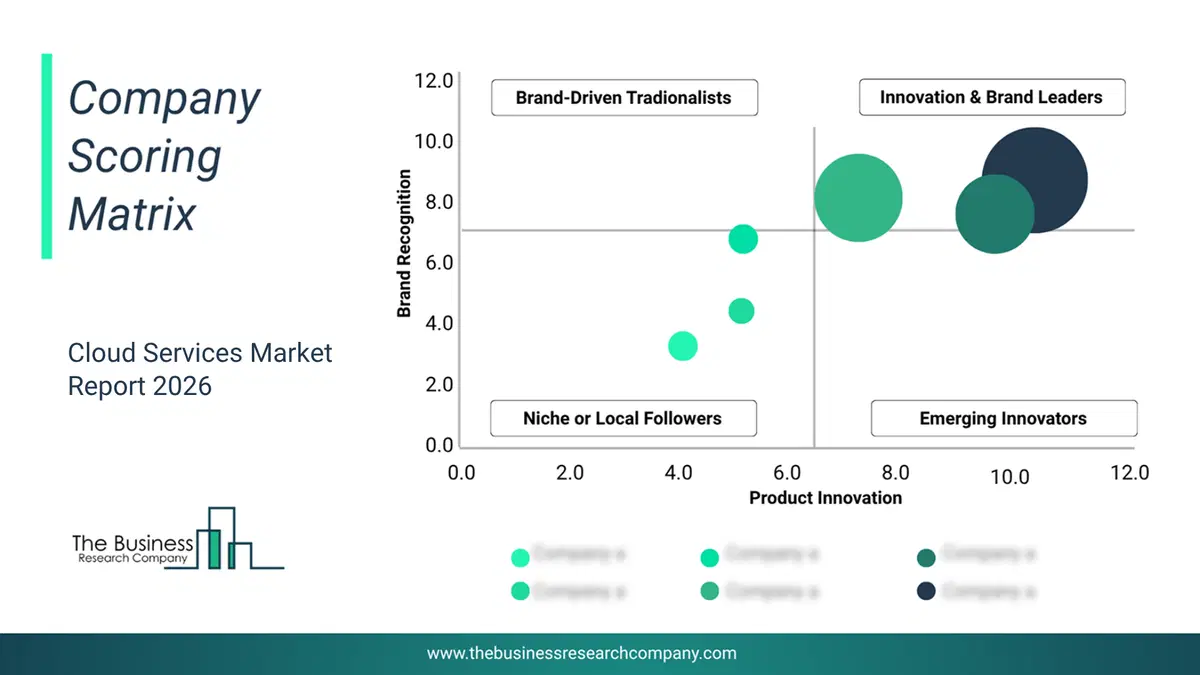
This chart maps companies by product innovation and brand strength, with bubble size indicating relative revenue, helping identify market leaders, challengers, and niche players. This is an illustrative chart; the full report provides a complete and accurate competitive analysis.
Global Cloud Services Market Trends and Insights
Major companies operating in the cloud services market are focusing on developing innovative solutions, such as GenAI aggregation platform, to enhance operational efficiency, accelerate digital transformation, and deliver personalized, scalable, and intelligent cloud services to enterprises. A GenAI aggregation platform is a software solution designed to integrate, manage, and leverage multiple generative AI (GenAI) models and tools in a unified interface. For instance, in June 2024, Tata Consultancy Services (TCS), an India-based IT services and consulting company, launched WisdomNext, an industry-first GenAI aggregation platform. It combines multiple generative AI models to deliver adaptive, context-aware insights, automates complex workflows, and accelerates digital transformation initiatives. It supports a wide range of enterprise applications, enhances productivity by reducing human intervention, and ensures scalability across cloud environments while integrating seamlessly with existing IT systems.What Are Latest Mergers And Acquisitions In The Cloud Services Market?
In January 2023, Dell Technologies Inc., a US-based technology company, acquired Cloudify for $100 million. This transaction boosts Dell’s cloud services business, specifically its offerings in DevOps. Cloudify is an Israel-based cloud services startup.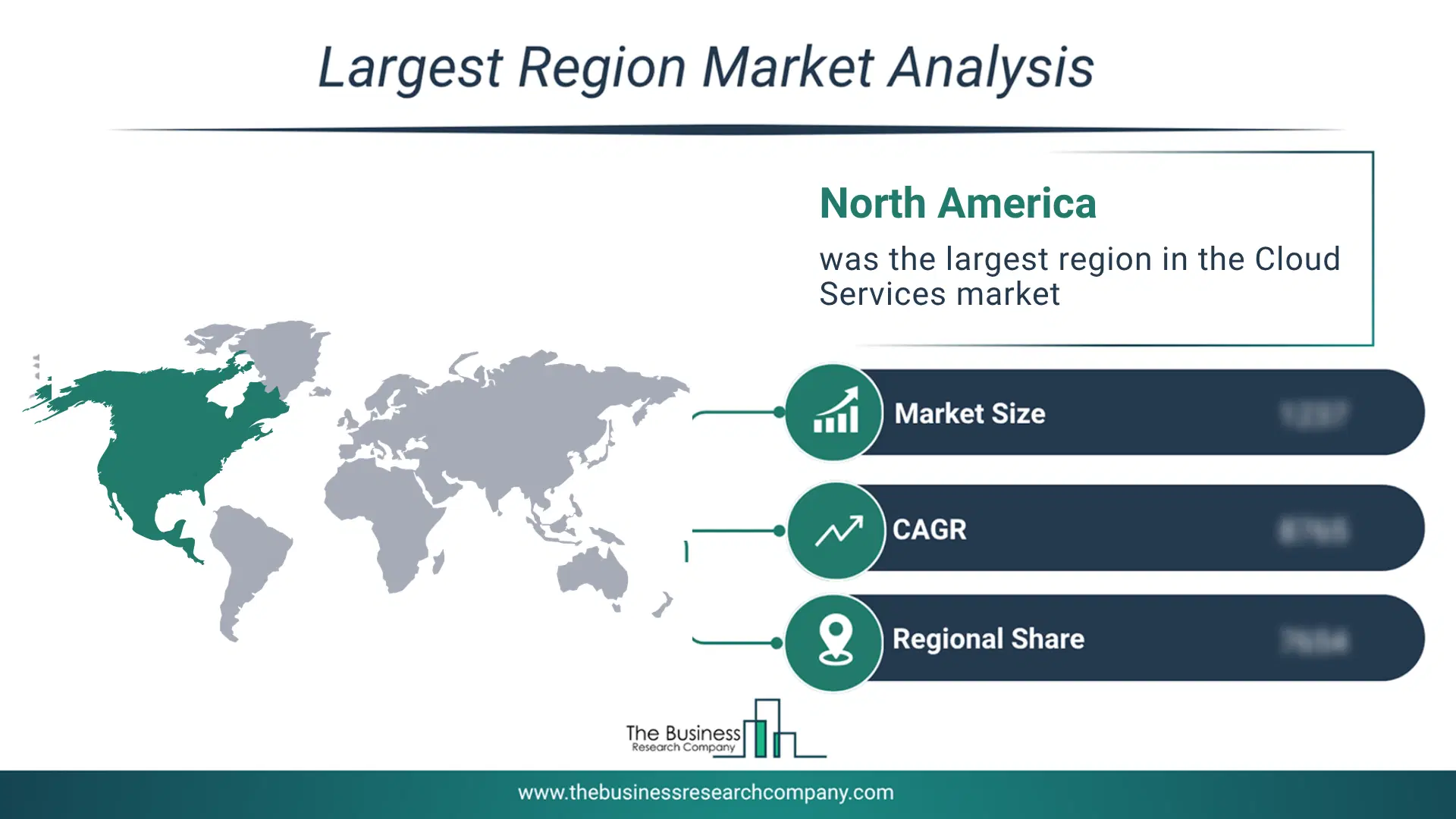
Regional Insights
North America was the largest region in the cloud services market in 2025. Western Europe was the second largest region cloud services market. The regions covered in this market report are Asia-Pacific, South East Asia, Western Europe, Eastern Europe, North America, South America, Middle East, Africa. The countries covered in this market report are China, India, Japan, Australia, Indonesia, South Korea, Bangladesh, Thailand, Vietnam, Malaysia, Singapore, Philippines, Hong Kong, Taiwan, New Zealand, UK, Germany, France, Italy, Spain, Austria, Belgium, Denmark, Finland, Ireland, Netherlands, Norway, Portugal, Sweden, Switzerland, Russia, Czech Republic, Poland, Romania, Ukraine, USA, Canada, Mexico, Brazil, Chile, Argentina, Colombia, Peru, Saudi Arabia, Israel, Iran, Turkey, UAE, Egypt, Nigeria, South Africa.What Defines the Cloud Services Market?
The cloud services market includes revenues earned by entities by providing cloud services that can be used for the delivery of information technology resources and applications on-demand through an internet platform. Companies in the cloud services market provide access to servers, storage, databases and a broad set of application services managed by hardware networking. This market includes sales of storage servers which are used to store, access, secure and manage digital data, files and services. It also includes sales of public cloud services, private cloud services, hybrid cloud services and multi-cloud services offered by providers are included. The market value includes the value of related goods sold by the service provider or included within the service offering. Only goods and services traded between entities or sold to end consumers are included.How is Market Value Defined and Measured?
The market value is defined as the revenues that enterprises gain from the sale of goods and/or services within the specified market and geography through sales, grants, or donations in terms of the currency (in USD unless otherwise specified). The revenues for a specified geography are consumption values that are revenues generated by organizations in the specified geography within the market, irrespective of where they are produced. It does not include revenues from resales along the supply chain, either further along the supply chain or as part of other products.
This chart presents market attractiveness based on a quantitative evaluation of growth, competition, strategic alignment, and risk, offering a clear view of opportunity areas for decision-making. This chart is for illustrative purposes; the full report contains the complete analysis.

This chart highlights the Total Addressable Market (TAM) by estimating the maximum revenue opportunity using an assumption-driven approach, supporting strategic planning and opportunity sizing across markets. The chart is illustrative; the full report provides a more comprehensive analysis.
What Key Data and Analysis Are Included in the Cloud Services Market Report 2026?
The cloud services market research report is one of a series of new reports from The Business Research Company that provides market statistics, including industry global market size, regional shares, competitors with the market share, detailed market segments, market trends and opportunities, and any further data you may need to thrive in the cloud services industry. The market research report delivers a complete perspective of everything you need, with an in-depth analysis of the current and future state of the industry.Cloud Services Market Report Forecast Analysis
| Report Attribute | Details |
|---|---|
| Market Size Value In 2026 | $668.38 billion |
| Revenue Forecast In 2030 | $948.98 billion |
| Growth Rate | CAGR of 9.2% from 2026 to 2030 |
| Base Year For Estimation | 2025 |
| Actual Estimates/Historical Data | 2020-2025 |
| Forecast Period | 2026 - 2030 |
| Market Representation | Revenue in USD Billion and CAGR from 2026 to 2030 |
| Segments Covered | Type, Deployment Model, Organisation Size, Application, End-user Industry |
| Regional Scope | Asia-Pacific, Western Europe, Eastern Europe, North America, South America, Middle East, Africa |
| Country Scope | The Countries Covered In This Market Report Are Australia, Brazil, China, France, Germany, India, Indonesia, Japan, Taiwan, Russia, South Korea, Uk, Usa, Canada, Italy, Spain. |
| Key Companies Profiled | Amazon, Microsoft Corporation, IBM Corporation, Oracle Corporation, Dell Technologies Inc., Salesforce, SAP, Alibaba Group Holding Limited, Nippon Telegraph And Telephone Corp, Kingsoft Corporation, UCloud Information Technology, Tencent Cloud, KingCloud, Fujitsu Ltd., Hitachi Ltd., KDDI Corporation, Infosys Technologies Ltd., Tata Consultancy Services, Cisco Systems, DigitalOcean, Inc., Wipro Ltd, NetApp India Pvt Ltd., SAVVIS Australia Pty Ltd, OVH, CloudSigma AG, Capgemini SE, Castleton Technology PLC, Caretower Ltd, Niu Solutions, HPE United Kingdom, SiteGround, CROC Incorporated, Servionica, Comarch, Onlanta Ltd, Red Hat, Inc., Google LLC, Adobe Inc., Claro, Locaweb, AllCloud Platforms Ltd |
| Customization Scope | Request for Customization |
| Pricing And Purchase Options | Explore Purchase Options |