
Cloud Sovereignty Controls Market Report 2026
Global Outlook – By Component (Software, Hardware, Services), By Deployment Model (Public Cloud, Private Cloud, Hybrid Cloud), By Organization Size (Small And Medium Enterprises, Large Enterprises), By Application (Data Security And Privacy, Compliance Management, Risk Management, Access Control, Other Applications), By End User (Banking, Financial Services, And Insurance, Healthcare, Government And Public Sector, Information Technology And Telecommunications, Manufacturing, Retail, Other End Users) – Market Size, Trends, Strategies, and Forecast to 2030
Cloud Sovereignty Controls Market Overview
• Cloud Sovereignty Controls market size has reached to $5.12 billion in 2025 • Expected to grow to $11.91 billion in 2030 at a compound annual growth rate (CAGR) of 18.4% • Growth Driver: Rising Security and Privacy Demands Propel Global Cloud Sovereignty Market Growth • Market Trend: Fusing Identity-Centric Security with Regional Compliance to Redefine Digital Sovereignty • North America was the largest region in 2025 and Asia-Pacific is the fastest growing region.Market Gains By 2030 – Top Opportunities By Segment
Market Gain identifies the most promising market opportunities by highlighting the segments or products expected to generate the highest incremental revenue growth over the next five years.
What Is Covered Under Cloud Sovereignty Controls Market?
Cloud sovereignty controls refer to mechanisms that ensure data, workloads, and operations comply with jurisdictional, legal, and regulatory requirements. They provide governance over where data is stored, processed, and accessed. These controls help maintain compliance and trust across distributed cloud environments. The main components of cloud sovereignty controls are software, hardware, and services. Software refers to solutions that enable organizations to enforce data residency, regulatory compliance, and governance policies across cloud environments. These solutions are deployed through different deployment models, including public cloud, private cloud, and hybrid cloud, and are designed for organizations of varying sizes, such as small and medium enterprises and large enterprises. They are used across multiple applications, including data security and privacy, compliance management, risk management, access control, and other applications, and serve a wide range of end users, such as banking, financial services, and insurance, healthcare, government and public sector, information technology and telecommunications, manufacturing, retail, and other end users.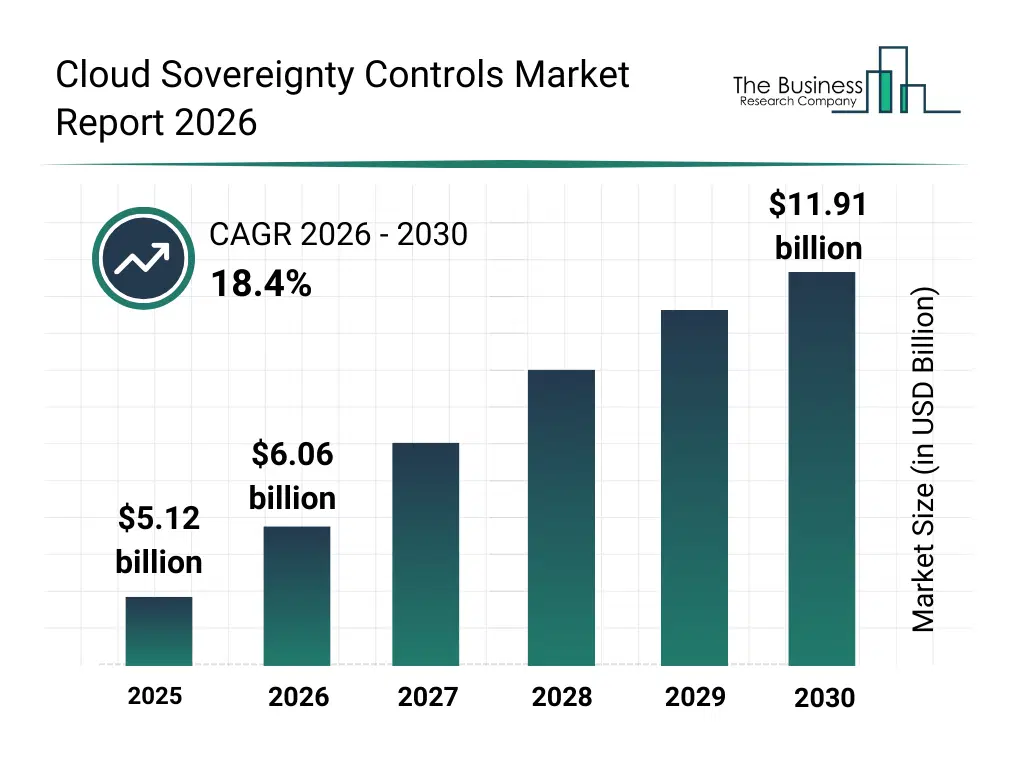
What Is The Cloud Sovereignty Controls Market Size and Share 2026?
The cloud sovereignty controls market size has grown rapidly in recent years. It will grow from $5.12 billion in 2025 to $6.06 billion in 2026 at a compound annual growth rate (CAGR) of 18.2%. The growth in the historic period can be attributed to increasing data localization laws, cross-border data risks, early cloud compliance frameworks, government cloud adoption, regulatory enforcement.What Is The Cloud Sovereignty Controls Market Growth Forecast?
The cloud sovereignty controls market size is expected to see rapid growth in the next few years. It will grow to $11.91 billion in 2030 at a compound annual growth rate (CAGR) of 18.4%. The growth in the forecast period can be attributed to sovereign cloud expansion, automated compliance controls, enterprise risk mitigation focus, national data protection mandates, cloud governance investment. Major trends in the forecast period include data residency enforcement, jurisdictional compliance monitoring, encryption and key custody, access control governance, regulatory risk management.
Global Cloud Sovereignty Controls Market Segmentation
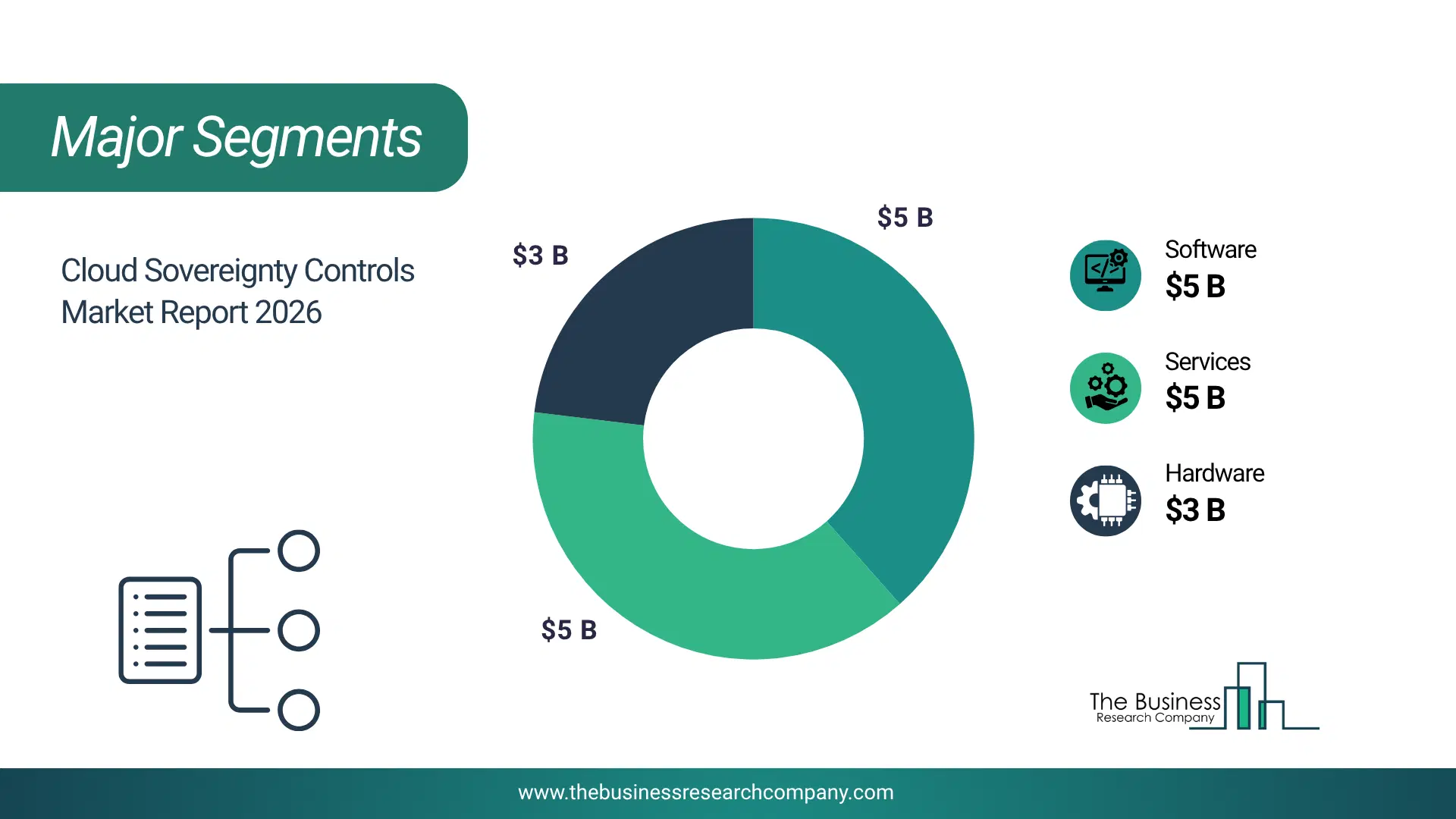
1) By Component: Software, Hardware, Services 2) By Deployment Model: Public Cloud, Private Cloud, Hybrid Cloud 3) By Organization Size: Small And Medium Enterprises, Large Enterprises 4) By Application: Data Security And Privacy, Compliance Management, Risk Management, Access Control, Other Applications 5) By End User: Banking, Financial Services, And Insurance, Healthcare, Government And Public Sector, Information Technology And Telecommunications, Manufacturing, Retail, Other End Users Subsegments: 1) By Software: Data Residency Management Software, Encryption And Key Management Software, Compliance And Policy Enforcement Software, Identity And Access Management 2) By Hardware: Sovereign Servers, Secure Storage Systems, Data Localization Appliances, Hardware Security Modules 3) By Services: Consulting And Advisory Services, Deployment And Integration Services, Managed Cloud Sovereignty Services, Compliance Monitoring And Audit Services The top segments in the cloud sovereignty controls market will be: • Software will reach $4.57 Billion by 2030. • Services will reach $4.55 Billion by 2030. • Hardware will reach $2.78 Billion by 2030.What Is The Driver Of The Cloud Sovereignty Controls Market?
The growing concerns over data privacy and national security are expected to propel the growth of the cloud sovereignty controls market going forward. The growing concerns over data privacy and national security refer to mechanisms ensuring cloud data stays within specific national borders, governed by local laws to protect privacy and security. Growing concerns over data privacy breaches and national security threats from foreign access drive this market's focus. The increasing volume of sensitive data being stored in cloud environments, along with stricter government regulations and heightened awareness of cyber threats, which require organizations to maintain greater control and compliance over where and how their data is managed. Cloud sovereignty controls help reduce data privacy and national security risks by ensuring sensitive data remains within approved jurisdictions, enabling regulatory compliance, strengthening security oversight, and improving trust in cloud-based services. For instance, in May 2025, according to the Office of the Australian Information Commissioner, an Australia-based government authority, Australia recorded 1,113 data breach notifications in 2024, which was a 25 % increase from the 893 data breaches reported in 2023 marking the highest total since mandatory reporting began. Therefore, the growing concerns over data privacy and national security are driving the growth of the cloud sovereignty controls industry.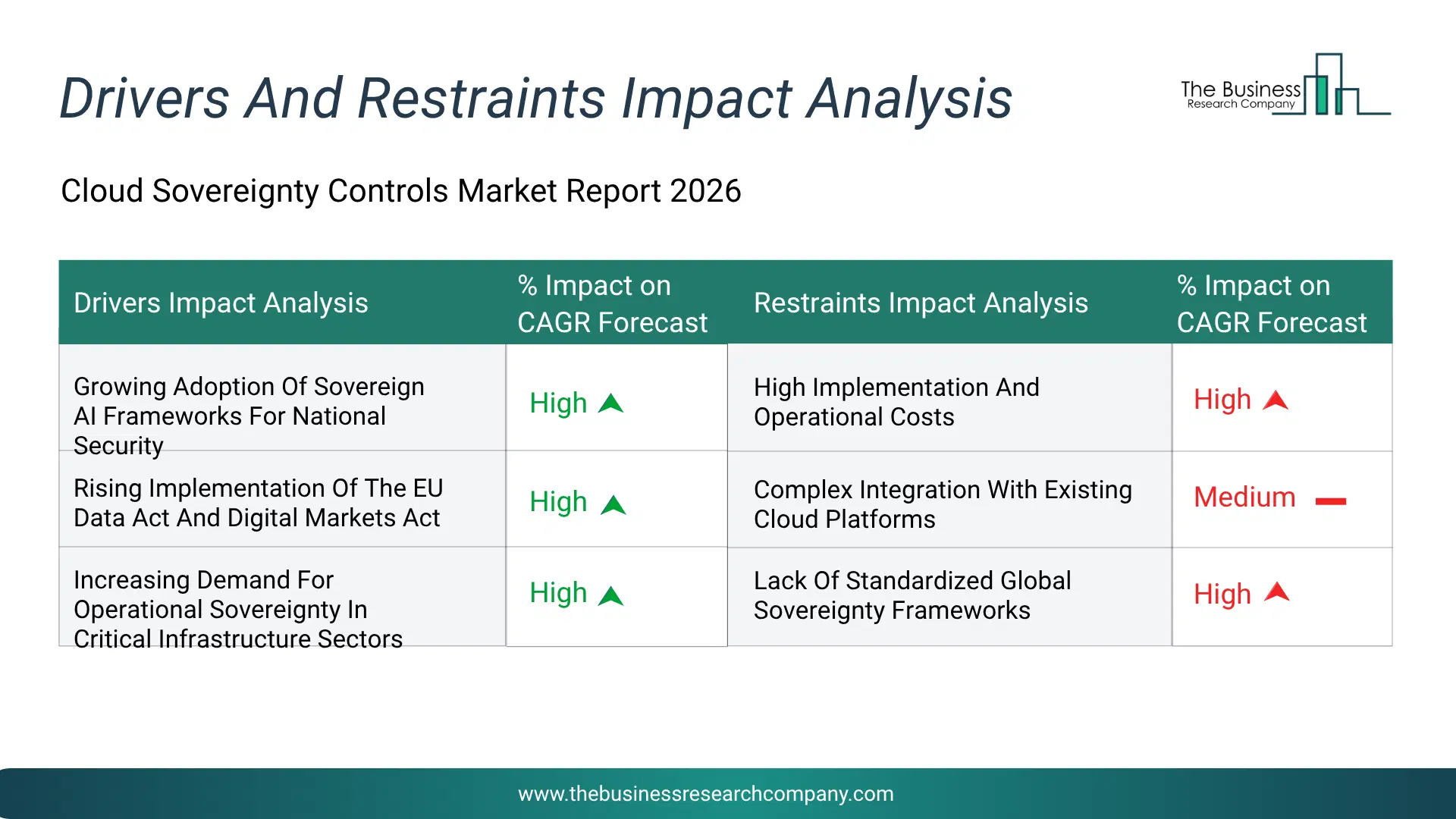
Infographic Chart Showing Key Market Drivers Analysis And Restraints For Cloud Sovereignty Controls Market
The chart presents an impact analysis of key drivers and restraints, quantifying their relative influence on the market's growth rate and helping assess the balance between growth enablers and limiting factors. This chart offers a high-level perspective; the full report contains more detailed insights.
How Will The Drivers Impact Growth In The Global Cloud Sovereignty Controls Market?
• Growing Adoption Of Sovereign AI Frameworks For National Security (High) – During the forecast period, the growing adoption of sovereign AI frameworks for national security is expected to become a key growth driver for the cloud sovereignty controls market by 2030. Governments and defense agencies are increasingly prioritizing domestically governed AI systems to ensure that sensitive data, algorithms, and decision-making processes remain within national boundaries. This trend is driving demand for sovereign cloud environments that provide strict data isolation, controlled access, and transparent audit capabilities. Additionally, the integration of AI within critical decision-making processes is reinforcing the need for secure and compliant infrastructure. • Rising Implementation Of The EU Data Act And Digital Markets Act (High) – During the forecast period, the rising implementation of the EU Data Act and Digital Markets Act is expected to emerge as a major factor driving the expansion of the cloud sovereignty controls market by 2030. These regulatory frameworks are compelling organizations operating in Europe to adopt stricter data sharing, portability, and localization measures while ensuring transparency in digital operations. Enterprises are therefore investing in advanced sovereignty control solutions to manage data flows, enforce jurisdictional policies, and maintain compliance across multiple cloud environments. This regulatory momentum is encouraging global cloud providers to enhance region-specific offerings and compliance capabilities. • Increasing Demand For Operational Sovereignty In Critical Infrastructure Sectors (High) – During the forecast period, the increasing demand for operational sovereignty in critical infrastructure sectors is expected to act as a key growth catalyst for the cloud sovereignty controls market by 2030. Industries such as energy, telecommunications, healthcare, and transportation are focusing on maintaining full control over their digital operations, including data storage, processing, and access management. This is driving the adoption of sovereign cloud architectures that ensure uninterrupted operations, resilience against external disruptions, and compliance with national regulations. Organizations are also emphasizing localized data processing and secure connectivity frameworks to safeguard mission-critical systems.How Will The Restraints Impact Growth In The Global Cloud Sovereignty Controls Market?
• High Implementation And Operational Costs (High) – During the forecast period, high implementation and operational costs are restricting the growth of the cloud sovereignty controls market. Significant investments required for data localization infrastructure, compliance management tools, and continuous monitoring systems are increasing overall operational expenses, thereby limiting adoption among cost-sensitive organizations • Complex Integration With Existing Cloud Platforms (High) – During the forecast period, complex integration with existing cloud platforms is restricting the growth of the cloud sovereignty controls market. Challenges in aligning sovereignty controls with multi-cloud and hybrid cloud environments, along with interoperability issues, are creating deployment complexities and reducing operational efficiency • Lack Of Standardized Global Sovereignty Frameworks (High) – During the forecast period, lack of standardized global sovereignty frameworks is restricting the growth of the cloud sovereignty controls market. Variations in regional data protection laws and absence of unified global standards are creating compliance uncertainties and increasing the burden on organizations operating across multiple jurisdictionsKey Players In The Global Cloud Sovereignty Controls Market
Major companies operating in the cloud sovereignty controls market are OVHcloud, Google Cloud, Microsoft Corporation, Amazon Web Services, Dell Technologies, Accenture Plc, International Business Machines Corporation, Cisco Systems, Oracle Corporation, SAP SE, Salesforce Inc., Hewlett Packard Enterprise (HPE), Thales Group, Capgemini Ltd., Atos Ltd., Orange Business Services, T-Systems (Deutsche Telekom), Alibaba Cloud, CloudBolt, NTT Communications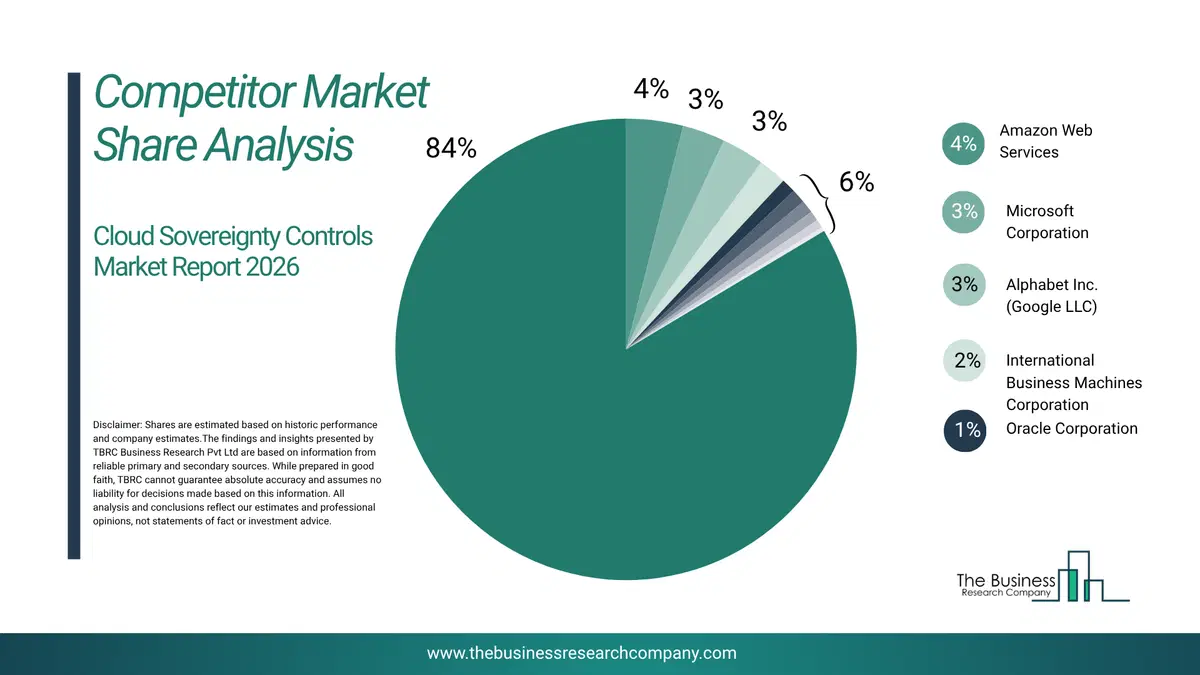
This chart is for illustrative purposes; the full report includes a detailed competitor analysis and comprehensive overview of the top 10 companies in the market.
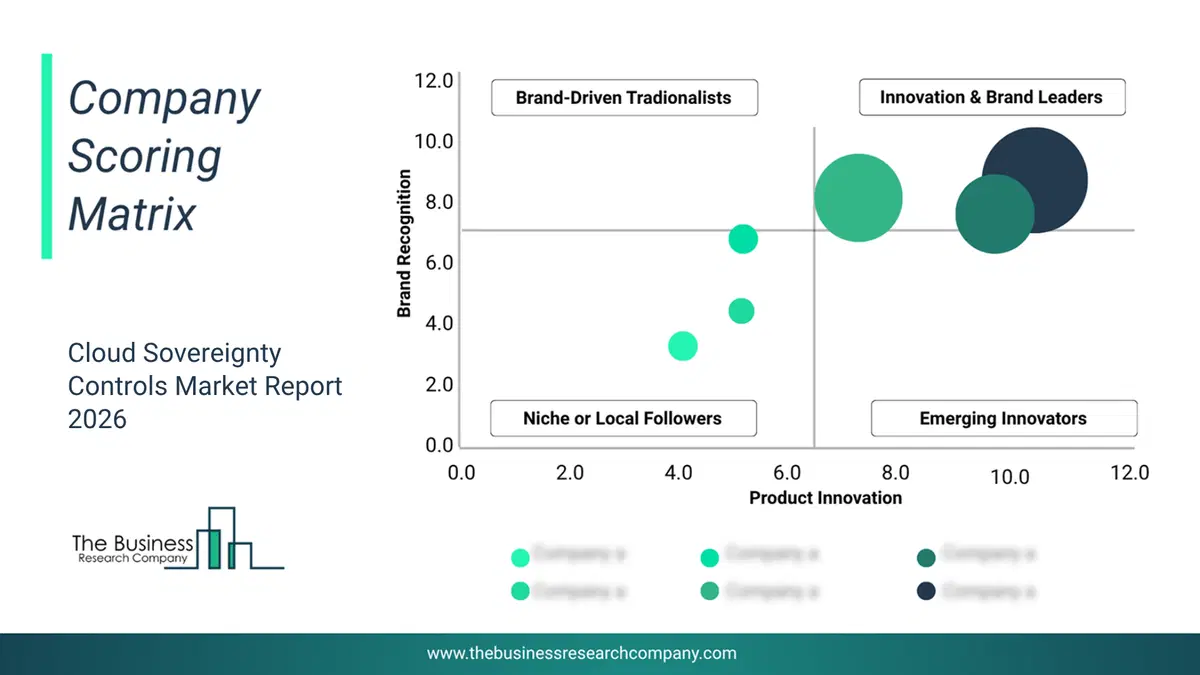
This chart maps companies by product innovation and brand strength, with bubble size indicating relative revenue, helping identify market leaders, challengers, and niche players. This is an illustrative chart; the full report provides a complete and accurate competitive analysis.
Global Cloud Sovereignty Controls Market Trends and Insights
Major companies operating in the cloud sovereignty controls market are focusing on Integration of zero trust security with sovereignty frameworks, such as Sovereign Zero Trust Access Gateways, to ensure that every user, device, and workload accessing sovereign cloud environments is continuously verified and authorized in compliance with jurisdiction-specific data residency, governance, and regulatory requirements. Sovereign Zero Trust Access Gateways are cloud-native security control layers that enforce identity-centric access, continuous authentication, and policy-based authorization while ensuring that data processing, encryption, and access controls remain confined within legally mandated geographic and regulatory boundaries. For instance, in September 2025, SAP SE, a Germany-based enterprise software and cloud company, launched EU AI Cloud, a fully sovereign AI and cloud platform designed to meet European data residency and digital sovereignty requirements, supporting zero trust access controls and regional compliance. The offering provides full sovereignty over infrastructure and operations within EU jurisdictions, integration with advanced AI capabilities including Cohere North for agentic and multimodal AI services, and flexible deployment models across on-site, trusted infrastructure, or fully managed sovereign cloud environments, enabling regulated industries and public sector organizations to maintain strict control over their data and workloads.What Are Latest Mergers And Acquisitions In The Cloud Sovereignty Controls Market?
In November 2023, Broadcom, a US-based provider of semiconductor and infrastructure software solutions, acquired VMware for $69 billion. With this acquisition, Broadcom aims to dominate the Sovereign Cloud infrastructure layer by leveraging VMware’s Sovereign Cloud framework, which enables local providers to offer cloud services that comply with specific national data privacy and residency laws. VMware is a US-based provider of multi-cloud services, virtualization, and software-defined networking solutions that form the technical foundation for many national sovereign cloud initiatives.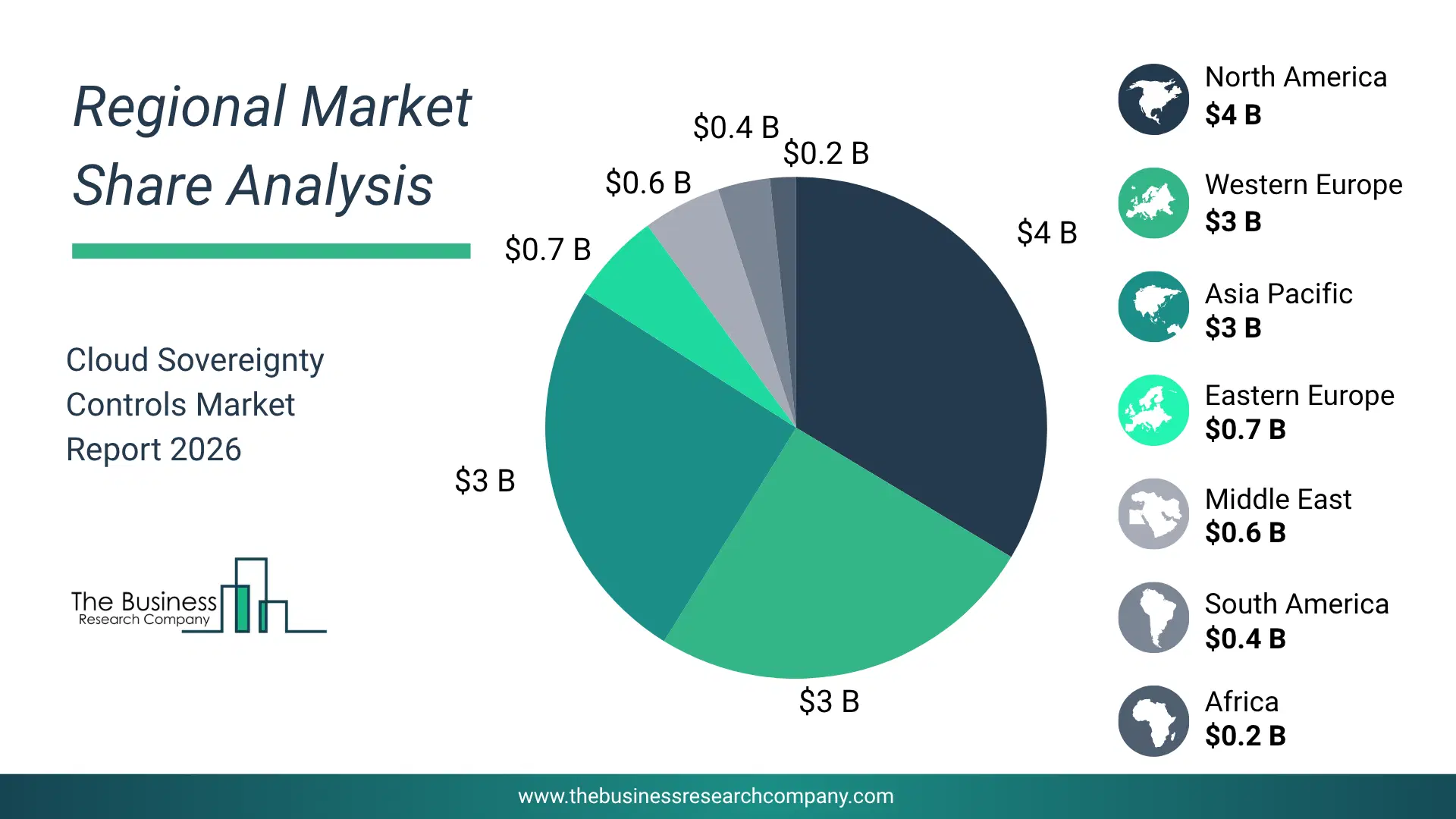
Regional Outlook
North America was the largest region in the cloud sovereignty controls market in 2025. Asia-Pacificis expected to be the fastest-growing region in the forecast period. The regions covered in this market report are Asia-Pacific, South East Asia, Western Europe, Eastern Europe, North America, South America, Middle East, Africa. The countries covered in this market report are Australia, Brazil, China, France, Germany, India, Indonesia, Japan, Taiwan, Russia, South Korea, UK, USA, Canada, Italy, Spain.What Defines the Cloud Sovereignty Controls Market?
The cloud sovereignty controls market consists of revenues earned by entities by providing services such as sovereignty policy management, jurisdictional compliance monitoring, data residency enforcement, encryption and key custody services, regulatory audit support, incident response, forensics and compliance consulting. The market value includes the value of related goods sold by the service provider or included within the service offering. The cloud sovereignty controls market also includes sales of access control and identity management tools, encryption and key management systems, compliance and governance management platforms, policy enforcement and monitoring solutions, and secure cloud gateways. Values in this market are ‘factory gate’ values, that is the value of goods sold by the manufacturers or creators of the goods, whether to other entities (including downstream manufacturers, wholesalers, distributors and retailers) or directly to end customers. The value of goods in this market includes related services sold by the creators of the goods.How is Market Value Defined and Measured?
The market value is defined as the revenues that enterprises gain from the sale of goods and/or services within the specified market and geography through sales, grants, or donations in terms of the currency (in USD unless otherwise specified). The revenues for a specified geography are consumption values that are revenues generated by organizations in the specified geography within the market, irrespective of where they are produced. It does not include revenues from resales along the supply chain, either further along the supply chain or as part of other products.
This chart presents market attractiveness based on a quantitative evaluation of growth, competition, strategic alignment, and risk, offering a clear view of opportunity areas for decision-making. This chart is for illustrative purposes; the full report contains the complete analysis.

This chart highlights the Total Addressable Market (TAM) by estimating the maximum revenue opportunity using an assumption-driven approach, supporting strategic planning and opportunity sizing across markets. The chart is illustrative; the full report provides a more comprehensive analysis.
What Key Data and Analysis Are Included in the Cloud Sovereignty Controls Market Report 2026?
The cloud sovereignty controls market research report is one of a series of new reports from The Business Research Company that provides market statistics, including industry global market size, regional shares, competitors with the market share, detailed market segments, market trends and opportunities, and any further data you may need to thrive in the cloud sovereignty controls industry. The market research report delivers a complete perspective of everything you need, with an in-depth analysis of the current and future state of the industry.Cloud Sovereignty Controls Market Report Forecast Analysis
| Report Attribute | Details |
|---|---|
| Market Size Value In 2026 | $6.06 billion |
| Revenue Forecast In 2030 | $11.91 billion |
| Growth Rate | CAGR of 18.2% from 2026 to 2030 |
| Base Year For Estimation | 2025 |
| Actual Estimates/Historical Data | 2020-2025 |
| Forecast Period | 2026 - 2030 |
| Market Representation | Revenue in USD Billion and CAGR from 2026 to 2030 |
| Segments Covered | Component, Deployment Model, Organization Size, Application, End User |
| Regional Scope | Asia-Pacific, Western Europe, Eastern Europe, North America, South America, Middle East, Africa |
| Country Scope | The countries covered in the report are Australia, Brazil, China, France, Germany, India, Indonesia, Japan, Taiwan, Russia, South Korea, UK, USA, Canada, Italy, Spain. |
| Key Companies Profiled | OVHcloud, Google Cloud, Microsoft Corporation, Amazon Web Services, Dell Technologies, Accenture Plc, International Business Machines Corporation, Cisco Systems, Oracle Corporation, SAP SE, Salesforce Inc., Hewlett Packard Enterprise (HPE), Thales Group, Capgemini Ltd., Atos Ltd., Orange Business Services, T-Systems (Deutsche Telekom), Alibaba Cloud, CloudBolt, NTT Communications |
| Customization Scope | Request for Customization |
| Pricing And Purchase Options | Explore Purchase Options |