
Coatings And Application Technologies For Robotics Market Report 2026
Global Outlook – By Coating Technology Type (Powder, Ultra Violet Cure, Water Borne, Solvent Borne), By Resin Type (Acrylics, Polyurethanes, Polyester, Epoxy), By Coating Layer Type (Primer, Top Coat, Base Coat), By End-User Industry (Healthcare, Agriculture, Mining, Manufacturing, Other End-User Industries) – Market Size, Trends, Strategies, and Forecast to 2030
Coatings And Application Technologies For Robotics Market Overview
• Coatings And Application Technologies For Robotics market size has reached to $22.71 billion in 2025 • Expected to grow to $37.47 billion in 2030 at a compound annual growth rate (CAGR) of 10.5% • Growth Driver: Growing Automation Across Industries Is Driving The Market Growth Due To The Need For Continuous And Error-Free Operations • Market Trend: Technological Advancements In Coatings And Application Technologies For Robotics • North America was the largest region in 2025.What Is Covered Under Coatings And Application Technologies For Robotics Market?
Coatings and application technologies for robotics refer to the specialized surface treatments and the methods used to apply them that enhance the performance, durability, and functionality of robotic components. These coatings protect against wear, corrosion, chemicals, heat, and friction, while also improving properties such as conductivity, reflectivity, or biocompatibility. Application technologies include advanced techniques such as thermal spraying, physical and chemical vapor deposition (PVD/CVD), plasma coating, and automated painting systems, which ensure precision and consistency suited to the specific needs of robotic systems. The main types of coatings and application technologies for robotics are powder, ultraviolet cure, waterborne, and solvent borne. Powder coating is a dry, eco-friendly finish that enhances robotic systems' durability and lifespan through heat-cured, electrostatically applied protection. The resin type, such as acrylics, polyurethanes, polyester, epoxy, or alkyd, with various coating layer types, including primer, top coat, base coat, and clear coat, is used by several end-user industries, such as healthcare, agriculture, mining, manufacturing, construction, and others.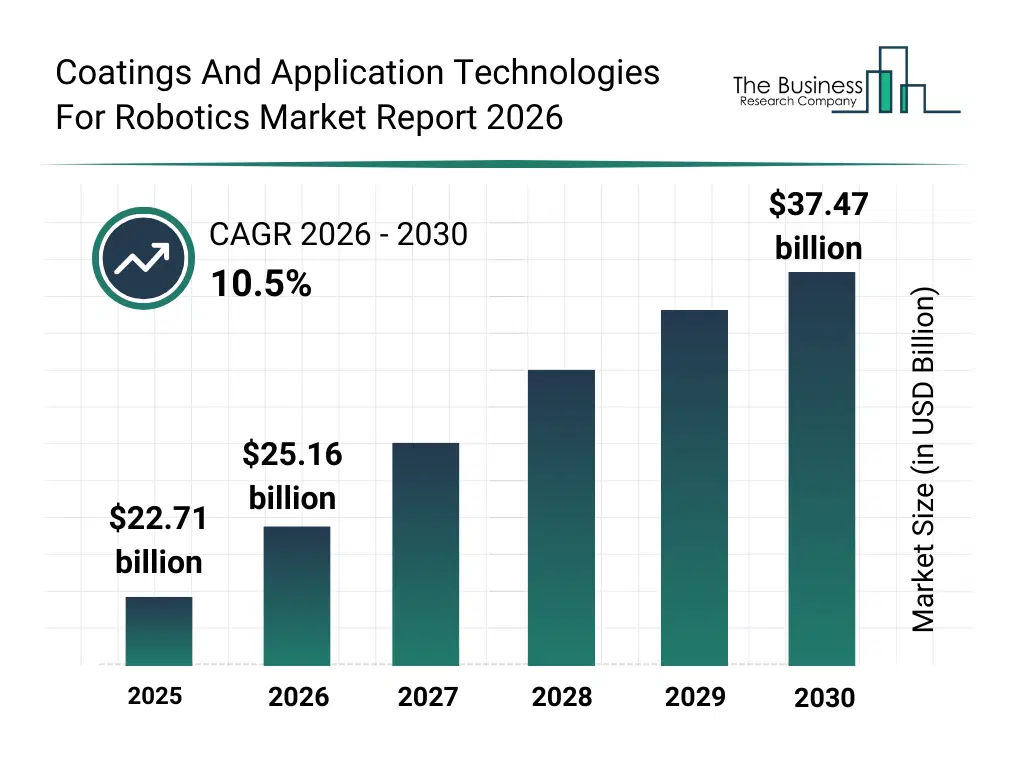
What Is The Coatings And Application Technologies For Robotics Market Size and Share 2026?
The coatings and application technologies for robotics market size has grown rapidly in recent years. It will grow from $22.71 billion in 2025 to $25.16 billion in 2026 at a compound annual growth rate (CAGR) of 10.8%. The growth in the historic period can be attributed to industrial automation growth, demand for durable robotic parts, use of protective coatings, expansion of manufacturing robotics, advancements in surface engineering.What Is The Coatings And Application Technologies For Robotics Market Growth Forecast?
The coatings and application technologies for robotics market size is expected to see rapid growth in the next few years. It will grow to $37.47 billion in 2030 at a compound annual growth rate (CAGR) of 10.5%. The growth in the forecast period can be attributed to growth in collaborative robots, expansion of smart factories, demand for high precision coatings, increasing robotics adoption across industries, development of advanced coating materials. Major trends in the forecast period include growing demand for wear resistant robotic coatings, increasing adoption of automated coating systems, rising use of low friction surface treatments, expansion of precision coating technologies, focus on corrosion protection for robotic components.
Global Coatings And Application Technologies For Robotics Market Segmentation
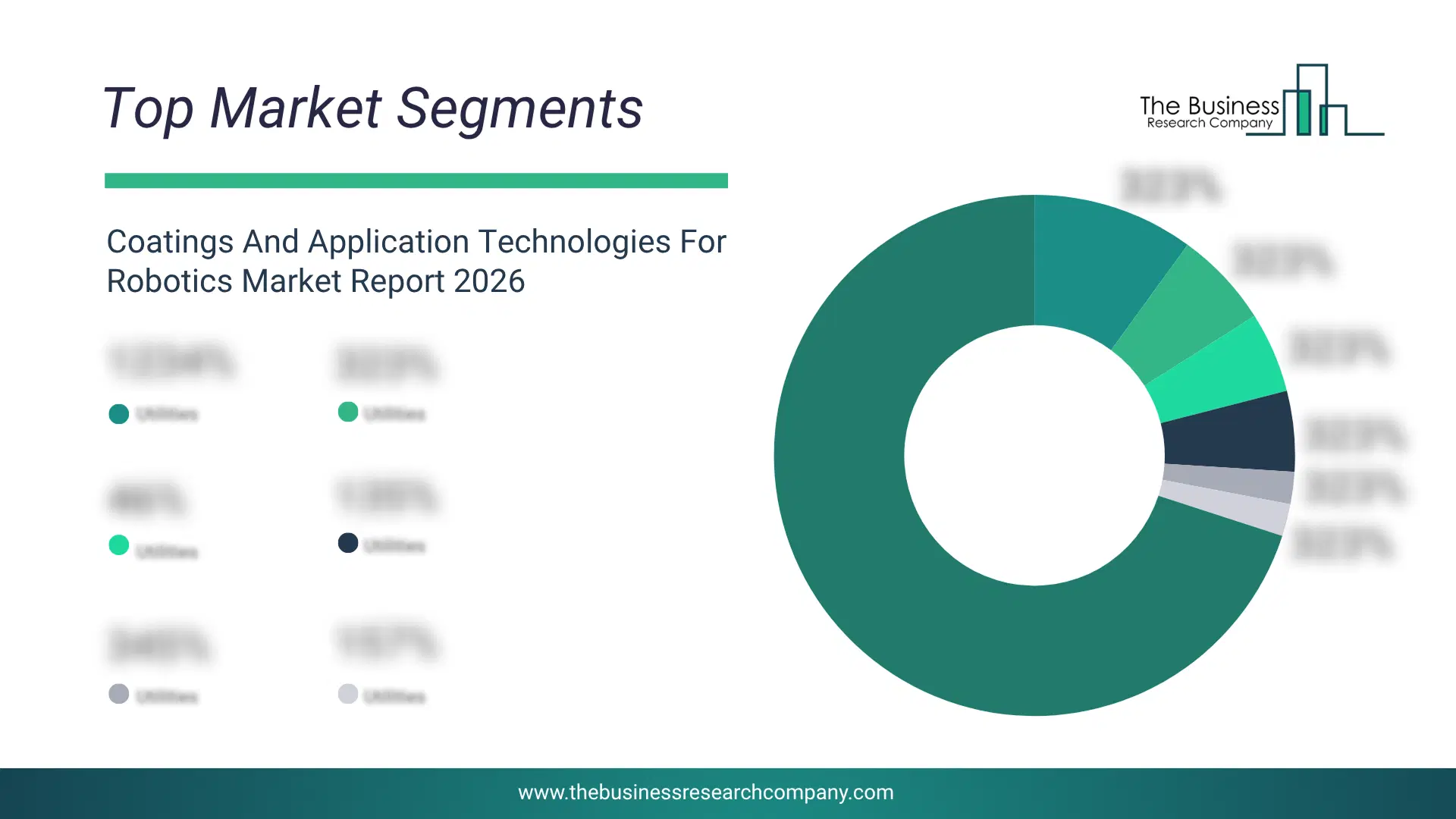
1) By Coating Technology Type: Powder, Ultra Violet Cure, Water Borne, Solvent Borne 2) By Resin Type: Acrylics, Polyurethanes, Polyester, Epoxy 3) By Coating Layer Type: Primer, Top Coat, Base Coat 4) By End-User Industry: Healthcare, Agriculture, Mining, Manufacturing, Other End-User Industries Subsegments: 1) By Powder: Electrostatic Spray, Fluidized Bed, Fusion Bonded Powder 2) By Ultra Violet Cure: Free Radical Ultra Violet Cure, Cationic Ultra Violet Cure, Dual Cure Ultra Violet Systems 3) By Water Borne: Single Component Waterborne, Two Component Waterborne, High Solids Waterborne 4) By Solvent Borne: One Component Solvent Borne, Two Component Solvent Borne, High Solids Solvent BorneWhat Is The Driver Of The Coatings And Application Technologies For Robotics Market?
The growing demand for automation in various industries is expected to propel the growth of coatings and application technologies for the robotics market going forward. Automation is the use of robotic systems and control technologies to perform tasks with minimal human input, boosting efficiency, precision, and scalability. Rising automation demand is driven by the need for efficiency, reduced human error, labor shortage solutions, and enhanced speed, quality, and cost-effectiveness across industries. Coatings and application technologies for robotics enhance automation by enabling consistent robotic performance in precision-dependent tasks and also support high-speed operations by minimizing thermal buildup and mechanical drag. For instance, in September 2023, according to the International Federation of Robotics, a Germany-based professional non-profit organization, in 2023 the industrial robot market is expected to grow by 7% to more than 590,000 units worldwide. Therefore, the growing demand for automation in various industries is driving the growth of the coatings and applications of technologies for the robotics market.Key Players In The Global Coatings And Application Technologies For Robotics Market
Major companies operating in the coatings and application technologies for robotics market are BASF SE, Henkel AG & Co. KGaA, The Sherwin‑Williams Company, Dürr Aktiengesellschaft, Nordson Corporation, Graco Inc., Tikkurila Oyj, Carlisle Fluid Technologies Inc., Rösler Oberflächentechnik GmbH, Sames Kremlin S.A.S., Hentzen Coatings Inc., Novaria Group, General Magnaplate Corporation, The Armoloy Corporation, A&A Company Inc., Praxair Surface Technologies Inc., PPG Industries, Inc., Akzo Nobel N.V., Hempel A/S, Jotun Group, Kansai Paint Co., Ltd., Nippon Paint Holdings Co., Ltd.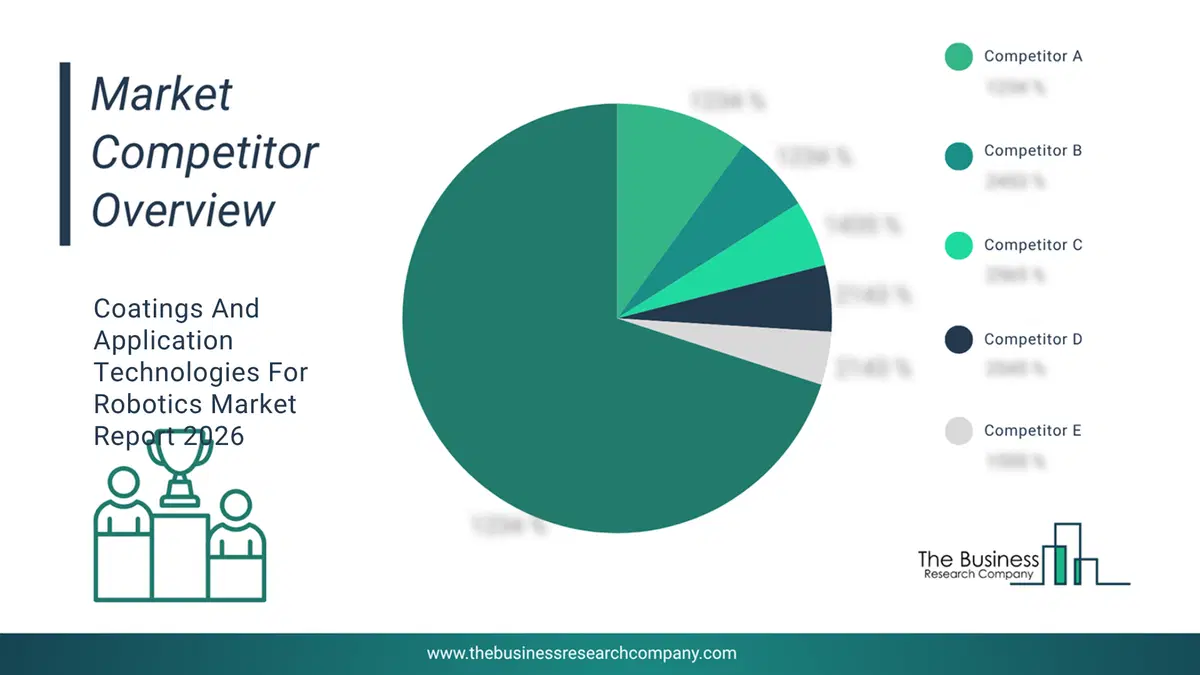
This chart is for illustrative purposes; the full report includes a detailed competitor analysis and comprehensive overview of the top 10 companies in the market.
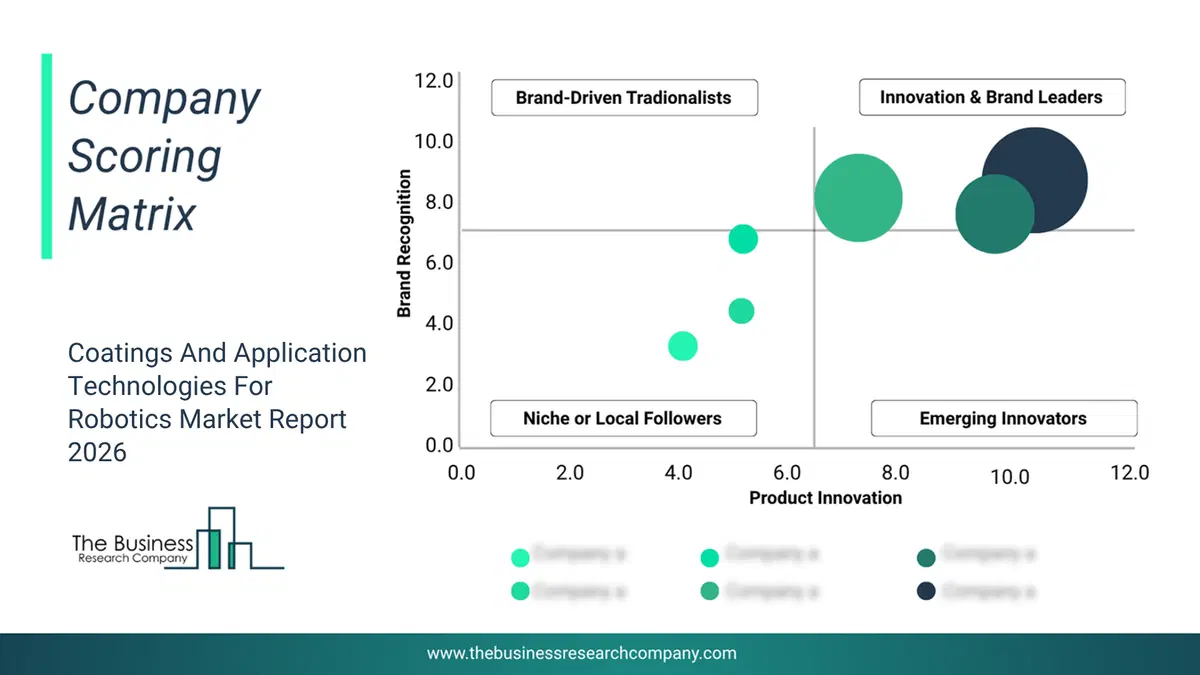
This chart maps companies by product innovation and brand strength, with bubble size indicating relative revenue, helping identify market leaders, challengers, and niche players. This is an illustrative chart; the full report provides a complete and accurate competitive analysis.
Global Coatings And Application Technologies For Robotics Market Trends and Insights
Major companies operating in the coatings and application technologies for robotics market are focusing on developing advanced solutions, such as advanced arc technology, to improve coating efficiency and sustainability in robotic component protection. Advanced arc technology is a next-generation physical vapor deposition (PVD) innovation that enhances arc control, enables multi-material coatings, and improves coating consistency for advanced applications such as robotics. For instance, in September 2024, Oerlikon Balzers, a Liechtenstein-based surface technology company, launched the INVENTA PVD Coating System, an advanced arc technology (AAT) that allows fast magnetic field adjustments, multi-material target usage, and nanolayer coating precision. It offers up to 50% higher deposition rates, 60% better material utilization, and smoother coatings, making it ideal for protecting high-tech robotic parts while reducing energy use and ownership costs. The system also includes a new chamber design, remote access capability, and smart monitoring tools to ensure operational efficiency and scalability for future coating innovations.What Are Latest Mergers And Acquisitions In The Coatings And Application Technologies For Robotics Market?
In June 2024, Denholm Industrial Services Ltd., a UK-based industrial solutions company, partnered with Qlayers B.V. to deploy advanced robotic coating technologies for major infrastructure and energy projects across the United Kingdom. With this partnership, Denholm Industrial Services and Qlayers aim to modernize large-scale coating operations by utilizing automated robotic systems that enhance application precision, reduce coating waste, improve worker safety, and ensure consistent coating quality in challenging industrial environments. Qlayers B.V. is a Netherlands-based robotics technology company that specializes in automated industrial coating solutions designed for tanks, pipelines, and large metal surfaces.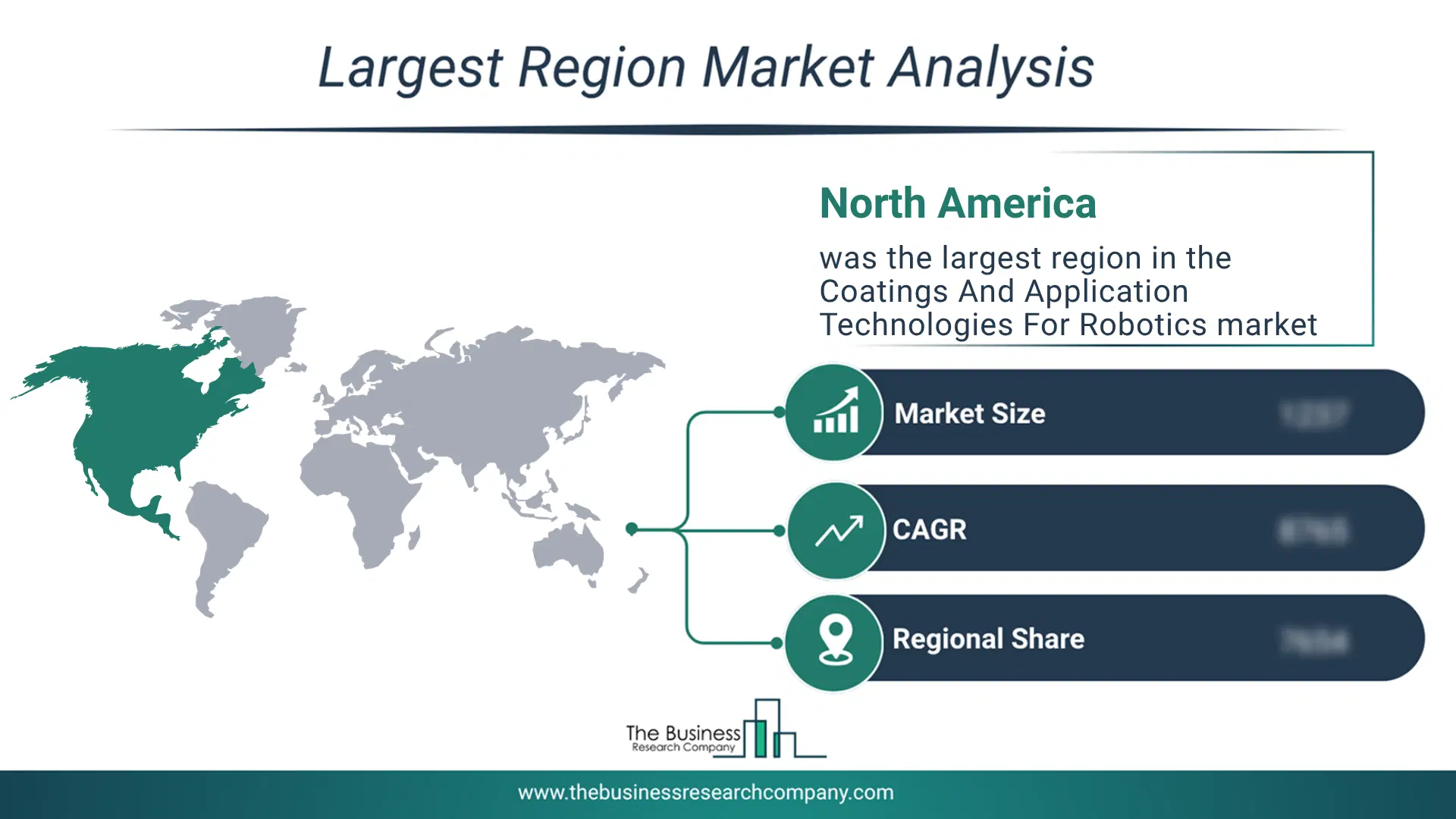
Regional Insights
North America was the largest region in the coatings and application technologies for robotics market in 2025. The regions covered in this market report are Asia-Pacific, South East Asia, Western Europe, Eastern Europe, North America, South America, Middle East, Africa The countries covered in this market report are Australia, Brazil, China, France, Germany, India, Indonesia, Japan, Taiwan, Russia, South Korea, UK, USA, Canada, Italy, SpainWhat Defines the Coatings And Application Technologies For Robotics Market?
The coatings and application technologies for robotics market consist of revenues earned by entities by providing services such as corrosion resistance, heat dissipation, electrical insulation, surface priming, and reflective coatings. The market value includes the value of related goods sold by the service provider or included within the service offering. The coatings and application technologies for the robotics market include sales of silicone coatings, ceramic coatings, thermal spray coatings, self-healing coatings, and anti-microbial coatings. Values in this market are ‘factory gate’ values, that is, the value of goods sold by the manufacturers or creators of the goods, whether to other entities (including downstream manufacturers, wholesalers, distributors, and retailers) or directly to end customers. The value of goods in this market includes related services sold by the creators of the goods.How is Market Value Defined and Measured?
The market value is defined as the revenues that enterprises gain from the sale of goods and/or services within the specified market and geography through sales, grants, or donations in terms of the currency (in USD unless otherwise specified). The revenues for a specified geography are consumption values that are revenues generated by organizations in the specified geography within the market, irrespective of where they are produced. It does not include revenues from resales along the supply chain, either further along the supply chain or as part of other products.
This chart presents market attractiveness based on a quantitative evaluation of growth, competition, strategic alignment, and risk, offering a clear view of opportunity areas for decision-making. This chart is for illustrative purposes; the full report contains the complete analysis.

This chart highlights the Total Addressable Market (TAM) by estimating the maximum revenue opportunity using an assumption-driven approach, supporting strategic planning and opportunity sizing across markets. The chart is illustrative; the full report provides a more comprehensive analysis.
What Key Data and Analysis Are Included in the Coatings And Application Technologies For Robotics Market Report 2026?
The coatings and application technologies for robotics market research report is one of a series of new reports from The Business Research Company that provides market statistics, including industry global market size, regional shares, competitors with the market share, detailed market segments, market trends and opportunities, and any further data you may need to thrive in the coatings and application technologies for robotics industry. The market research report delivers a complete perspective of everything you need, with an in-depth analysis of the current and future state of the industry.Coatings And Application Technologies For Robotics Market Report Forecast Analysis
| Report Attribute | Details |
|---|---|
| Market Size Value In 2026 | $25.16 billion |
| Revenue Forecast In 2030 | $37.47 billion |
| Growth Rate | CAGR of 10.8% from 2026 to 2030 |
| Base Year For Estimation | 2025 |
| Actual Estimates/Historical Data | 2020-2025 |
| Forecast Period | 2026 - 2030 |
| Market Representation | Revenue in USD Billion and CAGR from 2026 to 2030 |
| Segments Covered | Coating Technology Type, Resin Type, Coating Layer Type, End-User Industry |
| Regional Scope | Asia-Pacific, Western Europe, Eastern Europe, North America, South America, Middle East, Africa |
| Country Scope | The countries covered in this market report are Australia, Brazil, China, France, Germany, India, Indonesia, Japan, Taiwan, Russia, South Korea, UK, USA, Canada, Italy, Spain |
| Key Companies Profiled | BASF SE, Henkel AG & Co. KGaA, The Sherwin‑Williams Company, Dürr Aktiengesellschaft, Nordson Corporation, Graco Inc., Tikkurila Oyj, Carlisle Fluid Technologies Inc., Rösler Oberflächentechnik GmbH, Sames Kremlin S.A.S., Hentzen Coatings Inc., Novaria Group, General Magnaplate Corporation, The Armoloy Corporation, A&A Company Inc., Praxair Surface Technologies Inc., PPG Industries, Inc., Akzo Nobel N.V., Hempel A/S, Jotun Group, Kansai Paint Co., Ltd., Nippon Paint Holdings Co., Ltd. |
| Customization Scope | Request for Customization |
| Pricing And Purchase Options | Explore Purchase Options |