

Code Supply Chain Insurance Market Report 2026
Global Outlook – By Coverage Type (First-Party Coverage, Third-Party Liability, Business Interruption, Cyber Risk, Other Coverage Types), By Organization Size (Small And Medium Enterprises, Large Enterprises), By Distribution Channel (Direct Sales, Brokers, Online Platforms, Other Distribution Channels), By End-User (Technology Companies, Software Vendors, Managed Service Providers, Financial Institutions, Healthcare, Other End-Users) – Market Size, Trends, Strategies, and Forecast to 2030
Code Supply Chain Insurance Market Overview
• Code Supply Chain Insurance market size has reached to $1.9 billion in 2025 • Expected to grow to $6.1 billion in 2030 at a compound annual growth rate (CAGR) of 26.2% • Growth Driver: Increasing Cyber Threats Fueling Growth Due To Rising Digital Connectivity And Vulnerabilities • Market Trend: Advancing Insurance Resilience Through Secure Integration And Digital Connectivity Platforms • North America was the largest region in 2025 and Asia-Pacific is the fastest growing region.What Is Covered Under Code Supply Chain Insurance Market?
Code supply chain insurance refers to a specialized form of cybersecurity insurance that protects organizations from financial losses arising from vulnerabilities, breaches, or disruptions within their software supply chain. It covers risks associated with compromised open-source libraries, third-party code dependencies, and malicious software integrations. This insurance helps companies mitigate potential damages by providing financial support for incident response, remediation, and recovery efforts. The main coverage types in code supply chain insurance are first-party coverage, third-party liability, business interruption, cyber risk, and others. First-party coverage in the code supply chain insurance market refers to protection that compensates an organization for its own direct losses arising from disruptions, breaches, or damages within its software or code supply chain systems. The organization sizes in these are small and medium enterprises and large enterprises, distributed through various channels including direct sales, brokers, online platforms, and others, in the end-users including technology companies, software vendors, managed service providers, financial institutions, healthcare, and others.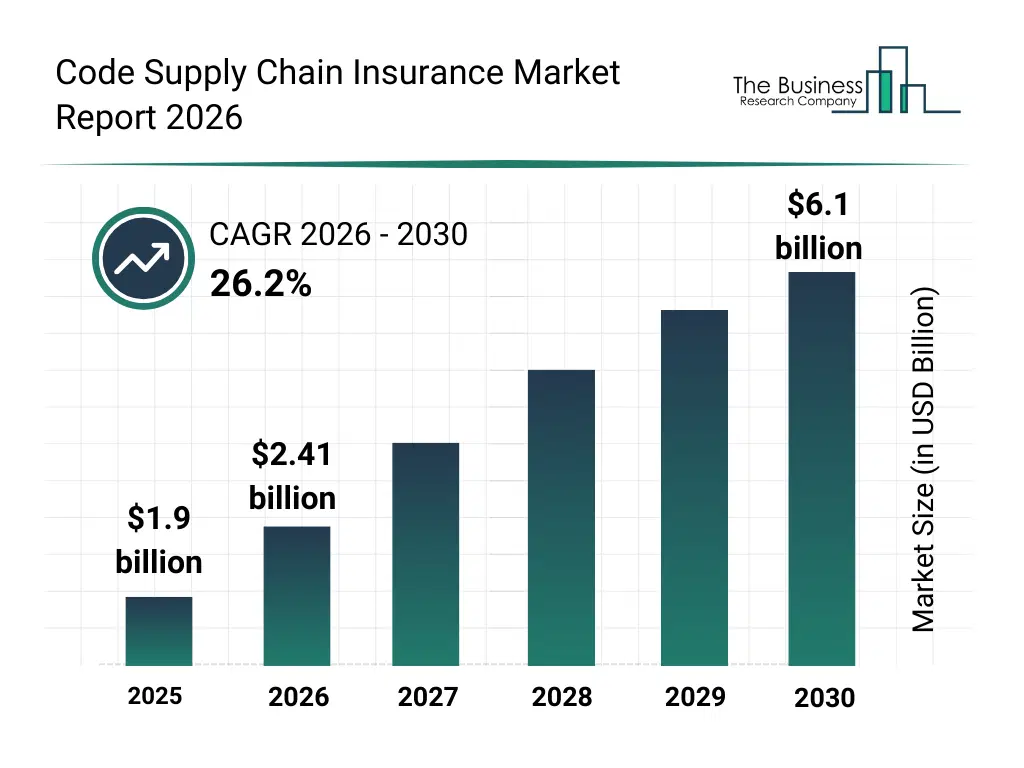
What Is The Code Supply Chain Insurance Market Size and Share 2026?
The code supply chain insurance market size has grown exponentially in recent years. It will grow from $1.9 billion in 2025 to $2.41 billion in 2026 at a compound annual growth rate (CAGR) of 26.5%. The growth in the historic period can be attributed to increasing reliance on third-party software components, rise in software supply chain attacks, expansion of cloud-native application development, growing awareness of cyber insurance products, early adoption by technology firms.What Is The Code Supply Chain Insurance Market Growth Forecast?
The code supply chain insurance market size is expected to see exponential growth in the next few years. It will grow to $6.1 billion in 2030 at a compound annual growth rate (CAGR) of 26.2%. The growth in the forecast period can be attributed to increasing regulatory focus on software security accountability, rising demand for comprehensive cyber risk transfer, expansion of devsecops adoption, growing integration of insurance with security tooling, increasing software dependency across industries. Major trends in the forecast period include growing adoption of software supply chain risk coverage, rising demand for open-source vulnerability protection, expansion of incident response insurance policies, increased focus on third-party code risk assessment, enhanced integration with devsecops practices.
Global Code Supply Chain Insurance Market Segmentation
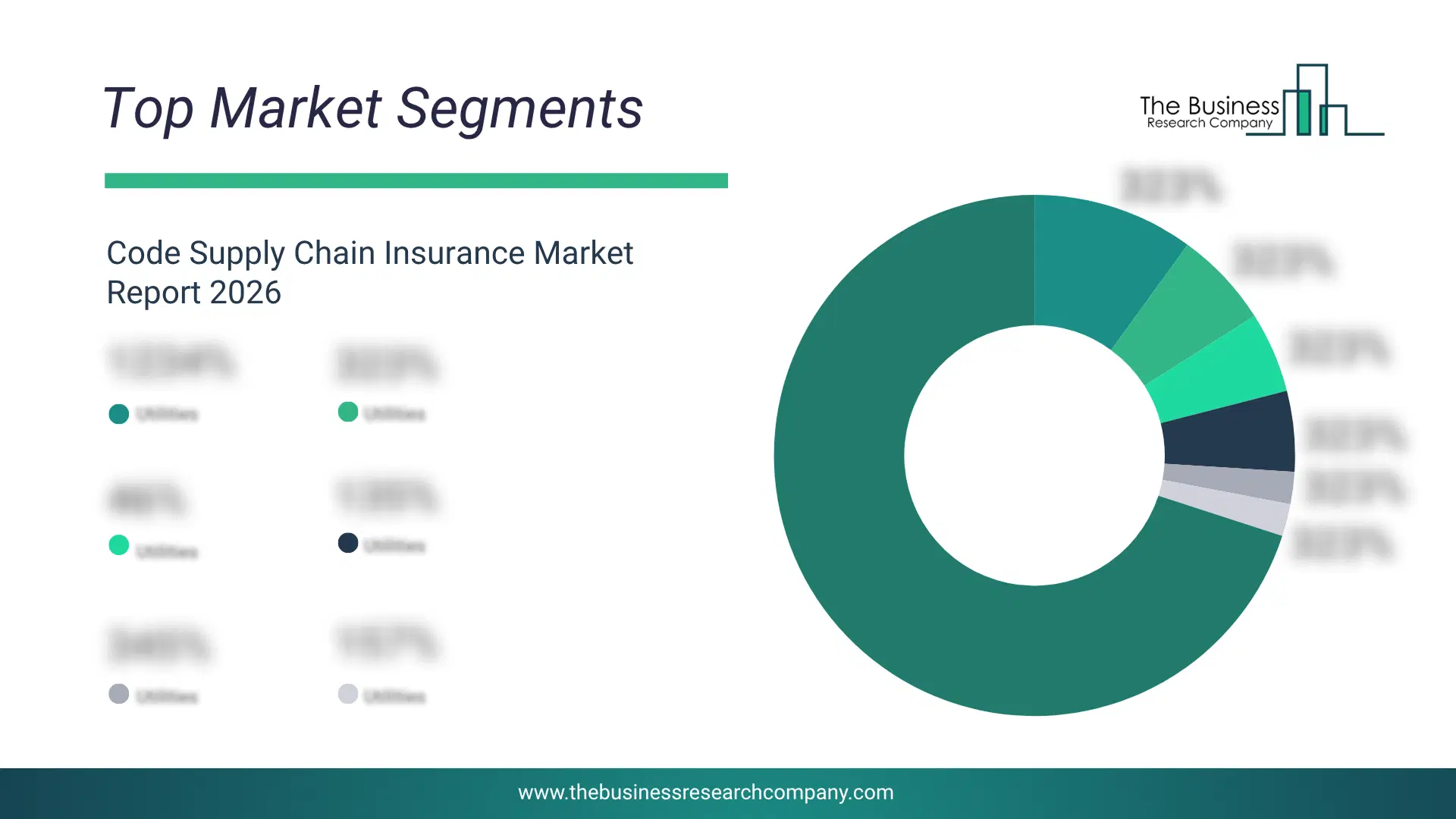
1) By Coverage Type: First-Party Coverage, Third-Party Liability, Business Interruption, Cyber Risk, Other Coverage Types 2) By Organization Size: Small And Medium Enterprises, Large Enterprises 3) By Distribution Channel: Direct Sales, Brokers, Online Platforms, Other Distribution Channels 4) By End-User: Technology Companies, Software Vendors, Managed Service Providers, Financial Institutions, Healthcare, Other End-Users Subsegments: 1) By First-Party Coverage: Data Breach Expenses, Incident Response Costs, Digital Asset Restoration, System Damage Repair, Notification And Credit Monitoring 2) By Third-Party Liability: Technology Errors And Omissions, Vendor Negligence Claims, Contractual Liability, Legal Defense Costs, Regulatory Penalties 3) By Business Interruption: Operational Downtime Losses, Revenue Replacement, Supply Chain Disruption Coverage, Contingent Business Interruption, Extra Expense Reimbursement 4) By Cyber Risk: Malware And Ransomware Protection, Phishing And Social Engineering Coverage, Data Integrity Protection, Unauthorized Access Mitigation, Cloud Service Attack Coverage 5) By Other Coverage Types: Reputational Damage Coverage, Intellectual Property Infringement, System Failure Liability, Compliance And Audit Expense Coverage, Employee Misconduct CoverageWhat Is The Driver Of The Code Supply Chain Insurance Market?
The increasing cyber threats are expected to propel the growth of the code supply chain insurance market going forward. Cyber threat refers to any malicious attempt or potential danger that seeks to damage, disrupt, or gain unauthorized access to computer systems, networks, or digital data. The rise in cyber threats is driven by growing digital connectivity, as increased use of online platforms and connected devices creates more vulnerabilities for malicious attacks. Code supply chain insurance helps address increasing cyber threats by providing financial protection and risk mitigation support against attacks or breaches originating from compromised third-party code and software dependencies. For instance, in July 2025, Check Point Software Technologies Ltd., an Israel-based cybersecurity company, reported that the global average of weekly cyberattacks per organization rose to 1,984 in Q2 2025, marking a 21% increase from the same period in 2024 and a 58% rise compared to two years earlier. Therefore, the increasing cyber threats are driving the growth of the code supply chain insurance industry.Key Players In The Global Code Supply Chain Insurance Market
Major companies operating in the code supply chain insurance market are AXA XL, Zurich Insurance Group, Lloyd’s of London, Chubb, Liberty Mutual Insurance, Tokio Marine Holdings, Swiss Re, Munich Re, Travelers Insurance, AIG (American International Group), Sompo International, Marsh McLennan, Allianz Global Corporate & Specialty, QBE Insurance Group, Markel Corporation, Arch Insurance Group, CNA Financial Corporation, Hiscox, Berkshire Hathaway Specialty Insurance, Beazley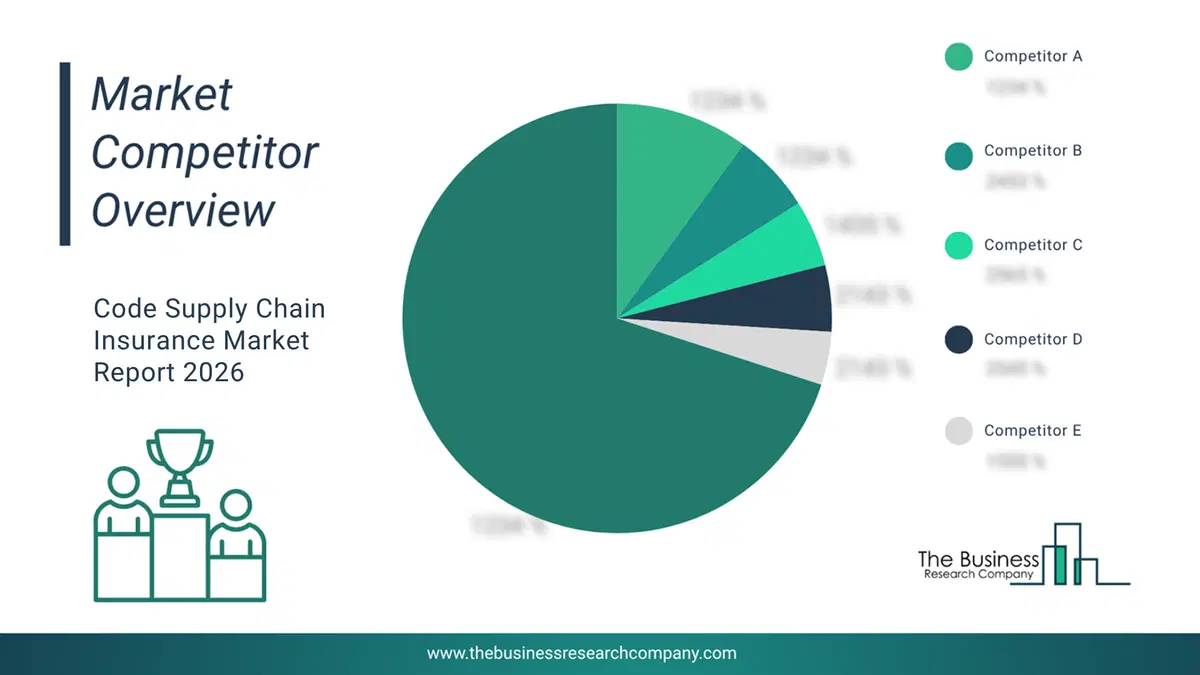
This chart is for illustrative purposes; the full report includes a detailed competitor analysis and comprehensive overview of the top 10 companies in the market.
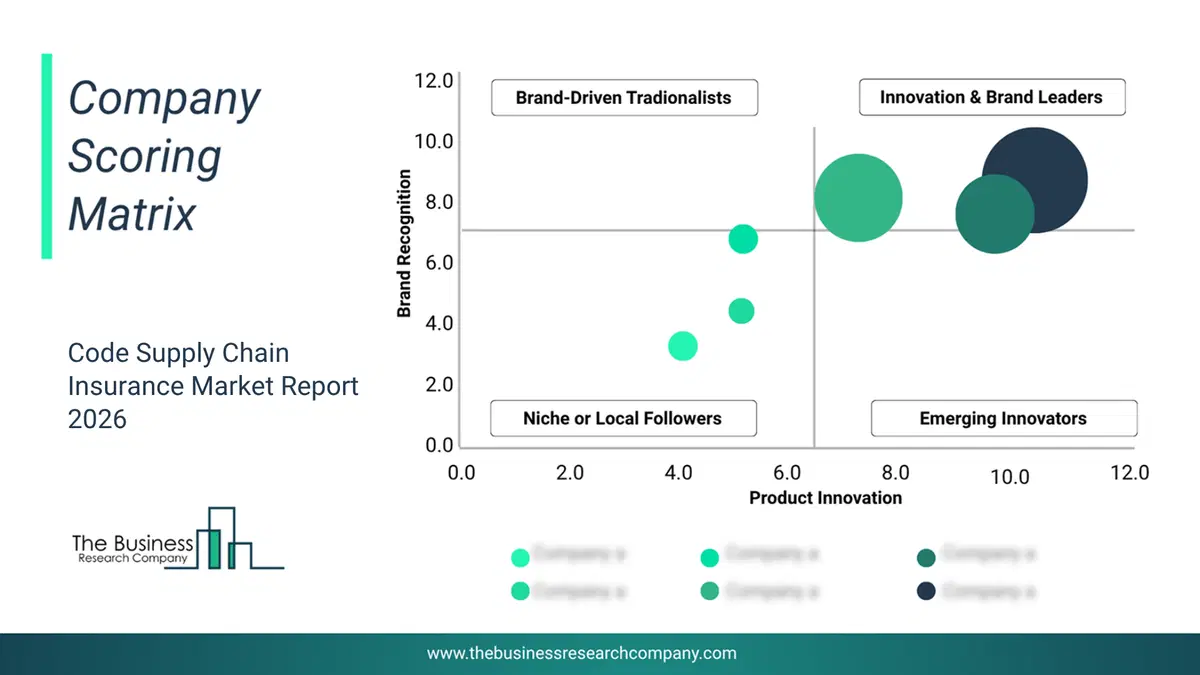
This chart maps companies by product innovation and brand strength, with bubble size indicating relative revenue, helping identify market leaders, challengers, and niche players. This is an illustrative chart; the full report provides a complete and accurate competitive analysis.
Global Code Supply Chain Insurance Market Trends and Insights
Major companies operating in the code supply chain insurance market are focusing on developing innovative advancements such as secure integration platforms to enhance operational efficiency, resilience, and risk control across interconnected insurance technology ecosystems. A secure integration platform is a cloud-based digital framework that enables seamless, standardized, and protected data and system connectivity between multiple stakeholders, reducing cybersecurity risks and operational fragmentation in technology-driven environments. For instance, in October 2025, DXC Technology, a US-based global information technology services provider, launched the DXC APEX (Assure Platform Ecosystem Exchange) Program. The program introduces a centralized hub that facilitates certified, pre-built integrations between insurers, brokers, and Insurtech providers, significantly simplifying interoperability and reducing integration costs. It further enhances security, accelerates the adoption of emerging technologies, and supports the digital transformation of insurance operations through artificial intelligence–driven automation and compliance-enabled cloud services.What Are Latest Mergers And Acquisitions In The Code Supply Chain Insurance Market?
In July 2025, Zurich Insurance Group (Zurich), a Switzerland-based multi-line insurer that provides a wide range of general and life insurance products, acquired BOXX Insurance Inc. for an undisclosed amount. Through this acquisition, Zurich aims to strengthen its cyber protection capabilities by integrating BOXX’s digital-first and service-led cyber insurance solutions to enhance coverage for retail and small- to medium-sized enterprise customers. BOXX Insurance Inc. is a Canada-based Insurtech company,that provides cyber insurance and protection services for businesses, individuals, and families to help them defend against cyber threats.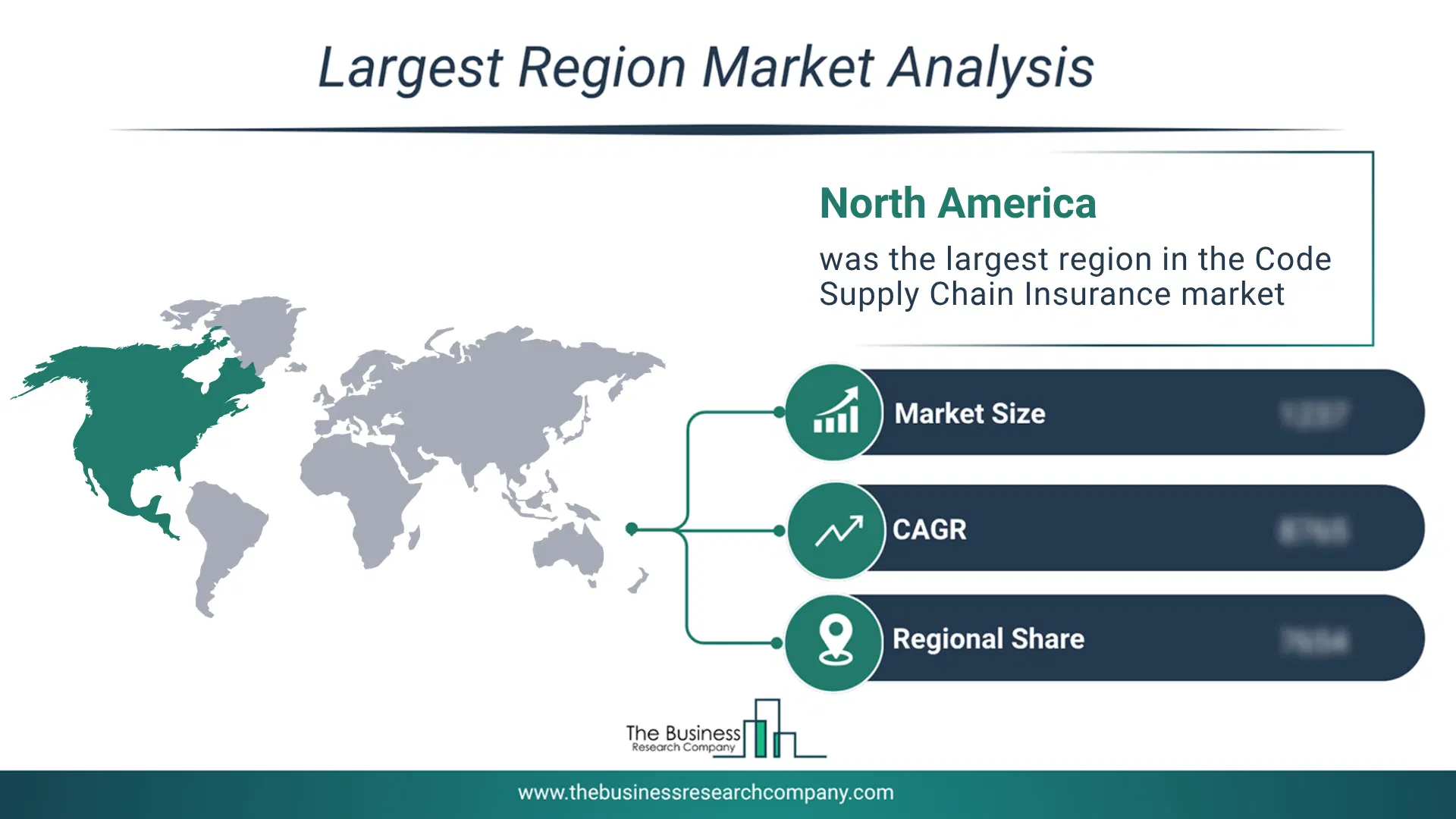
Regional Outlook
North America was the largest region in the code supply chain insurance market in 2025. Asia-Pacific is expected to be the fastest-growing region in the forecast period. The regions covered in this market report are Asia-Pacific, South East Asia, Western Europe, Eastern Europe, North America, South America, Middle East, Africa. The countries covered in this market report are Australia, Brazil, China, France, Germany, India, Indonesia, Japan, Taiwan, Russia, South Korea, UK, USA, Canada, Italy, Spain.What Defines the Code Supply Chain Insurance Market?
The code supply chain insurance market includes revenues earned by entities by providing services such as cyber risk assessment, vulnerability management, incident response, threat intelligence, code audit, penetration testing, compliance consulting, software bill of materials analysis, risk underwriting, policy management, claims handling, security monitoring, breach investigation, third-party risk management, data recovery, cloud security assessment. The market value includes the value of related goods sold by the service provider or included within the service offering. Only goods and services traded between entities or sold to end consumers are included.How is Market Value Defined and Measured?
The market value is defined as the revenues that enterprises gain from the sale of goods and/or services within the specified market and geography through sales, grants, or donations in terms of the currency (in USD unless otherwise specified). The revenues for a specified geography are consumption values that are revenues generated by organizations in the specified geography within the market, irrespective of where they are produced. It does not include revenues from resales along the supply chain, either further along the supply chain or as part of other products.
This chart presents market attractiveness based on a quantitative evaluation of growth, competition, strategic alignment, and risk, offering a clear view of opportunity areas for decision-making. This chart is for illustrative purposes; the full report contains the complete analysis.

This chart highlights the Total Addressable Market (TAM) by estimating the maximum revenue opportunity using an assumption-driven approach, supporting strategic planning and opportunity sizing across markets. The chart is illustrative; the full report provides a more comprehensive analysis.
What Key Data and Analysis Are Included in the Code Supply Chain Insurance Market Report 2026?
The code supply chain insurance market research report is one of a series of new reports from The Business Research Company that provides market statistics, including Market Report 2026?global market size, regional shares, competitors with the market share, detailed market segments, market trends and opportunities, and any further data you may need to thrive in the code supply chain insurance Market Report 2026? The market research report delivers a complete perspective of everything you need, with an in-depth analysis of the current and future state of the Market Report 2026?Code Supply Chain Insurance Market Report Forecast Analysis
| Report Attribute | Details |
|---|---|
| Market Size Value In 2026 | $2.41 billion |
| Revenue Forecast In 2030 | $6.1 billion |
| Growth Rate | CAGR of 26.5% from 2026 to 2030 |
| Base Year For Estimation | 2025 |
| Actual Estimates/Historical Data | 2020-2025 |
| Forecast Period | 2026 - 2030 |
| Market Representation | Revenue in USD Billion and CAGR from 2026 to 2030 |
| Segments Covered | Coverage Type, Organization Size, Distribution Channel, End-User |
| Regional Scope | Asia-Pacific, Western Europe, Eastern Europe, North America, South America, Middle East, Africa |
| Country Scope | The countries covered in the report are Australia, Brazil, China, France, Germany, India, Indonesia, Japan, Taiwan, Russia, South Korea, UK, USA, Canada, Italy, Spain. |
| Key Companies Profiled | AXA XL, Zurich Insurance Group, Lloyd’s of London, Chubb, Liberty Mutual Insurance, Tokio Marine Holdings, Swiss Re, Munich Re, Travelers Insurance, AIG (American International Group), Sompo International, Marsh McLennan, Allianz Global Corporate & Specialty, QBE Insurance Group, Markel Corporation, Arch Insurance Group, CNA Financial Corporation, Hiscox, Berkshire Hathaway Specialty Insurance, Beazley |
| Customization Scope | Request for Customization |
| Pricing And Purchase Options | Explore Purchase Options |