
Cognitive Supply Chain Market Report 2026
Global Outlook – By Offering (Solutions, Forecasting, Analytics, Inventory Management, Risk Management, Other Offerings), By Deployment (Cloud, On-Premise), By Enterprise Size (Large Enterprises, Small And Medium Enterprises (SMEs)), By End Use (Healthcare, Food And Beverages, Transportation And Logistics, Retail And E-commerce, Other End-uses) – Market Size, Trends, Strategies, and Forecast to 2030
Cognitive Supply Chain Market Overview
• Cognitive Supply Chain market size has reached to $10.05 billion in 2025 • Expected to grow to $19.06 billion in 2030 at a compound annual growth rate (CAGR) of 13.6% • Growth Driver: E-commerce Growth Fuels Expansion Of The Cognitive Supply Chain Market • Market Trend: Advancements In Cognitive Supply Chain Management With The Emergence Of AI Tools • North America was the largest region in 2025 and Asia-Pacific is the fastest growing region.What Is Covered Under Cognitive Supply Chain Market?
A cognitive supply chain refers to a supply chain that incorporates cognitive technologies, such as artificial intelligence (AI), machine learning (ML), and advanced analytics, to enhance and optimize its various processes. It involves the use of intelligent systems to make supply chain operations smarter, more efficient, and more responsive by automating jobs, anticipating outcomes, and delivering real-time information. The main types of cognitive supply chains are solutions, forecasting, analytics, inventory management, risk management, and others. A solution refers to a software program, algorithm, or system designed to solve a specific task or address a particular problem. These can be deployed on the cloud and on-premise and used by large enterprises and small and medium enterprises (SMEs). These are used by various end-users, such as healthcare, food and beverages, transportation and logistics, retail and e-commerce, and others.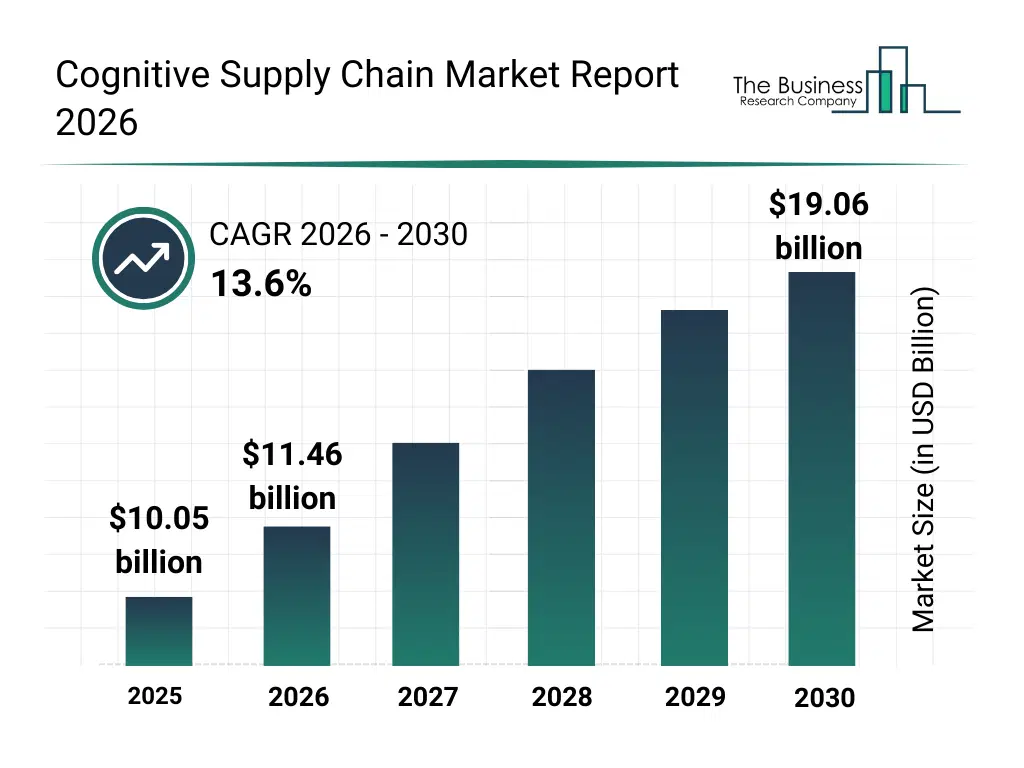
What Is The Cognitive Supply Chain Market Size and Share 2026?
The cognitive supply chain market size has grown rapidly in recent years. It will grow from $10.05 billion in 2025 to $11.46 billion in 2026 at a compound annual growth rate (CAGR) of 14.0%. The growth in the historic period can be attributed to rise in global supply chain complexity, increasing adoption of AI and ml solutions, demand for real-time supply chain visibility, growth of cloud-based supply chain platforms, need for inventory optimization.What Is The Cognitive Supply Chain Market Growth Forecast?
The cognitive supply chain market size is expected to see rapid growth in the next few years. It will grow to $19.06 billion in 2030 at a compound annual growth rate (CAGR) of 13.6%. The growth in the forecast period can be attributed to integration of blockchain in supply chain, adoption of predictive and prescriptive analytics, expansion of intelligent automation solutions, growth across healthcare, retail and logistics sectors, increased focus on risk management and resilience. Major trends in the forecast period include supply chain optimization, intelligent automation implementation, predictive and prescriptive analytics, inventory optimization and stock replenishment, risk assessment and mitigation.
Global Cognitive Supply Chain Market Segmentation
1) By Offering: Solutions, Forecasting, Analytics, Inventory Management, Risk Management, Other Offerings 2) By Deployment: Cloud, On-Premise 3) By Enterprise Size: Large Enterprises, Small And Medium Enterprises (SMEs) 4) By End Use: Healthcare, Food And Beverages, Transportation And Logistics, Retail And E-commerce, Other End-uses Subsegments: 1) By Solutions: Supply Chain Optimization, Intelligent Automation 2) By Forecasting: Demand Forecasting, Supply Forecasting 3) By Analytics: Descriptive Analytics, Predictive Analytics, Prescriptive Analytics 4) By Inventory Management: Inventory Optimization, Stock Replenishment 5) By Risk Management: Risk Assessment, Risk Mitigation 6) By Other Offerings: Blockchain Integration, Artificial Intelligence (AI) Integration, Machine Learning SolutionsWhat Is The Driver Of The Cognitive Supply Chain Market?
The growing e-commerce industry is expected to propel the growth of the cognitive supply chain market moving forward. E-commerce involves the exchange of goods and services conducted electronically, primarily over the Internet or through digital platforms. The e-commerce sector is experiencing rapid growth due to the proliferation of smartphones, increased internet penetration, and increasing demand for seamless payment and delivery options. The cognitive supply chain enhances efficiency and decision-making in the e-commerce industry by leveraging advanced technologies such as artificial intelligence (AI) and machine learning for intelligent data analysis and optimization. For instance, in February 2024, according to the United States Census Bureau, a US-based government agency, e-commerce sales for the fourth quarter of 2023 were $285.2 billion, which is a 0.8% increase from the third quarter of 2023. The estimated e-commerce sales for the fourth quarter of 2023 have increased by 7.5% (±1.2%) from the fourth quarter of 2022. Additionally, E-commerce sales accounted for 15.6% of the total sales in the fourth quarter of 2023. Therefore, the growing e-commerce industry is driving the growth of the cognitive supply chain industry.Key Players In The Global Cognitive Supply Chain Market
Major companies operating in the cognitive supply chain market are Amazon.com Inc.; Microsoft Corporation; Siemens AG; Intel Corporation (partial); Accenture plc; IBM Corporation; Oracle Corporation; Honeywell International Inc.; SAP SE; NVIDIA Corporation (partial); C.H. Robinson Worldwide Inc; SAS Institute Inc.; Panasonic Corporation (partial); Coupa Software Inc.; JDA Software Group Inc.; WiseTech Global Limited; E2open LLC; Kinaxis Inc.; Relex Solutions Ltd.; Logility Inc.; FourKites Inc.; Savi Technology Inc.; TransVoyant LLC; Terra Technology LLC; ClearMetal Inc.; Llamasoft Inc.
This chart is for illustrative purposes; the full report includes a detailed competitor analysis and comprehensive overview of the top 10 companies in the market.
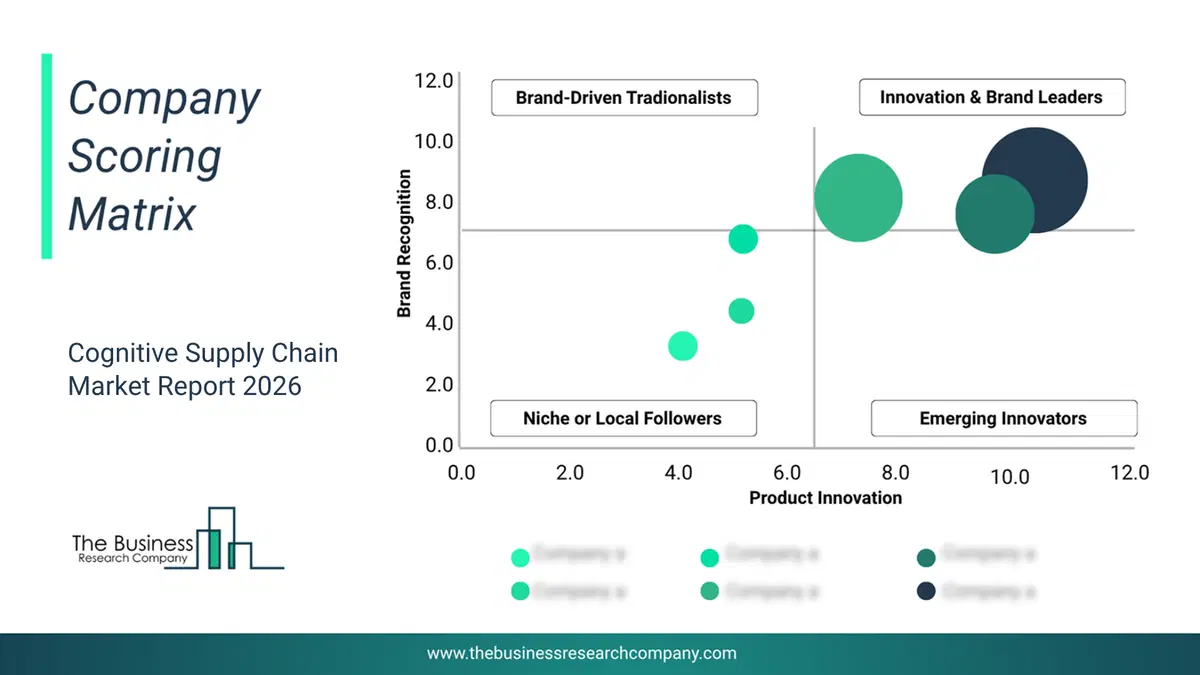
This chart maps companies by product innovation and brand strength, with bubble size indicating relative revenue, helping identify market leaders, challengers, and niche players. This is an illustrative chart; the full report provides a complete and accurate competitive analysis.
Global Cognitive Supply Chain Market Trends and Insights
Major companies operating in the cognitive supply chain market are increasing their focus on developing advanced solutions, such as AI (artificial intelligence) supply chain management tools, to gain a competitive edge in the market. An AI-based supply chain management tool is a software solution leveraging artificial intelligence (AI) technologies to optimize and streamline various aspects of the supply chain. For instance, in December 2023, Blue Yonder, a US-based supply chain management company, launched Blue Yonder Orchestrator, a new AI supply chain management tool as part of its Luminate Cognitive Platform. The tool combines large language models, cloud data, and prompt engineering to provide supply chain recommendations. Blue Yonder Orchestrator enables companies to derive value from their data, allowing business users to access recommendations, predictive insights, and intelligent decisions quickly to ensure the best outcomes for their supply chain.What Are Latest Mergers And Acquisitions In The Cognitive Supply Chain Market?
In February 2024, Blue Yonder, a US-based supply chain management company, acquired Flexis AG for an undisclosed amount. The acquisition aimed to strengthen Blue Yonder's capabilities to help businesses that offer highly configurable products and have extensive supplier networks plan and optimize their complex production facilities and network structures. Flexis AG is a Germany-based technology company that specializes in providing AI-driven optimization software and flexible information systems for supply chain management.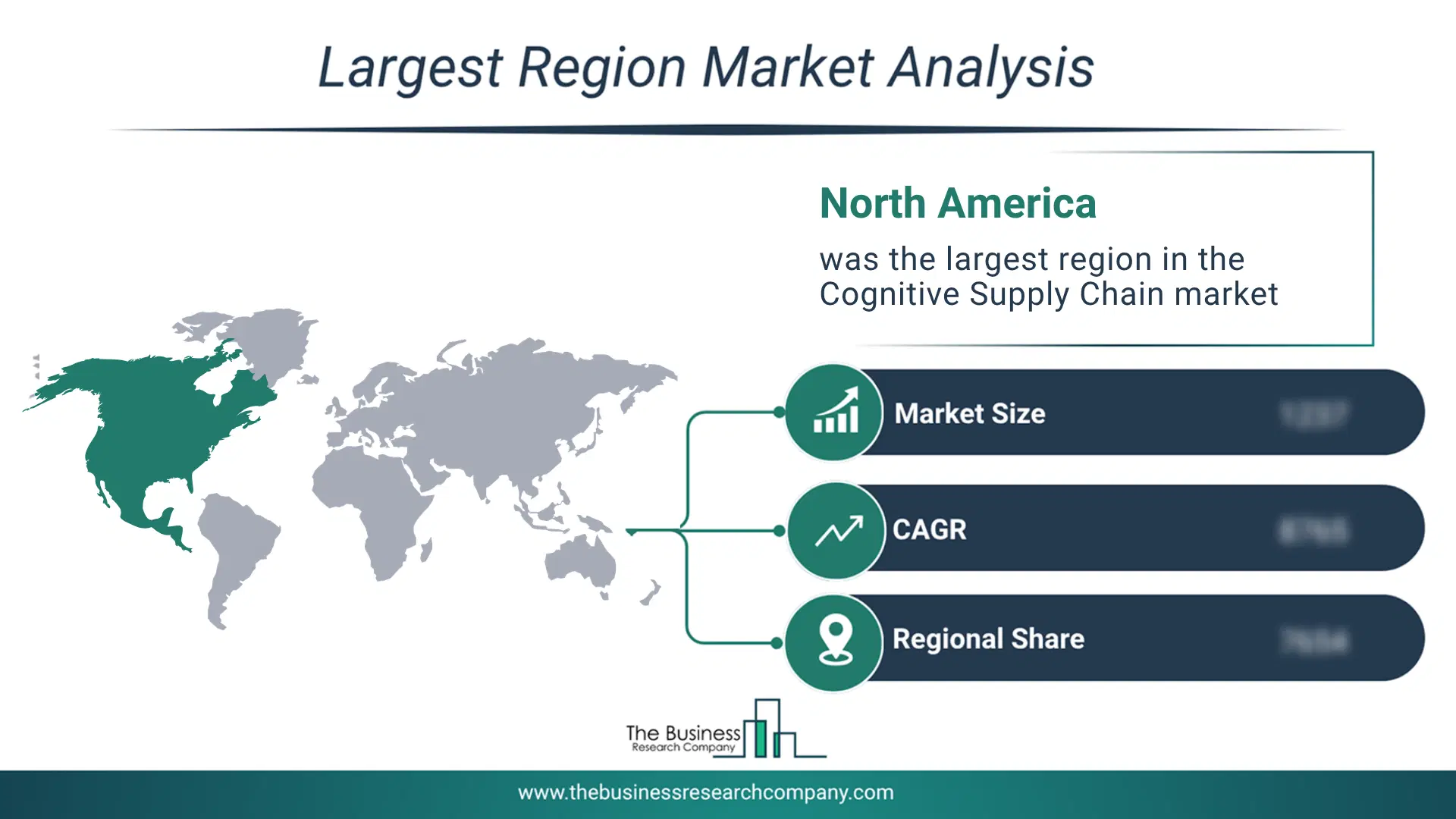
Regional Insights
North America was the largest region in the cognitive supply chain market in 2025. Asia-Pacific is expected to be the fastest-growing region in the forecast period. The regions covered in this market report are Asia-Pacific, South East Asia, Western Europe, Eastern Europe, North America, South America, Middle East, Africa. The countries covered in this market report are Australia, Brazil, China, France, Germany, India, Indonesia, Japan, Taiwan, Russia, South Korea, UK, USA, Canada, Italy, SpainWhat Defines the Cognitive Supply Chain Market?
The cognitive supply chain market includes revenues earned by entities by providing services such as demand forecasting and planning services, inventory optimization services, order fulfillment optimization services, and warehouse automation services. The market value includes the value of related goods sold by the service provider or included within the service offering. Only goods and services traded between entities or sold to end consumers are included.How is Market Value Defined and Measured?
The market value is defined as the revenues that enterprises gain from the sale of goods and/or services within the specified market and geography through sales, grants, or donations in terms of the currency (in USD unless otherwise specified). The revenues for a specified geography are consumption values that are revenues generated by organizations in the specified geography within the market, irrespective of where they are produced. It does not include revenues from resales along the supply chain, either further along the supply chain or as part of other products.
This chart presents market attractiveness based on a quantitative evaluation of growth, competition, strategic alignment, and risk, offering a clear view of opportunity areas for decision-making. This chart is for illustrative purposes; the full report contains the complete analysis.

This chart highlights the Total Addressable Market (TAM) by estimating the maximum revenue opportunity using an assumption-driven approach, supporting strategic planning and opportunity sizing across markets. The chart is illustrative; the full report provides a more comprehensive analysis.
What Key Data and Analysis Are Included in the Cognitive Supply Chain Market Report 2026?
The cognitive supply chain market research report is one of a series of new reports from The Business Research Company that provides market statistics, including industry global market size, regional shares, competitors with the market share, detailed market segments, market trends and opportunities, and any further data you may need to thrive in the cognitive supply chain industry. The market research report delivers a complete perspective of everything you need, with an in-depth analysis of the current and future state of the industry.Cognitive Supply Chain Market Report Forecast Analysis
| Report Attribute | Details |
|---|---|
| Market Size Value In 2026 | $11.46 billion |
| Revenue Forecast In 2030 | $19.06 billion |
| Growth Rate | CAGR of 13.6% from 2026 to 2030 |
| Base Year For Estimation | 2025 |
| Actual Estimates/Historical Data | 2020-2025 |
| Forecast Period | 2026 - 2030 |
| Market Representation | Revenue in USD Billion and CAGR from 2026 to 2030 |
| Segments Covered | Offering, Deployment, Enterprise Size, End Use |
| Regional Scope | Asia-Pacific, Western Europe, Eastern Europe, North America, South America, Middle East, Africa |
| Country Scope | The Countries Covered In This Market Report Are Australia, Brazil, China, France, Germany, India, Indonesia, Japan, Taiwan, Russia, South Korea, Uk, Usa, Canada, Italy, Spain. |
| Key Companies Profiled | Amazon.com Inc., Microsoft Corporation, Siemens AG, Intel Corporation (partial), Accenture plc, IBM Corporation, Oracle Corporation, Honeywell International Inc., SAP SE, NVIDIA Corporation (partial), C.H. Robinson Worldwide Inc, SAS Institute Inc., Panasonic Corporation (partial), Coupa Software Inc., JDA Software Group Inc., WiseTech Global Limited, E2open LLC, Kinaxis Inc., Relex Solutions Ltd., Logility Inc., FourKites Inc., Savi Technology Inc., TransVoyant LLC, Terra Technology LLC, ClearMetal Inc., Llamasoft Inc. |
| Customization Scope | Request for Customization |
| Pricing And Purchase Options | Explore Purchase Options |