
Coke Dry Quenching (CDQ) Equipment Market Report 2026
Global Outlook – By Type (Coke Dry Quenching Cooling Room, Circulation Fan, Waste Heat Boiler, Coke Tanker, Other Coke Dry Quenching Equipment), By Capacity (Less Than 100 Ton Per Hour, 100 To 250 Ton Per Hour, More Than 250 Ton Per Hour), By Deployment (New Installations, Retrofits And Upgrades), By End User (Steel Manufacturers, Coke Producers, Metallurgical Industry, Power And Energy Sector, Industrial Engineering Firms) – Market Size, Trends, Strategies, and Forecast to 2030
Coke Dry Quenching (CDQ) Equipment Market Overview
• Coke Dry Quenching (CDQ) Equipment market size has reached to $0.76 billion in 2025 • Expected to grow to $1.07 billion in 2030 at a compound annual growth rate (CAGR) of 6.9% • Growth Driver: Increasing Global Steel Production Driving The Market Growth Due To Rising Demand For Energy-Efficient Coke Cooling Systems • North America was the largest region in 2025 and Asia-Pacific is the fastest growing region.What Is Covered Under Coke Dry Quenching (CDQ) Equipment Market?
A coke dry quenching (CDQ) equipment is an industrial system used in steel plants to cool hot coke using an inert gas, typically nitrogen, instead of water. It recovers the heat generated during the quenching process and converts it into useful steam or energy. A coke dry quenching (CDQ) equipment improves energy efficiency, reduces air pollution, and enhances coke quality compared to conventional wet quenching methods. The main types of coke dry quenching (CDQ) equipment include coke dry quenching cooling room, circulation fan, waste heat boiler, coke tanker, and other coke dry quenching equipment. Coke dry quenching cooling room refers to the primary chamber where hot coke is cooled using inert gas, enabling heat recovery and improved energy efficiency in steel production processes. These systems are categorized by capacity including less than 100 ton per hour, 100 to 250 ton per hour, and more than 250 ton per hour and are deployed through new installations and retrofits and upgrades. They are used by end users such as steel manufacturers, coke producers, metallurgical industry, power and energy sector, and industrial engineering firms.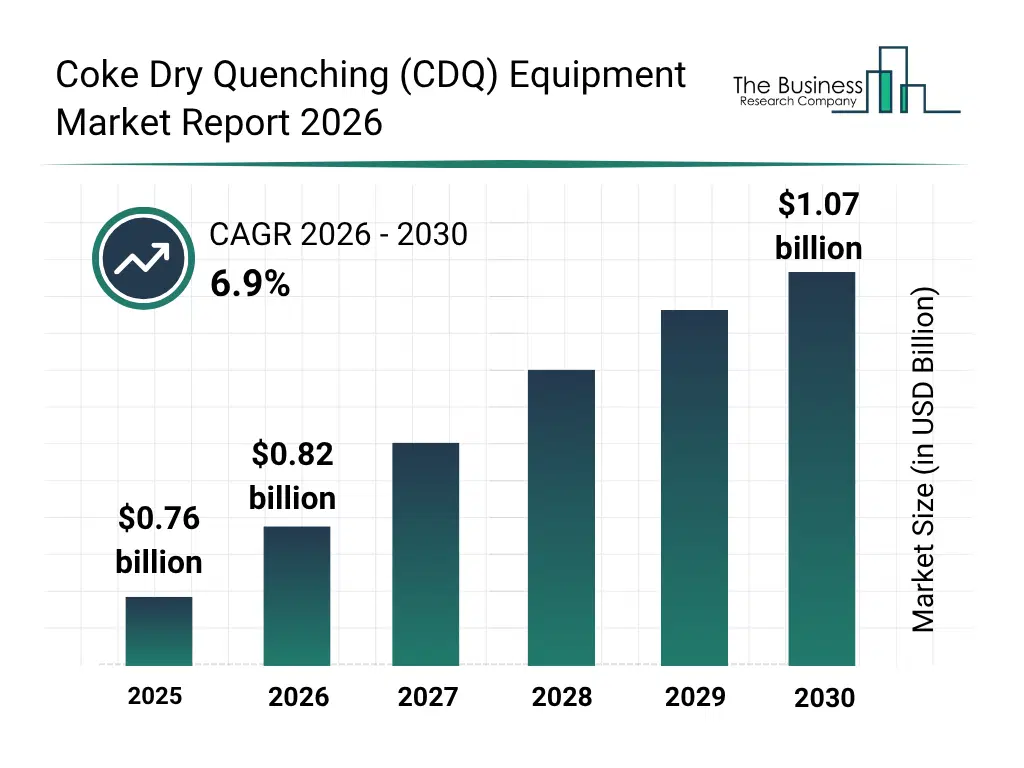
What Is The Coke Dry Quenching (CDQ) Equipment Market Size and Share 2026?
The coke dry quenching (CQD) equipment market size has grown strongly in recent years. It will grow from $0.76 billion in 2025 to $0.82 billion in 2026 at a compound annual growth rate (CAGR) of 7.4%. The growth in the historic period can be attributed to high environmental pollution from wet quenching processes, rising steel production demand from industrialization, regulatory pressure on emission control in steel plants, early adoption of heat recovery systems in large steel mills, increasing focus on operational efficiency in metallurgical processes.What Is The Coke Dry Quenching (CDQ) Equipment Market Growth Forecast?
The coke dry quenching (CQD) equipment market size is expected to see strong growth in the next few years. It will grow to $1.07 billion in 2030 at a compound annual growth rate (CAGR) of 6.9%. The growth in the forecast period can be attributed to stringent global carbon emission regulations in steel manufacturing, expansion of green steel production initiatives, increasing investment in energy efficient industrial equipment, rising demand for waste heat based power generation, modernization of aging coke oven batteries in developing economies. Major trends in the forecast period include increasing adoption of waste heat recovery systems in integrated steel plants, rising deployment of energy efficient coke dry quenching infrastructure in blast furnace operations, growing shift toward emission reduction technologies in metallurgical processes, expansion of retrofit projects replacing wet quenching systems with dry quenching systems, increasing integration of advanced thermal monitoring and process optimization in coke handling systems.
Global Coke Dry Quenching (CDQ) Equipment Market Segmentation
1) By Type: Coke Dry Quenching Cooling Room; Circulation Fan; Waste Heat Boiler; Coke Tanker; Other Coke Dry Quenching Equipment 2) By Capacity: Less Than 100 Ton Per Hour; 100 To 250 Ton Per Hour; More Than 250 Ton Per Hour 3) By Deployment: New Installations; Retrofits And Upgrades 4) By End User: Steel Manufacturers; Coke Producers; Metallurgical Industry; Power And Energy Sector; Industrial Engineering Firms Subsegments: 1) By Coke Dry Quenching Cooling Room: Single Chamber Cooling Room; Double Chamber Cooling Room; Vertical Cooling Room; Horizontal Cooling Room; Modular Cooling Room 2) By Circulation Fan: Axial Flow Circulation Fan; Centrifugal Circulation Fan; High Pressure Circulation Fan; Variable Speed Circulation Fan; Energy Efficient Circulation Fan 3) By Waste Heat Boiler: Natural Circulation Waste Heat Boiler; Forced Circulation Waste Heat Boiler; High Pressure Waste Heat Boiler; Low Pressure Waste Heat Boiler; Water Tube Waste Heat Boiler 4) By Coke Tanker: Rail Mounted Coke Tanker; Self Propelled Coke Tanker; Electric Coke Tanker; High Capacity Coke Tanker; Automated Coke Tanker 5) By Other Coke Dry Quenching Equipment: Dust Collection System; Gas Cleaning System; Heat Recovery System; Temperature Monitoring System; Conveyor And Material Handling SystemWhat Are The Drivers Of The Coke Dry Quenching (CDQ) Equipment Market?
The increasing global steel production is expected to propel the growth of the coke dry quenching (CDQ) equipment market going forward. Steel production refers to the large-scale manufacturing of steel through integrated and electric arc furnace processes to meet demand from construction, automotive, infrastructure, machinery, and industrial applications worldwide. Steel production is increasing due to rising infrastructure and construction activities worldwide, which are driving higher demand for steel in transportation, commercial buildings, energy projects, and urban development. Coke dry quenching (CDQ) equipment supports steel production by enabling energy-efficient coke cooling operations, reducing heat loss and emissions, improving coke quality, and enhancing operational efficiency in steel manufacturing facilities through waste heat recovery and environmentally sustainable processing systems. For instance, in January 2025, the World Steel Association, a Belgium-based international industry organization representing steel producers and associations, global crude steel production for 71 reporting countries reached 1,839.4 million tonnes in 2024. Additionally, December 2024 crude steel production increased by 5.6% to 144.5 million tonnes compared to December 2023. Therefore, the increasing global steel production is driving the growth of the coke dry quenching (CDQ) equipment industry. The increasing need to reduce freshwater consumption in heavy industries is expected to propel the growth of the coke dry quenching (CDQ) equipment market going forward. Freshwater consumption in heavy industries refers to the extensive use of freshwater resources in industrial operations for cooling, processing, cleaning, and operational purposes. The increasing need to reduce freshwater consumption in heavy industries is rising due to growing pressure to improve water efficiency amid declining freshwater availability, encouraging industries to adopt recycling and conservation practices for sustainable operations. Coke dry quenching (CDQ) equipment supports the reduction of freshwater consumption in heavy industries by enabling dry coke cooling processes that minimize water usage, recover waste heat for energy generation, reduce environmental pollution, and enhance sustainable and energy-efficient operations in steel manufacturing facilities. For instance, in August 2024, according to a report published by UN-Water, a Switzerland-based United Nations’ coordination mechanism for water and sanitation, only 27% of industrial wastewater was safely treated among reporting countries, highlighting the growing pressure on heavy industries to adopt wastewater recycling and treatment solutions to reduce freshwater consumption and support sustainable water management practices. Therefore, the increasing need to reduce freshwater consumption in heavy industries is driving the growth of the coke dry quenching (CDQ) equipment industry. The growing focus on energy recovery and efficiency is expected to propel the growth of the coke dry quenching (CDQ) equipment market going forward. Energy recovery and efficiency refer to technologies and processes that capture wasted heat or energy from industrial operations and reuse it to improve overall operational performance and reduce energy consumption. Energy recovery and efficiency are increasing due to the rising need to reduce operational energy costs, driving industries to adopt waste heat recovery and energy-efficient systems that reuse excess heat to improve productivity while lowering fuel consumption and emissions. Coke Dry Quenching (CDQ) equipment enhances energy recovery and efficiency by capturing the high-temperature waste heat generated during coke cooling and converting it into reusable steam or electricity. For instance, in March 2024, according to the Department for Energy Security and Net Zero, a UK-based government department, the Energy Company Obligation (ECO) continues to be the largest energy efficiency scheme, accounting for 83% of all installations in 2023 with 265,000 measures delivered, representing a 61% increase compared to 2022 due to the expansion of ECO4 after the conclusion of ECO3 in April 2022. Therefore, growing focus on energy recovery and efficiency is driving the growth of the coke dry quenching (CDQ) equipment industry.Key Players In The Global Coke Dry Quenching (CDQ) Equipment Market
Major companies operating in the coke dry quenching (cdq) equipment market are thyssenkrupp Industrial Solutions AG; Ansteel Engineering Technology Corporation Limited; IHI Corporation; Danieli & C. Officine Meccaniche S.p.A.; Sinosteel Equipment & Engineering Co. Ltd.; Primetals Technologies Limited; Paul Wurth S.A.; Thermax Limited; Nippon Steel Engineering Co. Ltd.; GIPROKOKS; Bhilai Engineering Corporation Limited; JFE Engineering Corporation; ACRE Coking & Refractory Engineering Consulting Corporation MCC; Beijing JC Energy & Environment Engineering Co. Ltd.; Isgec Heavy Engineering Limited; JP Steel Plantech Co.; Shougang International Engineering Technology Co. Ltd.; Kaifeng Xinli Boiler Equipment Co. Ltd.; Mukand Limited; Thermal Systems Hyderabad Pvt. Ltd.Regional Outlook
North America was the largest region in the coke dry quenching (CDQ) equipment market in 2025. Asia-Pacific is expected to be the fastest-growing region in the forecast period. The regions covered in this market report are Asia-Pacific, South East Asia, Western Europe, Eastern Europe, North America, South America, Middle East, Africa. The countries covered in this market report are Australia, Brazil, China, France, Germany, India, Indonesia, Japan, Taiwan, Russia, South Korea, UK, USA, Canada, Italy, Spain.What Defines the Coke Dry Quenching (CDQ) Equipment Market?
The coke dry quenching (CDQ) equipment market consists of sales of coke dry quenching chambers, waste heat boiler systems, inert gas circulation systems, dust collection and gas cleaning systems, and coke handling and transport systems. Values in this market are ‘factory gate’ values, that is, the value of goods sold by the manufacturers or creators of the goods, whether to other entities (including downstream manufacturers, wholesalers, distributors, and retailers) or directly to end customers. The value of goods in this market includes related services sold by the creators of the goods.How is Market Value Defined and Measured?
The market value is defined as the revenues that enterprises gain from the sale of goods and/or services within the specified market and geography through sales, grants, or donations in terms of the currency (in USD unless otherwise specified). The revenues for a specified geography are consumption values that are revenues generated by organizations in the specified geography within the market, irrespective of where they are produced. It does not include revenues from resales along the supply chain, either further along the supply chain or as part of other products.What Key Data and Analysis Are Included in the Coke Dry Quenching (CDQ) Equipment Market Report 2026?
The coke dry quenching (cdq) equipment market research report is one of a series of new reports from The Business Research Company that provides market statistics, including industry global market size, regional shares, competitors with the market share, detailed market segments, market trends and opportunities, and any further data you may need to thrive in the coke dry quenching (cdq) equipment industry. The market research report delivers a complete perspective of everything you need, with an in-depth analysis of the current and future state of the industry.Coke Dry Quenching (CDQ) Equipment Market Report Forecast Analysis
| Report Attribute | Details |
|---|---|
| Market Size Value In 2026 | $0.82 billion |
| Revenue Forecast In 2030 | $1.07 billion |
| Growth Rate | CAGR of 6.9% from 2026 to 2030 |
| Base Year For Estimation | 2025 |
| Actual Estimates/Historical Data | 2020-2025 |
| Forecast Period | 2026 - 2030 |
| Market Representation | Revenue in USD Billion and CAGR from 2026 to 2030 |
| Segments Covered | Type, Capacity, Deployment, End User |
| Regional Scope | Asia-Pacific, Western Europe, Eastern Europe, North America, South America, Middle East, Africa |
| Country Scope | The countries covered in the report are Australia, Brazil, China, France, Germany, India, ... |
| Key Companies Profiled | thyssenkrupp Industrial Solutions AG; Ansteel Engineering Technology Corporation Limited; IHI Corporation; Danieli & C. Officine Meccaniche S.p.A.; Sinosteel Equipment & Engineering Co. Ltd.; Primetals Technologies Limited; Paul Wurth S.A.; Thermax Limited; Nippon Steel Engineering Co. Ltd.; GIPROKOKS; Bhilai Engineering Corporation Limited; JFE Engineering Corporation; ACRE Coking & Refractory Engineering Consulting Corporation MCC; Beijing JC Energy & Environment Engineering Co. Ltd.; Isgec Heavy Engineering Limited; JP Steel Plantech Co.; Shougang International Engineering Technology Co. Ltd.; Kaifeng Xinli Boiler Equipment Co. Ltd.; Mukand Limited; Thermal Systems Hyderabad Pvt. Ltd. |
| Customization Scope | Request for Customization |
| Pricing And Purchase Options | Explore Purchase Options |