

Collaborative Robotic Joint Module Market Report 2026
Global Outlook – By Joint Type (Single-Axis Joints, Multi-Axis Joints, Custom And Hybrid Joints), By Payload Capacity (Light Duty, Medium Duty, Heavy Duty), By Robot Type (Articulated Robots, Collaborative Robots), By Application (Material Handling, Assembly And Disassembly, Welding And Soldering, Machine Tending, Quality Inspection And Testing, Packaging And Labelling), By End-User Industry (Automotive And Manufacturing, Electronics And Semiconductor, Healthcare And Pharmaceuticals, Food And Beverage, Logistics And Warehousing) – Market Size, Trends, Strategies, and Forecast to 2030
Collaborative Robotic Joint Module Market Overview
• Collaborative Robotic Joint Module market size has reached to $0.76 billion in 2025 • Expected to grow to $1.57 billion in 2030 at a compound annual growth rate (CAGR) of 15.6% • Growth Driver: Expanding Adoption Of Collaborative Robots For Flexible And Safe Industrial Automation Driving Market Growth • Market Trend: Enhancing Collaborative Robotics With Industry?Leading Safety And Hygiene Standards, Versatile Deployment, And Food?Grade Compliance • Asia-Pacific was the largest region and fastest growing region.What Is Covered Under Collaborative Robotic Joint Module Market?
The collaborative robotic joint module refers to the industry focused on the development, production, and adoption of joint modules used in collaborative robots (cobots). These modules enable precise and flexible movement, allowing robots to safely work alongside humans in various applications such as manufacturing, assembly, and research. The market is driven by the growing demand for automation, improved productivity, and advanced robotics technology across multiple industries. The main joint types of collaborative robotic joint modules include single-axis joints, multi-axis joints, and custom or hybrid joints. Single-axis joints refer to robotic joint modules that allow rotation or movement around a single axis for controlled motion. The payload capacities include light duty, medium duty, and heavy-duty. The robot types include articulated robots and collaborative robots for safe human-robot interaction. The applications include material handling, assembly and disassembly, welding and soldering, machine tending, quality inspection and testing, and packaging and labeling. The key end-user industries include automotive and manufacturing, electronics and semiconductor, healthcare and pharmaceuticals, food and beverage, and logistics and warehousing.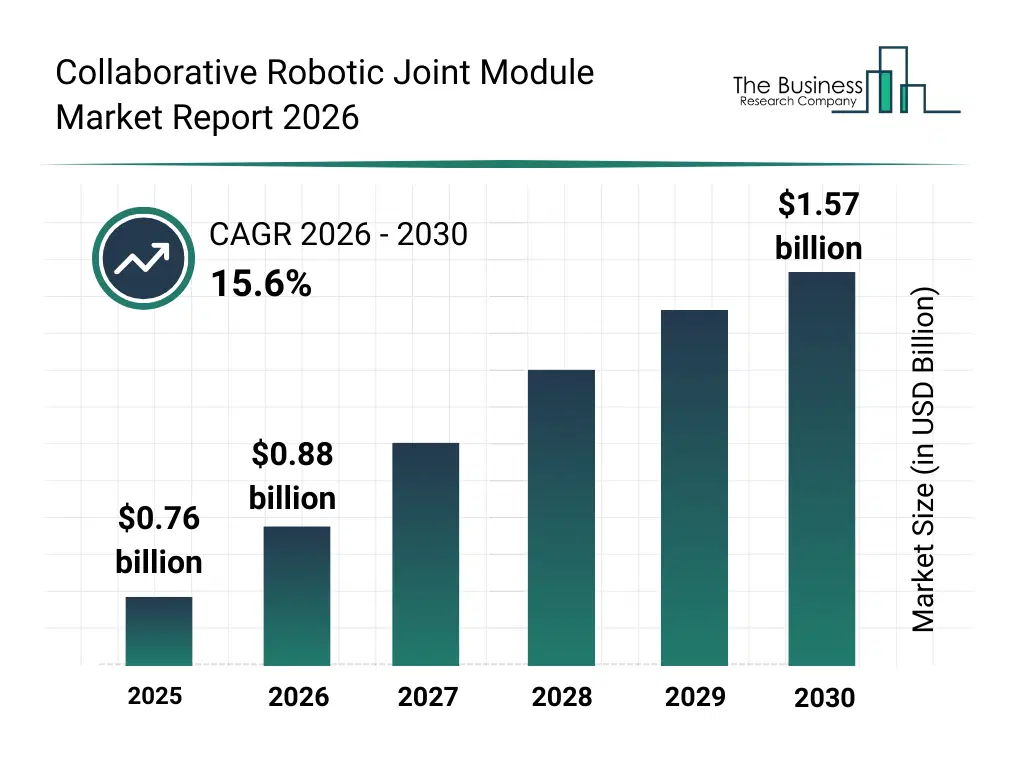
What Is The Collaborative Robotic Joint Module Market Size and Share 2026?
The collaborative robotic joint module market size has grown rapidly in recent years. It will grow from $0.76 billion in 2025 to $0.88 billion in 2026 at a compound annual growth rate (CAGR) of 15.8%. The growth in the historic period can be attributed to increasing adoption of collaborative robots in manufacturing, rising automation in assembly lines, growing demand for precision robotic components, increasing shift toward human-robot collaboration, expanding use of cobots in small and medium enterprises.What Is The Collaborative Robotic Joint Module Market Growth Forecast?
The collaborative robotic joint module market size is expected to see rapid growth in the next few years. It will grow to $1.57 billion in 2030 at a compound annual growth rate (CAGR) of 15.6%. The growth in the forecast period can be attributed to growing integration of joint modules in next-generation cobots, increasing investment in flexible automation, rising demand for compact and lightweight robotic joints, expanding industrial digitalization initiatives, growing adoption of cobots in logistics and healthcare and Major trends in the forecast period include technology advancements in robotic joint design, innovations in lightweight actuator systems, developments in torque and force sensing modules, research and development in modular cobot architectures, advancements in ai-enabled motion control systems.

Global Collaborative Robotic Joint Module Market Segmentation
1) By Joint Type: Single-Axis Joints, Multi-Axis Joints, Custom And Hybrid Joints 2) By Payload Capacity: Light Duty, Medium Duty, Heavy Duty 3) By Robot Type: Articulated Robots, Collaborative Robots 4) By Application: Material Handling, Assembly And Disassembly, Welding And Soldering, Machine Tending, Quality Inspection And Testing, Packaging And Labelling 5) By End-User Industry: Automotive And Manufacturing, Electronics And Semiconductor, Healthcare And Pharmaceuticals, Food And Beverage, Logistics And Warehousing Subsegments: 1) By Single-Axis Joints: Rotational Joint, Prismatic Joint, Revolute Joint 2) By Multi-Axis Joints: Spherical Joint, Cylindrical Joint, Universal Joint 3) By Custom And Hybrid Joints: Combination Joint, Adaptive Joint, Modular JointWhat Is The Driver Of The Collaborative Robotic Joint Module Market?
The expanding adoption of robots in factories is expected to propel the growth of the collaborative robotic joint module market going forward. Collaborative robot automation is the deployment of robots designed to work alongside humans in industrial and logistics settings, with integrated joint modules that enable precise articulation, force feedback, and safe interaction. The rise in collaborative robots in factories is due to increasing labor shortages and the need for higher operational efficiency in manufacturing, healthcare, and logistics industries. Collaborative robotic joint module supports collaborative robots in factories by providing the essential motion, torque control, and safety capabilities required for collaborative robot arms to operate effectively alongside humans. For instance, in December 2024, according to the International Federation of Robotics, a Germany-based robotics industry organization, collaborative robots (cobots) accounted for 10.5% of the total 541,302 industrial robots installed in 2023. Therefore, the expanding adoption of robots in factories is driving the growth of the collaborative robotic joint module industry.Key Players In The Global Collaborative Robotic Joint Module Market
Major companies operating in the collaborative robotic joint module market are Nidec Corporation, Yaskawa Electric Corporation, Moog Inc., Nabtesco Corporation, Han’s Robot Co. Ltd., Kollmorgen Corporation, Estun Automation Co. Ltd., Siasun Robot & Automation Co. Ltd., Harmonic Drive Systems Inc., Maxon Group, JAKA Robotics Co. Ltd., DOBOT Technology Co. Ltd., AUBO Robotics Co. Ltd., ROBOTIS Co. Ltd, Harmonic Drive SE, Elite Robots Co. Ltd., Elephant Robotics Co. Ltd., Techman Robot Inc., Changzhou MyActuator Robot Technology Co. Ltd., Laifual Drive Co. Ltd.
This chart is for illustrative purposes; the full report includes a detailed competitor analysis and comprehensive overview of the top 10 companies in the market.
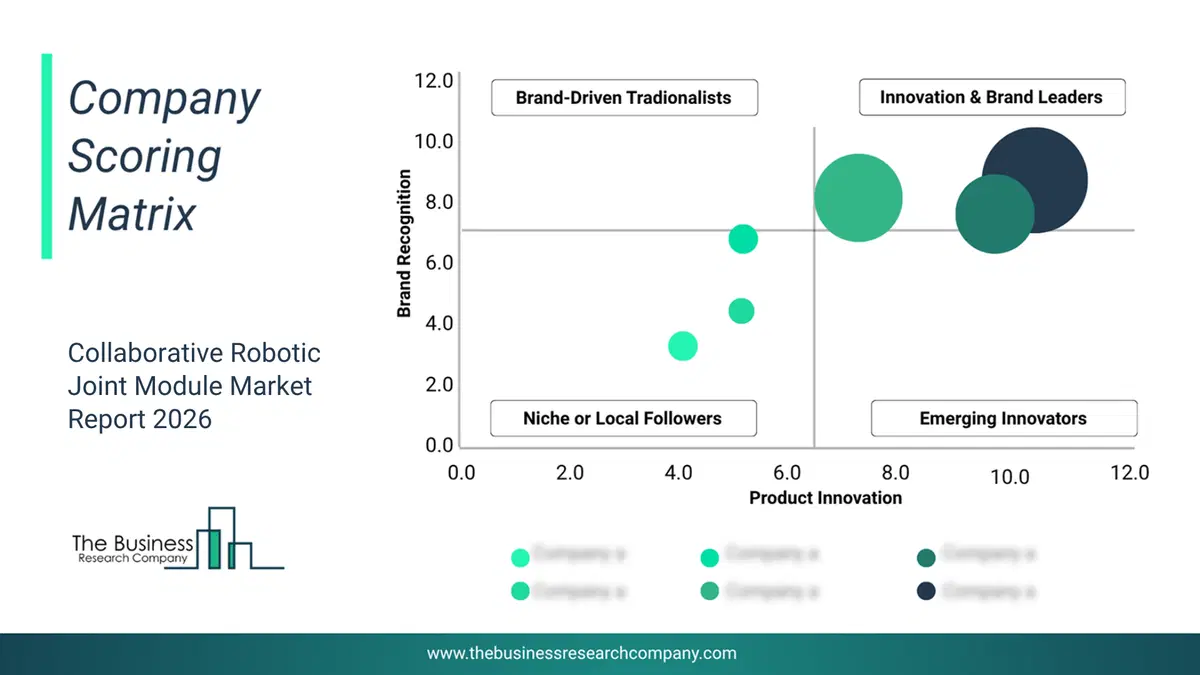
This chart maps companies by product innovation and brand strength, with bubble size indicating relative revenue, helping identify market leaders, challengers, and niche players. This is an illustrative chart; the full report provides a complete and accurate competitive analysis.
Global Collaborative Robotic Joint Module Market Trends and Insights
Major companies operating in the collaborative robotic joint module market are focusing on developing advanced automation solutions, such as industry‑leading safety and hygiene standards, to support safe, efficient, and compliant operations in environments where humans and robots work side‑by‑side, particularly in food processing, beverage production, and other regulated industries. Industry‑leading safety and hygiene standards refer to design criteria and certifications that ensure collaborative robots (cobots) meet stringent requirements for cleanability, contamination control, and operational safety, enabling deployment in sensitive production areas without compromising product quality or workplace safety. For instance, in April 2023, Doosan Robotics Co. Ltd., a South Korea‑based provider of collaborative automation technologies, launched its NSF‑certified E‑Series line of cobots specifically dedicated to the food and beverage industry. The E‑Series collaborative robots incorporate joint modules and components designed for easy cleaning, food‑safe materials, and compliance with international hygiene standards, while delivering reliable performance and safe human‑robot interaction in demanding production environments. The launch highlights the growing emphasis on collaborative robotic systems that combine robust joint module performance with enhanced safety features and sanitation capabilities.What Are Latest Mergers And Acquisitions In The Collaborative Robotic Joint Module Market?
In November 2025, Aptiv PLC, a US‑based technology company, partnered with Robust.AI to co‑develop AI‑powered collaborative robot (cobot) joint modules and related smart automation technologies. Through this collaboration, Aptiv PLC and Robust.AI aim to integrate advanced AI decisioning, perception systems, and adaptive control into collaborative robot platforms to enhance safety, flexibility, and performance in human‑robot work environments. Robust.AI is a US‑based artificial intelligence and robotics software company.
Regional Insights
Asia-Pacific was the largest region in the collaborative robotic joint module market in 2025, and it is expected to be the fastest-growing region in the forecast period. The regions covered in this market report are Asia-Pacific, South East Asia, Western Europe, Eastern Europe, North America, South America, Middle East, Africa. The countries covered in this market report are Australia, Brazil, China, France, Germany, India, Indonesia, Japan, Taiwan, Russia, South Korea, UK, USA, Canada, Italy, Spain.What Defines the Collaborative Robotic Joint Module Market?
The collaborative robotic joint module market consists of revenues earned by through installation, maintenance, repair, calibration, training. The market value includes the value of related goods sold by the service provider or included within the service offering. The collaborative robotic joint module market includes sales of servo motors, actuators, sensors, robotic joints, control units, gear systems, robotic arms, end effectors. Values in this market are ‘factory gate’ values, that is, the value of goods sold by the manufacturers or creators of the goods, whether to other entities (including downstream manufacturers, wholesalers, distributors, and retailers) or directly to end customers. The value of goods in this market includes related services sold by the creators of the goods.How is Market Value Defined and Measured?
The market value is defined as the revenues that enterprises gain from the sale of goods and/or services within the specified market and geography through sales, grants, or donations in terms of the currency (in USD unless otherwise specified). The revenues for a specified geography are consumption values that are revenues generated by organizations in the specified geography within the market, irrespective of where they are produced. It does not include revenues from resales along the supply chain, either further along the supply chain or as part of other products.
This chart presents market attractiveness based on a quantitative evaluation of growth, competition, strategic alignment, and risk, offering a clear view of opportunity areas for decision-making. This chart is for illustrative purposes; the full report contains the complete analysis.

This chart highlights the Total Addressable Market (TAM) by estimating the maximum revenue opportunity using an assumption-driven approach, supporting strategic planning and opportunity sizing across markets. The chart is illustrative; the full report provides a more comprehensive analysis.
What Key Data and Analysis Are Included in the Collaborative Robotic Joint Module Market Report 2026?
The collaborative robotic joint module market research report is one of a series of new reports from The Business Research Company that provides market statistics, including industry global market size, regional shares, competitors with the market share, detailed market segments, market trends and opportunities, and any further data you may need to thrive in the collaborative robotic joint module industry. The market research report delivers a complete perspective of everything you need, with an in-depth analysis of the current and future state of the industry.Collaborative Robotic Joint Module Market Report Forecast Analysis
| Report Attribute | Details |
|---|---|
| Market Size Value In 2026 | $0.88 billion |
| Revenue Forecast In 2030 | $1.57 billion |
| Growth Rate | CAGR of 15.6% from 2026 to 2030 |
| Base Year For Estimation | 2025 |
| Actual Estimates/Historical Data | 2020-2025 |
| Forecast Period | 2026 - 2030 |
| Market Representation | Revenue in USD Billion and CAGR from 2026 to 2030 |
| Segments Covered | Joint Type, Payload Capacity, Robot Type, Application, End-User Industry |
| Regional Scope | Asia-Pacific, Western Europe, Eastern Europe, North America, South America, Middle East, Africa |
| Key Companies Profiled | Nidec Corporation, Yaskawa Electric Corporation, Moog Inc., Nabtesco Corporation, Han’s Robot Co. Ltd., Kollmorgen Corporation, Estun Automation Co. Ltd., Siasun Robot & Automation Co. Ltd., Harmonic Drive Systems Inc., Maxon Group, JAKA Robotics Co. Ltd., DOBOT Technology Co. Ltd., AUBO Robotics Co. Ltd., ROBOTIS Co. Ltd, Harmonic Drive SE, Elite Robots Co. Ltd., Elephant Robotics Co. Ltd., Techman Robot Inc., Changzhou MyActuator Robot Technology Co. Ltd., Laifual Drive Co. Ltd. |
| Customization Scope | Request for Customization |
| Pricing And Purchase Options | Explore Purchase Options |