
Collision Avoidance System Market Report 2026
Global Outlook – By Product (Adaptive Cruise Control (ACC), Autonomous Emergency Braking (AEB), Lane Departure Warning System (LDWS), Parking Assistance, Other Products), By Technology (LiDAR, RADAR, Ultrasonic, Camera, Other Technologies), By Application (Automotive, Marine, Aerospace, Railways, Other Applications) – Market Size, Trends, Strategies, and Forecast to 2030
Collision Avoidance System Market Overview
• Collision Avoidance System market size has reached to $49.39 billion in 2025 • Expected to grow to $76.8 billion in 2030 at a compound annual growth rate (CAGR) of 9.2% • Growth Driver: Rising Demand For Automated Vehicles Fuels Growth In The Collision Avoidance System Market • Market Trend: Implementation Of Advanced Driver Assistance Systems (ADAS) Transforming The Collision Avoidance Market • North America was the largest region in 2025 and Asia-Pacific is the fastest growing region.What Is Covered Under Collision Avoidance System Market?
Collision avoidance systems refer to safety systems designed to warn, alert, or assist drivers in avoiding impending collisions and lowering the risk of incidents by providing visual and auditory warnings to operators or by actively enforcing defensive maneuvers such as braking when a collision is impending. The collision avoidance system is used to prevent or decrease the severity of a collision. The main products of collision avoidance systems are adaptive cruise control (ACC), autonomous emergency braking (AEB), lane departure warning systems, parking assistance, and other products. An adaptive cruise control (ACC) collision avoidance system is a type of active safety system that automatically regulates a vehicle's acceleration and braking system. The technologies used are lidar, radar, ultrasonic, cameras, and other technologies. The various applications involved automotive, marine, aerospace, railways, and other applications.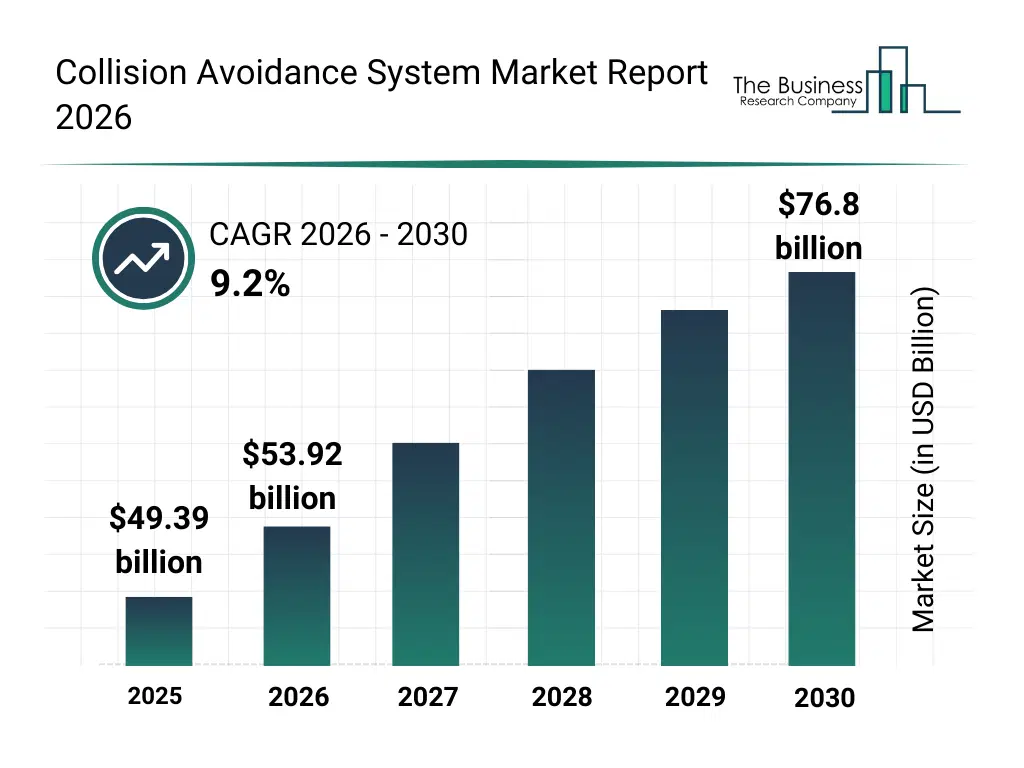
What Is The Collision Avoidance System Market Size and Share 2026?
The collision avoidance system market size has grown strongly in recent years. It will grow from $49.39 billion in 2025 to $53.92 billion in 2026 at a compound annual growth rate (CAGR) of 9.2%. The growth in the historic period can be attributed to increasing vehicle safety regulations, rising consumer demand for safer vehicles, expansion of ADAS adoption in passenger cars, availability of advanced sensing technologies, growth in automotive electronics integration.What Is The Collision Avoidance System Market Growth Forecast?
The collision avoidance system market size is expected to see strong growth in the next few years. It will grow to $76.8 billion in 2030 at a compound annual growth rate (CAGR) of 9.2%. The growth in the forecast period can be attributed to growing adoption of autonomous driving technologies, increasing penetration of collision avoidance in commercial vehicles, expansion of smart transportation infrastructure, rising demand for electric and connected vehicles, continuous advancements in sensor accuracy. Major trends in the forecast period include increasing integration of multi-sensor fusion systems, rising deployment of advanced driver assistance features, growing adoption of autonomous emergency braking solutions, expansion of vehicle-to-vehicle communication systems, enhanced focus on real-time hazard detection.Tariff Impact On Collision Avoidance System Market
Tariffs are affecting the collision avoidance system market by raising the cost of imported LiDAR units, radar modules, camera sensors, semiconductors, and embedded processing hardware. Automotive manufacturers in North America and Europe are particularly impacted due to dependence on sensor and chip imports from Asia-Pacific, leading to higher vehicle production costs and delayed system rollouts. These tariffs are increasing system integration expenses and affecting price competitiveness across passenger and commercial vehicles. At the same time, they are accelerating domestic semiconductor investment, local sensor manufacturing, and strategic partnerships aimed at building resilient regional supply chains for advanced safety technologies.
Global Collision Avoidance System Market Segmentation
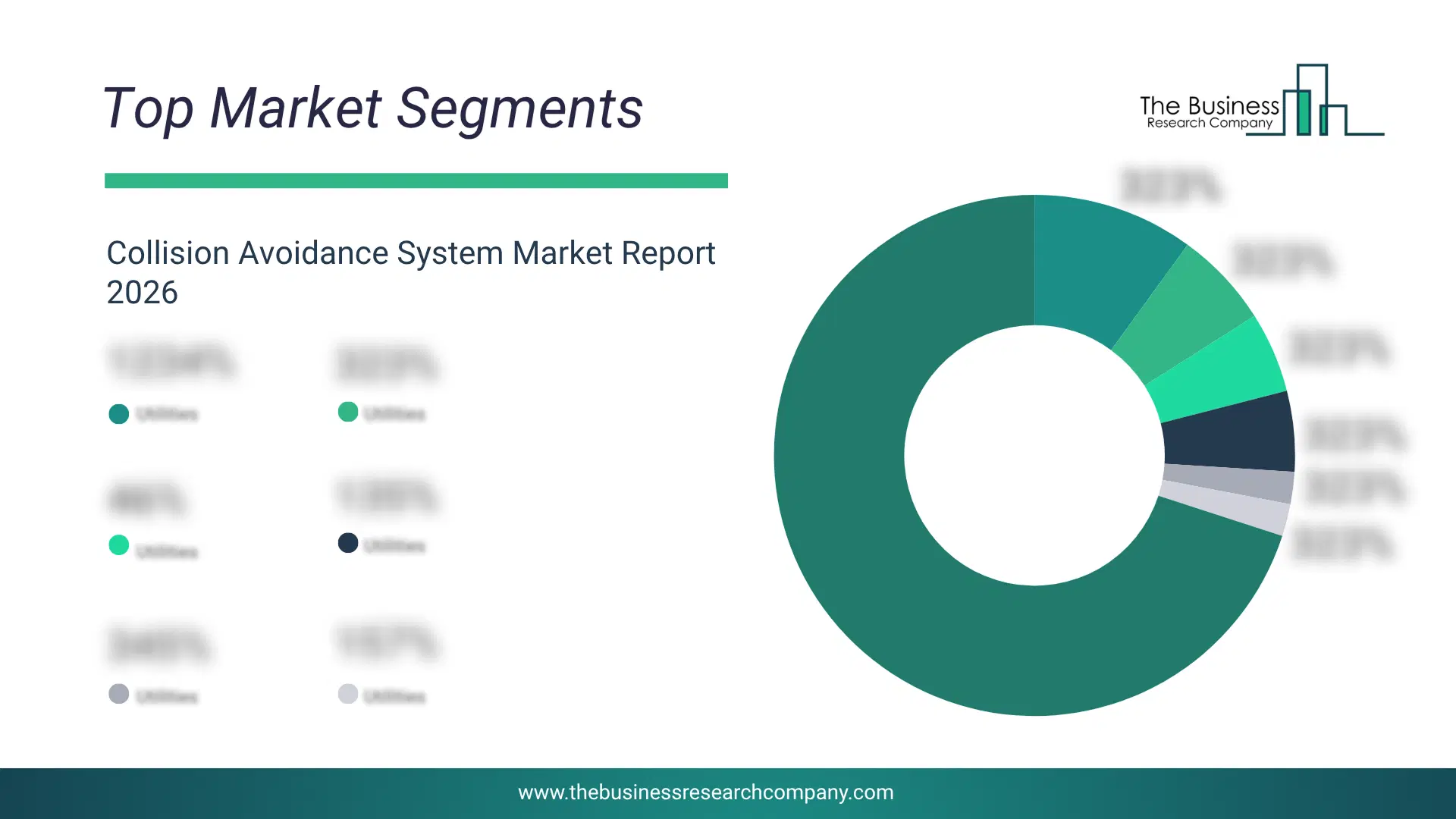
1) By Product: Adaptive Cruise Control (ACC), Autonomous Emergency Braking (AEB), Lane Departure Warning System (LDWS), Parking Assistance, Other Products 2) By Technology: LiDAR, RADAR, Ultrasonic, Camera, Other Technologies 3) By Application: Automotive, Marine, Aerospace, Railways, Other Applications Subsegments: 1) By Adaptive Cruise Control (ACC): Standard ACC, Dynamic ACC with Stop-and-Go Functionality 2) By Autonomous Emergency Braking (AEB): Forward Collision Warning (FCW) with AEB, Pedestrian Detection AEB 3) By Lane Departure Warning System (LDWS): Lane Keeping Assist (LKA), Lane Departure Prevention (LDP) 4) By Parking Assistance: Rear Parking Sensors, Automatic Parallel Parking Systems, 360-Degree Camera Systems 5) By Other Products: Blind Spot Detection Systems, Cross Traffic Alert Systems, Vehicle-to-Vehicle (V2V) Communication SystemsWhat Is The Driver Of The Collision Avoidance System Market?
An increase in demand for automated vehicles is expected to drive the collision avoidance system market going forward. Automated vehicles refer to vehicles that can sense their surroundings and operate without human intervention. Automated vehicles use collision avoidance systems such as sensors, cameras, emergency braking, lane-keeping, and others to control the car and avoid accidents. For instance, in December 2024, according to the National Highway Traffic Safety Administration, a US-based government agency, by 2030, an estimated 4.5 million self-driving vehicles will operate on U.S. roads. Therefore, the rising demand for automated vehicles drives growth in the collision avoidance system industry.Key Players In The Global Collision Avoidance System Market
Major companies operating in the collision avoidance system market are ZF Friedrichshafen AG, General Electric Company, Mobileye Global Inc., Denso Corporation, Robert Bosch GmbH, Wabtec Corporation, Alstom SA, Autoliv Inc., Honeywell International Inc., Ride Vision Ltd., LILEE System Ltd., Knorr-Bremse AG, Hella GmbH & Co. KGaA, Becker Mining Systems AG, Hexagon AB, Saab AB, Rockwell Automation Inc., Hyundai Mobis, Analog Devices, Murata Manufacturing Co. Ltd., Infineon Technologies, Panasonic Corporation, Continental AG, Siemens AG, Aptiv Plc, Magna International Inc., Valeo India Pvt. Ltd., NXP Semiconductors, Texas Instruments Incorporated, STMicroelectronics N.V., Renesas Electronics Corporation, Aisin Seiki Co. Ltd., Sensata Technologies Inc., First Sensor AG, LeddarTech Inc., Quanergy Systems Inc., Velodyne Lidar Inc., Ouster Inc., Luminar Technologies Inc.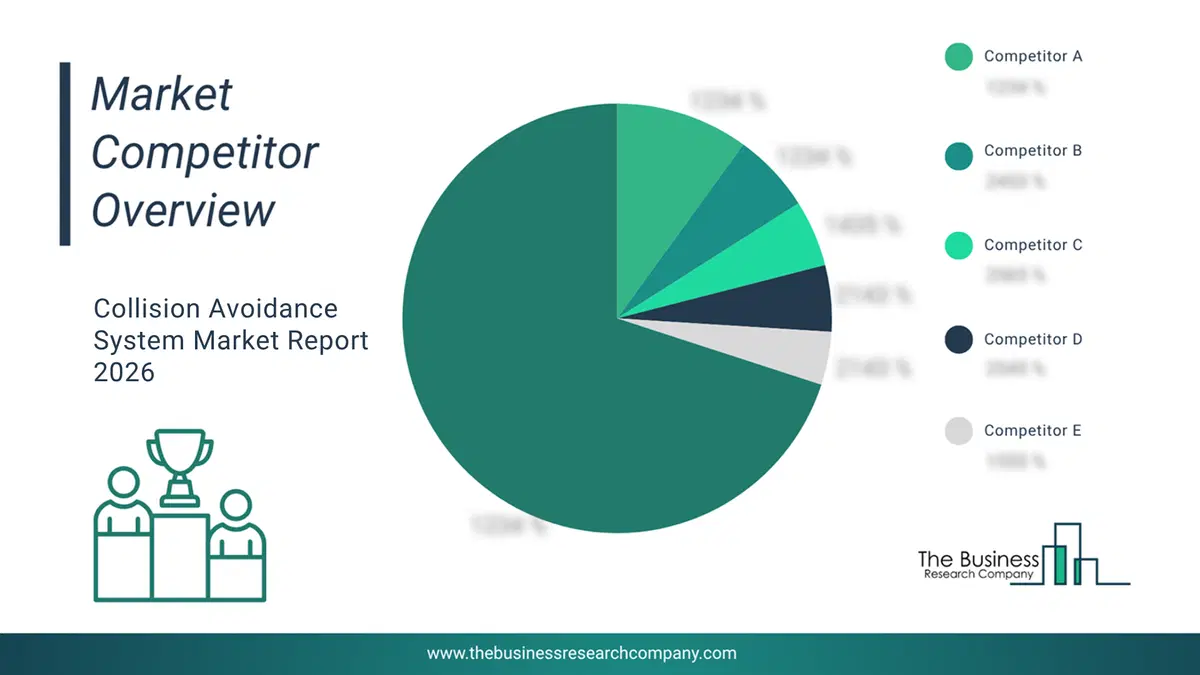
This chart is for illustrative purposes; the full report includes a detailed competitor analysis and comprehensive overview of the top 10 companies in the market.
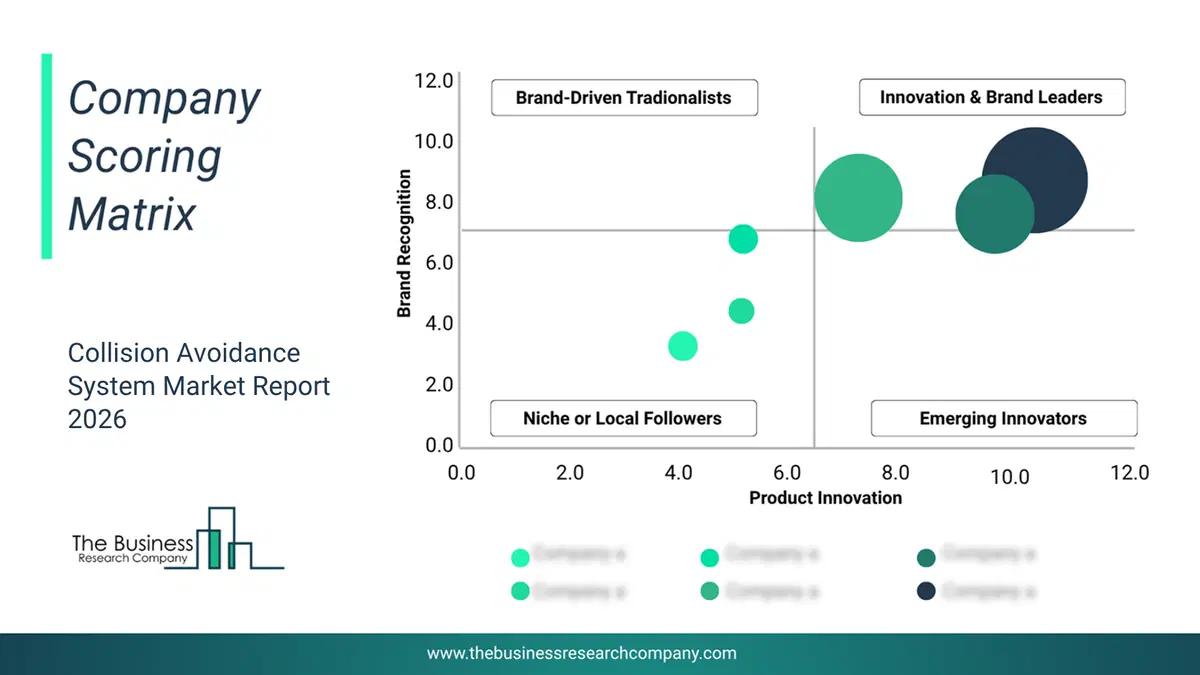
This chart maps companies by product innovation and brand strength, with bubble size indicating relative revenue, helping identify market leaders, challengers, and niche players. This is an illustrative chart; the full report provides a complete and accurate competitive analysis.
Global Collision Avoidance System Market Trends and Insights
Major companies operating in the collision avoidance market are incorporating Advanced Driver Assistance Systems (ADAS) into their products to sustain their position in the market. ADAS technologies can provide warnings to the driver, assist with vehicle control, and, in some cases, take autonomous actions to prevent or mitigate collisions and enhance overall driving safety. For instance, in January 2023, MG Motor, a UK-based automotive company launched the Next-Gen Hector, featuring an Autonomous Level 2 (ADAS) system with 11 Advanced Driver Assistance Systems, and over 75 connected car features through the i-SMART technology. Safety features include airbags, a 360-degree camera, and stability controls.What Are Latest Mergers And Acquisitions In The Collision Avoidance System Market?
In June 2023, Magna, a Canada-based automotive parts and technology company, acquired Veoneer’s Active Safety business for an undisclosed amount. Through this acquisition, Magna aims to strengthen its advanced driver-assistance systems (ADAS) portfolio and enhance its capabilities in sensors, software, and systems integration. Veoneer Active Safety is a Sweden-based automotive technology company specializing in active-safety solutions, including sensors and software, for automotive manufacturers, focusing on improving vehicle safety and automation performance.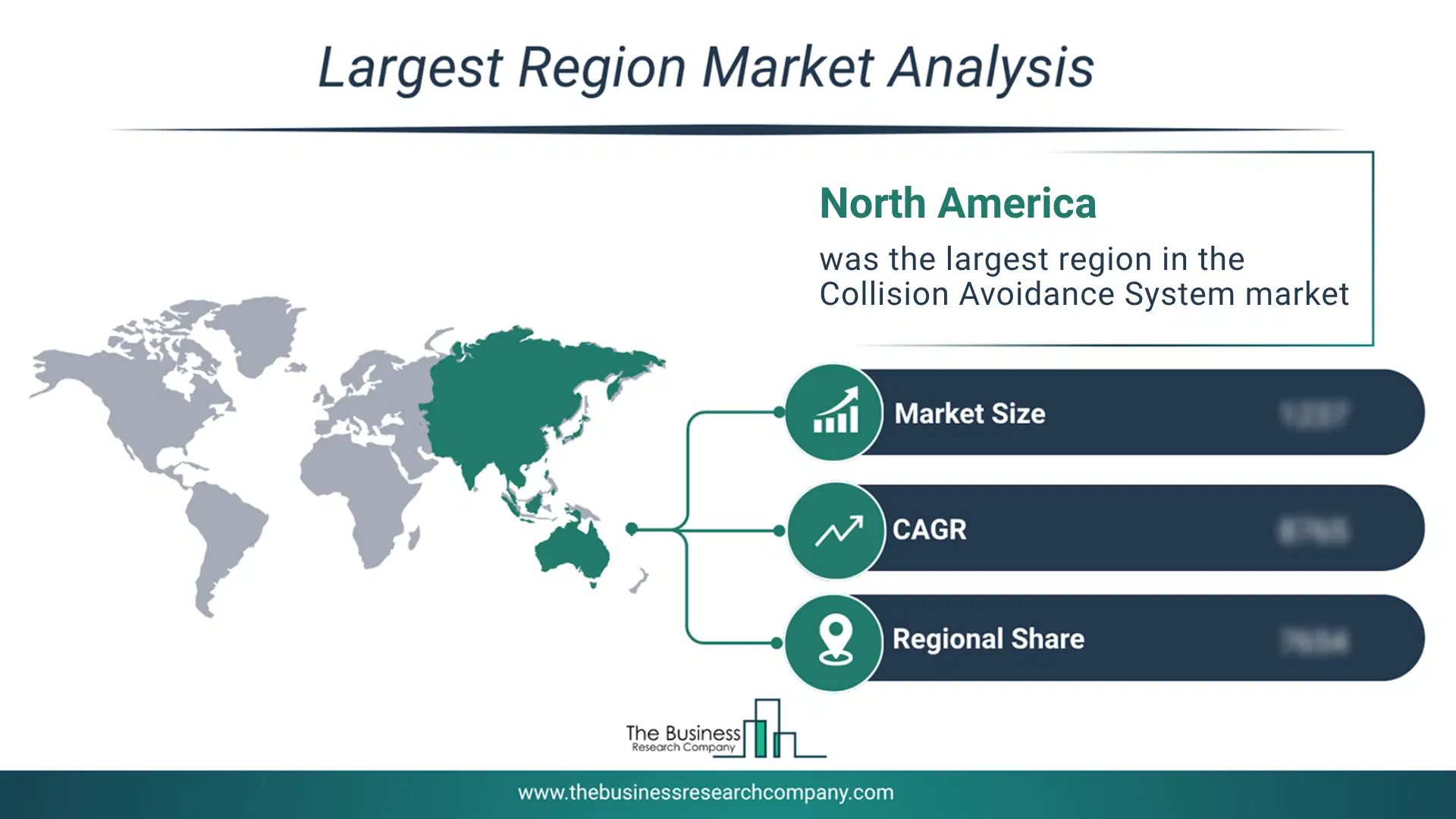
Regional Outlook
North America was the largest region in the collision avoidance system market in 2025. Asia-Pacific is expected to be the fastest-growing region in the forecast period. The regions covered in this market report are Asia-Pacific, South East Asia, Western Europe, Eastern Europe, North America, South America, Middle East, Africa The countries covered in this market report are Australia, Brazil, China, France, Germany, India, Indonesia, Japan, Taiwan, Russia, South Korea, UK, USA, Canada, Italy, Spain.What Defines the Collision Avoidance System Market?
The collision avoidance systems market consists of sales of electronic stability control (ESC), pedestrian detection systems, and cross-traffic warnings, sensors, such as lasers, GPS, and artificial intelligence. Values in this market are ‘factory gate’ values, that is the value of goods sold by the manufacturers or creators of the goods, whether to other entities (including downstream manufacturers, wholesalers, distributors, and retailers) or directly to end customers. The value of goods in this market includes related services sold by the creators of the goods.How is Market Value Defined and Measured?
The market value is defined as the revenues that enterprises gain from the sale of goods and/or services within the specified market and geography through sales, grants, or donations in terms of the currency (in USD unless otherwise specified). The revenues for a specified geography are consumption values that are revenues generated by organizations in the specified geography within the market, irrespective of where they are produced. It does not include revenues from resales along the supply chain, either further along the supply chain or as part of other products.
This chart presents market attractiveness based on a quantitative evaluation of growth, competition, strategic alignment, and risk, offering a clear view of opportunity areas for decision-making. This chart is for illustrative purposes; the full report contains the complete analysis.

This chart highlights the Total Addressable Market (TAM) by estimating the maximum revenue opportunity using an assumption-driven approach, supporting strategic planning and opportunity sizing across markets. The chart is illustrative; the full report provides a more comprehensive analysis.
What Key Data and Analysis Are Included in the Collision Avoidance System Market Report 2026?
The collision avoidance system market research report is one of a series of new reports from The Business Research Company that provides market statistics, including industry global market size, regional shares, competitors with the market share, detailed market segments, market trends and opportunities, and any further data you may need to thrive in the collision avoidance system industry. The market research report delivers a complete perspective of everything you need, with an in-depth analysis of the current and future state of the industry.Collision Avoidance System Market Report Forecast Analysis
| Report Attribute | Details |
|---|---|
| Market Size Value In 2026 | $53.92 billion |
| Revenue Forecast In 2030 | $76.8 billion |
| Growth Rate | CAGR of 9.2% from 2026 to 2030 |
| Base Year For Estimation | 2025 |
| Actual Estimates/Historical Data | 2020-2025 |
| Forecast Period | 2026 - 2030 |
| Market Representation | Revenue in USD Billion and CAGR from 2026 to 2030 |
| Segments Covered | Product, Technology, Application |
| Regional Scope | Asia-Pacific, Western Europe, Eastern Europe, North America, South America, Middle East, Africa |
| Key Companies Profiled | ZF Friedrichshafen AG, General Electric Company, Mobileye Global Inc., Denso Corporation, Robert Bosch GmbH, Wabtec Corporation, Alstom SA, Autoliv Inc., Honeywell International Inc., Ride Vision Ltd., LILEE System Ltd., Knorr-Bremse AG, Hella GmbH & Co. KGaA, Becker Mining Systems AG, Hexagon AB, Saab AB, Rockwell Automation Inc., Hyundai Mobis, Analog Devices, Murata Manufacturing Co. Ltd., Infineon Technologies, Panasonic Corporation, Continental AG, Siemens AG, Aptiv Plc, Magna International Inc., Valeo India Pvt. Ltd., NXP Semiconductors, Texas Instruments Incorporated, STMicroelectronics N.V., Renesas Electronics Corporation, Aisin Seiki Co. Ltd., Sensata Technologies Inc., First Sensor AG, LeddarTech Inc., Quanergy Systems Inc., Velodyne Lidar Inc., Ouster Inc., Luminar Technologies Inc. |
| Customization Scope | Request for Customization |
| Pricing And Purchase Options | Explore Purchase Options |