
Color Detection Sensor Market Report 2026
Global Outlook – By Type (Brightness Sensor, Contrast Sensor, Molecular Luminescence Sensor, Red, Green, Blue (RGB) Sensor, Printed Mark Sensor, Other Types), By Application (Chemicals, Life Sciences, Food And Beverages, Cosmetics, Wood And Paper Processing, Packaging, Textiles, Other Applications), By End-User Industry (Healthcare, Printing, Consumer Electronics, Lighting And Signage, Industrial Automation, Fluid Analysis, Other End-Use Industries) – Market Size, Trends, Strategies, and Forecast to 2030
Color Detection Sensor Market Overview
• Color Detection Sensor market size has reached to $2.12 billion in 2025 • Expected to grow to $2.88 billion in 2030 at a compound annual growth rate (CAGR) of 6.3% • Growth Driver: Increasing Demand For Consumer Electronics • Market Trend: Innovations In True Color Sensor Technology Enhance Accurate Color Detection And Sensing Applications • North America was the largest region in 2025 and Asia-Pacific is the fastest growing region.What Is Covered Under Color Detection Sensor Market?
A color detection sensor is a photoelectric sensor that uses a transmitter to send out light and a receiver to pick up the light reflected from the detection item. It is designed to detect and identify colors in the surrounding environment. These sensors work by emitting light onto an object, measuring the light reflected from it, and then analyzing the wavelengths of the reflected light to determine the object's color. The main types of color detection sensors are brightness sensors, contrast sensors, molecular luminescence sensors, red, green, and blue (RGB) sensors, printed mark sensors, and others. Brightness sensors refer to electronic devices that are designed to measure the level of ambient light or brightness in a given environment. These are used for several applications, including chemicals, life sciences, food and beverages, cosmetics, wood and paper processing, packaging, textiles, and others, and are used by numerous end-user industries, such as healthcare, printing, consumer electronics, lighting and signage, industrial automation, fluid analysis, and others.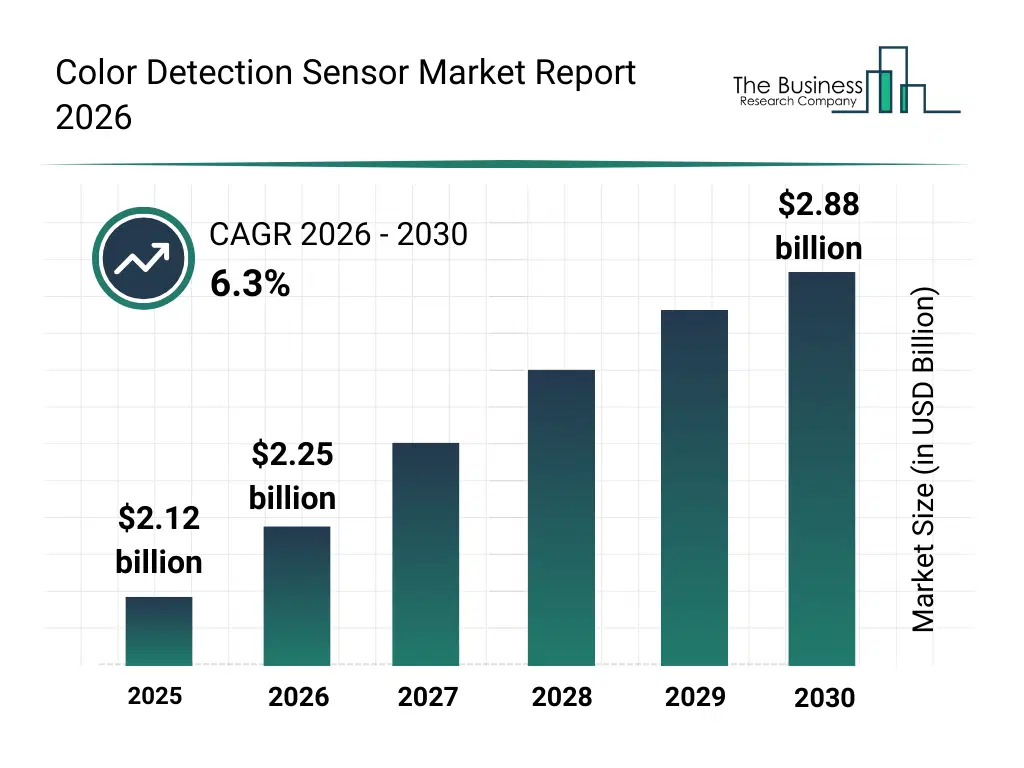
What Is The Color Detection Sensor Market Size and Share 2026?
The color detection sensor market size has grown strongly in recent years. It will grow from $2.12 billion in 2025 to $2.25 billion in 2026 at a compound annual growth rate (CAGR) of 6.1%. The growth in the historic period can be attributed to expansion of industrial automation systems, rising demand for quality assurance in manufacturing, growth of packaging and printing industries, availability of advanced photoelectric sensors, increasing use of machine vision.What Is The Color Detection Sensor Market Growth Forecast?
The color detection sensor market size is expected to see strong growth in the next few years. It will grow to $2.88 billion in 2030 at a compound annual growth rate (CAGR) of 6.3%. The growth in the forecast period can be attributed to growing integration with AI-based inspection systems, rising adoption in pharmaceutical and food processing, expansion of smart factories, increasing demand for miniaturized sensors, growing use in real-time process monitoring. Major trends in the forecast period include increasing adoption of inline color inspection systems, rising demand for high-precision color recognition, growing use of sensors in automated quality control, expansion of compact and high-speed color sensors, enhanced focus on process consistency.Tariff Impact On Color Detection Sensor Market
Tariffs are impacting the color detection sensor market by increasing the cost of imported optical components, semiconductors, microcontrollers, and precision lenses used in sensor manufacturing. Industrial automation, packaging, and electronics sectors in North America and Europe are most affected due to reliance on imported sensor modules and components from Asia-Pacific. These cost increases are influencing equipment pricing and slowing sensor upgrades in cost-sensitive applications. However, tariffs are also encouraging local sensor production, regional optical component sourcing, and innovation in cost-efficient sensor designs tailored for industrial automation environments.
Global Color Detection Sensor Market Segmentation
1) By Type: Brightness Sensor, Contrast Sensor, Molecular Luminescence Sensor, Red, Green, Blue (RGB) Sensor, Printed Mark Sensor, Other Types 2) By Application: Chemicals, Life Sciences, Food And Beverages, Cosmetics, Wood And Paper Processing, Packaging, Textiles, Other Applications 3) By End-User Industry: Healthcare, Printing, Consumer Electronics, Lighting And Signage, Industrial Automation, Fluid Analysis, Other End-Use Industries Subsegments: 1) By Brightness Sensor: Ambient Light Sensors, Luminance Sensors 2) By Contrast Sensor: High Contrast Sensors, Low Contrast Sensors 3) By Molecular Luminescence Sensor: Fluorescence Sensors, Phosphorescence Sensors 4) By Red, Green, Blue (RGB) Sensor: Red Sensor, Green Sensor, Blue Sensor 5) By Printed Mark Sensor: Barcode Sensors, QR Code Sensors 6) By Other Types: Colorimeters, SpectrophotometersWhat Is The Driver Of The Color Detection Sensor Market?
The increasing demand for consumer electronics is expected to propel the growth of the color detection sensor market going forward. Consumer electronics refers to any electronic gadget designed for everyday, private, or professional use by consumers or end users. Color detection sensors are used in consumer electronics to adjust the backlight brightness based on ambient light. This helps to save battery life and improve the user experience. For instance, in May 2023, according to the Japan Electronics and Information Technology Industries Association, a Japan-based trade association, the total consumer electronic equipment production in Japan reached $209.16 million (¥32,099 million), compared to $164.65 million (¥25,268 million) in May 2022. Therefore, increasing demand for consumer electronics is driving the growth of the color detection sensor industry.Key Players In The Global Color Detection Sensor Market
Major companies operating in the color detection sensor market are Panasonic Corporation, Honeywell International Inc., STMicroelectronics, Omron Corporation, Keyence Corporation, ams OSRAM AG, Vishay Intertechnology Inc., SICK AG, Hamamatsu Photonics K.K., IFM Electronic GmbH, Pepperl+Fuchs, Datalogic S.p.A., Baumer Group, Leuze electronic GmbH + Co. KG, Carlo Gavazzi Holding AG, Micro-Epsilon, Contrinex AG, Balluff GmbH, Banner Engineering Corp., SensoPart Industriesensorik GmbH, ASTECH GmbH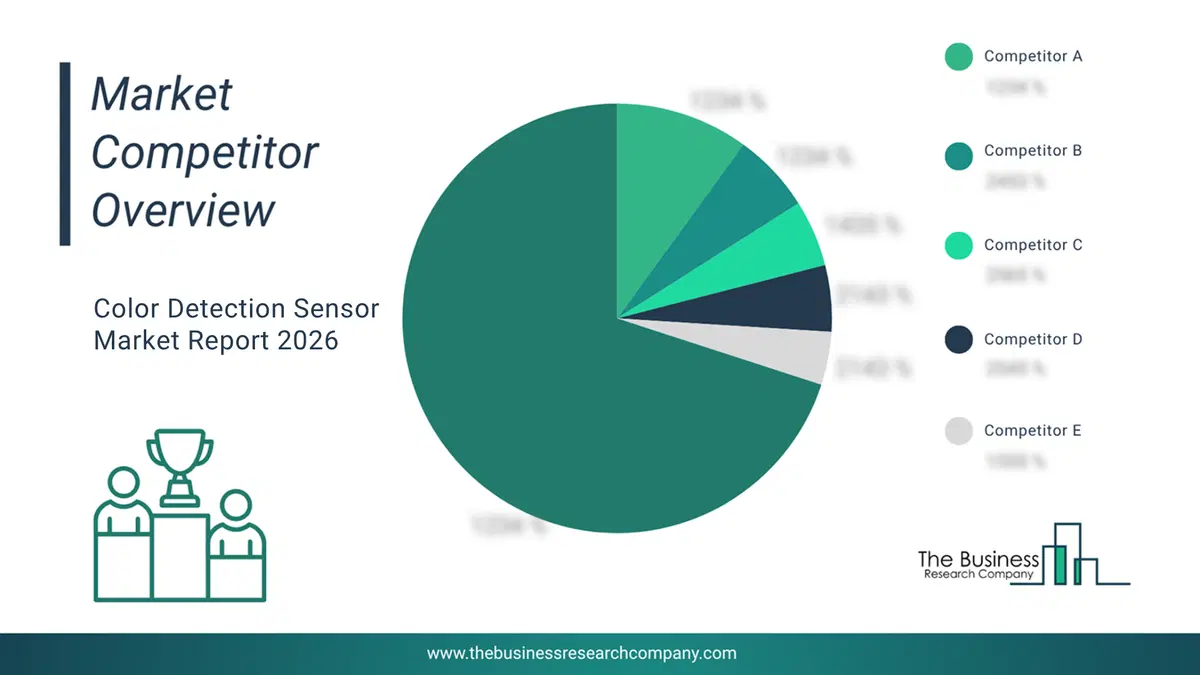
This chart is for illustrative purposes; the full report includes a detailed competitor analysis and comprehensive overview of the top 10 companies in the market.
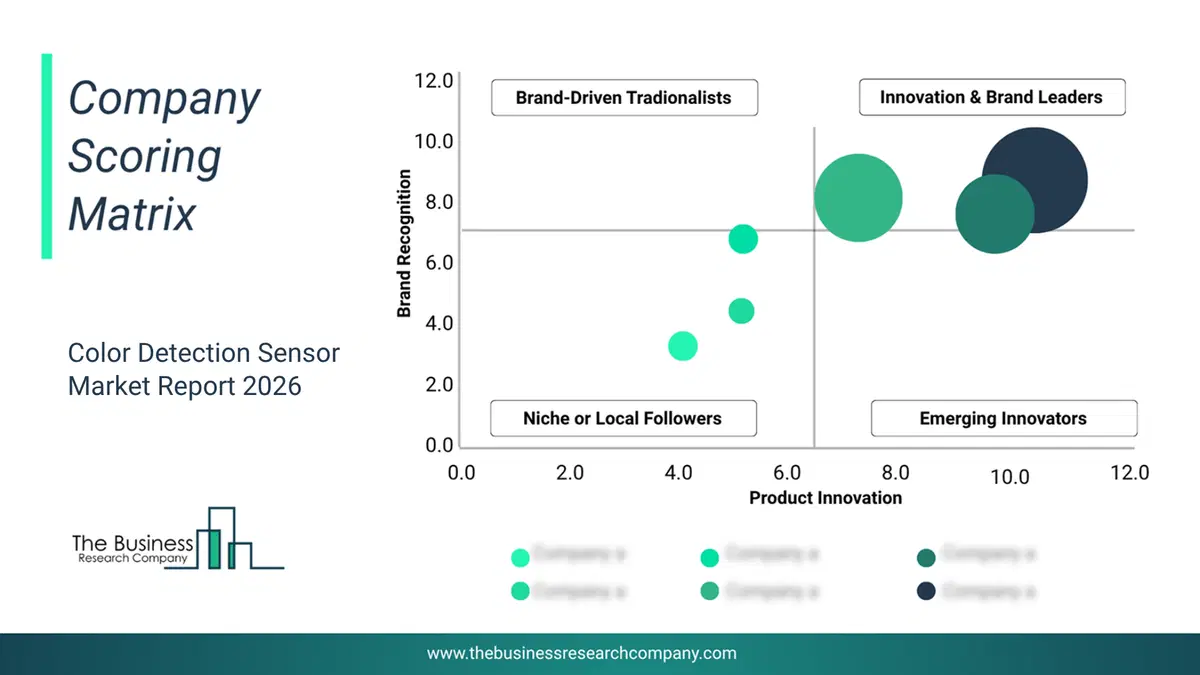
This chart maps companies by product innovation and brand strength, with bubble size indicating relative revenue, helping identify market leaders, challengers, and niche players. This is an illustrative chart; the full report provides a complete and accurate competitive analysis.
Global Color Detection Sensor Market Trends and Insights
Major companies operating in the color detection sensor market are focusing on developing advanced solutions, such as multi-spectral sensing, to enhance color accuracy, improve detection precision, and support a wide range of applications. Multi-spectral sensing refers to a technological feature in color detection sensors that captures and analyzes multiple wavelengths of light, enabling precise identification of subtle color variations in real time. For instance, in July 2023, ams OSRAM, an Austria-based semiconductor company, launched the TCS3530, its next-generation true color sensor, designed to provide accurate color measurement across various ambient lighting conditions. Engineered for integration in consumer electronics, industrial devices, and smart lighting systems, the TCS3530 delivers high-resolution color detection and introduces features such as low-power operation and flexible interface support to enhance application performance and sensing reliability.What Are Latest Mergers And Acquisitions In The Color Detection Sensor Market?
In February 2024, Chenghe Acquisition Corp., a Singapore-based special purpose acquisition company (SPAC) focused on identifying and merging with promising businesses, successfully completed its business combination with Taiwan Color Optics, headquartered in Taiwan. Taiwan Color Optics specializes in providing LiDAR (Light Detection and Ranging) and ADB (Adaptive Driving Beam) components and solutions. This merger aims to enhance capabilities in optical 3D sensing technology, specifically for applications such as LiDAR sensors and smart headlights, thereby strengthening both companies' positions in the rapidly evolving sensor market.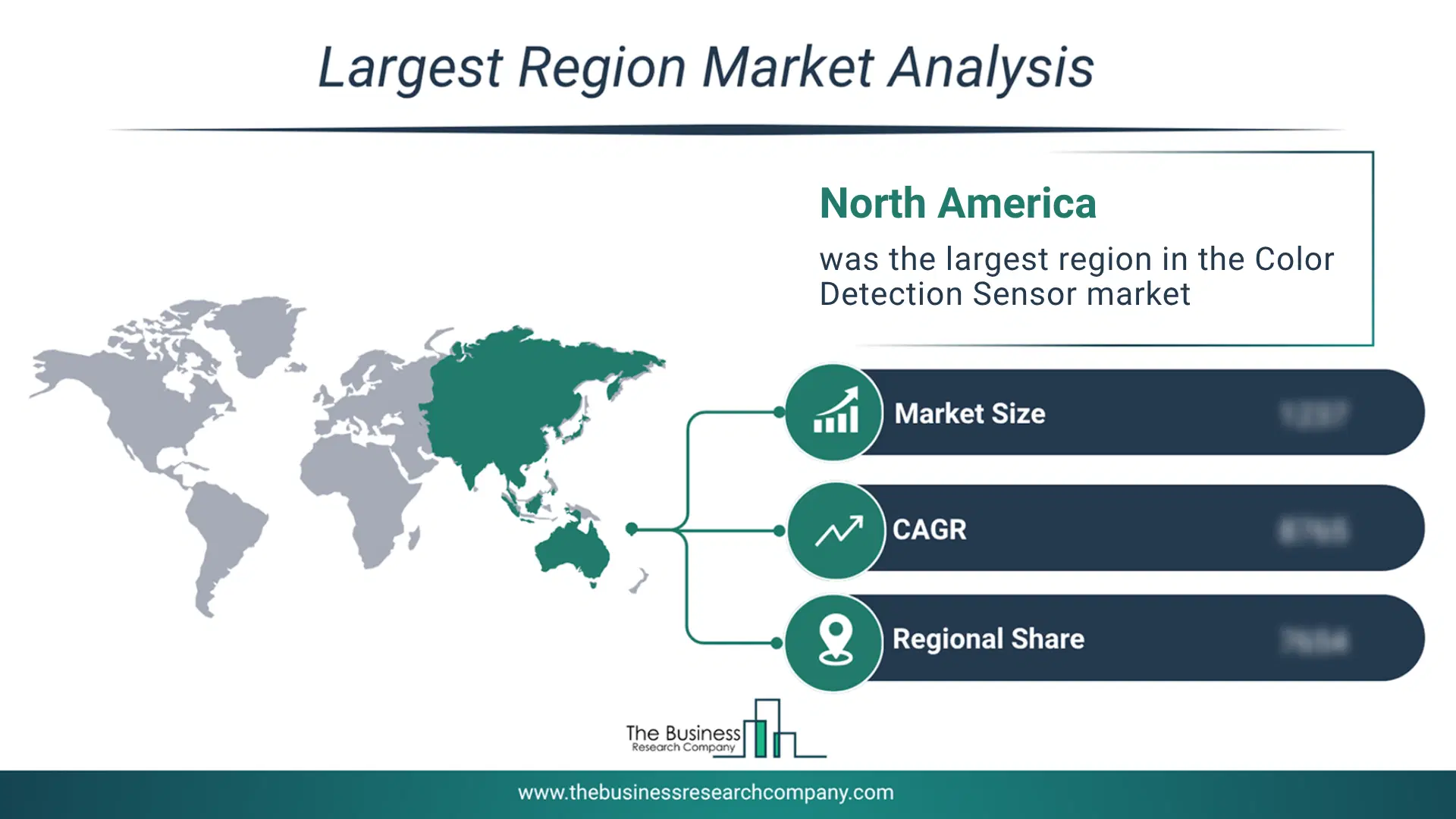
Regional Outlook
North America was the largest region in the color detection sensor market in 2025. Asia-Pacific is expected to be the fastest-growing region in the forecast period. The regions covered in this market report are Asia-Pacific, South East Asia, Western Europe, Eastern Europe, North America, South America, Middle East, Africa The countries covered in this market report are Australia, Brazil, China, France, Germany, India, Indonesia, Japan, Taiwan, Russia, South Korea, UK, USA, Canada, Italy, Spain.What Defines the Color Detection Sensor Market?
The color detection sensor market consists of sales of fiber optics, lasers, halogen lamps, and display interfaces. Values in this market are ‘factory gate’ values, that is, the value of goods sold by the manufacturers or creators of the goods, whether to other entities (including downstream manufacturers, wholesalers, distributors, and retailers) or directly to end customers. The value of goods in this market includes related services sold by the creators of the goods.How is Market Value Defined and Measured?
The market value is defined as the revenues that enterprises gain from the sale of goods and/or services within the specified market and geography through sales, grants, or donations in terms of the currency (in USD unless otherwise specified). The revenues for a specified geography are consumption values that are revenues generated by organizations in the specified geography within the market, irrespective of where they are produced. It does not include revenues from resales along the supply chain, either further along the supply chain or as part of other products.
This chart presents market attractiveness based on a quantitative evaluation of growth, competition, strategic alignment, and risk, offering a clear view of opportunity areas for decision-making. This chart is for illustrative purposes; the full report contains the complete analysis.

This chart highlights the Total Addressable Market (TAM) by estimating the maximum revenue opportunity using an assumption-driven approach, supporting strategic planning and opportunity sizing across markets. The chart is illustrative; the full report provides a more comprehensive analysis.
What Key Data and Analysis Are Included in the Color Detection Sensor Market Report 2026?
The color detection sensor market research report is one of a series of new reports from The Business Research Company that provides market statistics, including industry global market size, regional shares, competitors with the market share, detailed market segments, market trends and opportunities, and any further data you may need to thrive in the color detection sensor industry. The market research report delivers a complete perspective of everything you need, with an in-depth analysis of the current and future state of the industry.Color Detection Sensor Market Report Forecast Analysis
| Report Attribute | Details |
|---|---|
| Market Size Value In 2026 | $2.25 billion |
| Revenue Forecast In 2030 | $2.88 billion |
| Growth Rate | CAGR of 6.3% from 2026 to 2030 |
| Base Year For Estimation | 2025 |
| Actual Estimates/Historical Data | 2020-2025 |
| Forecast Period | 2026 - 2030 |
| Market Representation | Revenue in USD Billion and CAGR from 2026 to 2030 |
| Segments Covered | Type, Application, End-User Industry |
| Regional Scope | Asia-Pacific, Western Europe, Eastern Europe, North America, South America, Middle East, Africa |
| Key Companies Profiled | Panasonic Corporation, Honeywell International Inc., STMicroelectronics, Omron Corporation, Keyence Corporation, ams OSRAM AG, Vishay Intertechnology Inc., SICK AG, Hamamatsu Photonics K.K., IFM Electronic GmbH, Pepperl+Fuchs, Datalogic S.p.A., Baumer Group, Leuze electronic GmbH + Co. KG, Carlo Gavazzi Holding AG, Micro-Epsilon, Contrinex AG, Balluff GmbH, Banner Engineering Corp., SensoPart Industriesensorik GmbH, ASTECH GmbH |
| Customization Scope | Request for Customization |
| Pricing And Purchase Options | Explore Purchase Options |