
Color Measuring Instruments Market Report 2026
Global Outlook – By Product Type (Colorimeters, Spectrophotometers, Color Difference Meters), By Technology (Reflective Measurement Technology, Transmissive Measurement Technology), By Application (Textiles, Paints And Coatings, Plastics, Food And Beverages, Automotive), By End-User Industry (Cosmetics, Printing, Manufacturing) – Market Size, Trends, Strategies, and Forecast to 2030
Color Measuring Instruments Market Overview
• Color Measuring Instruments market size has reached to $1.48 billion in 2025 • Expected to grow to $2.29 billion in 2030 at a compound annual growth rate (CAGR) of 9.1% • Growth Driver: Surge In Research & Development Investment Fueling The Growth Of The Market Due To Rising Demand For High-Precision Quality Control • Market Trend: Advancements In Spectrophotometers For Enhanced Color Measurement Accuracy • North America was the largest region in 2025 and Asia-Pacific is the fastest growing region.What Is Covered Under Color Measuring Instruments Market?
Color measuring instruments are devices that accurately quantify and analyze the color of materials. They capture precise color data and provide consistent, objective results, eliminating subjective human interpretation. These instruments enhance quality control and ensure uniformity across production processes. Their key advantage lies in delivering reliable, repeatable measurements that support decision-making in color-critical environments. The main product types of color measuring instruments are colorimeters, spectrophotometers, gloss meters, color difference meters, and fluorescent meters. Colorimeters are instruments that measure the intensity and composition of colors to ensure accurate color matching and consistency. The display types are digital displays and analog displays, with technologies such as reflective measurement technology, transmissive measurement technology, and fluorescent measurement technology. They are applied across multiple applications, including textiles, paints and coatings, plastics, food and beverages, and automotive, and the key end-user industries are healthcare, aerospace, cosmetics, printing, and manufacturing.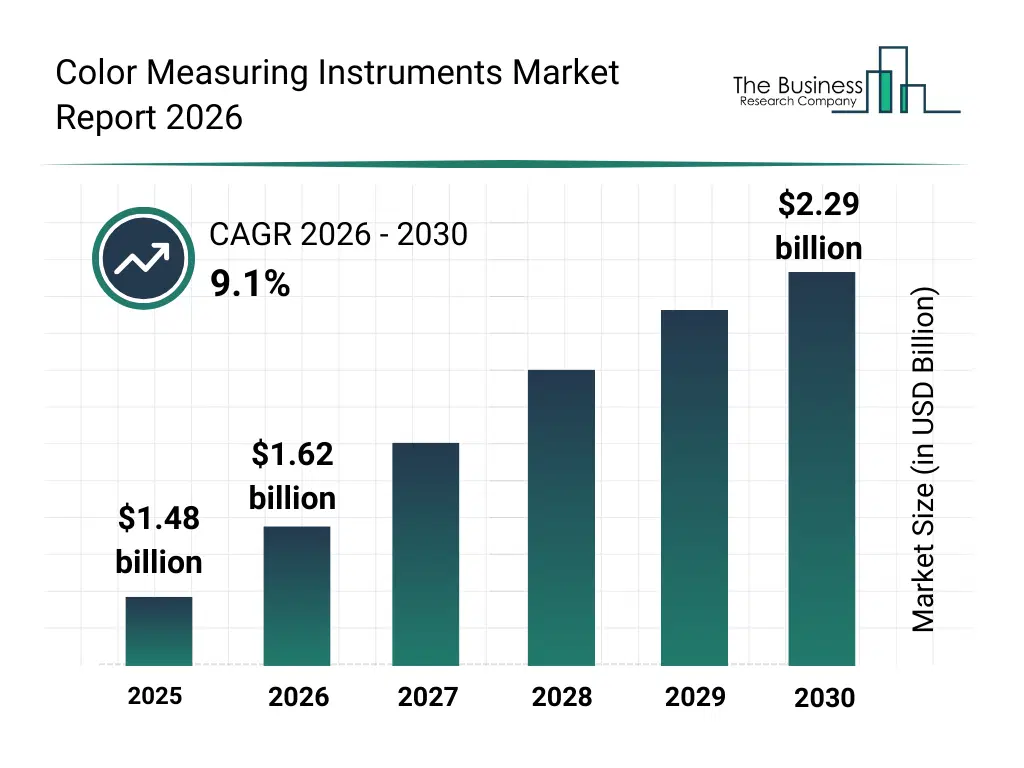
What Is The Color Measuring Instruments Market Size and Share 2026?
The color measuring instruments market size has grown strongly in recent years. It will grow from $1.48 billion in 2025 to $1.62 billion in 2026 at a compound annual growth rate (CAGR) of 9.4%. The growth in the historic period can be attributed to standardization of color quality in manufacturing, growth of textile and coatings industries, increased adoption of objective measurement tools, expansion of plastics processing, rising quality control requirements.What Is The Color Measuring Instruments Market Growth Forecast?
The color measuring instruments market size is expected to see strong growth in the next few years. It will grow to $2.29 billion in 2030 at a compound annual growth rate (CAGR) of 9.1%. The growth in the forecast period can be attributed to increasing automation in production lines, growing demand for real-time color monitoring, expansion of smart factories, rising use of digital twins in quality control, increasing adoption in food and beverage processing. Major trends in the forecast period include increasing adoption of automated color quality control systems, rising demand for high-precision spectrophotometers, growing integration of digital color management software, expansion of inline and portable measurement devices, enhanced focus on consistency in manufacturing.Tariff Impact On Color Measuring Instruments Market
Tariffs are significantly impacting the color measuring instruments market by increasing the cost of imported optical sensors, precision lenses, electronic components, and calibration systems that are essential for accurate color measurement. Manufacturing, automotive, and printing industries in regions such as North America and Europe are most affected due to heavy reliance on high-end imported instruments, while Asia-Pacific faces export pricing pressure. These tariffs are leading to higher equipment acquisition costs and delayed technology upgrades across production facilities. However, tariffs are also encouraging local assembly, regional component sourcing, and investments in cost-optimized instrument design, strengthening domestic manufacturing capabilities over time.
Global Color Measuring Instruments Market Segmentation
1) By Product Type: Colorimeters, Spectrophotometers, Color Difference Meters 2) By Technology: Reflective Measurement Technology, Transmissive Measurement Technology 3) By Application: Textiles, Paints And Coatings, Plastics, Food And Beverages, Automotive 4) By End-User Industry: Cosmetics, Printing, Manufacturing Subsegments: 1) By Colorimeters: Portable Colorimeters, Benchtop Colorimeters, Handheld Colorimeters 2) By Spectrophotometers: Ultraviolet (UV)-Visible Spectrophotometers, Visible Spectrophotometers, Multi-Angle Spectrophotometers, Benchtop Spectrophotometers, Portable Spectrophotometers 3) By Color Difference Meters: Portable Color Difference Meters, Benchtop Color Difference Meters, Spectrophotometric Color Difference MetersWhat Is The Driver Of The Color Measuring Instruments Market?
The increasing investment in research and development (R&D) is expected to propel the growth of the color measuring instruments market going forward. R&D investment refers to the expenditure allocated by governments and private enterprises toward scientific research, technological innovation, and development of new technologies. Investment in R&D is rising due to growing demand for innovation, advancements in manufacturing and quality-control standards, and the need for consistent, high-quality production across industries. Investment in R&D enhances the precision, efficiency, and reliability of color measuring instruments by supporting development of advanced sensors, calibration technologies, and software for consistent color measurement across sectors such as textiles, printing, automotive, and coating. For instance, in December 2024, according to Eurostat, a Luxembourg-based organization, reported that the EU’s expenditure on R&D increased to $442.18 billion (€381.4 billion) in 2023, a 6.7% rise compared with the previous year. Therefore, the increasing investment in research and development is driving the growth of the color measuring instruments industry.Key Players In The Global Color Measuring Instruments Market
Major companies operating in the color measuring instruments market are Konica Minolta Inc., X-Rite Incorporated, Datacolor AG, BYK-Gardner GmbH, Nippon Denshoku Industries Co. Ltd., ColorLite GmbH, Techkon GmbH, Instrument Systems GmbH, Chromasens GmbH, Hunter Associates Laboratory Inc., JETI Technische Instrumente GmbH, Admesy B.V., Murakami Color Research Laboratory Co. Ltd., Hangzhou CHNSpec Technology Co. Ltd., Shenzhen Wave Optoelectronics Technology Co. Ltd., Shenzhen Threenh Technology Co. Ltd., Toray Engineering Co. Ltd., Radiant Vision Systems Inc., Photo Research Inc., Konica Minolta Sensing Americas Inc. (brand-level, not subsidiary manufacturing split), Shanghai Precision & Scientific Instrument Co. Ltd., Beijing Beifen-Ruili Analytical Instrument Co. Ltd.
This chart is for illustrative purposes; the full report includes a detailed competitor analysis and comprehensive overview of the top 10 companies in the market.
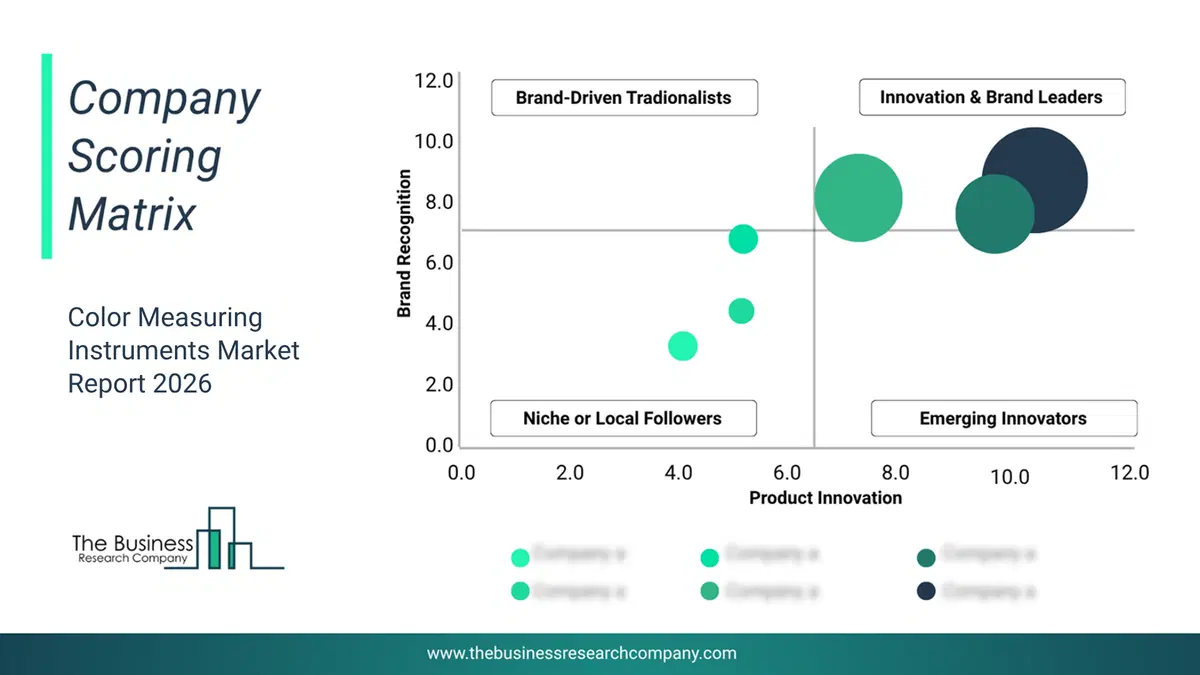
This chart maps companies by product innovation and brand strength, with bubble size indicating relative revenue, helping identify market leaders, challengers, and niche players. This is an illustrative chart; the full report provides a complete and accurate competitive analysis.
Global Color Measuring Instruments Market Trends and Insights
Major companies operating in the color measuring instruments market are focusing on developing advanced products such as spectrophotometers to enhance measurement accuracy and meet diverse industry requirements. A spectrophotometer is an instrument that measures the amount of light a sample absorbs or transmits at specific wavelengths, and it is widely used to accurately determine color, concentration, and chemical composition. For instance, in December 2024, Konica Minolta, a Japan-based technology company, launched the CM-3700A Plus, a flagship spectrophotometer model designed to deliver high accuracy and reliability in color measurement. The model builds on the widely used CM-3700A, and world-class precision was achieved, including improved measurement of challenging colors such as black. It is equipped with features such as a camera viewfinder for easier sample positioning and a thermometer to measure sample temperature concurrently with color. It can measure both SCI and SCE at the same time, which cuts the measurement time by almost half, and it uses very durable parts to ensure it works well over a long time, making it useful for quality control in industries such as automotive, electronics, and cosmetics.What Are Latest Mergers And Acquisitions In The Color Measuring Instruments Market?
In November 2024, X-Rite Incorporated, a US-based provider of color science and technology, acquired Colorware B.V. for an undisclosed amount. With this acquisition, X-Rite aimed to expand its comprehensive color management solutions specifically for the printing and packaging industries by integrating Colorware's flagship product to ensure precise and efficient color quality control in print production workflows. Colorware B.V. is a Netherlands-based provider of color management software for the printing and packaging industries.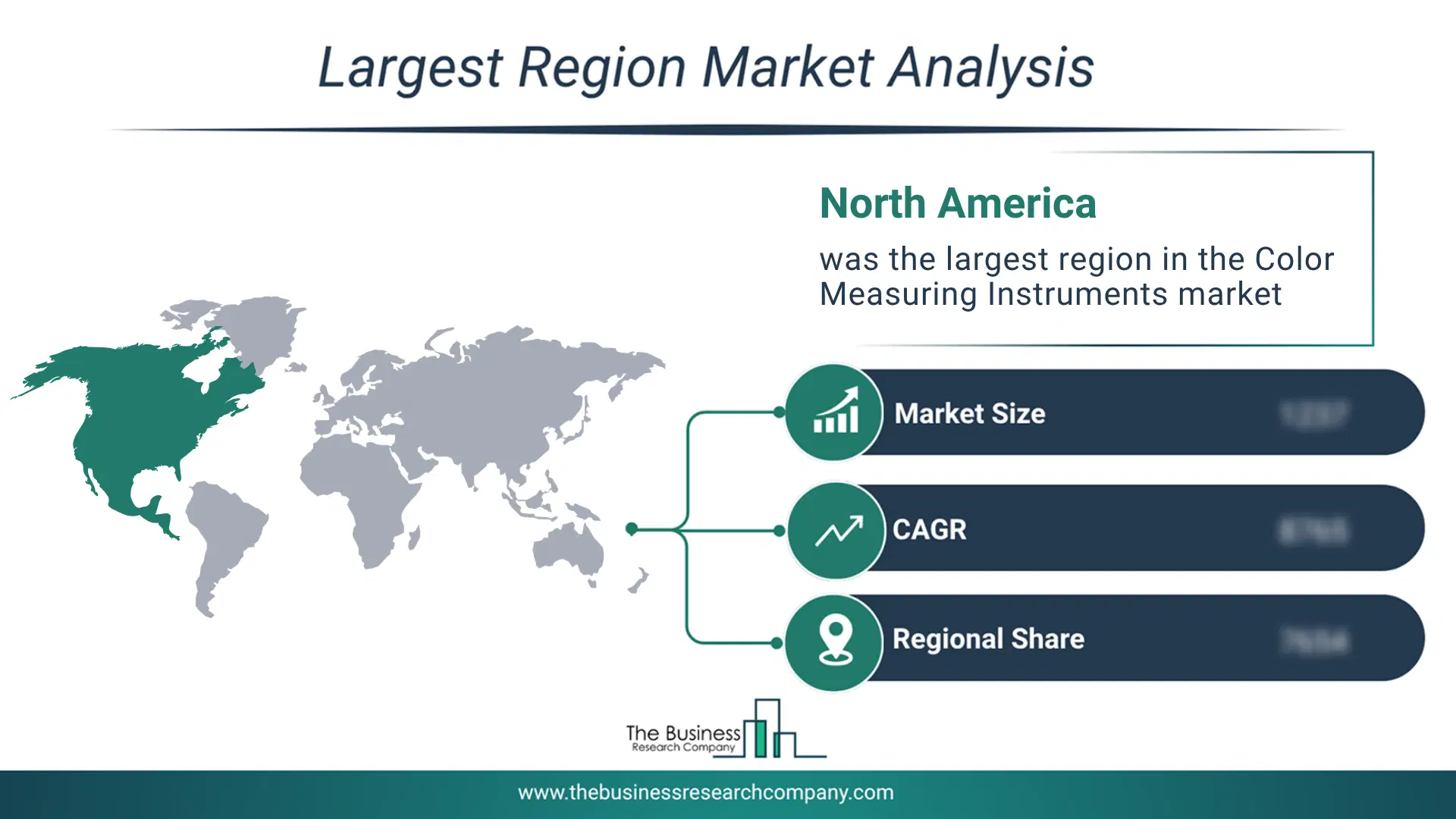
Regional Outlook
North America was the largest region in the color measuring instruments market in 2025. Asia-Pacific is expected to be the fastest-growing region in the forecast period. The regions covered in this market report are Asia-Pacific, South East Asia, Western Europe, Eastern Europe, North America, South America, Middle East, Africa The countries covered in this market report are Australia, Brazil, China, France, Germany, India, Indonesia, Japan, Taiwan, Russia, South Korea, UK, USA, Canada, Italy, Spain.What Defines the Color Measuring Instruments Market?
The color measuring instruments market consists of revenues earned by entities by providing services such as quality control, formulation, consistency testing, spectral analysis, digital color communication, and gloss and appearance evaluation. The market value includes the value of related goods sold by the service provider or included within the service offering. The color measuring instruments market also includes sales of color analyzers, chroma meters, portable color scanners, and image-based color measurement systems. Values in this market are ‘factory gate’ values, that is, the value of goods sold by the manufacturers or creators of the goods, whether to other entities (including downstream manufacturers, wholesalers, distributors, and retailers) or directly to end customers. The value of goods in this market includes related services sold by the creators of the goodsHow is Market Value Defined and Measured?
The market value is defined as the revenues that enterprises gain from the sale of goods and/or services within the specified market and geography through sales, grants, or donations in terms of the currency (in USD unless otherwise specified). The revenues for a specified geography are consumption values that are revenues generated by organizations in the specified geography within the market, irrespective of where they are produced. It does not include revenues from resales along the supply chain, either further along the supply chain or as part of other products.
This chart presents market attractiveness based on a quantitative evaluation of growth, competition, strategic alignment, and risk, offering a clear view of opportunity areas for decision-making. This chart is for illustrative purposes; the full report contains the complete analysis.

This chart highlights the Total Addressable Market (TAM) by estimating the maximum revenue opportunity using an assumption-driven approach, supporting strategic planning and opportunity sizing across markets. The chart is illustrative; the full report provides a more comprehensive analysis.
What Key Data and Analysis Are Included in the Color Measuring Instruments Market Report 2026?
The color measuring instruments market research report is one of a series of new reports from The Business Research Company that provides market statistics, including industry global market size, regional shares, competitors with the market share, detailed market segments, market trends and opportunities, and any further data you may need to thrive in the color measuring instruments industry. The market research report delivers a complete perspective of everything you need, with an in-depth analysis of the current and future state of the industry.Color Measuring Instruments Market Report Forecast Analysis
| Report Attribute | Details |
|---|---|
| Market Size Value In 2026 | $1.62 billion |
| Revenue Forecast In 2030 | $2.29 billion |
| Growth Rate | CAGR of 9.1% from 2026 to 2030 |
| Base Year For Estimation | 2025 |
| Actual Estimates/Historical Data | 2020-2025 |
| Forecast Period | 2026 - 2030 |
| Market Representation | Revenue in USD Billion and CAGR from 2026 to 2030 |
| Segments Covered | Product Type, Technology, Application, End-User Industry |
| Regional Scope | Asia-Pacific, Western Europe, Eastern Europe, North America, South America, Middle East, Africa |
| Key Companies Profiled | Konica Minolta Inc., X-Rite Incorporated, Datacolor AG, BYK-Gardner GmbH, Nippon Denshoku Industries Co. Ltd., ColorLite GmbH, Techkon GmbH, Instrument Systems GmbH, Chromasens GmbH, Hunter Associates Laboratory Inc., JETI Technische Instrumente GmbH, Admesy B.V., Murakami Color Research Laboratory Co. Ltd., Hangzhou CHNSpec Technology Co. Ltd., Shenzhen Wave Optoelectronics Technology Co. Ltd., Shenzhen Threenh Technology Co. Ltd., Toray Engineering Co. Ltd., Radiant Vision Systems Inc., Photo Research Inc., Konica Minolta Sensing Americas Inc. (brand-level, not subsidiary manufacturing split), Shanghai Precision & Scientific Instrument Co. Ltd., Beijing Beifen-Ruili Analytical Instrument Co. Ltd. |
| Customization Scope | Request for Customization |
| Pricing And Purchase Options | Explore Purchase Options |