
Colorectal Cancer Drugs Market 2025
By Cancer Type (Colorectal Adenocarcinoma, Gastrointestinal Carcinoid Tumors, Other Cancer Types), By Class (Targeted Therapy, Immunotherapy, Chemotherapy, Other Classes), By Distribution Channel (Hospital Pharmacies, Retail Pharmacies, Other Distribution Channels), And By Region, Opportunities And Strategies – Global Forecast To 2035
Colorectal Cancer Drugs Market Definition
Colorectal cancer drugs refer to pharmaceutical treatments developed to prevent, manage, or cure cancer that begins in the colon or rectum. These drugs include various therapeutic approaches designed to target cancer cells, slow disease progression and improve survival rates. They play a crucial role in reducing the global burden of colorectal cancer by enhancing patient outcomes. The colorectal cancer drugs market consists of the sales of colorectal cancer drugs by entities (organizations, sole traders, or partnerships) that develop, manufacture and distribute pharmaceutical products aimed at treating cancers of the colon and rectum. These drugs are designed to improve survival, reduce disease progression and enhance the quality of life for patients. The market reflects advancements in oncology research, growing healthcare investments and rising global demand for effective cancer therapies.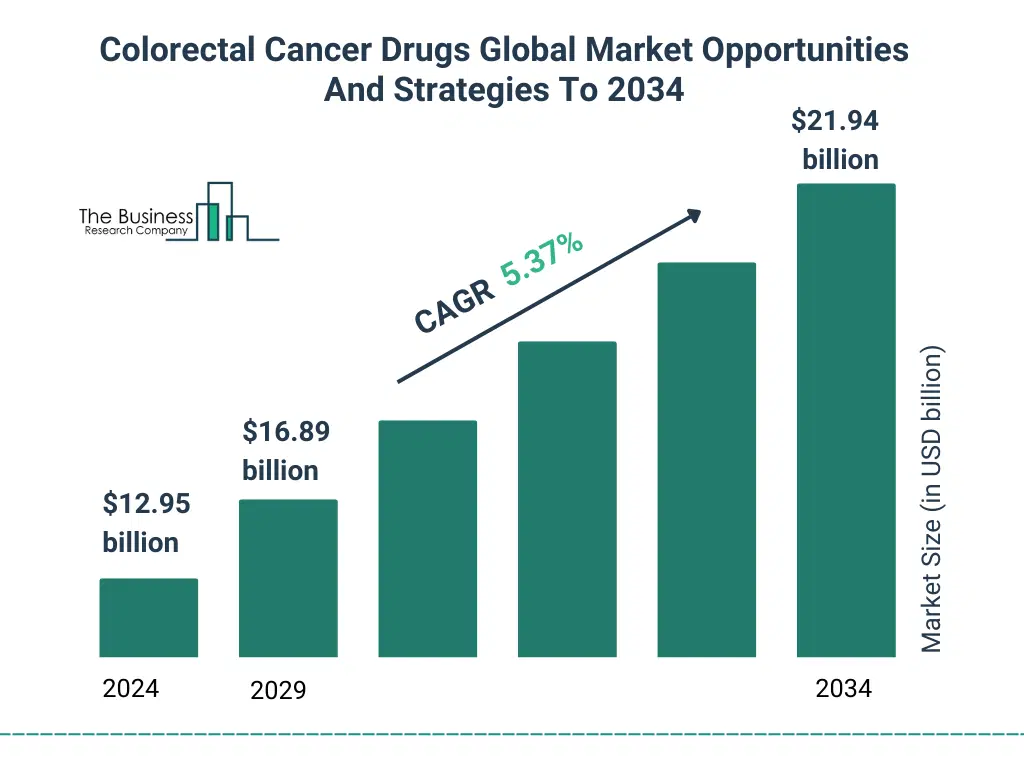
Colorectal Cancer Drugs Market Size
The global colorectal cancer drugs market reached a value of nearly $12,951.67 million in 2024, having grown at a compound annual growth rate (CAGR) of 6.74% since 2019. The market is expected to grow from $12,951.67 million in 2024 to $16,885.59 million in 2029 at a rate of 5.45%. The market is then expected to grow at a CAGR of 5.37% from 2029 and reach $21,935.16 million in 2034. Growth in the historic period resulted from rising clinical trial activity in pharma, rising incidence of colorectal cancer, favorable government initiatives and funding and growth of precision medicine and targeted therapies. Factors that negatively affected growth in the historic period were high treatment costs and affordability issues and severe side effects and toxicities of chemotherapy and biologics. Going forward, increasing awareness and screening programs, increasing healthcare expenditure, growing use of combination therapies and rise in aging population will drive growth. Factors that could hinder the growth of the colorectal cancer drugs market in the future include reimbursement challenges for novel drugs, stringent regulatory approval processes and impact of trade war and tariff.Colorectal Cancer Drugs Market Drivers
The key drivers of the colorectal cancer drugs market include: Rise In Aging Population The growing aging population is expected to significantly drive the growth of the colorectal cancer drugs market during the forecast period. Older individuals face a higher risk of developing colorectal cancer due to factors such as age-related genetic mutations, long-term lifestyle influences and a decline in immune function. As the global population aged 60 and above continues to expand, the incidence of colorectal cancer is projected to rise accordingly, fueling increased demand for effective treatment options. This demographic trend also highlights the need for treatment approaches specifically designed for elderly patients, who often have comorbidities and greater sensitivity to drug toxicity. In response, healthcare systems are placing greater emphasis on geriatric oncology, enhanced screening efforts and preventive measures to address the growing cancer burden among older adults. As a result, the rising elderly population is expected to be a key driver of market demand for colorectal cancer drugs throughout the forecast period. The rise in aging population contribution during the forecast period in 2024 is 2.00%.Colorectal Cancer Drugs Market Restraints
The key restraints on the colorectal cancer drugs market include: Stringent Regulatory Approval Processes Stringent regulatory approval processes are expected to hinder the growth of the colorectal cancer drugs market during the forecast period. Regulatory bodies such as the U.S. Food and Drug Administration (FDA) and the European Medicines Agency (EMA) enforce comprehensive and rigorous standards for clinical trials, safety assessments and efficacy validation. While these regulations are essential for ensuring patient safety, they can significantly delay the approval and launch of new therapies. The growing emphasis on complex biologics and targeted molecular treatments further intensifies the regulatory burden, as these drugs require extensive testing, longer trial durations and more detailed documentation. As a result, pharmaceutical companies face higher development costs and prolonged time-to-market, which can reduce the pace of innovation and limit patient access to new therapies. These regulatory hurdles, while necessary for quality assurance, remain a critical barrier to the timely expansion and accessibility of advanced colorectal cancer treatments. Growth affected by stringent regulatory approval processes during the forecast period in 2024 is -2.14%.Colorectal Cancer Drugs Market Trends
Major trends shaping the colorectal cancer drugs market include: Biosimilar Innovations Enhancing Accessibility And Reducing Costs In Colorectal Cancer Companies operating in the colorectal cancer drugs market are developing biosimilars to expand treatment accessibility, lower overall therapy costs and provide affordable alternatives to high-priced biologics, while maintaining equivalent safety, efficacy and quality to the reference drugs. Biosimilars also aim to increase patient adherence by reducing financial barriers and to enable broader adoption of standard-of-care therapies in regions with constrained healthcare budgets. For example, in April 2025, Biocon Biologics, an India-based biopharmaceutical company, received approval from the Food and Drug Administration, a US-based federal agency, for Jobevne, a bevacizumab biosimilar indicated for the treatment of metastatic colorectal cancer and other cancers. Jobevne is a biosimilar to Avastin and demonstrates comparable safety, efficacy and quality, while providing a lower-cost alternative that can improve patient access and affordability. It can be used in combination with chemotherapy regimens for metastatic colorectal cancer, supporting broader adoption of standard-of-care therapies, particularly in markets with constrained healthcare budgets. Advancing Frontline Treatment In BRAF V600E-Mutant Metastatic Colorectal Cancer Major companies in the colorectal cancer drugs market are moving targeted therapies into frontline treatment settings by combining BRAF (v-Raf murine sarcoma viral oncogene homolog B1) inhibitors with EGFR (Epidermal Growth Factor Receptor) blockade and chemotherapy for patients with BRAF V600E-mutant metastatic colorectal cancer (mCRC). This shift is driven by the recognition that patients with BRAF V600E mutations typically have poor prognoses and limited response to standard chemotherapy alone. For example, in December 2024, Pfizer, a US-based biopharmaceutical company, received approval from the Food and Drug Administration, a US-based federal agency, for BRAFTOVI in combination with cetuximab as a first-line treatment for adult patients with BRAF V600E-mutant metastatic colorectal cancer. This approval marks a significant advancement in targeted therapy, providing a personalized treatment option that specifically addresses the BRAF V600E mutation, which is associated with aggressive disease and poor prognosis. The combination regimen is expected to improve clinical outcomes and expand first-line therapy options for patients with this molecular subtype of colorectal cancer.Opportunities And Recommendations In The colorectal cancer drugs Market
Opportunities – The top opportunities in the colorectal cancer drugs market segmented by cancer type will arise in the colorectal adenocarcinoma segment, which will gain $3,571.68 million of global annual sales by 2029. The top opportunities in the colorectal cancer drugs market segmented by class will arise in the targeted therapy segment, which will gain $1,438.85 million of global annual sales by 2029. The top opportunities in the colorectal cancer drugs market segmented by distribution channel will arise in the hospital pharmacies segment, which will gain $1,763.03 million of global annual sales by 2029. The colorectal cancer drugs market size will gain the most in the USA at $1,437.78 million. Recommendations- To take advantage of the opportunities, The Business Research Company recommends the colorectal cancer drug companies to focus on expanding biosimilar portfolios to enhance access and affordability, focus on advancing targeted therapies into first-line treatment for improved outcomes, focus on expanding combination regimens targeting kras g12c-mutant colorectal cancer, focus on advancing next-generation oral tkis to improve late-line treatment options, focus on the gastrointestinal carcinoid tumors segment for accelerated growth, focus on the immunotherapy segment to drive long-term market expansion, expand in emerging markets, focus on strengthening multi-channel distribution networks, focus on developing value-based and region-specific pricing strategies, focus on strengthening evidence-based engagement with healthcare stakeholders, focus on expanding digital and data-driven promotional channels, focus on the retail pharmacies segment to capture emerging growth opportunities.
Colorectal Cancer Drugs Market Segmentation
The colorectal cancer drugs market is segmented by cancer type, by class, and by distribution channels.By Cancer Type –
The colorectal cancer drugs market is segmented by cancer type into:
- a) Colorectal Adenocarcinoma
- b) Gastrointestinal Carcinoid Tumors
- c) Other Cancer Types
By Class –
The colorectal cancer drugs market is segmented by class into:
- a) Targeted Therapy
- b) Immunotherapy
- c) Chemotherapy
- d) Other Classes
By Distribution Channels –
The colorectal cancer drugs market is segmented by distribution channels into:
- a) Hospital Pharmacies
- b) Hospital Pharmacies
- c) Other Distribution Channels
By Geography - The colorectal cancer drugs market is segmented by geography into:
- • China
- • India
- • Japan
- • Australia
- • Indonesia
- • South Korea
- • USA
- • Canada
- • Brazil
- • France
- • Germany
- • UK
- • Italy
- • Spain
- • Russia
-
o Asia Pacific
o Africa