
Colorectal Cancer Molecular Diagnostics Market 2025
By Type (Instruments, Reagents And Kits, Services), By Technology (Polymerase Chain Reaction (PCR), Sequencing, Mass Spectrometry, Transcription Mediated Amplification, Chips And Microarrays, Isothermal Nucleic Acid Amplification Technology (INAAT), In Situ Hybridization (FISH/ISH), Immunohistochemistry (IHC)), By End Users (Hospitals, Ambulatory Surgical Centers, Diagnostic Laboratories, Homecare Settings, Other End Users), And By Region, Opportunities And Strategies – Global Forecast To 2035
Colorectal Cancer Molecular Diagnostics Market Definition
Colorectal cancer molecular diagnostics refers to a category of diagnostic technologies and tools designed to detect specific molecular alterations associated with colorectal cancer. These alterations include gene mutations, microsatellite instability and DNA (Deoxyribonucleic Acid) methylation patterns, which are critical for understanding disease behavior and informing clinical decisions. These diagnostics play a central role in enhancing the accuracy of screening, confirming diagnoses, guiding treatment strategies and monitoring for disease progression or recurrence. The colorectal cancer molecular diagnostics market consists of sales, by entities (organizations, sole traders, or partnerships), of colorectal cancer molecular diagnostics that are used by healthcare professionals across a variety of clinical environments, including hospitals, diagnostic laboratories, surgical centers, homecare settings and research institutions. They are applied at multiple stages of patient care, from screening individuals at risk to confirming malignancy, identifying therapeutic options and tracking treatment outcomes. The ability to detect molecular changes enables clinicians to tailor therapies to individual patient profiles and improve clinical outcomes.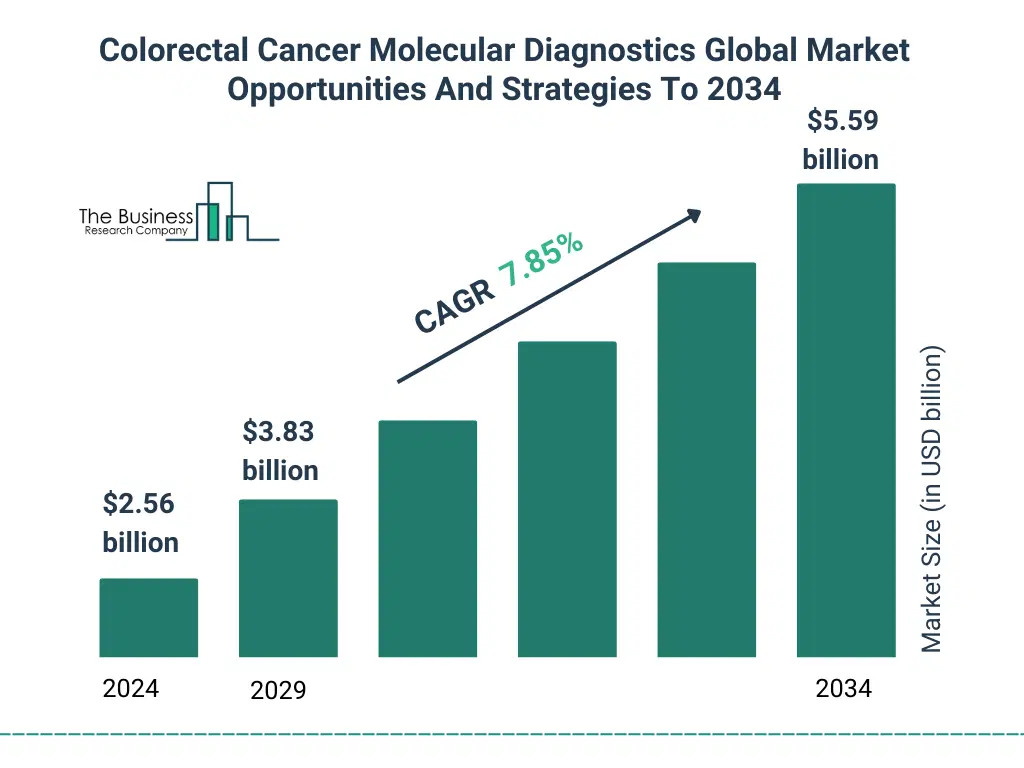
Colorectal Cancer Molecular Diagnostics Market Size
The global colorectal cancer molecular diagnostics market reached a value of nearly $2,560.91 million in 2024, having grown at a compound annual growth rate (CAGR) of 6.54% since 2019. The market is expected to grow from $2,560.91 million in 2024 to $3,827.29 million in 2029 at a rate of 8.37%. The market is then expected to grow at a CAGR of 7.85% from 2029 and reach $5,585.53 million in 2034. Growth in the historic period resulted from the shift towards personalized medicine, rising incidence of cancer cases, government screening programs and public-health initiatives and shift toward early detection and preventive screening. Factors that negatively affected growth in the historic period were high cost of molecular diagnostic tests and instruments and financial and reimbursement restraints. Going forward, the growing aging population, increasing healthcare expenditure, growing investments and funding in cancer diagnostics startups and rising demand for non-invasive and home-based testing will drive the growth. Factors that could hinder the growth of the colorectal cancer molecular diagnostics market in the future include stringent and evolving regulatory frameworks, lack of standardized protocols across laboratories and impact of trade war and tariff.Colorectal Cancer Molecular Diagnostics Market Drivers
The key drivers of the colorectal cancer molecular diagnostics market include: Growing Aging Population During the forecast period, the growing aging population is expected to propel the growth of the colorectal cancer molecular diagnostics market. As the global population continues to live longer, the proportion of older adults is steadily increasing and age is recognized as one of the major risk factors for colorectal cancer. This demographic trend is expected to create a stronger need for reliable diagnostic solutions that can enable early detection, continuous monitoring and effective disease management in older individuals. Moreover, elderly populations are more likely to participate in screening programs and require advanced diagnostic approaches to guide treatment decisions, thereby fueling the adoption of molecular diagnostic technologies. The share of older people is rising worldwide, with aging populations contributing significantly to the overall disease burden, including colorectal cancer. The growing aging population contribution during the forecast period in 2024 is 2.00%.Colorectal Cancer Molecular Diagnostics Market Restraints
The key restraints on the colorectal cancer molecular diagnostics market include: Stringent And Evolving Regulatory Frameworks During the forecast period, stringent and evolving regulatory frameworks is expected to hamper the growth of the colorectal cancer molecular diagnostics market. Regulatory bodies such as the U.S. Food and Drug Administration (FDA) and the Centers for Medicare & Medicaid Services (CMS) are implementing increasingly complex and variable policies that govern the approval, reimbursement and utilization of molecular diagnostic tests. These shifting policies can create uncertainty for laboratories and healthcare providers, potentially delaying the introduction of new diagnostic technologies and complicating the integration of molecular diagnostics into clinical practice. Growth affected by stringent and evolving regulatory frameworks during the forecast period in 2024 is -1.51%.Colorectal Cancer Molecular Diagnostics Market Trends
Major trends shaping the colorectal cancer molecular diagnostics market include: Expansion Of Blood-Based Colorectal Cancer Screening Tests Major companies in the colorectal cancer molecular diagnostics market are focusing on the expansion of blood-based screening tests designed to improve early cancer detection and increase patient compliance compared to traditional stool-based or colonoscopy methods. These initiatives aim to enhance accessibility, convenience and adoption rates, particularly among populations hesitant to undergo invasive procedures. For instance, in August 2025, Exact Sciences, a US-based molecular diagnostics company specializing in cancer screening, entered into an exclusive licensing agreement with Freenome, a US-based biotechnology company, to commercialize Freenome’s blood-based colorectal cancer screening tests in the United States. The agreement includes an upfront payment of USD 75 million and potential milestone payments up to USD 700 million. By integrating blood-based screening into its portfolio, Exact Sciences aims to strengthen its leadership position in non-invasive cancer diagnostics and address the growing demand for simple, reliable and widely accessible colorectal cancer screening solutions. Additionally in March 2025, New Day Diagnostics, a US-based developer of non-invasive diagnostic tests, has announced the nationwide launch of ColoHealth, a new blood-based screening test for early detection of colorectal cancer, especially aimed at individuals who have not completed traditional screening methods such as colonoscopies or stool-based tests. ColoHealth is a qualitative in vitro diagnostic test that detects methylated Septin 9 DNA, a biomarker strongly associated with colorectal cancer, from a standard blood sample. The test is designed primarily for average-risk adults aged 50 and older who have been offered but not completed conventional screening. It offers a non-invasive, patient-friendly alternative to conventional procedures, requiring no bowel prep, anesthesia, or time off work simply a standard blood draw. Growing Adoption Of At-Home Colorectal Cancer Screening Kits Major players in the colorectal cancer molecular diagnostics market are focusing on the launch and expansion of at-home screening kits designed to improve convenience and encourage greater participation in regular cancer screening programs. These initiatives are aimed at reducing barriers such as clinic visits and invasive procedures, while also expanding access to underserved populations. For instance, in March 2024, Guardant Health, a US-based precision oncology company, launched Shield, its first blood-based colorectal cancer screening test available for at-home use. Shield enables individuals to collect samples outside clinical settings, thereby improving compliance and broadening adoption. By emphasizing patient-centered accessibility, Guardant Health aims to increase early cancer detection rates and strengthen its position in the non-invasive diagnostics market.Opportunities And Recommendations In The Colorectal Cancer Molecular Diagnostics Market
Opportunities – The top opportunities in the colorectal cancer molecular diagnostics markets segmented by type will arise in the reagents and kits segment, which will gain $783.92 million of global annual sales by 2029. The top opportunities in the colorectal cancer molecular diagnostics markets segmented by technology will arise in the polymerase chain reaction (PCR) segment, which will gain $634.59 million of global annual sales by 2029. The top opportunities in the colorectal cancer molecular diagnostics markets segmented by end users will arise in the hospitals segment, which will gain $682.77 million of global annual sales by 2029. The colorectal cancer molecular diagnostics market size will gain the most in the USA at $503.38 million. Recommendations- To take advantage of the opportunities, The Business Research Company recommends the colorectal cancer molecular diagnostics market companies to focus on expanding blood-based colorectal cancer screening, focus on at-home colorectal cancer screening solutions, focus on implementing fully automated pcr platforms, focus on reagents and kits for rapid growth, focus on sequencing for rapid growth in molecular diagnostics, expand in emerging markets, focus on expanding strategic distribution channels, focus on value-based and tiered pricing strategies, focus on evidence-based awareness campaigns, focus on multi-channel targeted communication, focus on diagnostic laboratories for market expansion.
Colorectal Cancer Molecular Diagnostics Market Segmentation
The colorectal cancer molecular diagnostics market is segmented by type, by technology, and by end user.By Type –
The colorectal cancer molecular diagnostics market is segmented by type into:
- a) Instruments
- b) Reagents And Kits
- c) Services
By Technology –
The colorectal cancer molecular diagnostics market is segmented by technology into:
- a) Polymerase Chain Reaction (PCR)
- b) Sequencing
- c) Mass Spectrometry
- d) Transcription Mediated Amplification
- d) Chips And Microarrays
- d) Isothermal Nucleic Acid Amplification Technology (INAAT)
- d) In Situ Hybridization (FISH/ISH)
- d) Immunohistochemistry (IHC)
By End User –
The colorectal cancer molecular diagnostics market is segmented by end user into:
- a) Hospitals
- b) Ambulatory Surgical Centers
- c) Diagnostic Laboratories
- c) Homecare Settings
- c) Other End Users
By Geography - The colorectal cancer molecular diagnostics market is segmented by geography into:
- • China
- • India
- • Japan
- • Australia
- • Indonesia
- • South Korea
- • USA
- • Canada
- • Brazil
- • France
- • Germany
- • UK
- • Italy
- • Spain
- • Russia
-
o Asia Pacific
o Africa