
Combi Boiler Market Report 2026
Global Outlook – By Fuel (Natural Gas, Liquefied Petroleum Gas, Oil, Electric), By Technology (Condensing, Non-Condensing), By Power Output (24 Kilowatt (kW) Or Less, 25-30 Kilowatt (kW), 31-35 Kilowatt (kW), 36 Kilowatt (kW) Or More), By Distribution Channel (Distributors and Dealers, Direct Sales, Online Sales), By End-Use (Residential, Non-Residential) – Market Size, Trends, Strategies, and Forecast to 2030
Combi Boiler Market Overview
• Combi Boiler market size has reached to $33.3 billion in 2025 • Expected to grow to $49.42 billion in 2030 at a compound annual growth rate (CAGR) of 8.2% • Growth Driver: Surge In Energy-Efficient Heating Systems Fueling The Growth Of The Market Due To Rising Environmental Awareness • Market Trend: Development Of High-Performance, Energy-Efficient Combi Boilers Addresses Growing Demand For Sustainable Home Heating Solutions • North America was the largest region in 2025 and Asia-Pacific is the fastest growing region.What Is Covered Under Combi Boiler Market?
A combi boiler, or combination boiler, is a compact and energy-efficient unit that delivers both central heating and instant hot water without the need for a separate water tank or cylinder. It draws water directly from the mains, providing hot water on demand. This space-saving solution is ideal for smaller homes or apartments and is known for its easy installation and reduced energy usage. Combi boilers are particularly well-suited for households with limited space and moderate hot water requirements. The main types of fuel for combi boiler are natural gas, oil, electricity, and others. Natural gas combi boilers offer efficient, low-emission heating and hot water, making them a cost-effective choice in areas with established gas infrastructure. It utilizes various technologies, such as condensing and non-condensing, with different power outputs, including 24 kilowatts (kW) or less, 25-30 kilowatts (kW), 31-35 kilowatts (kW), and 36 kilowatts (kW) or more. It is distributed through several distribution channels, such as online retail, physical automotive stores, distributors and dealers, and direct sales, and is used by various end-uses, including residential and non-residential.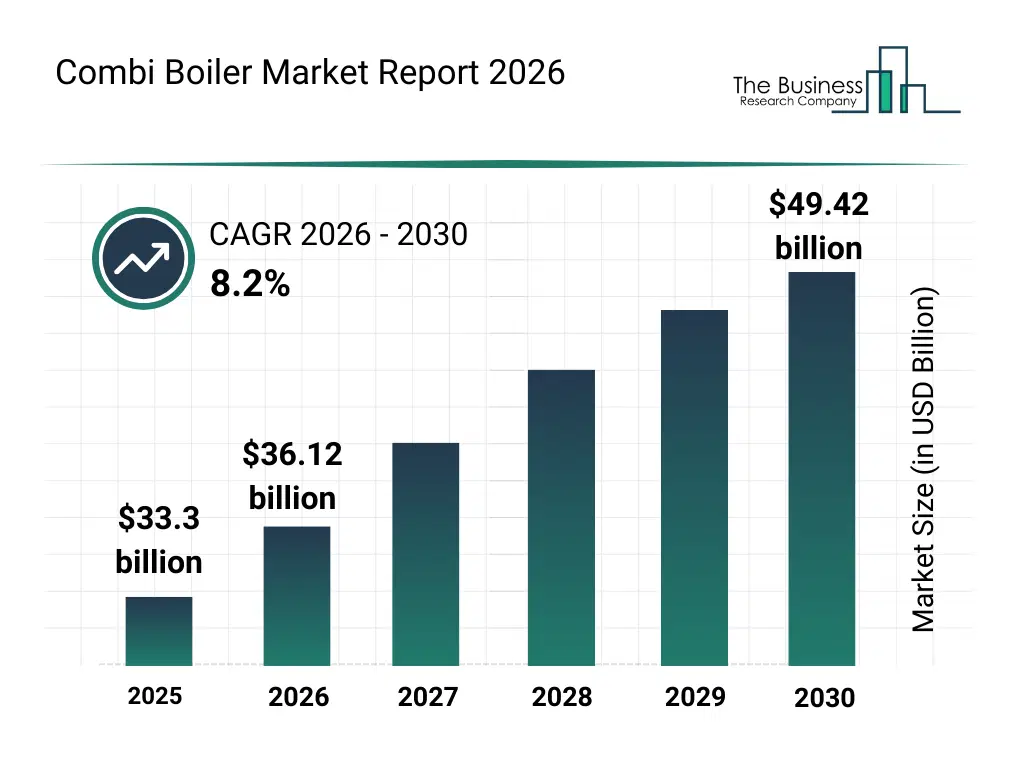
What Is The Combi Boiler Market Size and Share 2026?
The combi boiler market size has grown strongly in recent years. It will grow from $33.3 billion in 2025 to $36.12 billion in 2026 at a compound annual growth rate (CAGR) of 8.5%. The growth in the historic period can be attributed to growth of urban housing developments, replacement of traditional boiler systems, demand for energy efficient home heating, limited space availability in residential buildings, rising natural gas infrastructure.What Is The Combi Boiler Market Growth Forecast?
The combi boiler market size is expected to see strong growth in the next few years. It will grow to $49.42 billion in 2030 at a compound annual growth rate (CAGR) of 8.2%. The growth in the forecast period can be attributed to stricter carbon emission regulations, expansion of hydrogen blending initiatives, growth of smart home adoption, increasing electricity grid decarbonization, rising residential renovation activities. Major trends in the forecast period include growing adoption of condensing combi boilers, rising demand for hydrogen ready boiler systems, increasing integration of smart and connected controls, shift toward compact and space saving heating solutions, expansion of electric and hybrid combi boiler models.Tariff Impact On Combi Boiler Market
Tariffs have impacted the combi boiler market by increasing the cost of imported heat exchangers, electronic controls, and precision components. These higher costs have affected pricing in residential heating markets, particularly in Europe and Asia Pacific. Condensing and hydrogen ready combi boilers are most impacted due to higher component complexity. At the same time, tariffs are supporting localized manufacturing and regional supply chain development.
Global Combi Boiler Market Segmentation
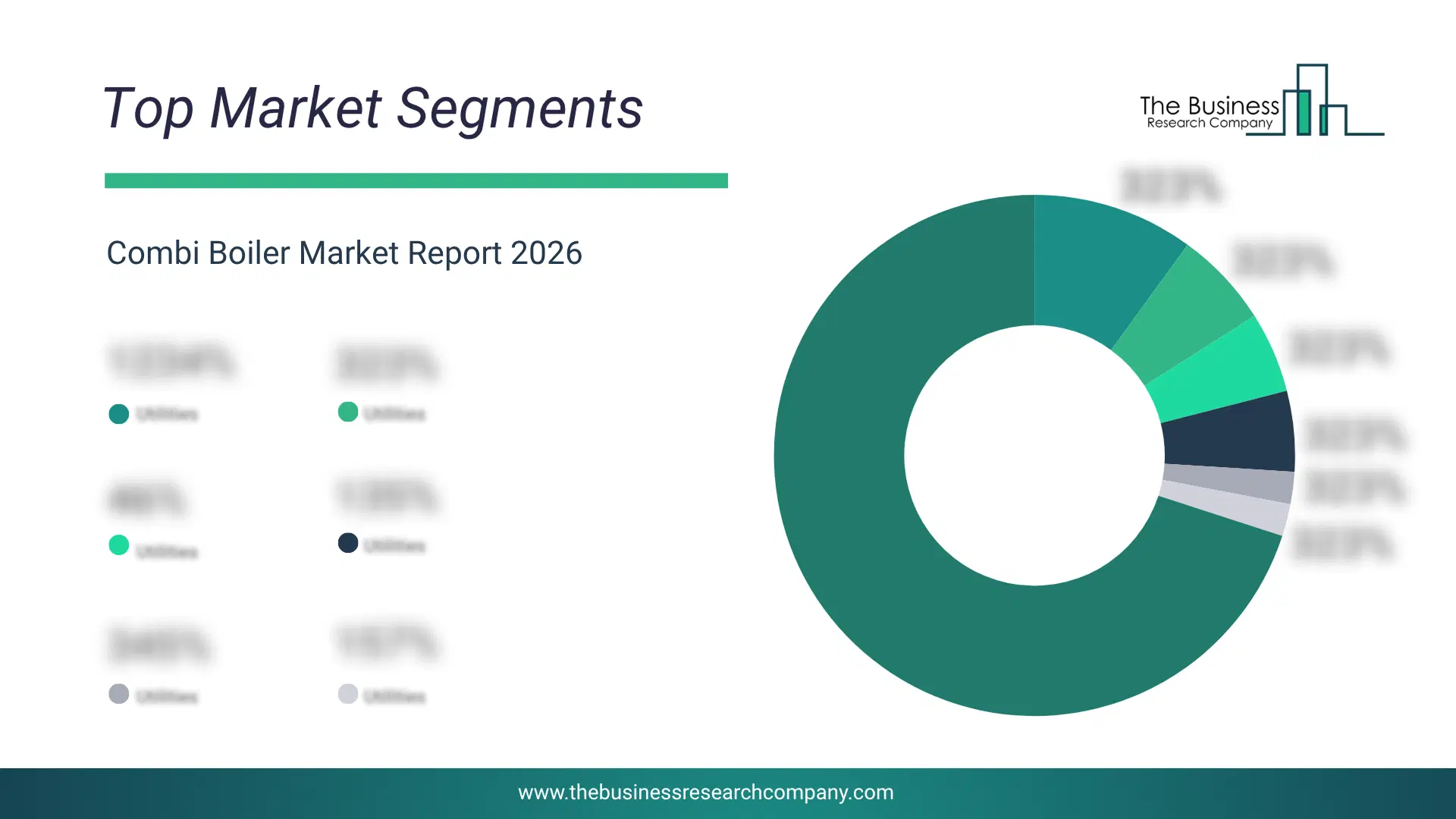
1) By Fuel: Natural Gas, Liquefied Petroleum Gas, Oil, Electric 2) By Technology: Condensing, Non-Condensing 3) By Power Output: 24 Kilowatt (kW) Or Less, 25-30 Kilowatt (kW), 31-35 Kilowatt (kW), 36 Kilowatt (kW) Or More 4) By Distribution Channel: Distributors and Dealers, Direct Sales, Online Sales 5) By End-Use: Residential, Non-Residential Subsegments: 1) By Natural Gas: Conventional Gas Combi Boilers, Condensing Gas Combi Boilers, Hydrogen-Ready Gas Combi Boilers 2) By Liquefied Petroleum Gas: Conventional LPG Combi Boilers, Condensing LPG Combi Boilers 3) By Oil: Condensing Oil Combi Boilers, Biofuel-Compatible Oil Combi Boilers 4) By Electric: Direct Electric Combi BoilersWhat Is The Driver Of The Combi Boiler Market?
The growing demand for energy-efficient heating systems is expected to propel the growth of the combi boiler market going forward. Energy-efficient heating systems refer to heating technologies designed to use less energy while providing the same or better level of warmth. Energy-efficient heating systems are rising due to the need to cut energy expenses, as they use less power and lower utility bills. Combi boiler systems leverage energy-efficient heating technologies to reduce fuel consumption, cut operating costs, and provide consistent heating with minimal environmental impact. This makes them a cost-effective and eco-friendly solution for modern homes. For instance, in September 2024, according to ElectricHomes, a UK-based information and media organization, 36,799 air source and 2,469 ground or water source heat pumps were installed in 2023, bringing total Microgeneration Certification Scheme (MCS) certified units to 229,6188, a 20% rise from 2022. The UK targets 600,000 installations annually by 2028. Therefore, the growing demand for energy-efficient heating systems is driving the growth of the combi boiler industry.Key Players In The Global Combi Boiler Market
Major companies operating in the combi boiler market are Vaillant Group, Viessmann Werke GmbH & Co. KG, Worcester Bosch Group, Ariston Group, Baxi Heating UK Limited, Ideal Heating, Ferroli S.p.A., Intergas Heating Ltd., Alpha Heating Innovation, ATAG Heating Technology, Saunier Duval, Glow-worm, Rinnai Corporation, Noritz Corporation, KD Navien Co. Ltd., Immergas S.p.A., De Dietrich Thermique, Chaffoteaux (Ariston Brand), Vaillant Boilers (Vaillant Brand), Bosch Thermotechnology, Fondital S.p.A., Sime S.p.A., Cosmogas S.r.l.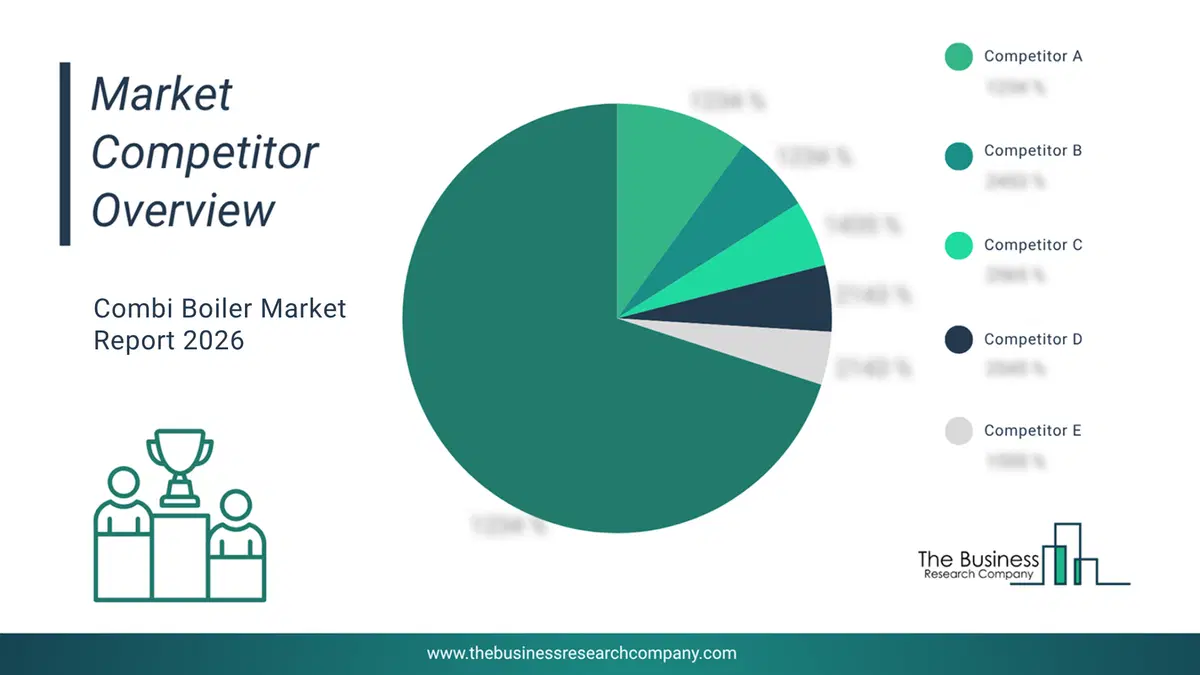
This chart is for illustrative purposes; the full report includes a detailed competitor analysis and comprehensive overview of the top 10 companies in the market.
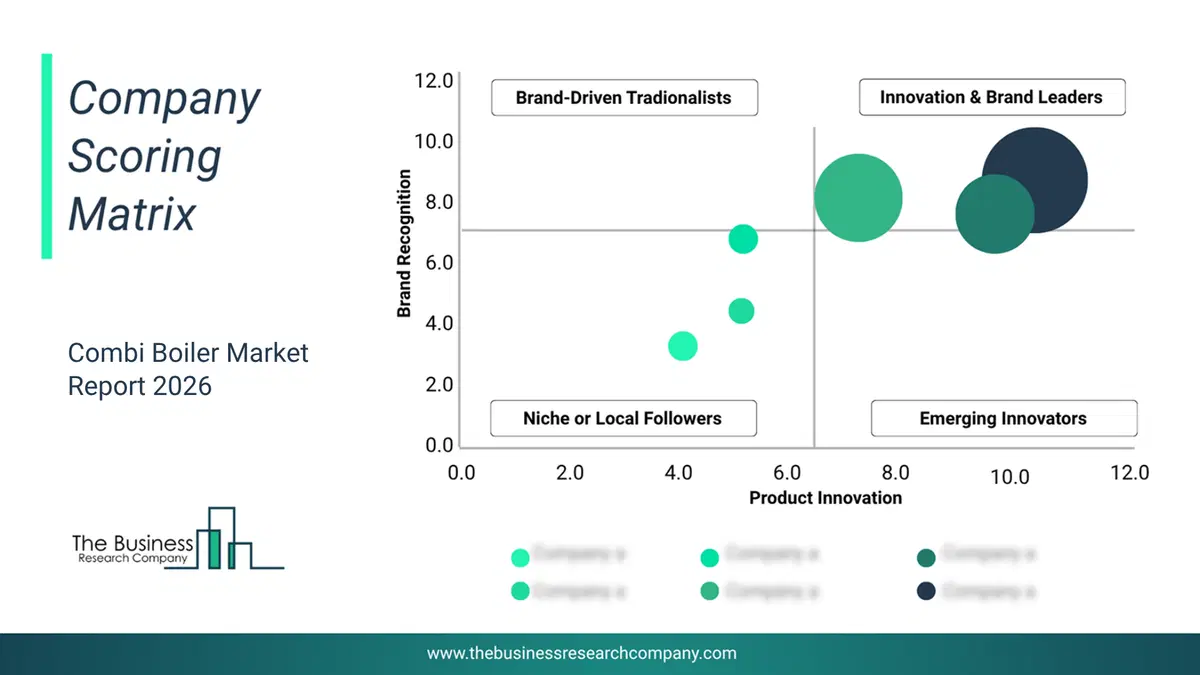
This chart maps companies by product innovation and brand strength, with bubble size indicating relative revenue, helping identify market leaders, challengers, and niche players. This is an illustrative chart; the full report provides a complete and accurate competitive analysis.
Global Combi Boiler Market Trends and Insights
Major companies operating in the combi boiler market are focusing on developing advanced products such as high-performance combi boilers to meet growing consumer demand for sustainable heating solutions. High-performance combi boilers are cutting-edge heating units that deliver instant hot water and central heating with maximum energy efficiency, ensuring quicker heating and better fuel savings than conventional boilers. For instance, in February 2025, Viessmann Climate Solutions, a UK-based heating and refrigeration manufacturing company, launched Vitodens 025-W, a new compact combi boiler to offer efficient, quiet heating for homes with limited space. This comprises advanced features such as a durable Inox-Radial stainless steel heat exchanger, high-efficiency MatriX-Plus burner, and a compact, quiet design, it achieves up to 98% seasonal efficiency (ERP Class A) and is easy to install and operate, all at a very attractive price point.What Are Latest Mergers And Acquisitions In The Combi Boiler Market?
In January 2024, Carrier Global Corporation, a US-based climate and energy‑technology company, acquired Viessmann Climate Solutions SE for an undisclosed amount. With this acquisition, Carrier Global aims to broaden and deepen its global leadership in intelligent HVAC and sustainable climate‑energy solutions, particularly strengthening its footprint in the residential and light‑commercial (RLC) segment across Europe and beyond. Viessmann Climate Solutions SE is a Germany‑based heating, ventilation, and climate‑technology company that specializes in highly efficient and renewable climate solutions.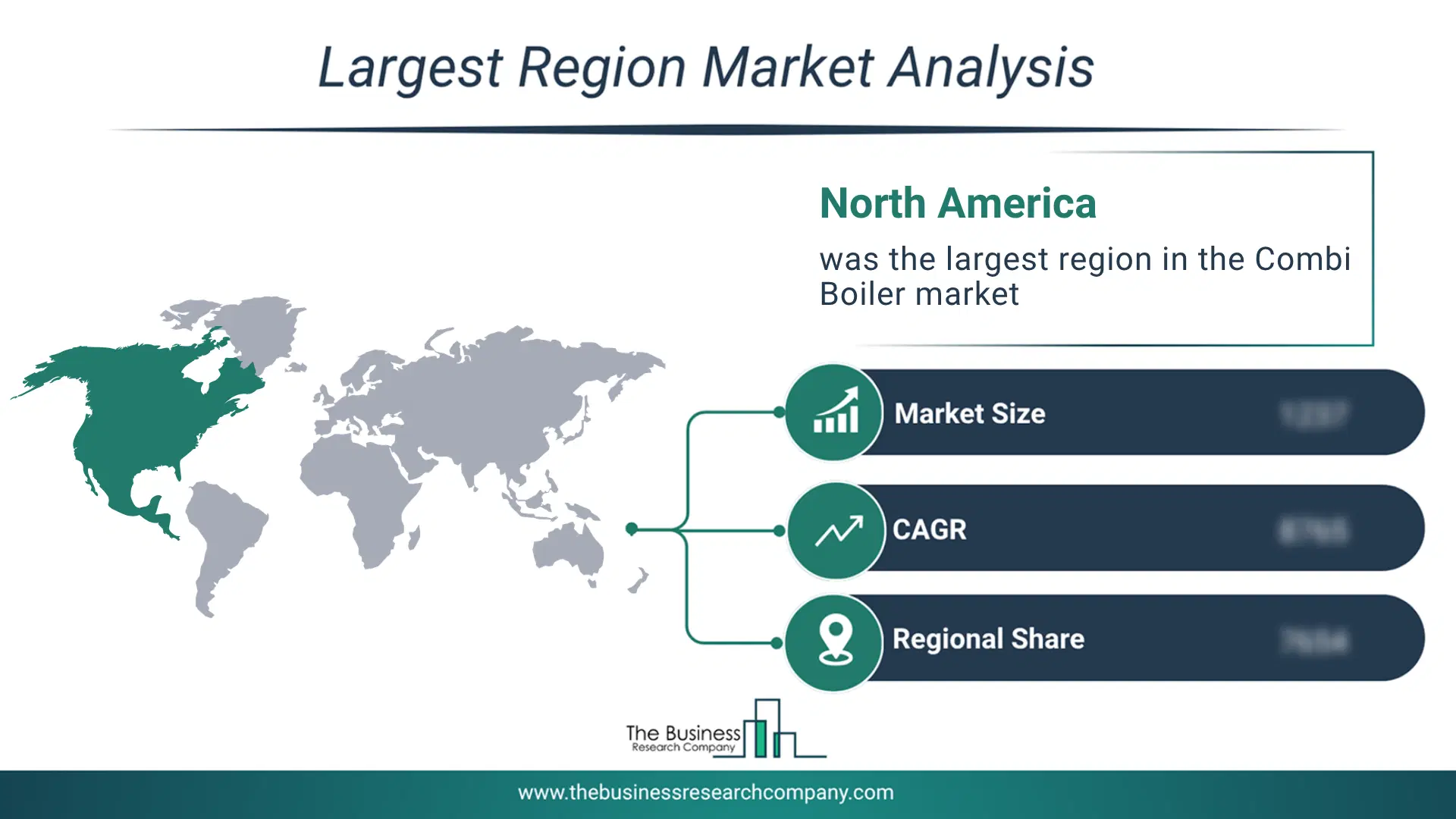
Regional Outlook
North America was the largest region in the combi boiler market in 2025. Asia-Pacific is expected to be the fastest-growing region in the forecast period. The regions covered in this market report are Asia-Pacific, South East Asia, Western Europe, Eastern Europe, North America, South America, Middle East, Africa The countries covered in this market report are Australia, Brazil, China, France, Germany, India, Indonesia, Japan, Taiwan, Russia, South Korea, UK, USA, Canada, Italy, Spain.What Defines the Combi Boiler Market?
The combi boiler market consists of sales of lpg-powered combi boiler, hydrogen-ready combi boiler, condensing combi boiler, smart combi boiler, dual-fuel combi boiler and biomass combi boiler. Values in this market are ‘factory gate’ values, that is, the value of goods sold by the manufacturers or creators of the goods, whether to other entities (including downstream manufacturers, wholesalers, distributors, and retailers) or directly to end customers. The value of goods in this market includes related services sold by the creators of the goods.How is Market Value Defined and Measured?
The market value is defined as the revenues that enterprises gain from the sale of goods and/or services within the specified market and geography through sales, grants, or donations in terms of the currency (in USD unless otherwise specified). The revenues for a specified geography are consumption values that are revenues generated by organizations in the specified geography within the market, irrespective of where they are produced. It does not include revenues from resales along the supply chain, either further along the supply chain or as part of other products.
This chart presents market attractiveness based on a quantitative evaluation of growth, competition, strategic alignment, and risk, offering a clear view of opportunity areas for decision-making. This chart is for illustrative purposes; the full report contains the complete analysis.

This chart highlights the Total Addressable Market (TAM) by estimating the maximum revenue opportunity using an assumption-driven approach, supporting strategic planning and opportunity sizing across markets. The chart is illustrative; the full report provides a more comprehensive analysis.
What Key Data and Analysis Are Included in the Combi Boiler Market Report 2026?
The combi boiler market research report is one of a series of new reports from The Business Research Company that provides market statistics, including industry global market size, regional shares, competitors with the market share, detailed market segments, market trends and opportunities, and any further data you may need to thrive in the combi boiler industry. The market research report delivers a complete perspective of everything you need, with an in-depth analysis of the current and future state of the industry.Combi Boiler Market Report Forecast Analysis
| Report Attribute | Details |
|---|---|
| Market Size Value In 2026 | $36.12 billion |
| Revenue Forecast In 2030 | $49.42 billion |
| Growth Rate | CAGR of 8.2% from 2026 to 2030 |
| Base Year For Estimation | 2025 |
| Actual Estimates/Historical Data | 2020-2025 |
| Forecast Period | 2026 - 2030 |
| Market Representation | Revenue in USD Billion and CAGR from 2026 to 2030 |
| Segments Covered | Fuel, Technology, Power Output, Distribution Channel, End-Use |
| Regional Scope | Asia-Pacific, Western Europe, Eastern Europe, North America, South America, Middle East, Africa |
| Key Companies Profiled | Vaillant Group, Viessmann Werke GmbH & Co. KG, Worcester Bosch Group, Ariston Group, Baxi Heating UK Limited, Ideal Heating, Ferroli S.p.A., Intergas Heating Ltd., Alpha Heating Innovation, ATAG Heating Technology, Saunier Duval, Glow-worm, Rinnai Corporation, Noritz Corporation, KD Navien Co. Ltd., Immergas S.p.A., De Dietrich Thermique, Chaffoteaux (Ariston Brand), Vaillant Boilers (Vaillant Brand), Bosch Thermotechnology, Fondital S.p.A., Sime S.p.A., Cosmogas S.r.l. |
| Customization Scope | Request for Customization |
| Pricing And Purchase Options | Explore Purchase Options |