
Combustion Emissions Analyzer Market Report 2026
Global Outlook – By Type (Portable Combustion Analyzer, Stationary Combustion Analyzer), By Technology (Electrochemical, Infrared, Catalytic, Other Technologies), By Regulatory Standards (International Organization For Standardization (ISO) Standards, Environmental Protection Agency (EPA) Regulations, European Union Emission Standards, International Maritime Organization (IMO) Regulations), By Application (Environmental Monitoring, Industrial Emission Monitoring, Research And Development, Waste Management), By End-User (Power Generation, Oil And Gas, Chemicals, Metals, Other End Users) – Market Size, Trends, Strategies, and Forecast to 2030
Combustion Emissions Analyzer Market Overview
• Combustion Emissions Analyzer market size has reached to $1.09 billion in 2025 • Expected to grow to $1.46 billion in 2030 at a compound annual growth rate (CAGR) of 6% • Growth Driver: Growing Focus On Reducing Greenhouse Gas Emissions Driving The Market Growth Due To Rising Environmental Monitoring Requirements • Market Trend: Adoption Of Wireless Communication Capabilities To Enable Enhanced Operational Insight And Control • North America was the largest region in 2025.What Is Covered Under Combustion Emissions Analyzer Market?
A combustion emissions analyzer is a device used to measure and analyze the gases emitted during the combustion of fuels such as natural gas, oil, coal, or biomass in industrial, commercial, and residential systems. It typically detects gases such as carbon monoxide (CO), carbon dioxide (CO₂), oxygen (O₂), nitrogen oxides (NOₓ), and sulfur dioxide (SO₂) to assess combustion efficiency, pollutant levels, and regulatory compliance. The main types of combustion emissions analyzers are portable combustion analyzers and stationary combustion analyzers. A portable combustion analyzer is a compact, easy-to-carry device used for on-site measurement of combustion emissions, providing quick and accurate results for maintenance and field diagnostics. These analyzers use various technologies such as electrochemical, infrared, catalytic, and others and comply with regulatory standards, including International Organization for Standardization (ISO) standards, Environmental Protection Agency (EPA) regulations, European Union emission standards, International Maritime Organization (IMO) regulations, and National Ambient Air Quality Standards (NAAQS). They are used in various applications such as environmental monitoring, industrial emission monitoring, automotive testing, research and development, and waste management. Key end-users include power generation, oil and gas, chemicals, metals, and others.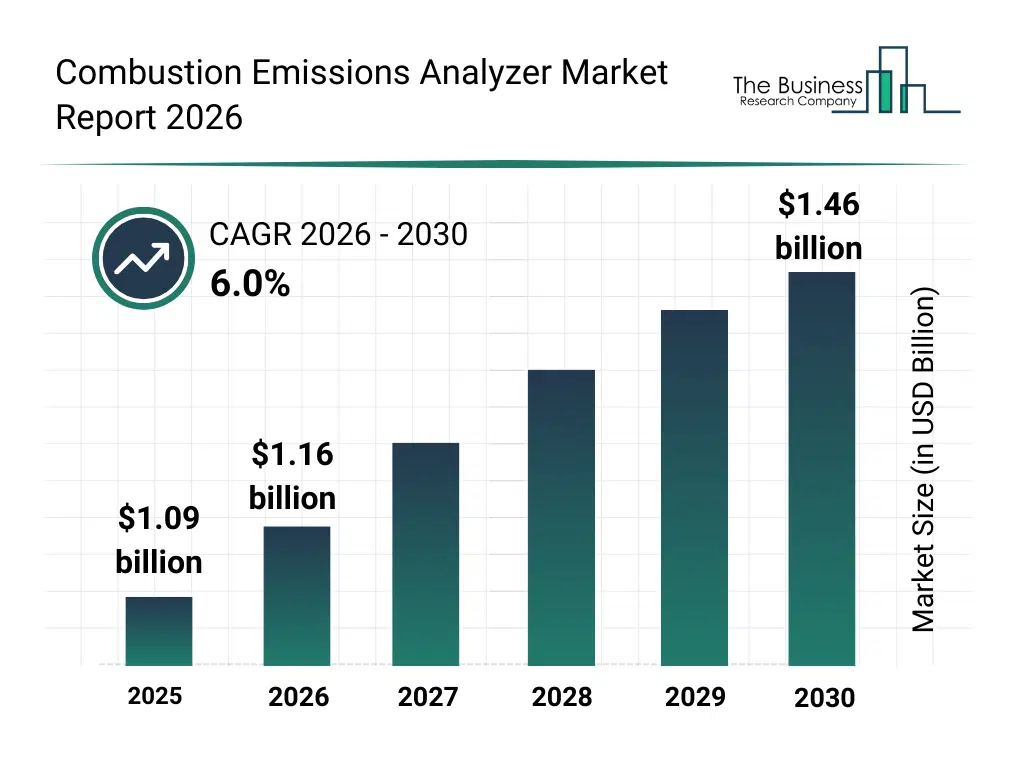
What Is The Combustion Emissions Analyzer Market Size and Share 2026?
The combustion emissions analyzer market size has grown strongly in recent years. It will grow from $1.09 billion in 2025 to $1.16 billion in 2026 at a compound annual growth rate (CAGR) of 6.3%. The growth in the historic period can be attributed to industrial emission regulations, power plant monitoring needs, oil and gas combustion testing, automotive emission testing demand, environmental compliance enforcement.What Is The Combustion Emissions Analyzer Market Growth Forecast?
The combustion emissions analyzer market size is expected to see strong growth in the next few years. It will grow to $1.46 billion in 2030 at a compound annual growth rate (CAGR) of 6.0%. The growth in the forecast period can be attributed to stricter global emission standards, expansion of clean energy monitoring, smart sensor integration, demand for predictive maintenance tools, industrial digital transformation. Major trends in the forecast period include integration of real time emission monitoring, growth of portable combustion analyzers, adoption of multi gas detection systems, increasing demand for regulatory compliance tools, remote diagnostics and cloud connectivity.Tariff Impact On Combustion Emissions Analyzer Market
Tariffs have impacted the combustion emissions analyzer market by increasing costs of imported sensors, optical components, and electronic control modules. Portable and stationary analyzers are most affected, particularly across asia pacific manufacturing regions. Higher equipment prices have influenced procurement cycles for industrial users. However, tariffs are supporting localized production and development of cost optimized emission monitoring systems.
Global Combustion Emissions Analyzer Market Segmentation
1) By Type: Portable Combustion Analyzer, Stationary Combustion Analyzer 2) By Technology: Electrochemical, Infrared, Catalytic, Other Technologies 3) By Regulatory Standards: International Organization For Standardization (ISO) Standards, Environmental Protection Agency (EPA) Regulations, European Union Emission Standards, International Maritime Organization (IMO) Regulations 4) By Application: Environmental Monitoring, Industrial Emission Monitoring, Research And Development, Waste Management 5) By End-User: Power Generation, Oil And Gas, Chemicals, Metals, Other End Users Subsegments: 1) By Portable Combustion Analyzer: Handheld Portable Analyzer, Backpack Portable Analyzer, Wheeled Portable Analyzer 2) By Stationary Combustion Analyzer: Wall-Mounted Analyzer, Rack-Mounted Analyzer, Cabinet-Mounted AnalyzerWhat Is The Driver Of The Combustion Emissions Analyzer Market?
The growing focus on reducing greenhouse gas emissions is expected to propel the growth of the combustion emissions analyzer market going forward. Reducing greenhouse gas emissions involves minimizing the release of carbon dioxide, methane, and other pollutants that contribute to global warming and climate change. The growing focus on reducing greenhouse gas emissions is primarily due to the urgent need to mitigate climate change, as excessive emissions trap heat in the atmosphere, leading to global warming and severe environmental impacts such as rising sea levels, extreme weather events, and ecosystem disruption. A combustion emissions analyzer helps reduce greenhouse gas emissions by accurately measuring and monitoring pollutants from combustion systems, enabling timely adjustments that optimize fuel efficiency and minimize harmful gas output. For instance, in May 2024, according to the World Bank, a US-based international financial institution, carbon-pricing revenues reached a record USD 104 billion in 2023, with about 24% of global greenhouse-gas emissions covered by carbon-pricing mechanisms. Therefore, the growing focus on reducing greenhouse gas emissions is driving the growth of the combustion emissions analyzer industry.Key Players In The Global Combustion Emissions Analyzer Market
Major companies operating in the combustion emissions analyzer market are Siemens AG, ABB Ltd, Emerson Electric Co., Fuji Electric Co. Ltd., AMETEK Inc., Teledyne Technologies Incorporated, Drägerwerk AG & Co. KGaA, HORIBA Ltd., SICK AG, Testo SE & Co. KGaA, Wuhan Cubic Optoelectronics Co. Ltd., ENOTEC GmbH, KANE International Limited, California Analytical Instruments Inc., Ecom America Ltd., Analytical Systems Keco Inc., MRU Instruments Inc., E Instruments International LLC, IMR Environmental Equipment Inc., Enerac LLC.
This chart is for illustrative purposes; the full report includes a detailed competitor analysis and comprehensive overview of the top 10 companies in the market.
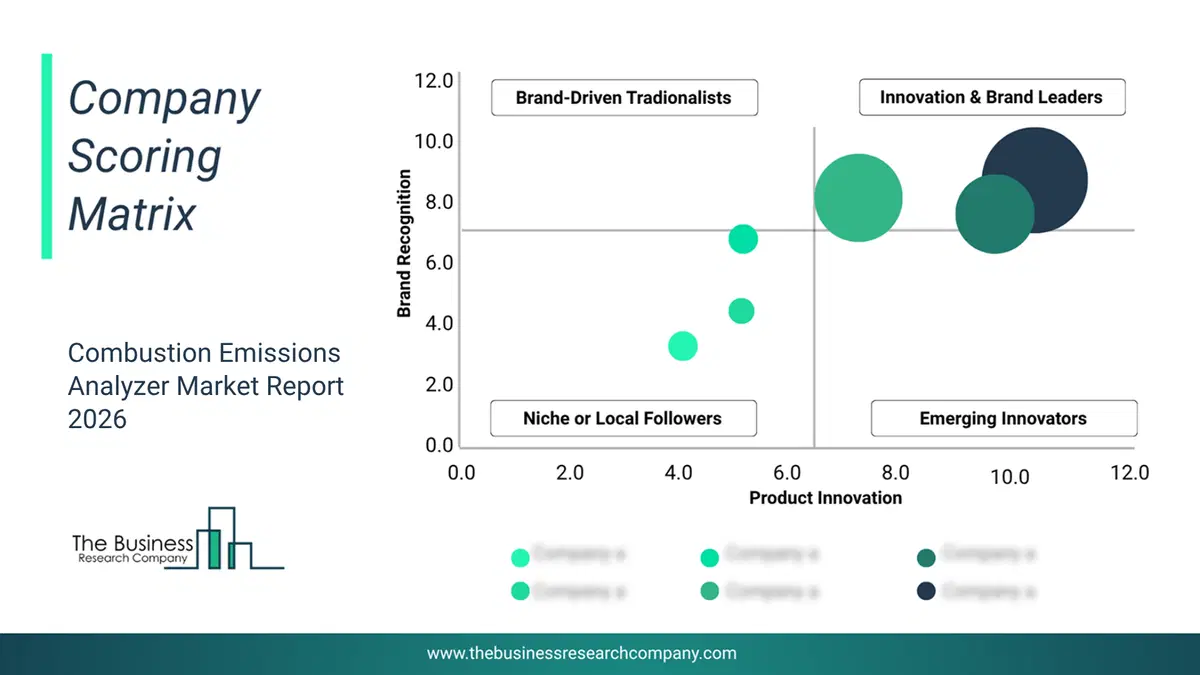
This chart maps companies by product innovation and brand strength, with bubble size indicating relative revenue, helping identify market leaders, challengers, and niche players. This is an illustrative chart; the full report provides a complete and accurate competitive analysis.
Global Combustion Emissions Analyzer Market Trends and Insights
Major companies operating in the combustion emissions analyzer market are focusing on incorporating smart digital technologies such as Bluetooth connectivity to enhance efficiency and monitoring. Bluetooth connectivity is a short-range wireless communication technology that enables devices to securely exchange data with nearby equipment, enabling capabilities such as on-site data transfer, remote viewing of readings, and printing without cables. For instance, in March 2023, Tecnocontrol S.r.l., an Italy-based manufacturer of gas analysis and monitoring systems, introduced BostonX, a Bluetooth-enabled smart combustion analyzer designed to measure flue-gas emissions and combustion performance, featuring real-time parameter display, a digital interface for easier navigation, and optional wireless data transmission to external devices. BostonX improves operational efficiency, record-keeping, and accuracy for industrial thermal plant operators.What Are Latest Mergers And Acquisitions In The Combustion Emissions Analyzer Market?
In February 2025, Advanced Automation Technologies (AAT), a US-based platform of laboratory automation brands, acquired TE Instruments B.V. for an undisclosed amount. With this acquisition, AAT aimed to strengthen its position in the global laboratory automation market by expanding its combustion elemental analyzer portfolio, enhancing regional sales and service capabilities across Europe and North America, and leveraging TE Instruments’ technical expertise to provide comprehensive solutions for commercial and industrial laboratories. TE Instruments B.V. is a Netherlands-based company specializing in the development and manufacturing of combustion elemental analyzers used in environmental, petrochemical, and industrial applications.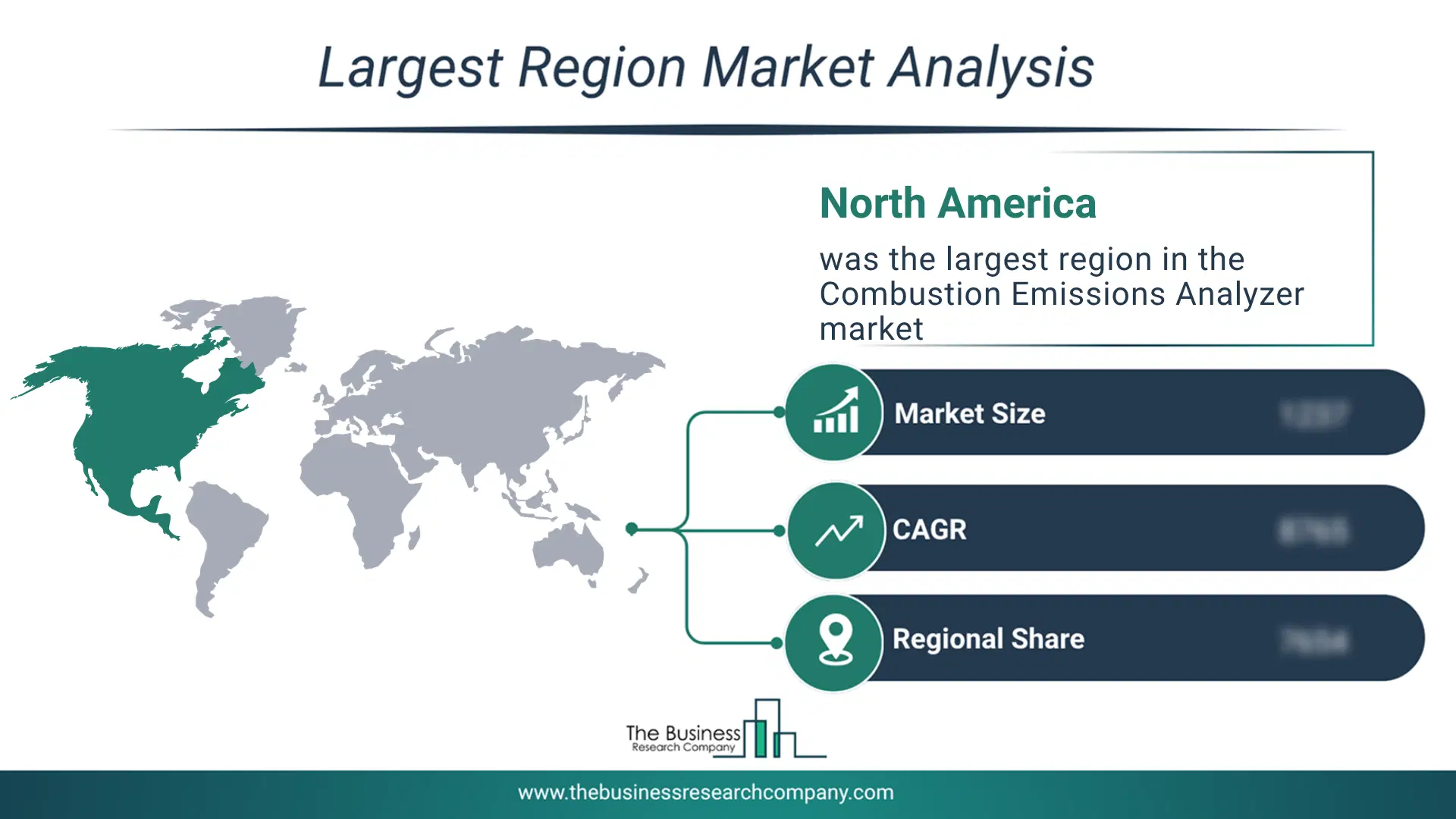
Regional Outlook
North America was the largest region in the combustion emissions analyzer market in 2025. The regions covered in this market report are Asia-Pacific, South East Asia, Western Europe, Eastern Europe, North America, South America, Middle East, Africa The countries covered in this market report are Australia, Brazil, China, France, Germany, India, Indonesia, Japan, Taiwan, Russia, South Korea, UK, USA, Canada, Italy, Spain.What Defines the Combustion Emissions Analyzer Market?
The combustion emissions analyzer market includes revenues earned by entities by providing services such as installation, calibration, maintenance, emissions testing, data analysis, compliance reporting, on-site training, technical support, and software integration for real-time monitoring and diagnostics. The market value includes the value of related goods sold by the service provider or included within the service offering. The combustion emissions analyzer market also includes sales of emission gas sensors and probes, data acquisition systems, sample conditioning systems, calibration equipment, and software platforms. Values in this market are ‘factory gate’ values, that is the value of goods sold by the manufacturers or creators of the goods, whether to other entities (including downstream manufacturers, wholesalers, distributors and retailers) or directly to end customers. The value of goods in this market includes related services sold by the creators of the goods.How is Market Value Defined and Measured?
The market value is defined as the revenues that enterprises gain from the sale of goods and/or services within the specified market and geography through sales, grants, or donations in terms of the currency (in USD unless otherwise specified). The revenues for a specified geography are consumption values that are revenues generated by organizations in the specified geography within the market, irrespective of where they are produced. It does not include revenues from resales along the supply chain, either further along the supply chain or as part of other products.
This chart presents market attractiveness based on a quantitative evaluation of growth, competition, strategic alignment, and risk, offering a clear view of opportunity areas for decision-making. This chart is for illustrative purposes; the full report contains the complete analysis.

This chart highlights the Total Addressable Market (TAM) by estimating the maximum revenue opportunity using an assumption-driven approach, supporting strategic planning and opportunity sizing across markets. The chart is illustrative; the full report provides a more comprehensive analysis.
What Key Data and Analysis Are Included in the Combustion Emissions Analyzer Market Report 2026?
The combustion emissions analyzer market research report is one of a series of new reports from The Business Research Company that provides market statistics, including industry global market size, regional shares, competitors with the market share, detailed market segments, market trends and opportunities, and any further data you may need to thrive in the combustion emissions analyzer industry. The market research report delivers a complete perspective of everything you need, with an in-depth analysis of the current and future state of the industry.Combustion Emissions Analyzer Market Report Forecast Analysis
| Report Attribute | Details |
|---|---|
| Market Size Value In 2026 | $1.16 billion |
| Revenue Forecast In 2030 | $1.46 billion |
| Growth Rate | CAGR of 6% from 2026 to 2030 |
| Base Year For Estimation | 2025 |
| Actual Estimates/Historical Data | 2020-2025 |
| Forecast Period | 2026 - 2030 |
| Market Representation | Revenue in USD Billion and CAGR from 2026 to 2030 |
| Segments Covered | Type, Technology, Regulatory Standards, Application, End-User |
| Regional Scope | Asia-Pacific, Western Europe, Eastern Europe, North America, South America, Middle East, Africa |
| Key Companies Profiled | Siemens AG, ABB Ltd, Emerson Electric Co., Fuji Electric Co. Ltd., AMETEK Inc., Teledyne Technologies Incorporated, Drägerwerk AG & Co. KGaA, HORIBA Ltd., SICK AG, Testo SE & Co. KGaA, Wuhan Cubic Optoelectronics Co. Ltd., ENOTEC GmbH, KANE International Limited, California Analytical Instruments Inc., Ecom America Ltd., Analytical Systems Keco Inc., MRU Instruments Inc., E Instruments International LLC, IMR Environmental Equipment Inc., Enerac LLC. |
| Customization Scope | Request for Customization |
| Pricing And Purchase Options | Explore Purchase Options |