

Commercial Air Traffic Management Market Report 2026
Global Outlook – By Component (Services, Software, Hardware), By Technology Type (Ground Based Systems, Satellite Based Systems, Hybrid Systems, Advanced Communication Systems, Surveillance Systems), By Application (Passenger Aircraft Operations, Cargo Aircraft Operations, Business Aviation Operations, Charter Flight Operations, Airport Traffic Management), By End User (Air Navigation Service Providers, Civil Aviation Authorities, Commercial Airlines, Cargo Airlines, Airport Operators) – Market Size, Trends, Strategies, and Forecast to 2035
Commercial Air Traffic Management Market Overview
• Commercial Air Traffic Management market size has reached to $7.89 billion in 2025 • Expected to grow to $11.53 billion in 2030 at a compound annual growth rate (CAGR) of 7.7% • Growth Driver: Growth In Commercial Aircraft Production Driving The Growth Of The Market Due To Increasing Global Air Passenger Traffic • Market Trend: Unified Digital Infrastructure Supports Smarter Airspace Management • North America was the largest region in 2025 and Asia-Pacific is the fastest growing region.What Is Covered Under Commercial Air Traffic Management Market?
Commercial air traffic management refers to the planning, coordination, and control of air traffic operations for commercial aviation to ensure the safe, efficient, and orderly movement of aircraft throughout all phases of flight. It encompasses the systems, procedures, and technologies used by air navigation service providers, airports, and airlines to optimize airspace utilization, manage flight flows, reduce delays, and maintain compliance with aviation safety regulations. The main components of commercial air traffic management include services, software, and hardware. Services refer to operational and support solutions that help manage aircraft movements, optimize airspace utilization, and maintain safe and efficient air traffic operations. These systems use ground based systems, satellite based systems, hybrid systems, advanced communication systems, and surveillance systems. The various applications involved are passenger aircraft operations, cargo aircraft operations, business aviation operations, charter flight operations, and airport traffic management, and they are used by several end users such as air navigation service providers, civil aviation authorities, commercial airlines, cargo airlines, and airport operators.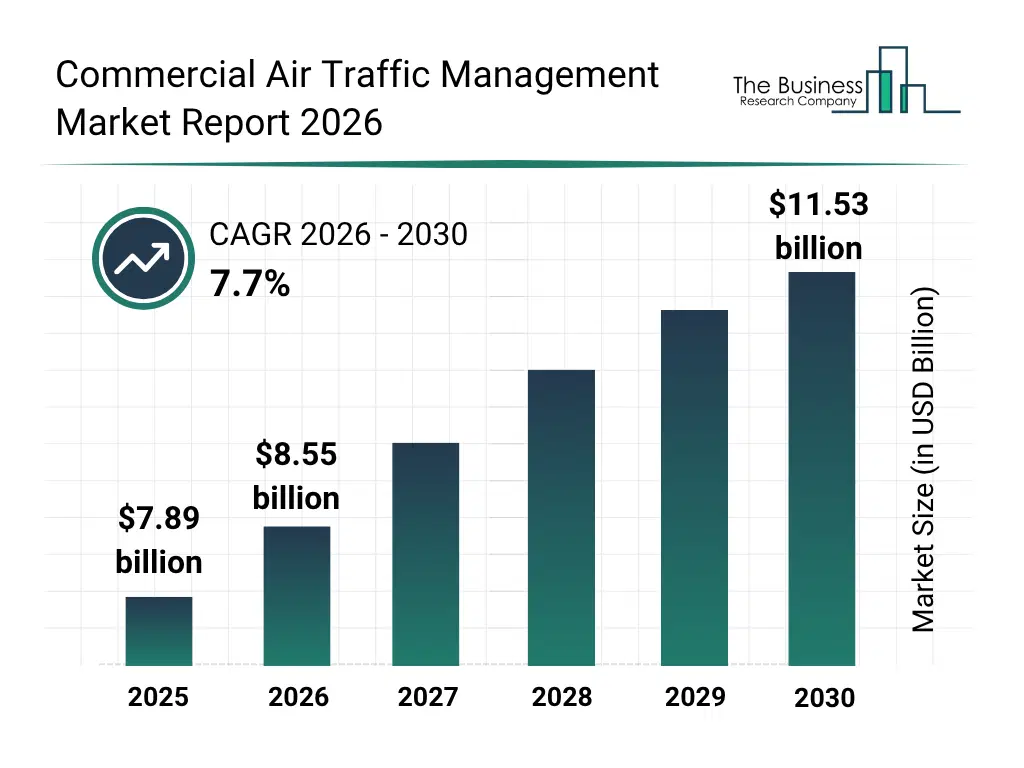
What Is The Commercial Air Traffic Management Market Size and Share 2026?
The commercial air traffic management market size has grown strongly in recent years. It will grow from $7.89 billion in 2025 to $8.55 billion in 2026 at a compound annual growth rate (CAGR) of 8.4%. The growth in the historic period can be attributed to increasing commercial air traffic volumes, rising demand for airspace capacity optimization, growing airport congestion, increasing adoption of advanced air traffic control systems, strengthening aviation safety regulations.What Is The Commercial Air Traffic Management Market Growth Forecast?
The commercial air traffic management market size is expected to see strong growth in the next few years. It will grow to $11.53 billion in 2030 at a compound annual growth rate (CAGR) of 7.7%. The growth in the forecast period can be attributed to expansion of global passenger and cargo aviation, rising demand for delay reduction, increasing deployment of next-generation air traffic management infrastructure, growing need for efficient airspace utilization, increasing investment in modern aviation communication and surveillance systems. Major trends in the forecast period include real-time air traffic flow management, next-generation air traffic surveillance, trajectory-based air traffic management, collaborative decision-making in aviation, dynamic airspace capacity management.Tariff Impact On Commercial Air Traffic Management Market
Tariffs are impacting the commercial air traffic management market by increasing the cost of imported radar systems, communication equipment, navigation equipment, surveillance sensors, and controller workstations. Hardware and system integration segments are likely to experience the greatest pressure, particularly in North America, Europe, and Asia-Pacific where aviation technology supply chains depend on internationally sourced components. However, tariffs can encourage local manufacturing, supplier diversification, and investment in domestic air traffic management technologies, potentially improving supply-chain resilience and supporting regional technology development.
Global Commercial Air Traffic Management Market Segmentation
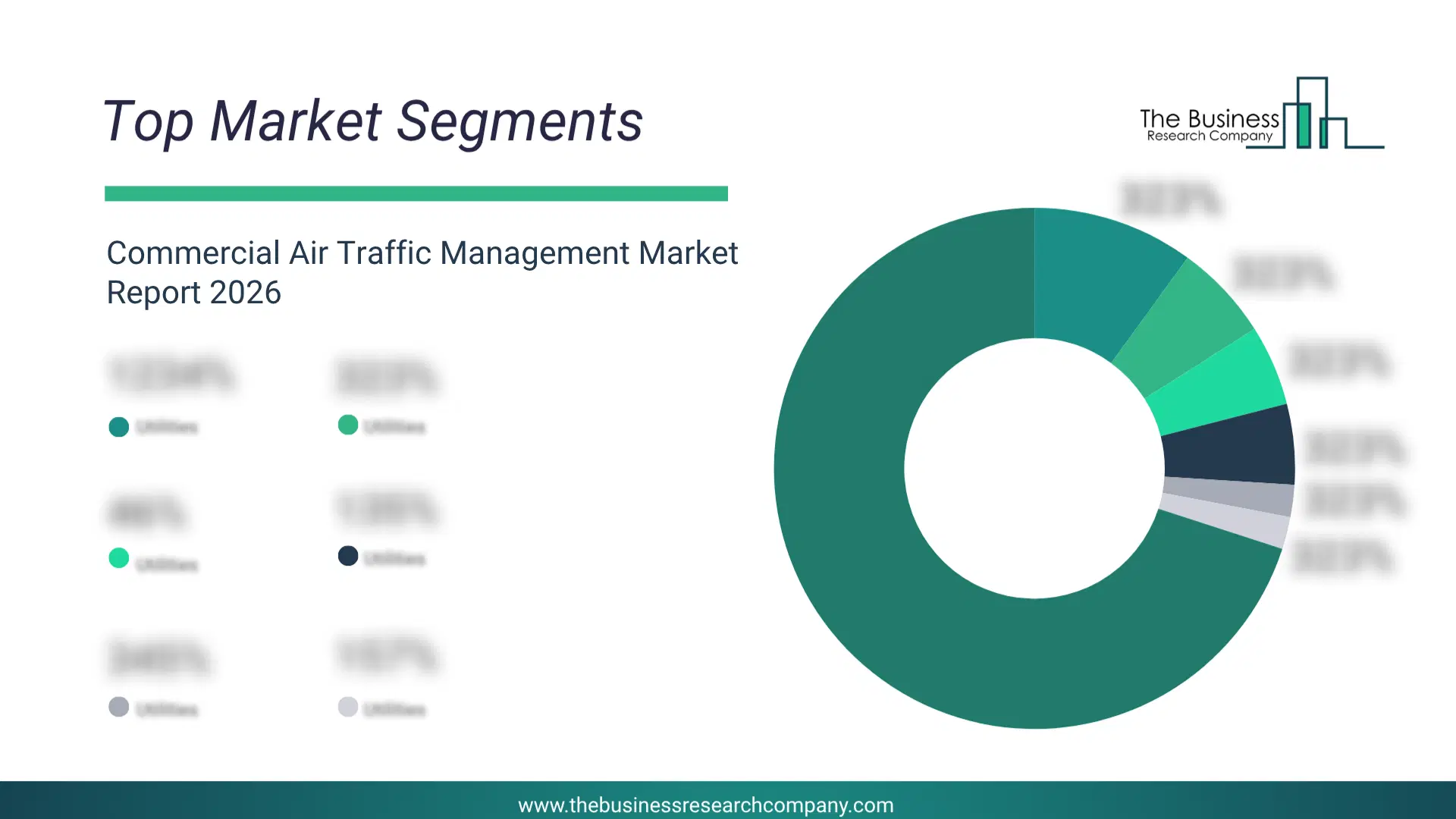
2) By Technology Type: Ground Based Systems, Satellite Based Systems, Hybrid Systems, Advanced Communication Systems, Surveillance Systems 3) By Application: Passenger Aircraft Operations, Cargo Aircraft Operations, Business Aviation Operations, Charter Flight Operations, Airport Traffic Management 4) By End User: Air Navigation Service Providers, Civil Aviation Authorities, Commercial Airlines, Cargo Airlines, Airport Operators Subsegments: 1) By Services: Consulting And Advisory Services, System Integration And Implementation Services, Installation And Commissioning Services, Maintenance And Support Services, Training And Simulation Services 2) By Software: Flight Data Processing Software, Surveillance Data Processing Software, Air Traffic Flow Management Software, Arrival And Departure Management Software, Conflict Detection And Resolution Software 3) By Hardware: Air Traffic Control Radar Systems, Communication Equipment, Navigation Equipment, Surveillance Sensors, Controller WorkstationsWhat Is The Driver Of The Commercial Air Traffic Management Market?
The growth in commercial aircraft production is expected to propel the growth of the commercial air traffic management market going forward. Commercial aircraft production refers to the process of designing, manufacturing, assembling, testing, and delivering passenger and cargo aircraft for commercial aviation operators, including airlines, leasing companies, and freight carriers. Growth in commercial aircraft production is due to increasing global air passenger traffic, which drives airlines to expand fleets, increase aircraft orders, and replace aging aircraft to meet rising travel demand. Commercial aircraft production drives demand for commercial air traffic management by expanding the global fleet of aircraft, increasing flight frequencies and airspace congestion, and necessitating advanced air traffic management systems to ensure safe, efficient, and coordinated air traffic operations. For instance, in January 2026, according to Airbus SE, a Netherlands-based aerospace and defense corporation, the company delivered 793 commercial aircraft to 91 customers worldwide in 2025, representing a 3.5% increase compared to the 766 aircraft delivered in 2024. Therefore, the growth in commercial aircraft production is driving the growth of the commercial air traffic management industry.Key Players In The Global Commercial Air Traffic Management Market
Major companies operating in the commercial air traffic management market are RTX Corporation, Airbus SE, Thales SA, NEC Corporation, L3Harris Technologies Inc, Leonardo SpA, Honeywell International Inc, Leidos Holdings Inc, Sopra Steria Group SA, Serco Group plc, Indra Sistemas SA, Saab AB, Kongsberg Gruppen ASA, HENSOLDT AG, ENAV SpA, Frequentis AG, Rohde & Schwarz GmbH & Co KG, Adacel Technologies Limited, Stratify Aerospace LLC, Air Traffic and Navigation Services SOC Limited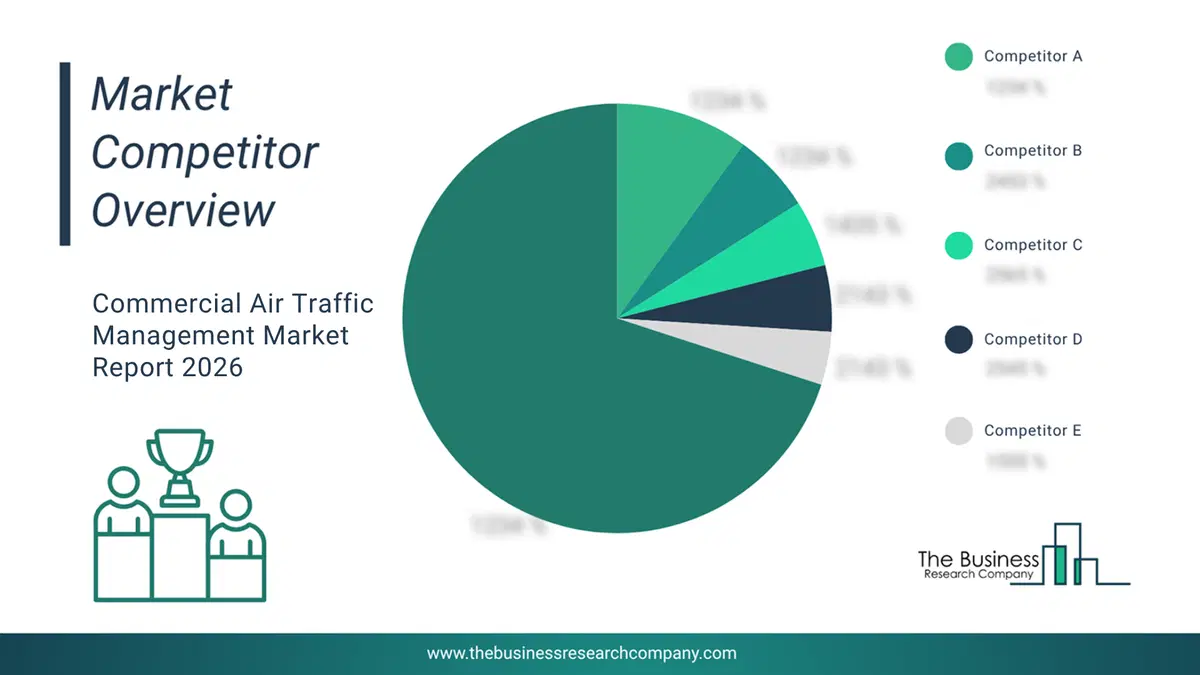
This chart is for illustrative purposes; the full report includes a detailed competitor analysis and comprehensive overview of the top 10 companies in the market.
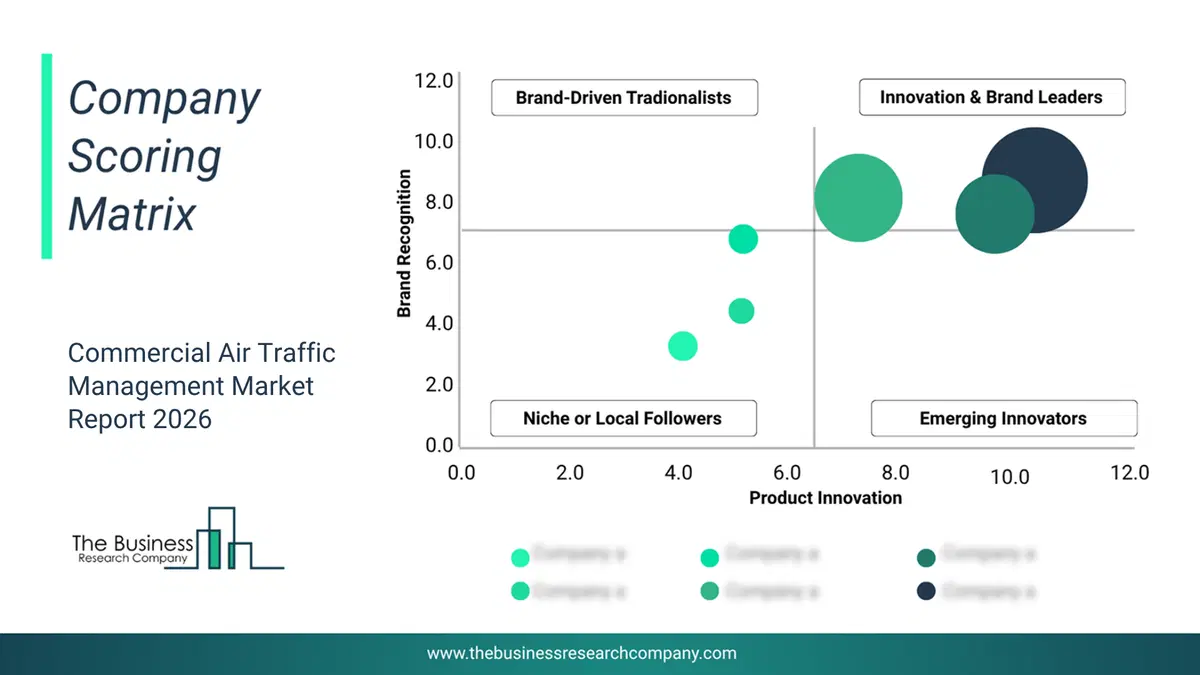
This chart maps companies by product innovation and brand strength, with bubble size indicating relative revenue, helping identify market leaders, challengers, and niche players. This is an illustrative chart; the full report provides a complete and accurate competitive analysis.
Global Commercial Air Traffic Management Market Trends and Insights
Major companies operating in the commercial air traffic management market are focusing on developing innovative solutions, such as digital air traffic management integration platforms, to enhance interoperability, operational efficiency, scalability, and the modernization of air navigation service provider (ANSP) infrastructures. A digital air traffic management integration platform is a software-based environment that unifies multiple ATM applications and systems into a common, independent infrastructure, enabling seamless data exchange, centralized management, and cloud-ready operations. For instance, in May 2026, Indra Sistemas S.A., a Spain-based aerospace and defense technology company, launched Linkia, the first digital platform specifically designed to integrate all air traffic management systems into a common infrastructure. Built natively for ATM and powered by IndraMind, Linkia provides a standardized software layer that enables applications from different vendors and technological generations to operate seamlessly within a unified environment. The platform incorporates advanced cloud capabilities while meeting stringent aviation regulatory and cybersecurity requirements, supports deployment in on-premises, public, private, and hybrid cloud environments, and allows ANSPs to deploy and scale applications within hours rather than through lengthy infrastructure projects. It also enables the gradual adoption of artificial intelligence to improve automation, predictive decision-making, operational resilience, and overall airspace efficiency, making it a significant advancement for next-generation commercial air traffic management systems.What Are Latest Mergers And Acquisitions In The Commercial Air Traffic Management Market?
In July 2026, Iridium Communications Inc., a US-based satellite communications company, acquired Aireon LLC for an undisclosed amount. With this acquisition, Iridium aims to strengthen its position in the global aviation ecosystem by integrating space-based air traffic surveillance with its satellite communications network, expanding its aviation safety, operational intelligence, and commercial data service capabilities. Aireon LLC is a US-based provider of space-based air traffic surveillance and air navigation services that support commercial air traffic management (ATM) operations.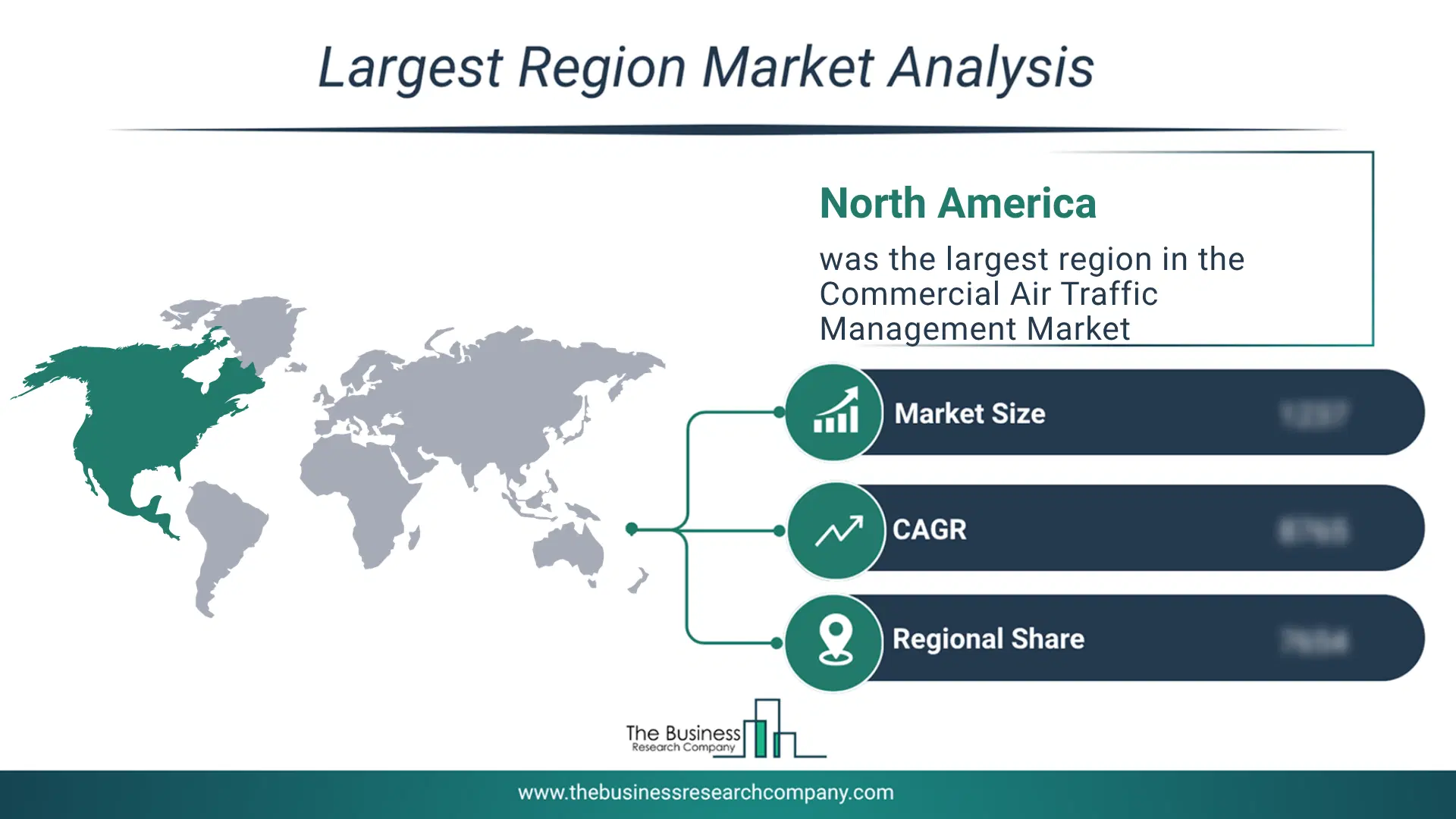
Regional Outlook/Insights
North America was the largest region in the commercial air traffic management market in 2025. Asia-Pacific is expected to be the fastest-growing region in the forecast period. The regions covered in this market report are Asia-Pacific, South East Asia, Western Europe, Eastern Europe, North America, South America, Middle East, Africa. The countries covered in this market report are Australia, Brazil, China, France, Germany, India, Indonesia, Japan, Taiwan, Russia, South Korea, UK, USA, Canada, Italy, Spain.What Defines the Commercial Air Traffic Management Market?
The commercial air traffic management market consists of revenues earned by entities by providing services such as flight planning and airspace optimization services, air traffic flow and capacity management services, and air traffic control operations and support. The market value includes the value of related goods sold by the service provider or included within the service offering. The commercial air traffic management market also includes sales of air traffic control automation systems, flight data processing systems, and aeronautical information management systems. Values in this market are ‘factory gate’ values, that is the value of goods sold by the manufacturers or creators of the goods, whether to other entities (including downstream manufacturers, wholesalers, distributors and retailers) or directly to end customers. The value of goods in this market includes related services sold by the creators of the goods.How is Market Value Defined and Measured?
The market value is defined as the revenues that enterprises gain from the sale of goods and/or services within the specified market and geography through sales, grants, or donations in terms of the currency (in USD unless otherwise specified). The revenues for a specified geography are consumption values that are revenues generated by organizations in the specified geography within the market, irrespective of where they are produced. It does not include revenues from resales along the supply chain, either further along the supply chain or as part of other products.
This chart presents market attractiveness based on a quantitative evaluation of growth, competition, strategic alignment, and risk, offering a clear view of opportunity areas for decision-making. This chart is for illustrative purposes; the full report contains the complete analysis.

This chart highlights the Total Addressable Market (TAM) by estimating the maximum revenue opportunity using an assumption-driven approach, supporting strategic planning and opportunity sizing across markets. The chart is illustrative; the full report provides a more comprehensive analysis.
What Key Data and Analysis Are Included in the Commercial Air Traffic Management Market Report 2026?
The commercial air traffic management market research report is one of a series of new reports from The Business Research Company that provides market statistics, including industry global market size, regional shares, competitors with the market share, detailed market segments, market trends and opportunities, and any further data you may need to thrive in the commercial air traffic management industry. The market research report delivers a complete perspective of everything you need, with an in-depth analysis of the current and future state of the industry.Commercial Air Traffic Management Market Report Forecast Analysis
| Report Attribute | Details |
|---|---|
| Market Size Value In 2026 | $8.55 billion |
| Revenue Forecast In 2030 | $11.53 billion |
| Growth Rate | CAGR of 7.7% from 2026 to 2035 |
| Base Year For Estimation | 2025 |
| Actual Estimates/Historical Data | 2020-2025 |
| Forecast Period | 2026 - 2030 |
| Market Representation | Revenue in USD Billion and CAGR from 2026 to 2030 |
| Segments Covered | Component, Technology Type, Application, End User |
| Regional Scope | Asia-Pacific, Western Europe, Eastern Europe, North America, South America, Middle East, Africa |
| Country Scope | The countries covered in the report are Australia, Brazil, China, France, Germany, India, Indonesia, Japan, Taiwan, Russia, South Korea, UK, USA, Canada, Italy, Spain. |
| Customization Scope | Request for Customization |
| Pricing And Purchase Options | Explore Purchase Options |