
Commercial Aircraft Aviation Fuel Market Report 2026
Global Outlook – By Fuel Type (Jet A, Jet A-1, Jet B, Sustainable Aviation Fuel, Biofuel, Other Fuel Types), By Aircraft Type (Narrow Body Aircraft, Wide Body Aircraft, Regional Aircraft, Turboprop Aircraft), By Distribution Channel (Direct Contracts With Airlines, Into Plane Service Providers, Airport Fuel Consortiums, Fuel Traders Or Distributors), By Application (Commercial Aviation, Cargo Aviation, Charter Aviation), By End User (Full Service Commercial Airlines, Low Cost Carriers, Cargo And Freight Operators, Charter And Private Business Aviation) – Market Size, Trends, Strategies, and Forecast to 2035
Commercial Aircraft Aviation Fuel Market Overview
• Commercial Aircraft Aviation Fuel market size has reached to $255.34 billion in 2025 • Expected to grow to $330.89 billion in 2030 at a compound annual growth rate (CAGR) of 5.2% • Growth Driver: Rising Air Passenger Traffic Driving The Growth Of The Market Due To Increasing Aircraft Utilization And Maintenance Demand • Market Trend: Technological Advancements In Renewable Aviation Fuel Technologies Are Enhancing Sustainability In Commercial Aviation • North America was the largest region in 2025 and Asia-Pacific is the fastest growing region.What Is Covered Under Commercial Aircraft Aviation Fuel Market?
Commercial aircraft aviation fuel refers to specialized aviation-grade fuel formulated to power commercial aircraft turbine engines while ensuring safe, efficient, and reliable flight operations. It is engineered to provide high energy density, thermal stability, low-temperature performance, and combustion efficiency, enabling consistent engine performance under varying atmospheric and operational conditions. These fuels are manufactured to meet stringent aviation safety, quality, and environmental standards. The main fuel types of commercial aircraft aviation fuel include Jet A, Jet A-1, Jet B, sustainable aviation fuel, biofuel, and other fuel types. Jet A refers to a kerosene based aviation fuel formulated for use in commercial aircraft engines and designed to provide reliable performance under varying flight conditions. These fuels are used in narrow body aircraft, wide body aircraft, regional aircraft, and turboprop aircraft and are distributed through direct contracts with airlines, into plane service providers, airport fuel consortiums, and fuel traders or distributors. They find application in commercial aviation, cargo aviation, and charter aviation, serving end users including full service commercial airlines, low cost carriers, cargo and freight operators, and charter and private business aviation.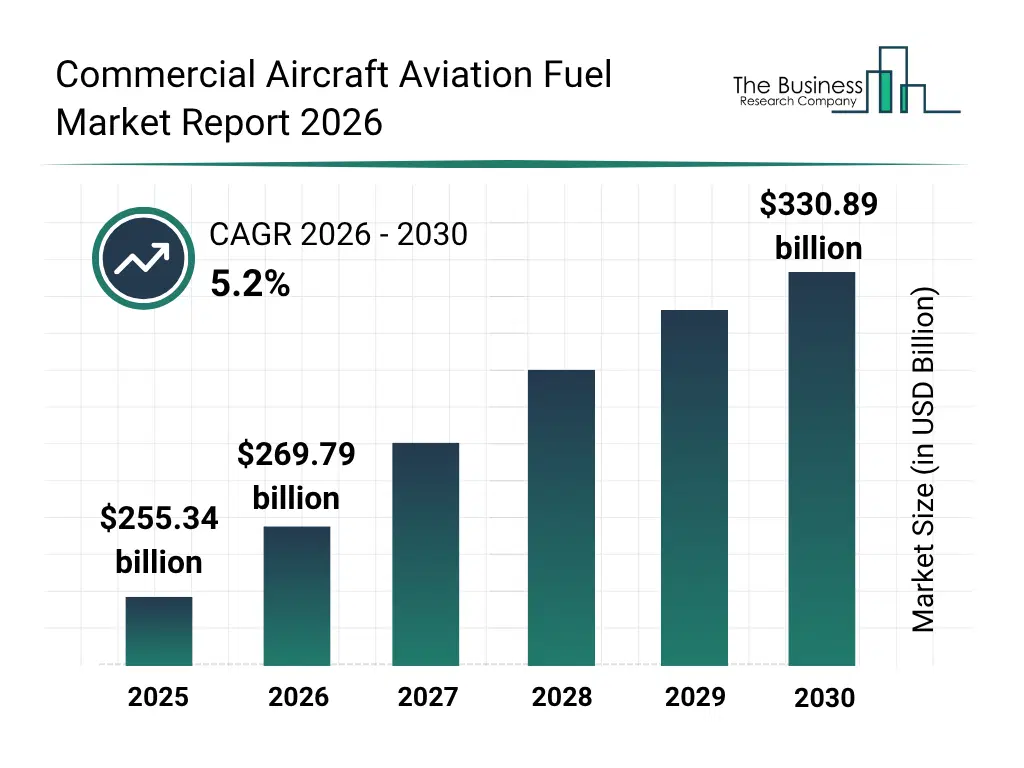
What Is The Commercial Aircraft Aviation Fuel Market Size and Share 2026?
The commercial aircraft aviation fuel market size has grown strongly in recent years. It will grow from $255.34 billion in 2025 to $269.79 billion in 2026 at a compound annual growth rate (CAGR) of 5.7%. The growth in the historic period can be attributed to growth in commercial air passenger traffic, expansion of global airline fleets, increasing aircraft utilization rates, rising air cargo transportation, growth in airport infrastructure and refueling capacity.What Is The Commercial Aircraft Aviation Fuel Market Growth Forecast?
The commercial aircraft aviation fuel market size is expected to see strong growth in the next few years. It will grow to $330.89 billion in 2030 at a compound annual growth rate (CAGR) of 5.2%. The growth in the forecast period can be attributed to increasing demand for sustainable aviation fuel, expansion of international air travel, rising adoption of fuel-efficient aircraft, growing airline commitments to emissions reduction, increasing government support for low-carbon aviation fuels. Major trends in the forecast period include increasing adoption of sustainable aviation fuel, expansion of synthetic aviation fuel production, development of lower-carbon aviation fuel blends, advancements in fuel quality and thermal stability, increasing use of renewable feedstocks for aviation fuel.Tariff Impact On Commercial Aircraft Aviation Fuel Market
Tariffs are impacting the commercial aircraft aviation fuel market by increasing the costs of imported fuel-processing equipment, blending components, feedstocks, and related airport fueling infrastructure. Sustainable aviation fuel and renewable fuel segments may face greater cost pressures, particularly in North America, Europe, and Asia-Pacific where international supply chains and cross-border feedstock trade are significant. Higher costs can raise fuel procurement expenses for airlines and distributors, while tariffs may also encourage regional fuel production, domestic feedstock sourcing, and investment in localized refining and blending capacity.
Global Commercial Aircraft Aviation Fuel Market Segmentation
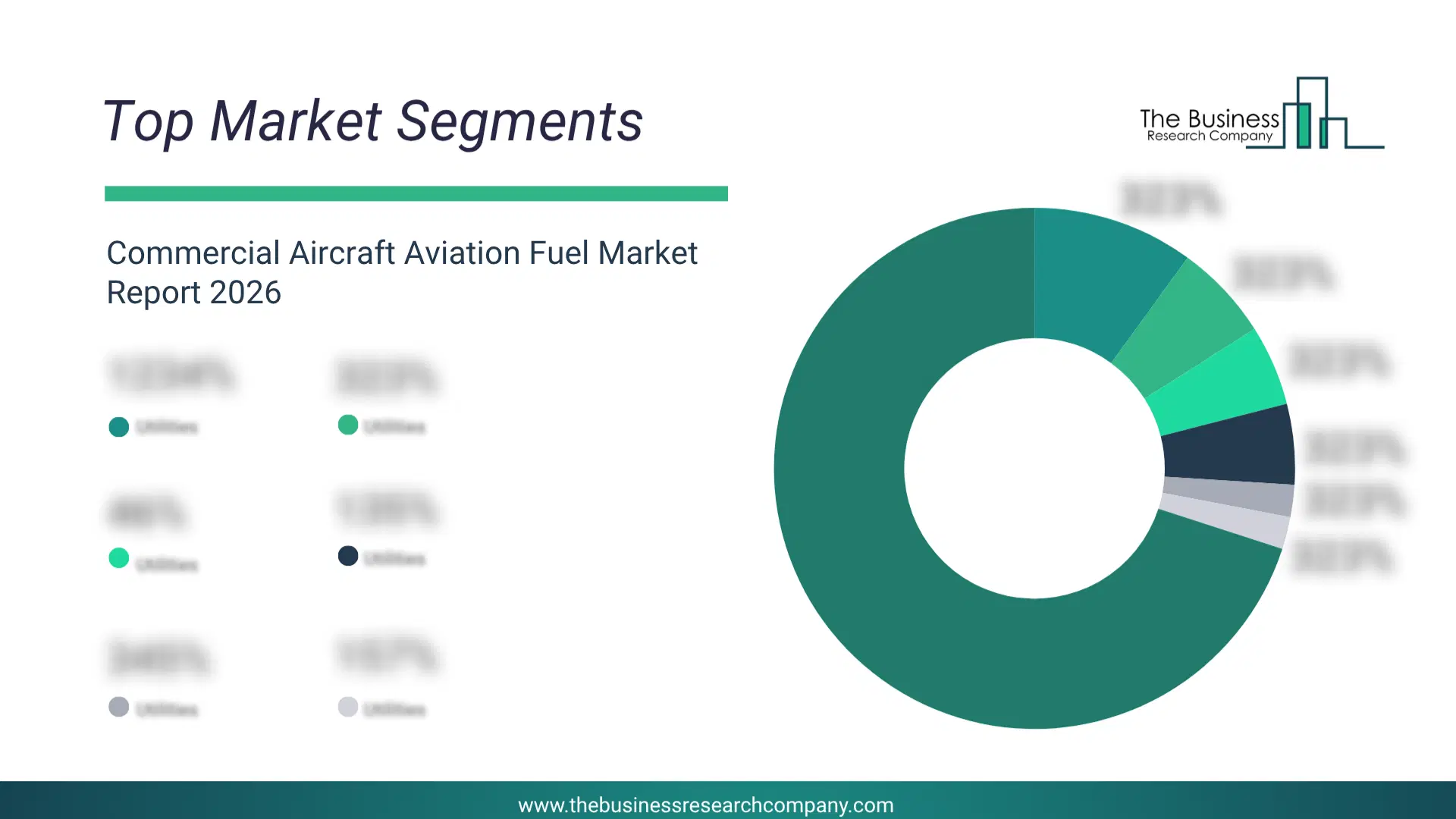
2) By Aircraft Type: Narrow Body Aircraft, Wide Body Aircraft, Regional Aircraft, Turboprop Aircraft 3) By Distribution Channel: Direct Contracts With Airlines, Into Plane Service Providers, Airport Fuel Consortiums, Fuel Traders Or Distributors 4) By Application: Commercial Aviation, Cargo Aviation, Charter Aviation 5) By End User: Full Service Commercial Airlines, Low Cost Carriers, Cargo And Freight Operators, Charter And Private Business Aviation Subsegments: 1) By Jet A: Conventional Jet A, Synthetic Jet A, Renewable Jet A, Blended Jet A 2) By Jet A-1: Conventional Jet A-1, Synthetic Jet A-1, Renewable Jet A-1, Blended Jet A-1 3) By Jet B: Conventional Jet B, Arctic Grade Jet B, Military Grade Jet B, Blended Jet B 4) By Sustainable Aviation Fuel: Hydroprocessed Esters And Fatty Acids Fuel, Fischer Tropsch Synthetic Paraffinic Kerosene, Alcohol To Jet Fuel, Power To Liquid Fuel 5) By Biofuel: Vegetable Oil Based Biofuel, Waste Oil Based Biofuel, Algae Based Biofuel, Lignocellulosic Biofuel 6) By Other Fuel Types: Synthetic Aviation Fuel, Aviation Gasoline, Coal To Liquid Aviation Fuel, Gas To Liquid Aviation FuelWhat Is The Driver Of The Commercial Aircraft Aviation Fuel Market?
The rising air passenger traffic is expected to propel the growth of the commercial aircraft aviation fuel market going forward. Air passenger traffic refers to the number of passengers traveling by air over a specific period across domestic and international routes. Air passenger traffic is rising due to increasing tourism, as more people are traveling for leisure, business, and international experiences, leading to higher demand for air travel. Rising air passenger traffic drives demand for commercial aircraft aviation fuel by increasing flight frequency, boosting aircraft utilization, and encouraging airlines to expand their fleets and route networks to accommodate growing travel demand. For instance, in January 2026, according to the International Air Transport Association (IATA), a Canada-based trade association, global air passenger traffic, measured in revenue passenger kilometers (RPKs), increased by 5.3% in 2025, with international demand growing by 7.1% and domestic demand increasing by 2.4%, reflecting continued growth in global air travel demand. Therefore, the rising air passenger traffic is driving the growth of the commercial aircraft aviation fuel industry.Key Players In The Global Commercial Aircraft Aviation Fuel Market
Major companies operating in the commercial aircraft aviation fuel market are Sinopec Corp, Exxon Mobil Corporation, Shell plc, BP plc, Chevron Corporation, TotalEnergies SE, Marathon Petroleum Corporation, Phillips 66, Valero Energy Corporation, Indian Oil Corporation Limited, Repsol SA, Bharat Petroleum Corporation Limited, Hindustan Petroleum Corporation Limited, OMV Aktiengesellschaft, HF Sinclair Corporation, Neste Oyj, ENEOS Holdings Inc, QatarEnergy, Avfuel Corporation, SkyNRG BV, GS Caltex Corporation, Moeve SAU, World Kinect Corporation, SK Energy Co Ltd, Vitol Aviation BV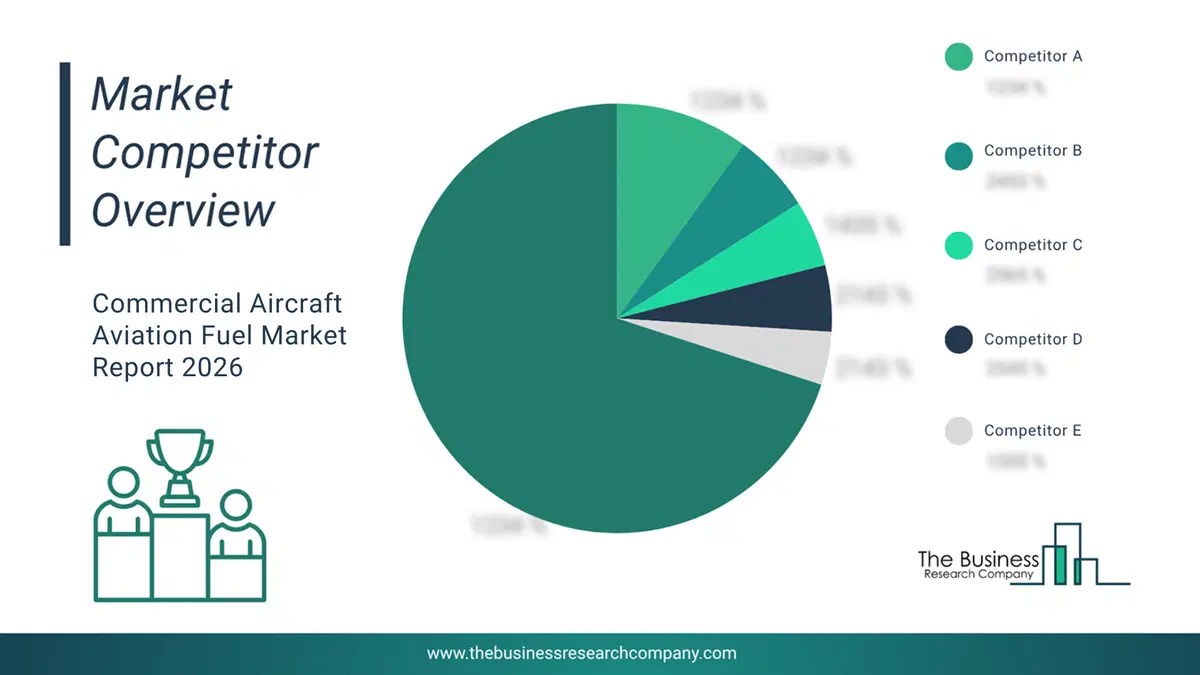
This chart is for illustrative purposes; the full report includes a detailed competitor analysis and comprehensive overview of the top 10 companies in the market.
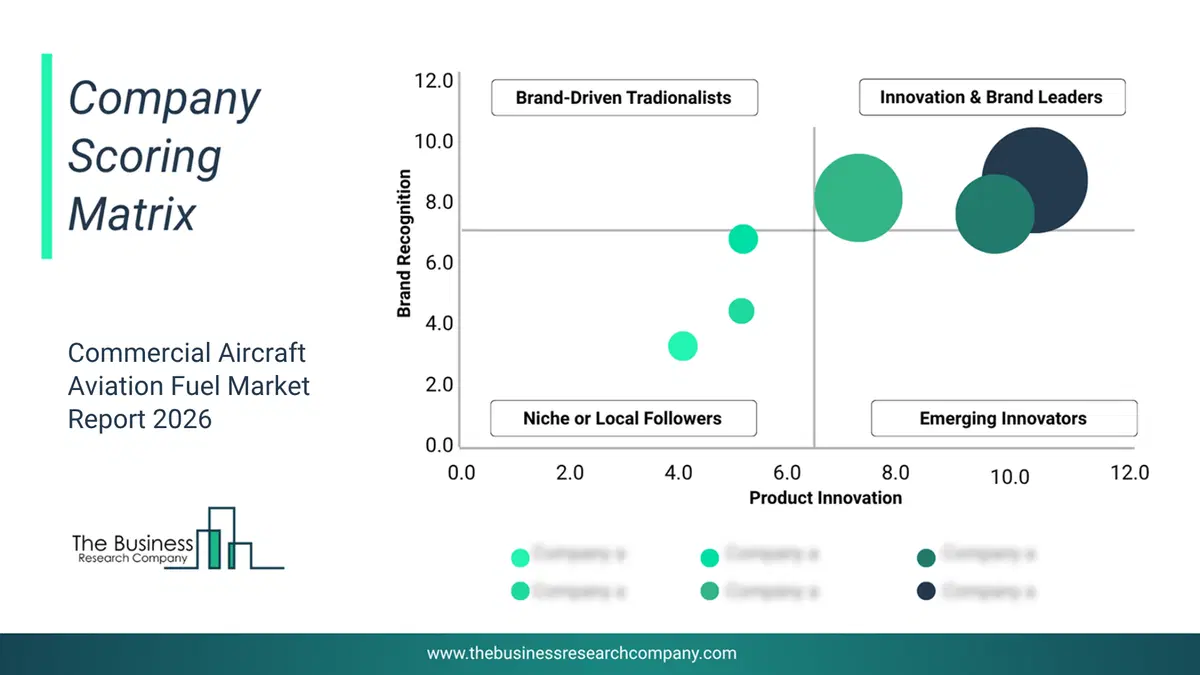
This chart maps companies by product innovation and brand strength, with bubble size indicating relative revenue, helping identify market leaders, challengers, and niche players. This is an illustrative chart; the full report provides a complete and accurate competitive analysis.
Global Commercial Aircraft Aviation Fuel Market Trends and Insights
Major companies operating in the commercial aircraft aviation fuel market are focusing on developing innovative solutions such as, power-to-liquid (PtL) sustainable aviation fuel (SAF) to enhance aviation decarbonization, reduce lifecycle greenhouse gas emissions, and improve fuel sustainability. Power-to-liquid (PtL) sustainable aviation fuel is a synthetic aviation fuel produced by combining captured carbon dioxide (CO₂), water, and renewable electricity to create hydrocarbon fuel molecules that are chemically identical to conventional jet fuel, helping reduce lifecycle emissions while remaining fully compatible with existing aircraft, engines, and airport infrastructure without requiring modifications. For instance, in June 2026, Twelve Benefit Corporation, a US-based carbon transformation and clean technology company, launched AirPlant One, the first commercial-scale facility in the United States to produce E-Jet fuel, a power-to-liquid sustainable aviation fuel. The facility manufactures ASTM-certified jet fuel using the company's proprietary eManufacturing process, which converts captured CO₂, water, and renewable electricity into synthetic jet fuel with the potential to reduce lifecycle greenhouse gas emissions by up to 90% compared to conventional aviation fuel. The fuel is fully compatible with existing commercial aircraft and airport infrastructure, supports long-haul aviation decarbonization, enhances energy security through diversified fuel supply, and is already supplying commercial aviation customers, including Alaska Airlines.What Are Latest Mergers And Acquisitions In The Commercial Aircraft Aviation Fuel Market?
In October 2025, Neste Corporation, a Finland-based renewable products company specializing in sustainable aviation fuel (SAF), renewable diesel, and renewable feedstock solutions, partnered with United Airlines Inc. to expand the supply and use of sustainable aviation fuel at three major US airports. Through this partnership, Neste Corporation and United Airlines, Inc. aim to increase SAF availability across key aviation hubs, reduce greenhouse gas emissions from air travel, support the transition from fossil-based jet fuel to renewable fuels, expand SAF adoption across the US aviation sector, and strengthen the infrastructure and supply capabilities required to support lower-carbon aviation. United Airlines Inc. is a US-based airline that specializes in scheduled passenger and cargo air transportation and operates a major global flight network.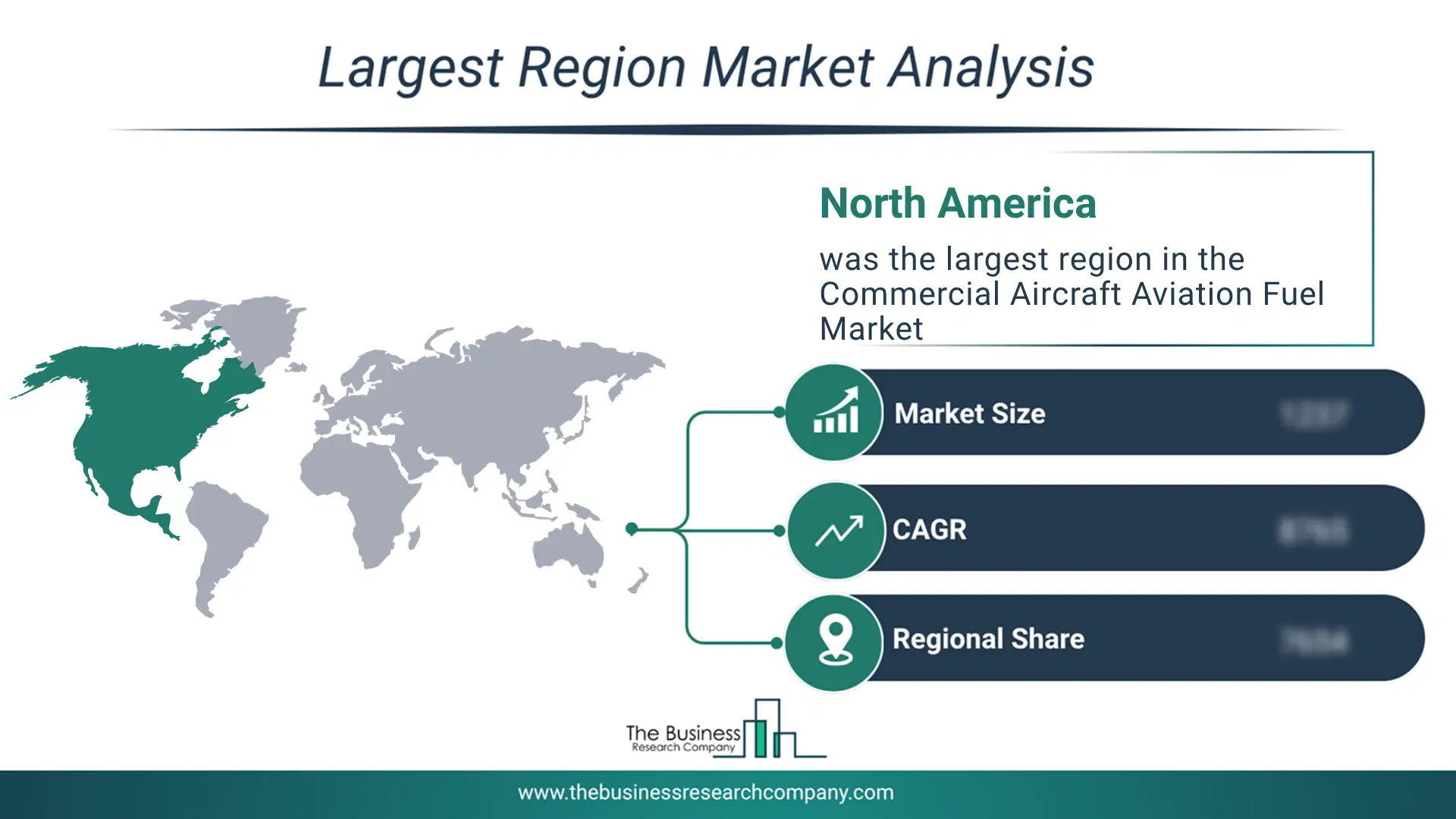
Regional Outlook/Insights
North America was the largest region in the commercial aircraft aviation fuel market in 2025. Asia-Pacific is expected to be the fastest-growing region in the forecast period. The regions covered in this market report are Asia-Pacific, South East Asia, Western Europe, Eastern Europe, North America, South America, Middle East, Africa. The countries covered in this market report are Australia, Brazil, China, France, Germany, India, Indonesia, Japan, Taiwan, Russia, South Korea, UK, USA, Canada, Italy, Spain.What Defines the Commercial Aircraft Aviation Fuel Market?
The commercial aircraft aviation fuel market consists of sales of aviation turbine fuels, conventional petroleum-based aviation fuels, sustainable aviation fuels, synthetic aviation fuels, renewable aviation fuels, blended aviation fuels, and aviation fuel additives. Values in this market are ‘factory gate’ values, that is, the value of goods sold by the manufacturers or creators of the goods, whether to other entities (including downstream manufacturers, wholesalers, distributors, and retailers) or directly to end customers. The value of goods in this market includes related services sold by the creators of the goods.How is Market Value Defined and Measured?
The market value is defined as the revenues that enterprises gain from the sale of goods and/or services within the specified market and geography through sales, grants, or donations in terms of the currency (in USD unless otherwise specified). The revenues for a specified geography are consumption values that are revenues generated by organizations in the specified geography within the market, irrespective of where they are produced. It does not include revenues from resales along the supply chain, either further along the supply chain or as part of other products.
This chart presents market attractiveness based on a quantitative evaluation of growth, competition, strategic alignment, and risk, offering a clear view of opportunity areas for decision-making. This chart is for illustrative purposes; the full report contains the complete analysis.

This chart highlights the Total Addressable Market (TAM) by estimating the maximum revenue opportunity using an assumption-driven approach, supporting strategic planning and opportunity sizing across markets. The chart is illustrative; the full report provides a more comprehensive analysis.
What Key Data and Analysis Are Included in the Commercial Aircraft Aviation Fuel Market Report 2026?
The commercial aircraft aviation fuel market research report is one of a series of new reports from The Business Research Company that provides market statistics, including industry global market size, regional shares, competitors with the market share, detailed market segments, market trends and opportunities, and any further data you may need to thrive in the commercial aircraft aviation fuel industry. The market research report delivers a complete perspective of everything you need, with an in-depth analysis of the current and future state of the industry.Commercial Aircraft Aviation Fuel Market Report Forecast Analysis
| Report Attribute | Details |
|---|---|
| Market Size Value In 2026 | $269.79 billion |
| Revenue Forecast In 2030 | $330.89 billion |
| Growth Rate | CAGR of 5.2% from 2026 to 2035 |
| Base Year For Estimation | 2025 |
| Actual Estimates/Historical Data | 2020-2025 |
| Forecast Period | 2026 - 2030 |
| Market Representation | Revenue in USD Billion and CAGR from 2026 to 2030 |
| Segments Covered | Fuel Type, Aircraft Type, Distribution Channel, Application, End User |
| Regional Scope | Asia-Pacific, Western Europe, Eastern Europe, North America, South America, Middle East, Africa |
| Country Scope | The countries covered in the report are Australia, Brazil, China, France, Germany, India, Indonesia, Japan, Taiwan, Russia, South Korea, UK, USA, Canada, Italy, Spain. |
| Customization Scope | Request for Customization |
| Pricing And Purchase Options | Explore Purchase Options |