
Commercial Aircraft Cabin Interiors Market Report 2026
Global Outlook – By Component (Seating Systems, Cabin Lighting, Galleys, Lavatories), By Aircraft Type (Narrow Body Aircraft, Wide Body Aircraft, Regional Transport Aircraft, Business Jets), By Material (Composites, Alloys, Plastics, Other Materials), By Cabin Class (Economy Class, Premium Economy, Business Class), By End User (Original Equipment Manufacturers, Aftermarket) – Market Size, Trends, Strategies, and Forecast to 2030
Commercial Aircraft Cabin Interiors Market Overview
• Commercial Aircraft Cabin Interiors market size has reached to $11.14 billion in 2025 • Expected to grow to $17.3 billion in 2030 at a compound annual growth rate (CAGR) of 9.1% • Growth Driver: The Rising Air Passenger Traffic Driving The Growth Of The Market Due To Higher Disposable Incomes • Market Trend: Unified Digital Cabin Ecosystems Driving The Next Wave Of Passenger Personalization • North America was the largest region in 2025 and Asia-Pacific is the fastest growing region.What Is Covered Under Commercial Aircraft Cabin Interiors Market?
Commercial aircraft cabin interiors refer to the design, integration, and installation of interior components and finishes within commercial aircraft cabins that enhance passenger comfort, safety, functionality, and overall travel experience. They encompass the materials, structures, and cabin environment solutions that optimize space utilization, aesthetics, durability, and compliance with aviation regulations. The main components of commercial aircraft cabin interiors include seating systems, cabin lighting, galleys, and lavatories. Seating systems refer to passenger seating assemblies designed to provide comfort, safety, and efficient cabin space utilization while complying with aviation standards and airline requirements. These components are installed across narrow body aircraft, wide body aircraft, regional transport aircraft, and business jets and are manufactured using composites, alloys, plastics, and other materials. They are configured for economy class, premium economy, and business class cabins and are used across end users such as original equipment manufacturers and aftermarket.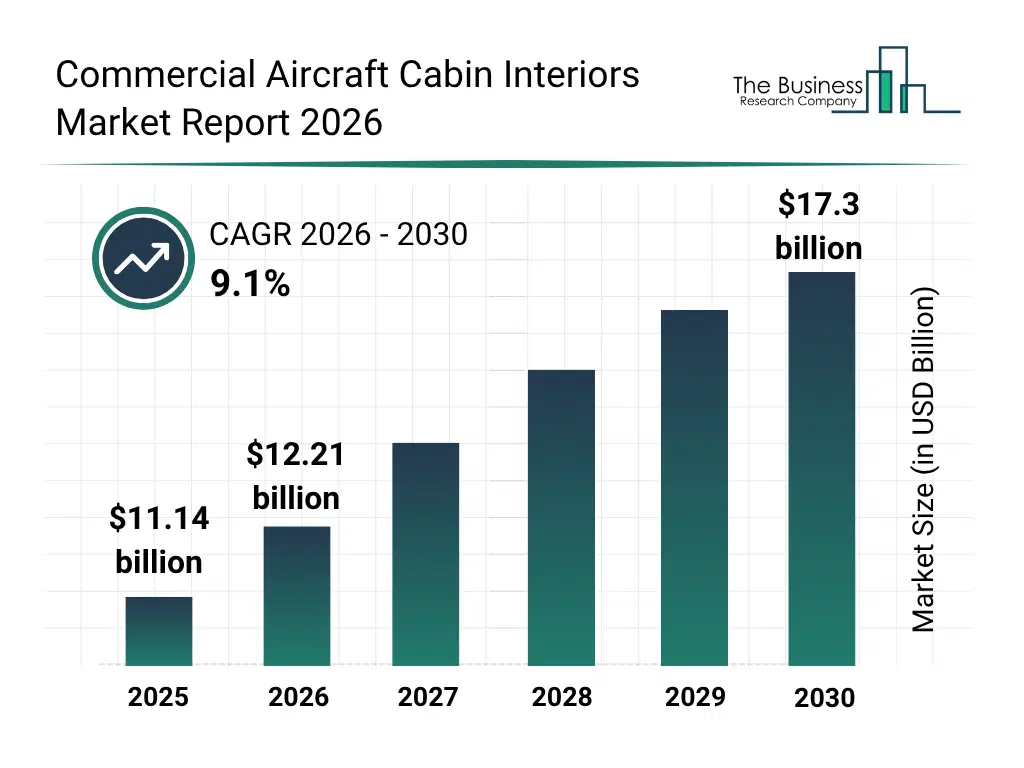
What Is The Commercial Aircraft Cabin Interiors Market Size and Share 2026?
The commercial aircraft cabin interiors market size has grown strongly in recent years. It will grow from $11.14 billion in 2025 to $12.21 billion in 2026 at a compound annual growth rate (CAGR) of 9.5%. The growth in the historic period can be attributed to increasing commercial aircraft deliveries and fleet expansion, growing demand for improved passenger experience, rising adoption of lightweight interior materials, increasing airline investments in cabin refurbishment programs, expanding focus on aircraft weight reduction initiatives.What Is The Commercial Aircraft Cabin Interiors Market Growth Forecast?
The commercial aircraft cabin interiors market size is expected to see strong growth in the next few years. It will grow to $17.3 billion in 2030 at a compound annual growth rate (CAGR) of 9.1%. The growth in the forecast period can be attributed to increasing demand for sustainable aircraft interior materials, growing adoption of modular and customizable cabin designs, rising requirement for premium passenger comfort solutions, increasing focus on smart cabin technologies, expanding aircraft modernization and retrofit activities. Major trends in the forecast period include increasing adoption of lightweight and durable cabin interior materials, growing demand for enhanced passenger comfort and personalized cabin solutions, rising focus on modular aircraft cabin interior designs, increasing development of advanced aircraft seating and space optimization solutions, expanding integration of smart cabin environment management systems.
Global Commercial Aircraft Cabin Interiors Market Segmentation
1) By Component: Seating Systems, Cabin Lighting, Galleys, Lavatories 2) By Aircraft Type: Narrow Body Aircraft, Wide Body Aircraft, Regional Transport Aircraft, Business Jets 3) By Material: Composites, Alloys, Plastics, Other Materials 4) By Cabin Class: Economy Class, Premium Economy, Business Class 5) By End User: Original Equipment Manufacturers, Aftermarket Subsegments: 1) By Seating Systems: Passenger Seat Frames, Seat Cushions And Upholstery, Recline Mechanisms, Seat Actuation Systems, Armrests And Tray Tables 2) By Cabin Lighting: Ambient Lighting, Reading Lights, Mood Lighting Systems, Emergency Lighting Systems 3) By Galleys: Galley Storage Units, Food Preparation Units, Oven And Heating Units, Refrigeration Units 4) By Lavatories: Lavatory Toilet Systems, Wash Basins, Faucets And Water Systems, Waste Disposal UnitsWhat Is The Driver Of The Commercial Aircraft Cabin Interiors Market?
The rising air passenger traffic is expected to propel the growth of the commercial aircraft cabin interiors market going forward. Air passenger traffic refers to the total number of passengers transported by airlines through domestic and international air services over a specific period and serves as a key indicator of air travel demand. Air passenger traffic is rising due to higher disposable incomes, as more people can afford air travel for business and leisure. Rising air passenger traffic drives higher aircraft utilization and fleet expansion, thereby increasing demand for new aircraft and retrofitting activities, which in turn accelerates the need for advanced and upgraded commercial aircraft cabin interiors to enhance passenger comfort and airline competitiveness. For instance, in October 2024, according to the Department of Transportation, a US-based government department, in August 2024, 647,205 flights were operated, representing a 2.61% increase from the 630,761 flights in August 2023. Therefore, the rising air passenger traffic is driving the growth of the commercial aircraft cabin interiors industry.Key Players In The Global Commercial Aircraft Cabin Interiors Market
Major companies operating in the commercial aircraft cabin interiors market are Collins Aerospace, Safran S.A., Airbus SE, The Boeing Company, Diehl Aviation GmbH, RECARO Aircraft Seating GmbH & Co. KG, JAMCO Corporation, Panasonic Holdings Corporation, Thales S.A., Honeywell International Inc., Astronics Corporation, Geven S.p.A., Aviointeriors S.p.A., Bucher Leichtbau AG, Acro Aircraft Seating Ltd., Expliseat SAS, Hong Kong Aircraft Engineering Company Limited, FACC AG, Aviation Industry Corporation of China, Tapis Corporation
This chart is for illustrative purposes; the full report includes a detailed competitor analysis and comprehensive overview of the top 10 companies in the market.
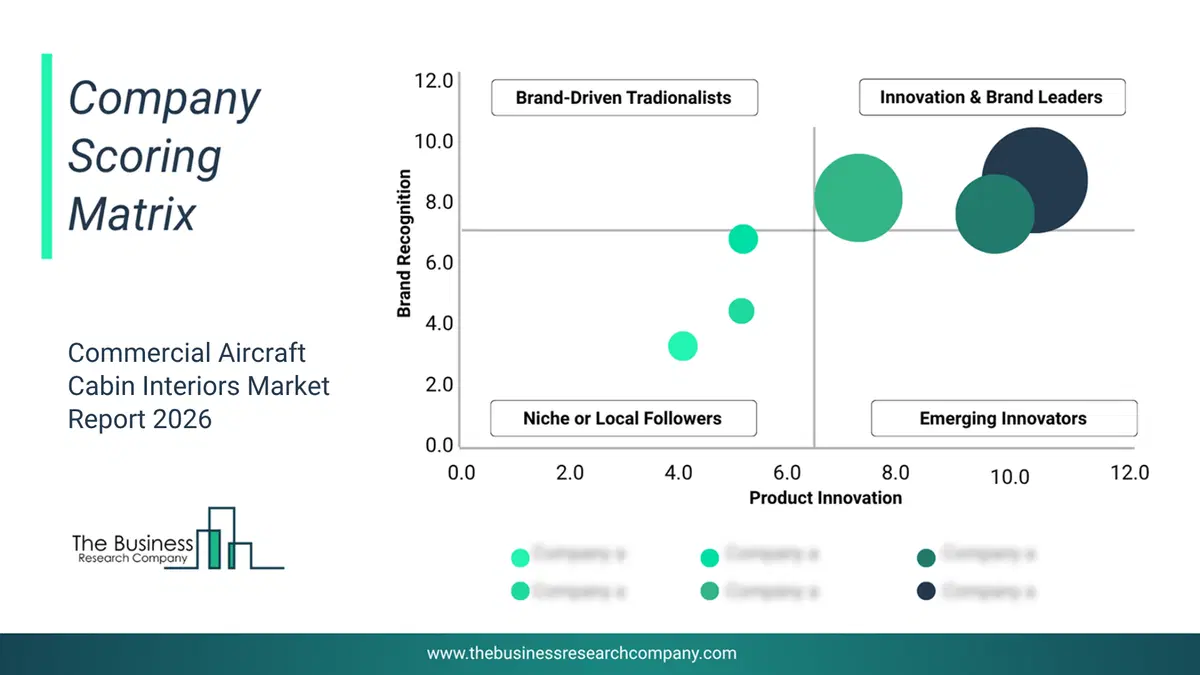
This chart maps companies by product innovation and brand strength, with bubble size indicating relative revenue, helping identify market leaders, challengers, and niche players. This is an illustrative chart; the full report provides a complete and accurate competitive analysis.
Global Commercial Aircraft Cabin Interiors Market Trends and Insights
Major companies operating in the commercial aircraft cabin interiors market are focusing on developing innovative platforms, such as aircraft-wide open application hosting platforms, to enhance in-flight connectivity, passenger personalization, operational efficiency, and real-time cabin system integration. Aircraft-wide application hosting platforms are advanced digital cabin ecosystem solutions that unify multiple in-flight services such as entertainment, connectivity, lighting control, galley operations, and maintenance monitoring into a single interoperable software infrastructure, replacing traditional fragmented cabin systems that operate independently and offer limited data integration. For instance, in April 2025, Panasonic Avionics Corporation, a US-based in-flight entertainment and communications company, launched Converix, a next-generation aircraft-wide hosting platform designed for non-safety-critical cabin applications. The system can be integrated across any aircraft type and supports functions such as in-flight entertainment and connectivity (IFEC), cabin and galley operations, lighting control, and aircraft maintenance monitoring. It processes large volumes of structured and unstructured aircraft data using responsible artificial intelligence, including large language models and agentic AI, to generate actionable airline insights such as executive performance reports. Additionally, Converix enables an AI-powered virtual attendant at every seat, offering passengers personalized services like baggage tracking, travel connections, and destination recommendations while also supporting airlines in delivering targeted in-flight advertising and enhanced passenger engagement.What Are Latest Mergers And Acquisitions In The Commercial Aircraft Cabin Interiors Market?
In July 2026, Setna iO, a US-based aviation company, acquired J and C Aero for an undisclosed amount. With this acquisition, Setna aims to strengthen its presence in the aircraft cabin interiors segment and expand its value-added capabilities by integrating design, certification, and interior modification expertise into its broader aviation aftermarket and supply chain ecosystem. J and C Aero UAB is a Lithuania-based provider of aircraft cabin interior design, engineering, manufacturing, certification support, and cabin modification solutions for commercial aviation operators and lessors.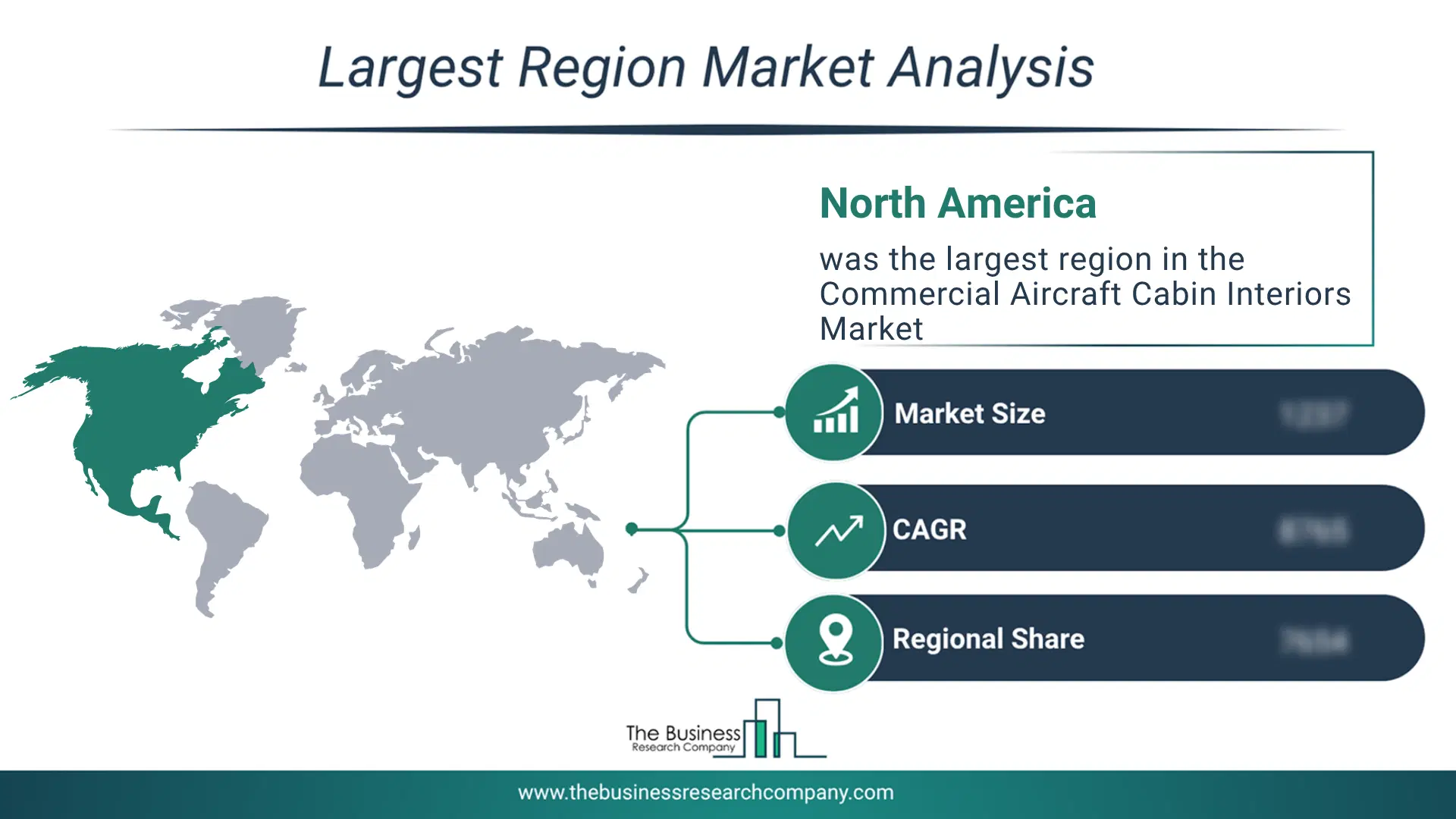
Regional Insights
North America was the largest region in the commercial aircraft cabin interiors market in 2025. Asia-Pacific is expected to be the fastest-growing region in the forecast period. The regions covered in this market report are Asia-Pacific, South East Asia, Western Europe, Eastern Europe, North America, South America, Middle East, Africa. The countries covered in this market report are Australia, Brazil, China, France, Germany, India, Indonesia, Japan, Taiwan, Russia, South Korea, UK, USA, Canada, Italy, Spain.What Defines the Commercial Aircraft Cabin Interiors Market?
The commercial aircraft cabin interiors market consists of sales of in-flight entertainment and connectivity systems, cabin interior panels and sidewall linings, overhead stowage bins and storage units, aircraft windows and shading systems, and cabin flooring and decorative surface materials. Values in this market are ‘factory gate’ values, that is, the value of goods sold by the manufacturers or creators of the goods, whether to other entities (including downstream manufacturers, wholesalers, distributors, and retailers) or directly to end customers. The value of goods in this market includes related services sold by the creators of the goods.How is Market Value Defined and Measured?
The market value is defined as the revenues that enterprises gain from the sale of goods and/or services within the specified market and geography through sales, grants, or donations in terms of the currency (in USD unless otherwise specified). The revenues for a specified geography are consumption values that are revenues generated by organizations in the specified geography within the market, irrespective of where they are produced. It does not include revenues from resales along the supply chain, either further along the supply chain or as part of other products.
This chart presents market attractiveness based on a quantitative evaluation of growth, competition, strategic alignment, and risk, offering a clear view of opportunity areas for decision-making. This chart is for illustrative purposes; the full report contains the complete analysis.

This chart highlights the Total Addressable Market (TAM) by estimating the maximum revenue opportunity using an assumption-driven approach, supporting strategic planning and opportunity sizing across markets. The chart is illustrative; the full report provides a more comprehensive analysis.
What Key Data and Analysis Are Included in the Commercial Aircraft Cabin Interiors Market Report 2026?
The commercial aircraft cabin interiors market research report is one of a series of new reports from The Business Research Company that provides market statistics, including industry global market size, regional shares, competitors with the market share, detailed market segments, market trends and opportunities, and any further data you may need to thrive in the commercial aircraft cabin interiors industry. The market research report delivers a complete perspective of everything you need, with an in-depth analysis of the current and future state of the industry.Commercial Aircraft Cabin Interiors Market Report Forecast Analysis
| Report Attribute | Details |
|---|---|
| Market Size Value In 2026 | $12.21 billion |
| Revenue Forecast In 2030 | $17.3 billion |
| Growth Rate | CAGR of 9.1% from 2026 to 2030 |
| Base Year For Estimation | 2025 |
| Actual Estimates/Historical Data | 2020-2025 |
| Forecast Period | 2026 - 2030 |
| Market Representation | Revenue in USD Billion and CAGR from 2026 to 2030 |
| Segments Covered | Component, Aircraft Type, Material, Cabin Class, End User |
| Regional Scope | Asia-Pacific, Western Europe, Eastern Europe, North America, South America, Middle East, Africa |
| Country Scope | The countries covered in the report are Australia, Brazil, China, France, Germany, India, Indonesia, Japan, Taiwan, Russia, South Korea, UK, USA, Canada, Italy, Spain. |
| Key Companies Profiled | Collins Aerospace, Safran S.A., Airbus SE, The Boeing Company, Diehl Aviation GmbH, RECARO Aircraft Seating GmbH & Co. KG, JAMCO Corporation, Panasonic Holdings Corporation, Thales S.A., Honeywell International Inc., Astronics Corporation, Geven S.p.A., Aviointeriors S.p.A., Bucher Leichtbau AG, Acro Aircraft Seating Ltd., Expliseat SAS, Hong Kong Aircraft Engineering Company Limited, FACC AG, Aviation Industry Corporation of China, Tapis Corporation |
| Customization Scope | Request for Customization |
| Pricing And Purchase Options | Explore Purchase Options |