
Commercial And Military Flight Simulation Market Report 2026
Global Outlook – By Component (Hardware, Software, Services), By Simulator Type (Full Flight Simulator, Flight Training Device, Fixed Base Simulator), By Platform (Fixed Wing Simulator, Rotary Wing Simulator, Unmanned Aerial Vehicle Simulator), By Application (Commercial Aviation, Military Aviation), By End User (Commercial Airlines, Aircraft Original Equipment Manufacturers, Flight Training Academies, Defense Organizations, Government Agencies, Maintenance, Repair And Overhaul Providers) – Market Size, Trends, Strategies, and Forecast to 2030
Commercial And Military Flight Simulation Market Overview
• Commercial And Military Flight Simulation market size has reached to $8.5 billion in 2025 • Expected to grow to $11.89 billion in 2030 at a compound annual growth rate (CAGR) of 6.9% • Growth Driver: Growing Air Traffic Fueling The Growth Of The Market Due To Rising Demand For Pilot Training And Operational Preparedness • Market Trend: Advancements In Virtual Flight Training Platforms Enhance Pilot Readiness And Training Efficiency • North America was the largest region in 2025 and Asia-Pacific is the fastest growing region.What Is Covered Under Commercial And Military Flight Simulation Market?
Commercial and military flight simulation refers to the use of advanced simulation software and hardware to recreate the operation of civil and military aircraft, realistic flight conditions, and mission environments in a virtual setting. It is primarily used for training, certification, and the safe evaluation of aircraft systems and flight procedures without the risks and costs associated with real-world flying. The main components of commercial and military flight simulation include hardware, software, and services. Hardware refers to the physical equipment and systems used to replicate aircraft controls, flight environments, and operational conditions for training and simulation purposes. These components support full flight simulators, flight training devices, and fixed base simulators and are available on fixed wing simulators, rotary wing simulators, and unmanned aerial vehicle simulators. The key applications include commercial aviation and military aviation, while the end users include commercial airlines, aircraft original equipment manufacturers, flight training academies, defense organizations, government agencies, and maintenance, repair and overhaul providers.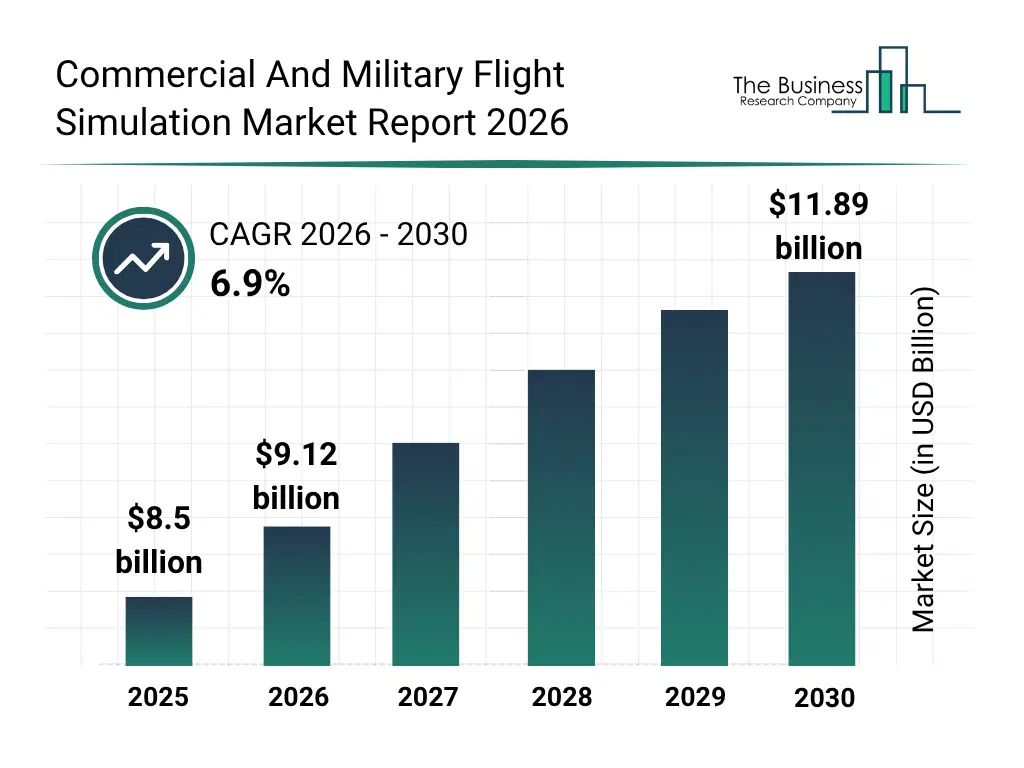
What Is The Commercial And Military Flight Simulation Market Size and Share 2026?
The commercial and military flight simulation market size has grown strongly in recent years. It will grow from $8.5 billion in 2025 to $9.12 billion in 2026 at a compound annual growth rate (CAGR) of 7.3%. The growth in the historic period can be attributed to increasing commercial pilot training requirements, rising military pilot training activities, growing demand for flight safety training, increasing adoption of simulator-based certification, rising aircraft fleet expansion.What Is The Commercial And Military Flight Simulation Market Growth Forecast?
The commercial and military flight simulation market size is expected to see strong growth in the next few years. It will grow to $11.89 billion in 2030 at a compound annual growth rate (CAGR) of 6.9%. The growth in the forecast period can be attributed to increasing demand for advanced pilot training systems, rising military modernization programs, growing demand for realistic mission simulation, increasing need to reduce pilot training costs, expanding adoption of synthetic training environments. Major trends in the forecast period include increasing demand for high-fidelity flight simulation systems, rising adoption of full-flight simulators for pilot training, growing demand for cost-effective virtual flight training, increasing use of simulation for aircraft certification and testing, expanding demand for mission-specific military flight simulation.
Global Commercial And Military Flight Simulation Market Segmentation
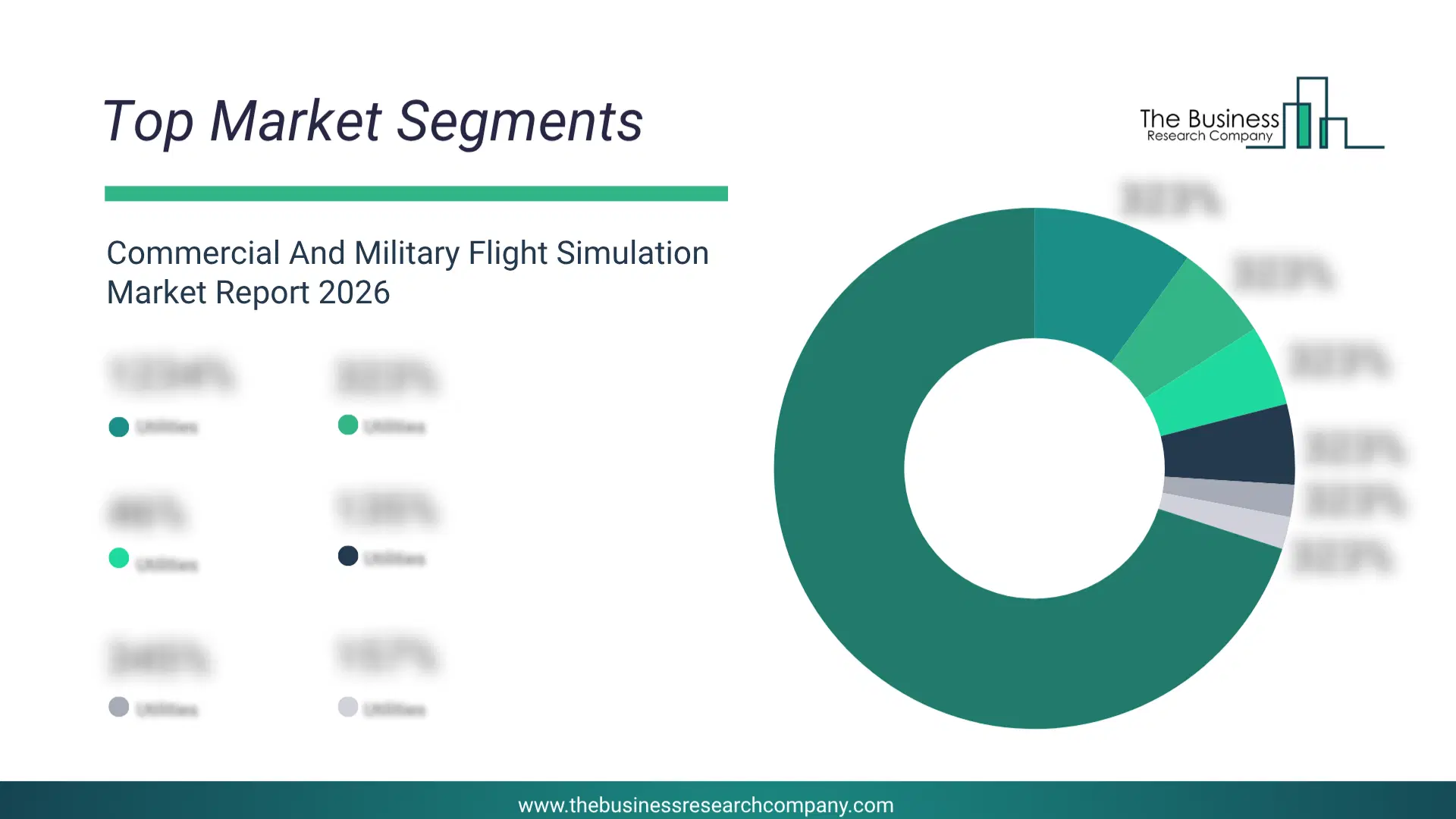
1) By Component: Hardware, Software, Services 2) By Simulator Type: Full Flight Simulator, Flight Training Device, Fixed Base Simulator 3) By Platform: Fixed Wing Simulator, Rotary Wing Simulator, Unmanned Aerial Vehicle Simulator 4) By Application: Commercial Aviation, Military Aviation 5) By End User: Commercial Airlines, Aircraft Original Equipment Manufacturers, Flight Training Academies, Defense Organizations, Government Agencies, Maintenance, Repair And Overhaul Providers Subsegments: 1) By Hardware: Flight Simulator Cockpits, Visual Display Systems, Motion Systems, Control Loading Systems, Flight Controls, Computing Systems, Audio Systems, Instructor Operator Stations, Networking Equipment 2) By Software: Simulation Software, Scenario Generation Software, Flight Dynamics Software, Visual Rendering Software, Database Management Software, Debriefing Software, Training Management Software, Artificial Intelligence Simulation Software 3) By Services: Installation Services, Integration Services, Maintenance Services, Technical Support Services, Software Upgrade Services, Calibration Services, Training Services, Consulting ServicesWhat Is The Driver Of The Commercial And Military Flight Simulation Market?
The growing air traffic is expected to propel the growth of the commercial and military flight simulation market going forward. Air traffic refers to the movement of aircraft transporting passengers, cargo, and military personnel through controlled airspace and airports. The air traffic is rising due to increasing demand for air travel, as more passengers choose air transport for domestic and international travel. Air traffic growth supports commercial and military flight simulation by increasing the need for pilot training, recurrent certification, and operational preparedness, ensuring safe and efficient flight operations while meeting rising aviation demand. For instance, in January 2025, according to the International Air Transport Association (IATA), a Switzerland-based aviation trade association, total global passenger traffic measured in revenue passenger kilometers increased by 10.4% in 2024 compared with 2023, while international passenger traffic increased by 13.6% during the same period. The overall passenger load factor reached a record 83.5% in 2024. Therefore, the growing air traffic is driving the growth of the commercial and military flight simulation industry.Key Players In The Global Commercial And Military Flight Simulation Market
Major companies operating in the commercial and military flight simulation market are Lockheed Martin Corporation, RTX Corporation, Thales SA, The Boeing Company, L3Harris Technologies Inc, CAE Inc, FlightSafety International Inc, Textron Inc, Leonardo SpA, Rheinmetall AG, Indra Sistemas SA, Saab AB, Moog Inc, HAVELSAN AS, ALSIM Flight Training, Aero Simulation Inc, Entrol SL, BRUNNER Elektronik AG, Flightdeck Solutions Inc, ELITE Simulation Solutions AG, Precision Flight Controls Inc, Acron Aviation Inc, Trident Military Systems LLC, Opencockpits SL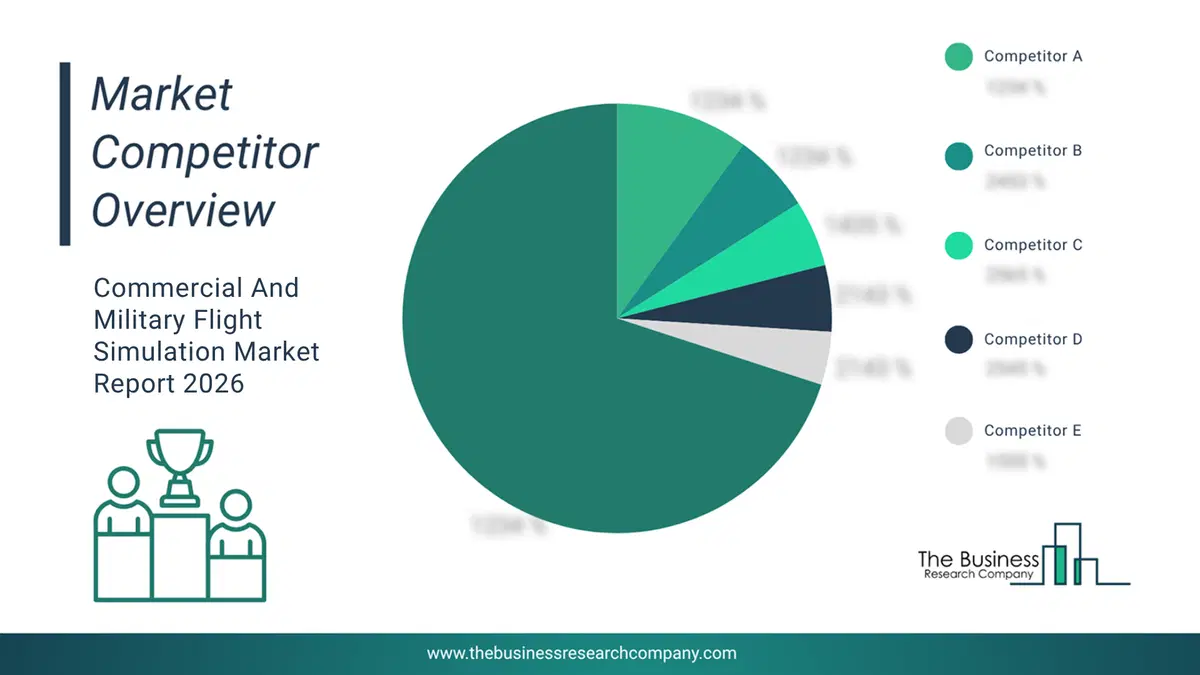
This chart is for illustrative purposes; the full report includes a detailed competitor analysis and comprehensive overview of the top 10 companies in the market.
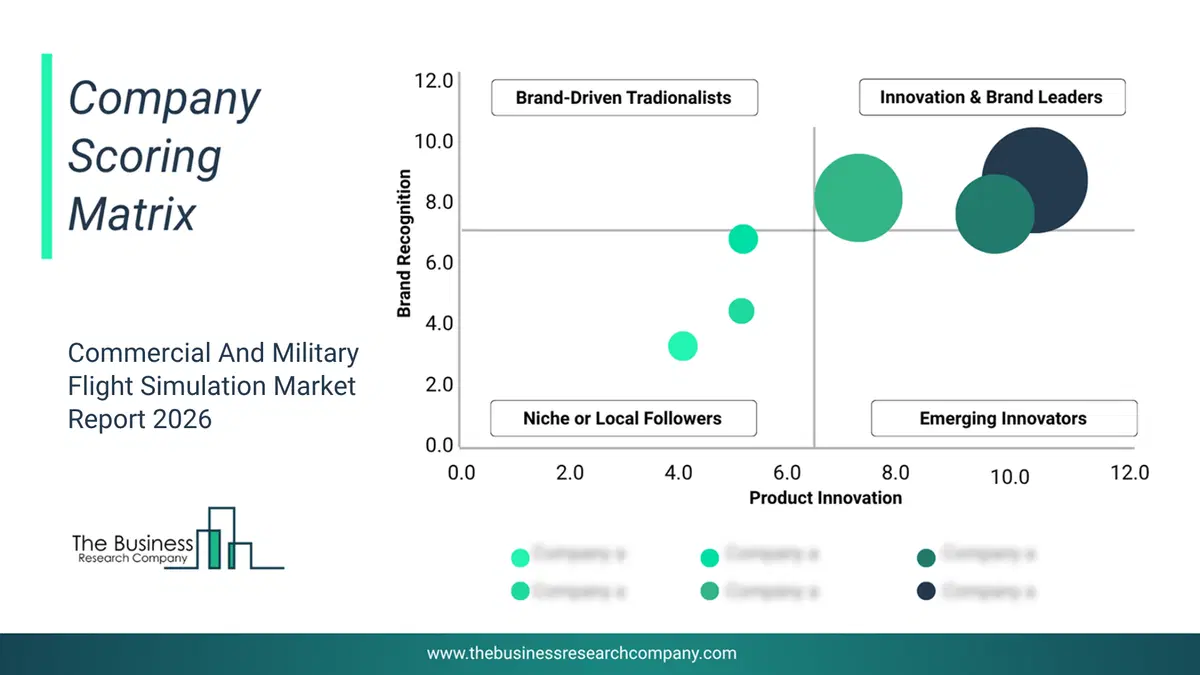
This chart maps companies by product innovation and brand strength, with bubble size indicating relative revenue, helping identify market leaders, challengers, and niche players. This is an illustrative chart; the full report provides a complete and accurate competitive analysis.
Global Commercial And Military Flight Simulation Market Trends and Insights
Major companies operating in the commercial and military flight simulation market are focusing on developing innovative solutions such as virtual airplane procedures trainers to enhance pilot training accessibility, simulation realism, operational readiness, and aviation safety. Virtual airplane procedures trainers are digital flight training platforms that use high-fidelity 3D simulations, cloud-based technologies, and interactive training tools to replicate aircraft cockpit environments, enabling pilots to practice procedures outside traditional full-flight simulator settings while reducing training costs and improving learning flexibility. For instance, in November 2025, The Boeing Company, a US-based aerospace and defense company, launched the Virtual Airplane Procedures Trainer (VAPT), a next-generation flight training platform powered by Microsoft Azure and Microsoft Flight Simulator. The platform provides immersive and customizable training experiences that allow pilots and flight training teams to practice realistic flight-deck procedures using lightweight devices such as computers and iPad devices. It features high-fidelity 3D simulations that help standardize training, reduce simulator familiarization time, and improve pilot readiness before using traditional flight training devices. The system also includes an intuitive authoring tool that enables training operators to create, customize, and distribute lessons across their programs, allowing airlines to quickly update procedures for pilot groups.What Are Latest Mergers And Acquisitions In The Commercial And Military Flight Simulation Market?
In March 2025, TJC L.P., a US-based private equity firm, acquired the Commercial Aviation Solutions (CAS) business from L3Harris Technologies for $800 million. Through this acquisition, TJC aims to strengthen its portfolio in commercial aviation by expanding its capabilities in commercial flight training, flight simulation, flight data analytics, and avionics solutions. L3Harris Technologies is a US-based technology company that provider of commercial flight simulators, pilot training systems, flight data analytics, and commercial avionics serving the global civil aviation industry.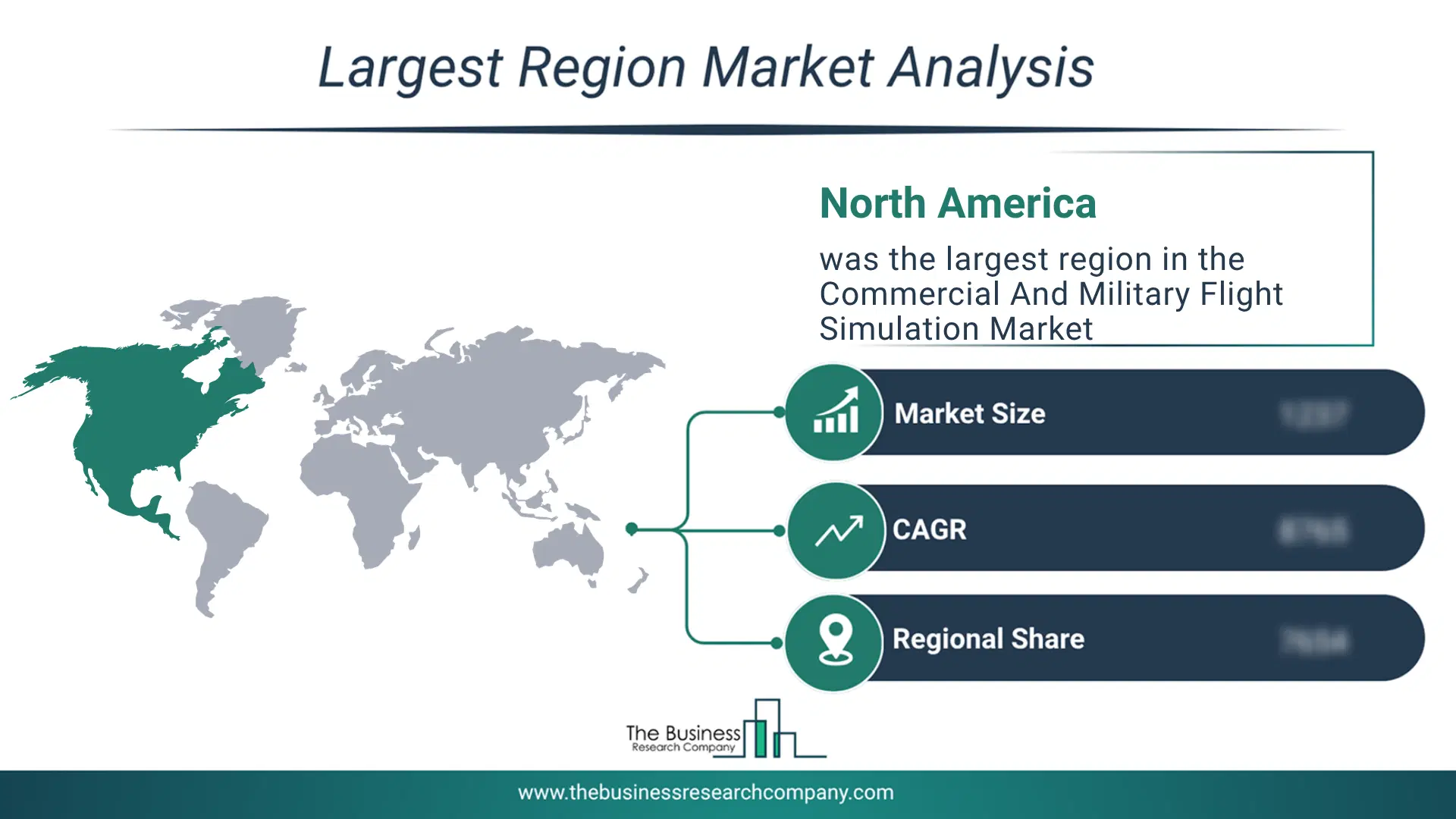
Regional Insights
North America was the largest region in the commercial and military flight simulation market in 2025. Asia-Pacific is expected to be the fastest-growing region in the forecast period. The regions covered in this market report are Asia-Pacific, South East Asia, Western Europe, Eastern Europe, North America, South America, Middle East, Africa. The countries covered in this market report are Australia, Brazil, China, France, Germany, India, Indonesia, Japan, Taiwan, Russia, South Korea, UK, USA, Canada, Italy, Spain.What Defines the Commercial And Military Flight Simulation Market?
The commercial and military flight simulation market includes revenues earned by entities by providing pilot training services, simulator-based flight training, recurrent and certification training, mission rehearsal services, crew resource management training, instructor-led simulation programs, simulator maintenance and support, and simulation system integration and consulting services. The market value includes the value of related goods sold by the service provider or included within the service offering. The commercial and military flight simulation market also consists of sales of full-mission simulators, virtual reality (VR) and mixed reality (MR) flight training systems, cockpit replicas, simulator software platforms, motion systems, and visual display systems. Values in this market are ‘factory gate’ values, that is the value of goods sold by the manufacturers or creators of the goods, whether to other entities (including downstream manufacturers, wholesalers, distributors and retailers) or directly to end customers. The value of goods in this market includes related services sold by the creators of the goods.How is Market Value Defined and Measured?
The market value is defined as the revenues that enterprises gain from the sale of goods and/or services within the specified market and geography through sales, grants, or donations in terms of the currency (in USD unless otherwise specified). The revenues for a specified geography are consumption values that are revenues generated by organizations in the specified geography within the market, irrespective of where they are produced. It does not include revenues from resales along the supply chain, either further along the supply chain or as part of other products.
This chart presents market attractiveness based on a quantitative evaluation of growth, competition, strategic alignment, and risk, offering a clear view of opportunity areas for decision-making. This chart is for illustrative purposes; the full report contains the complete analysis.

This chart highlights the Total Addressable Market (TAM) by estimating the maximum revenue opportunity using an assumption-driven approach, supporting strategic planning and opportunity sizing across markets. The chart is illustrative; the full report provides a more comprehensive analysis.
What Key Data and Analysis Are Included in the Commercial And Military Flight Simulation Market Report 2026?
The commercial and military flight simulation market research report is one of a series of new reports from The Business Research Company that provides market statistics, including industry global market size, regional shares, competitors with the market share, detailed market segments, market trends and opportunities, and any further data you may need to thrive in the commercial and military flight simulation industry. The market research report delivers a complete perspective of everything you need, with an in-depth analysis of the current and future state of the industry.Commercial And Military Flight Simulation Market Report Forecast Analysis
| Report Attribute | Details |
|---|---|
| Market Size Value In 2026 | $9.12 billion |
| Revenue Forecast In 2030 | $11.89 billion |
| Growth Rate | CAGR of 6.9% from 2026 to 2030 |
| Base Year For Estimation | 2025 |
| Actual Estimates/Historical Data | 2020-2025 |
| Forecast Period | 2026 - 2030 |
| Market Representation | Revenue in USD Billion and CAGR from 2026 to 2030 |
| Segments Covered | Component, Simulator Type, Platform, Application, End User |
| Regional Scope | Asia-Pacific, Western Europe, Eastern Europe, North America, South America, Middle East, Africa |
| Country Scope | The countries covered in the report are Australia, Brazil, China, France, Germany, India, Indonesia, Japan, Taiwan, Russia, South Korea, UK, USA, Canada, Italy, Spain. |
| Key Companies Profiled | Lockheed Martin Corporation, RTX Corporation, Thales SA, The Boeing Company, L3Harris Technologies Inc, CAE Inc, FlightSafety International Inc, Textron Inc, Leonardo SpA, Rheinmetall AG, Indra Sistemas SA, Saab AB, Moog Inc, HAVELSAN AS, ALSIM Flight Training, Aero Simulation Inc, Entrol SL, BRUNNER Elektronik AG, Flightdeck Solutions Inc, ELITE Simulation Solutions AG, Precision Flight Controls Inc, Acron Aviation Inc, Trident Military Systems LLC, Opencockpits SL |
| Customization Scope | Request for Customization |
| Pricing And Purchase Options | Explore Purchase Options |