

Commercial Robots Market Report 2026
Global Outlook – By Type (Service Robots, Medical Robots, Field Robots, Commercial Mobile Robots, Professional Drones), By Level Of Autonomy (Fully Autonomous, Semi-Autonomous, Human-Supervised Autonomous), By Application (Healthcare And Medical Services, Retail And Hospitality, Agriculture And Forestry, Logistics And Commercial Facilities, Security And Surveillance, Construction And Infrastructure, Environmental And Utility Services) – Market Size, Trends, Strategies, and Forecast to 2030
Commercial Robots Market Overview
• Commercial Robots market size has reached to $29.6 billion in 2025 • Expected to grow to $67.95 billion in 2030 at a compound annual growth rate (CAGR) of 17.7% • Growth Driver: Industrialization Surge Fuels Commercial Robot Market Growth • Market Trend: Serve Robotics Unveils Advanced Third-Generation Delivery Robot To Enhance Urban Food And Drink Services • North America was the largest region in 2025 and Asia-Pacific is the fastest growing region.Market Gains By 2030 – Top Opportunities By Segment
Market Gain identifies the most promising market opportunities by highlighting the segments or products expected to generate the highest incremental revenue growth over the next five years.
What Is Covered Under Commercial Robots Market?
Commercial robots are robots designed and used for a wide range of commercial applications across various industries. They are designed to work alongside humans in shared workspaces. They are intended to improve efficiency, safety, and productivity in non-industrial settings. The main types of commercial robots are field robots, medical robots, autonomous guided robotics, drones, and others. Field robots are designed to operate in the field, navigating rough terrain and performing tasks such as mapping, inspection, and maintenance. They work based on various technologies including automatic, semi-automatic, and manual for medical and healthcare, defense and security, agriculture and forestry, marine, and others.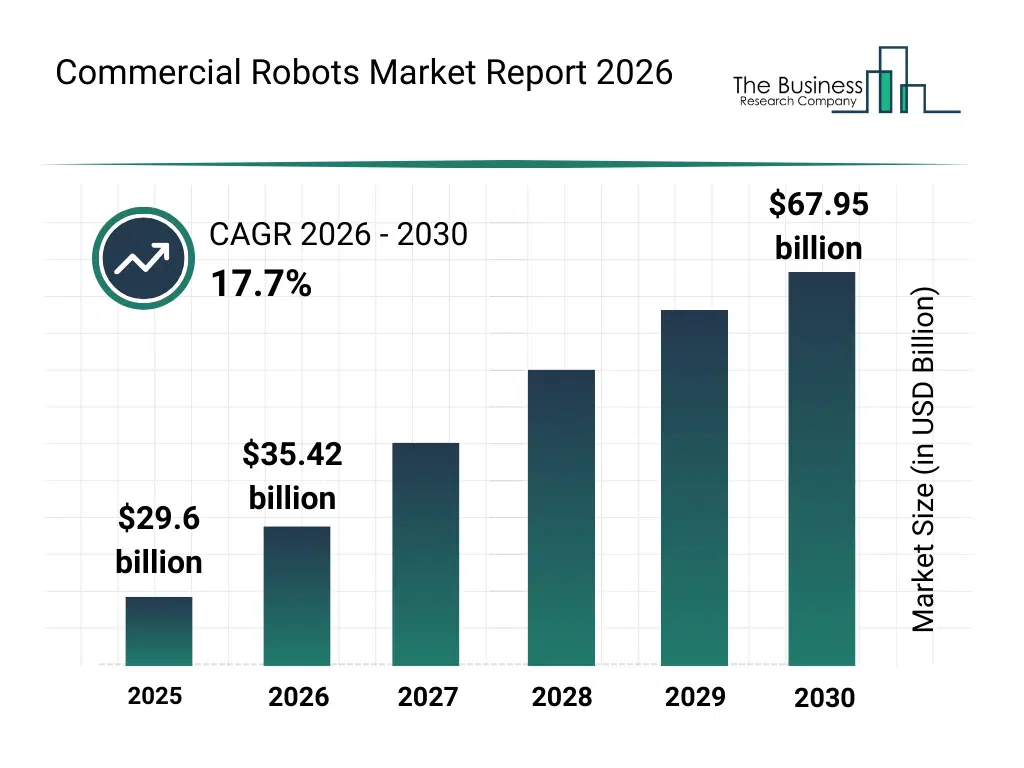
What Is The Commercial Robots Market Size and Share 2026?
The commercial robots market size has grown rapidly in recent years. It will grow from $29.6 billion in 2025 to $35.42 billion in 2026 at a compound annual growth rate (CAGR) of 19.6%. The growth in the historic period can be attributed to rising labor shortages across industries, expansion of automation in services, growing adoption of robots in healthcare and agriculture, availability of collaborative robot platforms, investments in robotics startups.What Is The Commercial Robots Market Growth Forecast?
The commercial robots market size is expected to see rapid growth in the next few years. It will grow to $67.95 billion in 2030 at a compound annual growth rate (CAGR) of 17.7%. The growth in the forecast period can be attributed to expansion of ai-enabled commercial robots, rising use of robots in public services, demand for cost-efficient automation, integration of advanced sensors and vision systems, growth of robotics-as-a-service models. Major trends in the forecast period include expansion of service robots in commercial spaces, increasing deployment of autonomous mobile robots, integration of ai-based human-robot interaction, growing demand for safety and collaboration features, customization of robots for sector-specific tasks.
Global Commercial Robots Market Segmentation
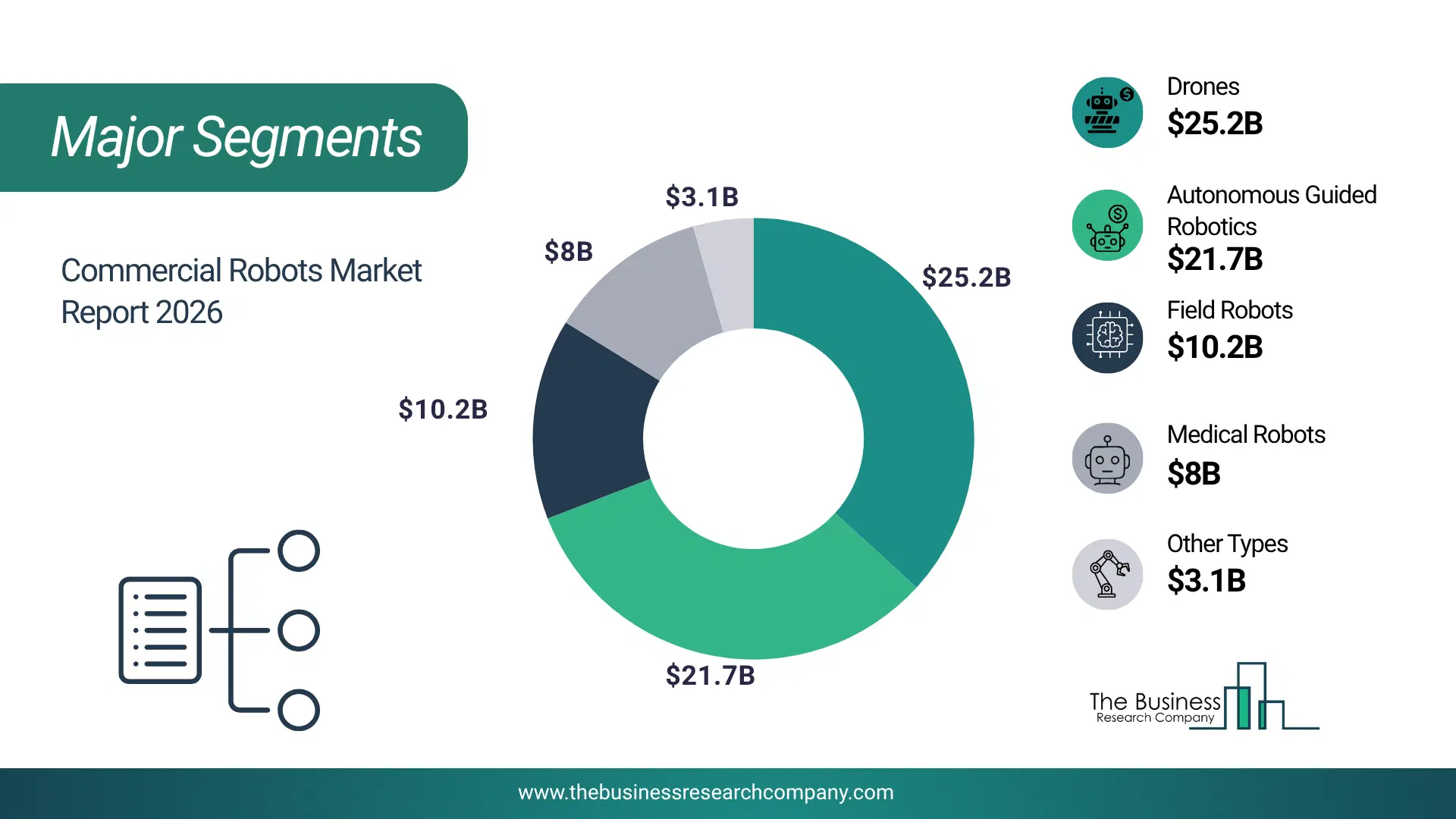
1) By Type: Service Robots, Medical Robots, Field Robots, Commercial Mobile Robots, Professional Drones 2) By Level Of Autonomy: Fully Autonomous, Semi-Autonomous, Human-Supervised Autonomous 3) By Application: Healthcare And Medical Services, Retail And Hospitality, Agriculture And Forestry, Logistics And Commercial Facilities, Security And Surveillance, Construction And Infrastructure, Environmental And Utility Services Subsegments: 1) By Service Robots: Cleaning Robots, Security And Surveillance Robots, Hospitality And Delivery Robots, Retail And Customer Assistance Robots 2) By Medical Robots: Surgical Robots, Rehabilitation Robots, Therapy And Assistive Robots, Diagnostic And Imaging Robots 3) By Field Robots: Agricultural Robots, Construction Robots, Environmental Monitoring Robots 4) By Commercial Mobile Robots: Autonomous Mobile Robots (AMRs), Service-Oriented Guided Vehicles (SGVs) 5) By Professional Drones: Inspection And Mapping Drones, Commercial Delivery Drones, Surveillance And Monitoring Drones The top segments in the commercial robots market will be: • Drones will reach $25.13 billion by 2030. • Autonomous Guided Robotics will reach $21.67 billion by 2030. • Field Robots will reach $10.17 billion by 2030. • Medical Robots will reach $7.94 billion by 2030. • Other Types will reach $3.04 billion by 2030.What Is The Driver Of The Commercial Robots Market?
The increased industrialization is expected to propel the growth of the commercial robot market going forward. Industrialization involves the mechanization of production, the use of inanimate sources of energy, and the organization of labor in large scale factories and enterprises that allow for mass production and economic growth. Industrialization is on the rise owing to several factors, such as the thriving industrial revolution and the rising manufacturing sector. Commercial robots are used by businesses to replicate, assist, or replace human tasks and functions. For instance, according to reports published by the National Bureau of Statistics (NBS) of China, the bureau responsible for collection, investigation, research, and publication of statistics, the country's industrial output increased 4.6% year over year in October 2023, exceeding forecasts of a 4.4% increase. This growth was faster than the 4.5% rate observed in September 2023. Therefore, increased industrialization is driving the growth commercial robot industry.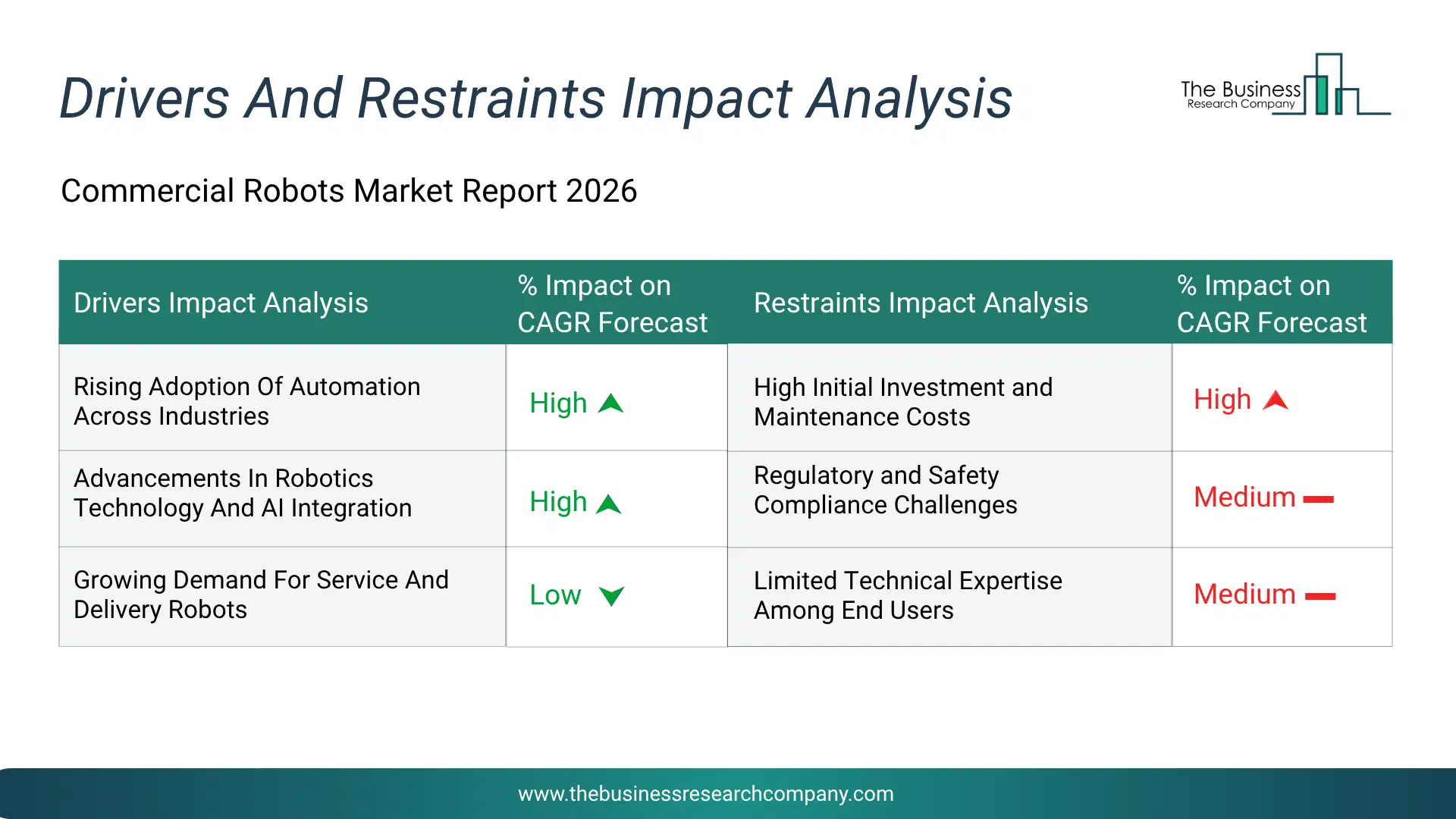
Infographic Chart Showing Key Market Drivers Analysis And Restraints For Commercial Robots Market
The chart presents an impact analysis of key drivers and restraints, quantifying their relative influence on the market's growth rate and helping assess the balance between growth enablers and limiting factors. This chart offers a high-level perspective; the full report contains more detailed insights.
How Will The Drivers Impact Growth In The Global Commercial Robots Market?
• Rising Adoption Of Automation Across Industries (High) – During the forecast period, the rising adoption of automation across industries is expected to become a key growth driver for the commercial robots market by 2030. Commercial robots operating in public spaces or alongside humans must comply with stringent safety, operational, and industry -specific regulations. Standards related to collision avoidance, electromagnetic compatibility, and workplace safety require rigorous testing and certification. Navigating diverse regional regulations and ensuring compliance can increase project timelines and operational complexity. These regulatory challenges act as a restraint on widespread and rapid adoption of commercial robotics solutions. • Advancements In Robotics Technology And AI Integration (High) – During the forecast period, the advancements in robotics technology and ai integration are expected to emerge as a major factor driving the expansion of the commercial robots market by 2030. Commercial robots are increasingly integrated with artificial intelligence, machine learning, computer vision, and advanced sensors, enabling them to perform complex tasks autonomously and interact intelligently with humans. Technologies such as slam (simultaneous localization and mapping), ai-based navigation, and voice recognition are expanding the functionality of service and industrial robots. These technological advancements enhance accuracy, adaptability, and efficiency, boosting adoption across sectors such as healthcare, retail, logistics, and hospitality. The innovation in robotics technology strongly drives market growth. • Growing Demand For Service And Delivery Robots (Low) – During the forecast period, the growing demand for service and delivery robots is expected to act as a key growth catalyst for the commercial robots market by 2030. The surge in e-commerce, hospitality, healthcare, and food delivery services has increased the demand for commercial robots in service roles. Autonomous delivery robots, cleaning robots, inventory management robots, and healthcare assistants help organizations streamline operations and enhance customer experience. The covid-19 pandemic further accelerated the adoption of contactless robotic solutions, reinforcing their importance in reducing human interaction and maintaining operational continuity. This rising demand for service-oriented commercial robots acts as a key growth driver.How Will The Restraints Impact Growth In The Global Commercial Robots Market?
• High Initial Investment and Maintenance Costs (High) – During the forecast period, the commercial robots, particularly advanced ai-enabled models, require significant upfront investment for acquisition, installation, and system integration. Additionally, ongoing maintenance, software updates, and training personnel add to the total cost of ownership. Small and medium-sized enterprises may find it challenging to justify these expenses, limiting market penetration in price-sensitive sectors. These high costs act as a key restraint to the rapid adoption of commercial robots. • Regulatory and Safety Compliance Challenges (Medium) – During the forecast period, the commercial robots operating in public spaces or alongside humans must comply with stringent safety, operational, and industry-specific regulations. Standards related to collision avoidance, electromagnetic compatibility, and workplace safety require rigorous testing and certification. Navigating diverse regional regulations and ensuring compliance can increase project timelines and operational complexity. These regulatory challenges act as a restraint on widespread and rapid adoption of commercial robotics solutions. • Limited Technical Expertise Among End Users (Medium) – During the forecast period, the many organizations lack the in-house expertise required to deploy, operate, and maintain advanced robotic systems effectively. Training employees and adapting workflows can require significant time and resources. Concerns regarding operational disruptions may delay purchasing decisions. These factors can slow adoption, particularly among small and medium-sized enterprises.Key Players In The Global Commercial Robots Market
Major companies operating in the commercial robots market are Honda Motor Co. Ltd., Omron Corporation, Teradyne Inc. (Universal Robots), Techman Robot Inc., iRobot Corporation, SoftBank Robotics Group, UBTECH Robotics Corp. Ltd., Pudu Technology Inc., Fourier Intelligence, Boston Dynamics, Sarcos Technology and Robotics Corporation, inVia Robotics Inc., Agrobot, Keenon Robotics Co. Ltd., Universal Robots A/S, Robocath, Wingcopter, 3DR Inc., Vecow Co. Ltd., PickNik Inc.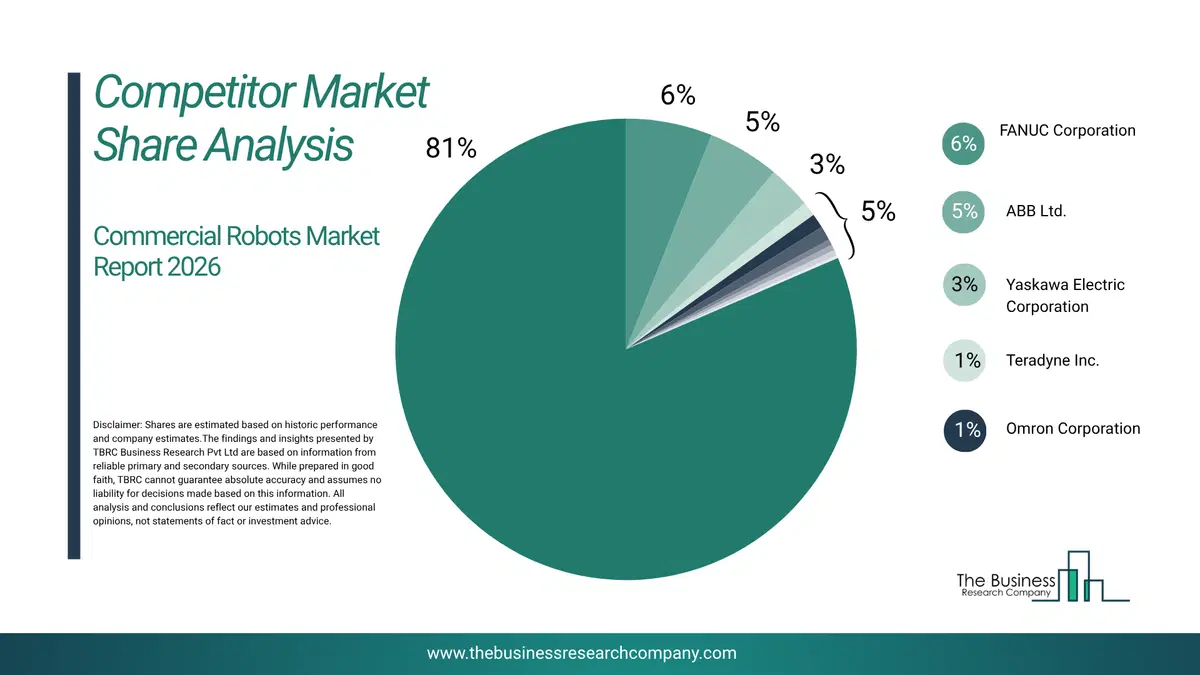
This chart is for illustrative purposes; the full report includes a detailed competitor analysis and comprehensive overview of the top 10 companies in the market.
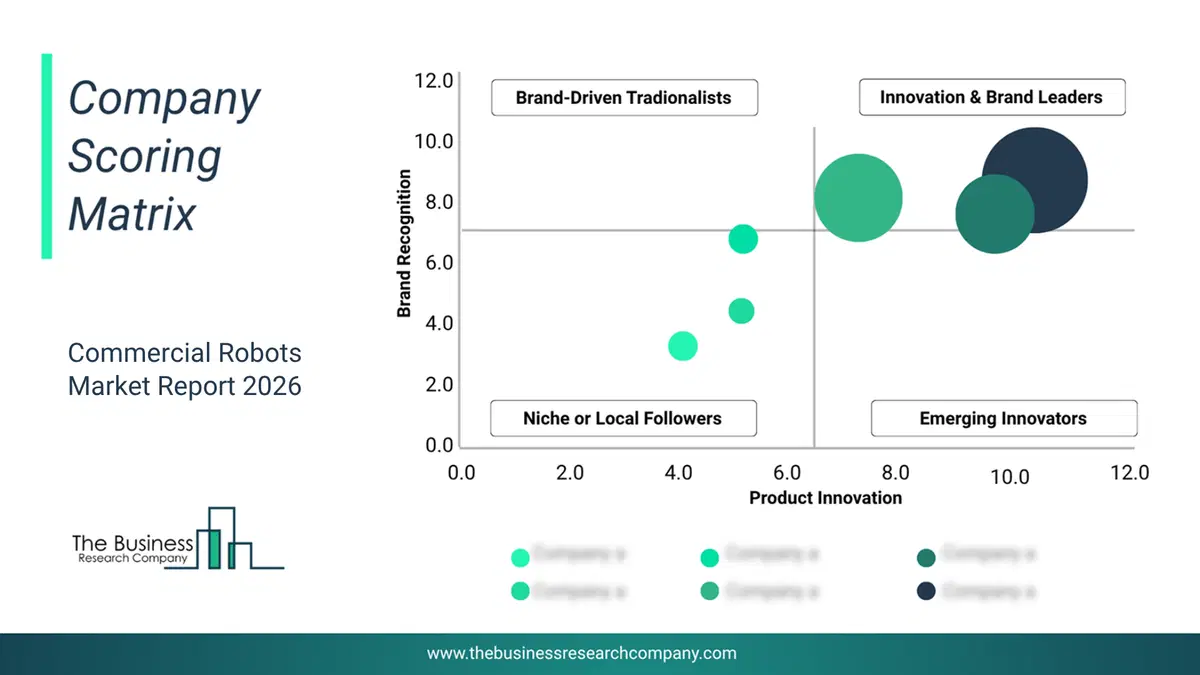
This chart maps companies by product innovation and brand strength, with bubble size indicating relative revenue, helping identify market leaders, challengers, and niche players. This is an illustrative chart; the full report provides a complete and accurate competitive analysis.
Global Commercial Robots Market Trends and Insights
Major companies operating in the commercial robot market are focused on investing in advanced robotic technologies such as third-generation delivery robot to enhance delivery services in urban environments, aiming to improve efficiency and customer satisfaction. A third-generation delivery robot refers to an advanced type of autonomous delivery robot that incorporates several enhancements over previous generations in terms of technology, functionality, and usability. For instance, in October 2024, according to a report published by Serve Robotics, Inc., a US-based company that specializes in developing and deploying robotic delivery solutions launched the latest third-generation delivery robot designed to enhance food and drink delivery in Los Angeles. This advanced robot features increased capacity for larger items like pizzas, improved speed and battery life for longer travel distances on a single charge, enhanced water resistance, and faster braking capabilities for better performance in adverse weather conditions. Originally part of Postmates, acquired by Uber, Serve Robotics aims to leverage the dense delivery market in L.A., operating in areas such as Hollywood and Koreatown. The company emphasizes the environmental and economic benefits of these robots, which could lower delivery costs, boost local commerce, and create new job opportunities in the gig economy.What Are Latest Mergers And Acquisitions In The Commercial Robots Market?
In January 2024, ABB, a US-based electrification and automation company that manufactures commercial robots, acquired Sevensense for an undisclosed amount. Through this acquisition, ABB aims to strategically enhance its presence in innovative AI solutions that transform industries such as logistics and manufacturing. Sevensense is a Switzerland-based company specializing in empowering mobile robots to move into public and dynamic spaces using edge AI and state of the art technologies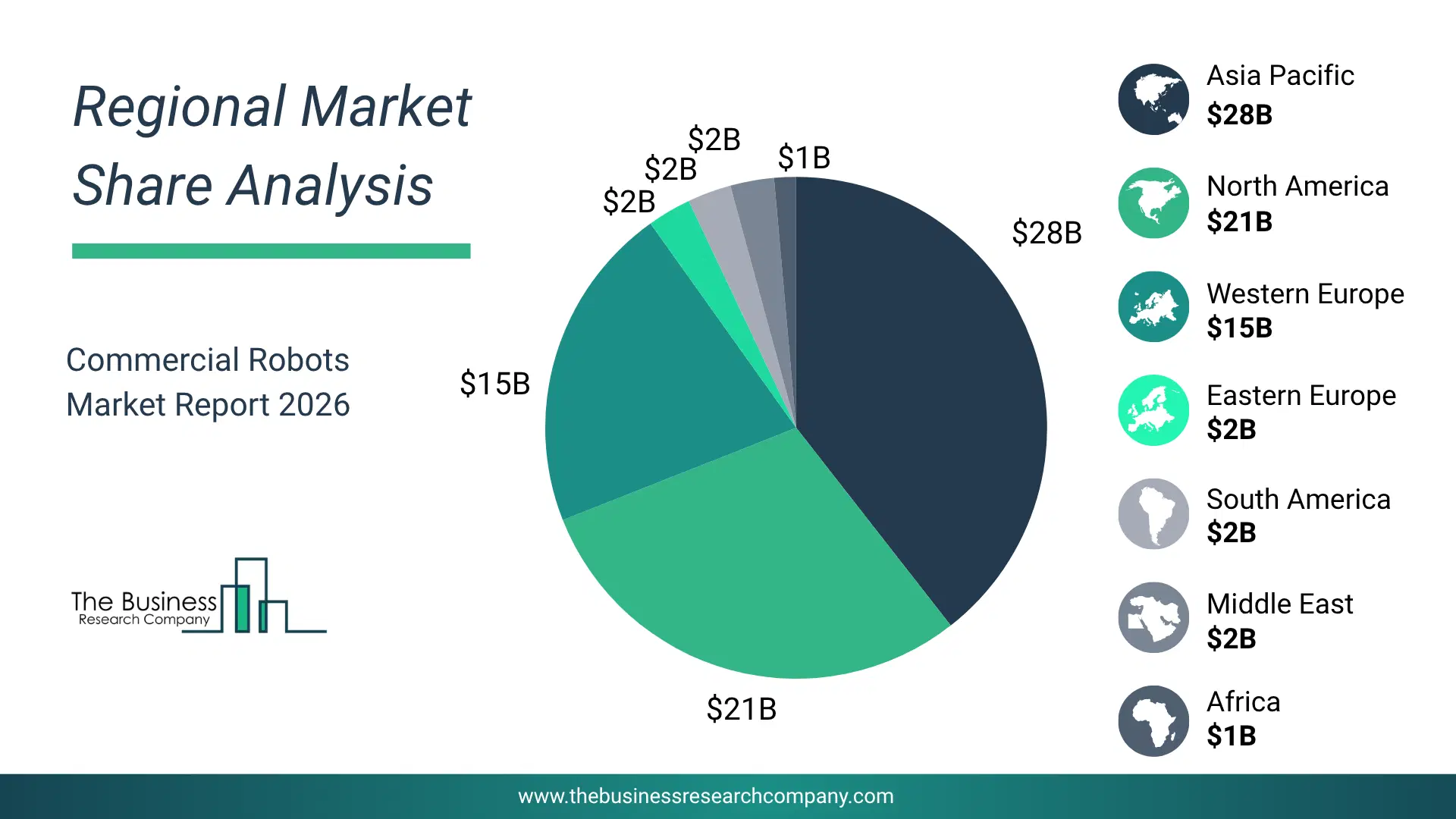
Regional Outlook
North America was the largest region in the commercial robots market in 2025. Asia-Pacific is expected to be the fastest-growing region in the forecast period. The regions covered in this market report are Asia-Pacific, South East Asia, Western Europe, Eastern Europe, North America, South America, Middle East, Africa The countries covered in this market report are Australia, Brazil, China, France, Germany, India, Indonesia, Japan, Taiwan, Russia, South Korea, UK, USA, Canada, Italy, Spain.What Defines the Commercial Robots Market?
The commercial robots consist of sales of service robots, logistics robots, and collaborative robots. Values in this market are ‘factory gate’ values, that is the value of goods sold by the manufacturers or creators of the goods, whether to other entities (including downstream manufacturers, wholesalers, distributors and retailers) or directly to end customers. The value of goods in this market includes related services sold by the creators of the goods.How is Market Value Defined and Measured?
The market value is defined as the revenues that enterprises gain from the sale of goods and/or services within the specified market and geography through sales, grants, or donations in terms of the currency (in USD unless otherwise specified). The revenues for a specified geography are consumption values that are revenues generated by organizations in the specified geography within the market, irrespective of where they are produced. It does not include revenues from resales along the supply chain, either further along the supply chain or as part of other products.
This chart presents market attractiveness based on a quantitative evaluation of growth, competition, strategic alignment, and risk, offering a clear view of opportunity areas for decision-making. This chart is for illustrative purposes; the full report contains the complete analysis.

This chart highlights the Total Addressable Market (TAM) by estimating the maximum revenue opportunity using an assumption-driven approach, supporting strategic planning and opportunity sizing across markets. The chart is illustrative; the full report provides a more comprehensive analysis.
What Key Data and Analysis Are Included in the Commercial Robots Market Report 2026?
The commercial robots market research report is one of a series of new reports from The Business Research Company that provides market statistics, including industry global market size, regional shares, competitors with the market share, detailed market segments, market trends and opportunities, and any further data you may need to thrive in the commercial robots industry. The market research report delivers a complete perspective of everything you need, with an in-depth analysis of the current and future state of the industry.Commercial Robots Market Report Forecast Analysis
| Report Attribute | Details |
|---|---|
| Market Size Value In 2026 | $35.42 billion |
| Revenue Forecast In 2030 | $67.95 billion |
| Growth Rate | CAGR of 17.7% from 2026 to 2030 |
| Base Year For Estimation | 2025 |
| Actual Estimates/Historical Data | 2020-2025 |
| Forecast Period | 2026 - 2030 |
| Market Representation | Revenue in USD Billion and CAGR from 2026 to 2030 |
| Segments Covered | Type, Level Of Autonomy, Application |
| Regional Scope | Asia-Pacific, Western Europe, Eastern Europe, North America, South America, Middle East, Africa |
| Country Scope | The countries covered in the report are Australia, Brazil, China, France, Germany, India, ... |
| Key Companies Profiled | Honda Motor Co. Ltd., Omron Corporation, Teradyne Inc. (Universal Robots), Techman Robot Inc., iRobot Corporation, SoftBank Robotics Group, UBTECH Robotics Corp. Ltd., Pudu Technology Inc., Fourier Intelligence, Boston Dynamics, Sarcos Technology and Robotics Corporation, inVia Robotics Inc., Agrobot, Keenon Robotics Co. Ltd., Universal Robots A/S, Robocath, Wingcopter, 3DR Inc., Vecow Co. Ltd., PickNik Inc. |
| Customization Scope | Request for Customization |
| Pricing And Purchase Options | Explore Purchase Options |