
Contact Us
  Search
The Business Research Company Logo
Commercial Space Station Global Market Opportunities And Strategies To 2035
Published :June 2026
Pages :326
Format :PDF
Delivery Time :2-3 Business Days
Why 2-3 days? We update the report with the latest data and news before delivery. Let us know if you need us to expedite.
Report Price :$4,490.00

Commercial Space Station Global Market Opportunities And Strategies To 2035

By Component (Structure, Life Support Systems, Power Systems, Communication Systems, Propulsion Systems, Other Components), By Orbit (Low Earth Orbit, Medium Earth Orbit, Other Orbits), By Application (Research And Development, Space Tourism, Manufacturing, Earth Observation, Other Applications), By End User (Government, Commercial, Defense, Other End-Users), And By Region, Opportunities And Strategies – Global Forecast To 2035

Commercial Space Station Market Definition

Commercial space stations refer to privately or commercially operated orbital platforms designed to host human activities in space, including research, manufacturing, tourism and other missions. These stations function as successors or complements to government-operated platforms such as the International Space Station, offering infrastructure and services to a broader set of customers. Commercial space stations are used by national space agencies, private aerospace companies, research institutions and even individual space tourists, typically in scenarios requiring microgravity environments, long-duration human habitation or orbital experimentation. They are used when scientific experiments, technology demonstrations, in-space production processes or human spaceflight missions require sustained presence in orbit. Complementary products and services include launch vehicles, crew and cargo transportation services, satellite systems, ground control infrastructure and training services, while substitutes may include suborbital flight platforms, robotic satellites or terrestrial simulation environments. The commercial space station market covered in this report includes revenues generated by entities (organizations, private companies and partnerships) through the provision of orbital infrastructure, habitation modules and associated services for conducting activities in space. The market includes income from leasing station capacity, hosting payloads, astronaut missions and providing auxiliary services such as logistics, training and mission management.
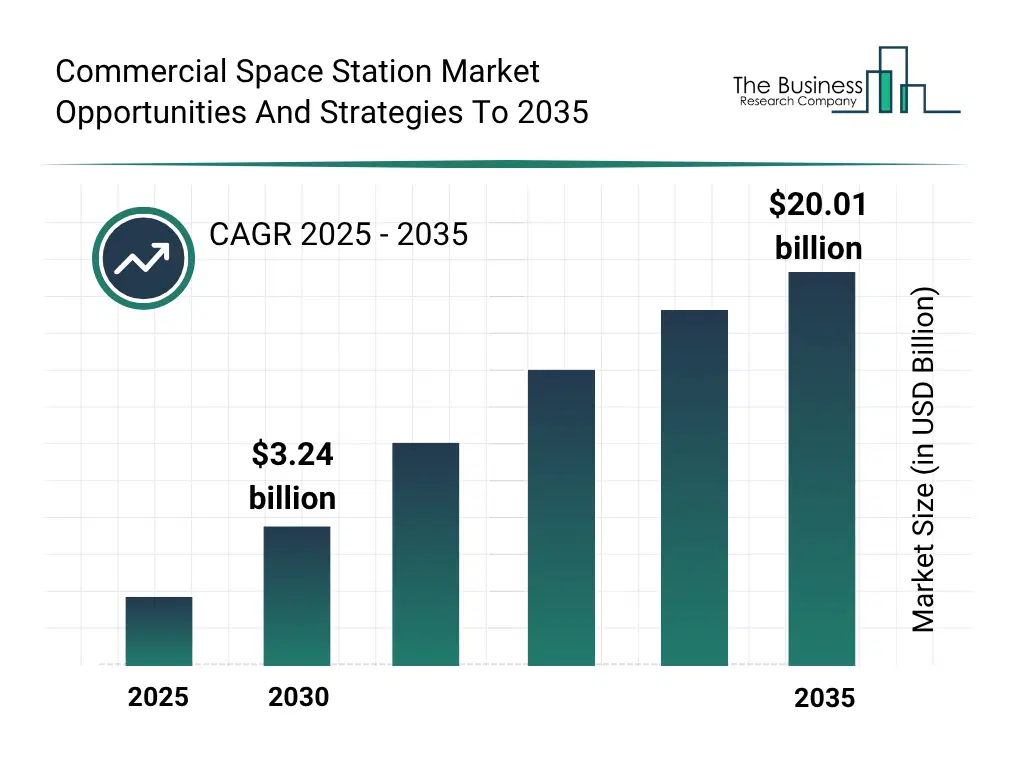
Commercial Space Station Global Market Opportunities And Strategies To 2035 Market Size and growth rate 2026 to 2030: Graph

Commercial Space Station Market Size

The global commercial space station market is expected to account to $3,240.0 million in 2030, and grow to $20,008.8 million in 2035 at a compound annual growth rate of 43.9%. Growth in the historic period resulted from increasing commercial space activities, rising interest in space tourism and hospitality, expansion of space infrastructure-as-a-service (IaaS) models and government–private partnerships in space programs. Factors that negatively affected growth in the historic period were high development and operational costs and complex system integration. Going forward, increasing private sector investment in space infrastructure, rising investments in deep space exploration missions, rapid growth of low earth orbit (LEO) satellite constellations and focus towards declining launch costs and reusable rocket technologies will drive the growth. Factors that could hinder the growth of the commercial space station market in the future include technological reliability and longevity, impact of geopolitical and trade dynamics and impact of trade wars and tariffs.
Research Expert

Book your 30 minutes free consultation with our research experts

Commercial Space Station Market Segmentation The commercial space station market is segmented by component, by orbit, by application and by end user.

By Component –
The commercial space station market is segmented by component into:
    • a) Structure
    • b) Life Support Systems
    • c) Power Systems
    • d) Communication Systems
    • e) Propulsion Systems
    • f) Other Components
The structure market is expected to account to $971.1 million in 2030, and grow to $5,892.1 million in 2035 at a compound annual growth rate of 43.4%.

By Orbit –
The commercial space station market is segmented by orbit into:
    • a) Low Earth Orbit
    • b) Medium Earth Orbit
    • c) Other Orbits
The low earth orbit market is expected to account to $3,240.0 million in 2030, and grow to $19,625.2 million in 2035 at a compound annual growth rate of 43.4%.

By Application –
The commercial space station market is segmented by application into:
  1. a) Research And Development
  2. b) Space Tourism
  3. c) Manufacturing
  4. d) Earth Observation
  5. e) Other Applications
The research and development market is expected to account to $1,408.6 million in 2030, and grow to $7,425.9 million in 2035 at a compound annual growth rate of 39.4%.

By End User –
The commercial space station market is segmented by end user into:
  1. a) a) Government
  2. b) b) Commercial
  3. c) c) Defense
  4. d) Other End-Users
The government market is expected to account to $1,385.5 million in 2030, and grow to $6,112.6 million in 2035 at a compound annual growth rate of 34.6%.

By Geography - The commercial space station market is segmented by geography into:
      o Asia Pacific
      • China
      • India
      • Japan
      • Australia
      • Taiwan
      • South Korea
      o South East Asia
      • Indonesia
      o North America
      • USA
      • Canada
      o South America
      • Brazil
      o Western Europe
      • France
      • Germany
      • UK
      • Italy
      • Spain
      o Eastern Europe
      • Russia
      o Middle East
      o Africa

Commercial Space Station Market Drivers

The key drivers of the commercial space station market include: Increasing Private Sector Investment In Space Infrastructure During the forecast period, the increasing private sector investment in space infrastructure is expected to propel expansion in the commercial space station market. Rising participation from private aerospace companies is accelerating the development of orbital platforms and supporting infrastructure. Increased capital inflow enables faster design, testing, and deployment of modular station components and habitation systems. These firms are also introducing innovative business models focused on leasing orbital space for research, manufacturing, and tourism. As private funding reduces reliance on government budgets, project timelines improve and scalability increases. This growing ecosystem directly boosts demand for new orbital stations and related services.

Commercial Space Station Market Restraints

The key restraints on the commercial space station market include: Technological Reliability And Longevity During the forecast period, technological reliability and longevity are restricting the growth of the commercial space station market. Ensuring long-term operational stability of orbital habitats requires highly reliable life-support, power, and structural systems that can function continuously in extreme space conditions. Any technical failure in critical systems such as oxygen generation, thermal control, or radiation protection can jeopardize crew safety and mission continuity. The need for frequent maintenance, redundancy systems, and component upgrades significantly increases complexity and cost. Additionally, limited opportunities for repair missions further elevate operational risks. These challenges slow deployment timelines and discourage large-scale adoption of orbital platforms.

Commercial Space Station Market Competitive Landscape

Major Competitors are:

  • Vast Space Inc.
  • Voyager Space Holdings Inc. (Starlab)
  • Axiom Space Inc.
  • Blue Origin LLC
  • Sierra Space Corporation
  • Other Competitors Include:

  • The Boeing Company
  • Airbus SE
  • Lockheed Martin Corporation
  • Northrop Grumman Corporation
  • L3Harris Technologies
  • Thales Alenia Space
  • Redwire Space Inc
  • European Space Agency (ESA)
  • Redwire Space Inc.
  • Max Space
  • Need data on a specific region in this market?

    Opportunities And Recommendations In The Commercial Space Station Market

    Opportunities – The top opportunities in the commercial space station markets segmented by type will arise in the portable fridge segment, which will gain $565.3 million of global annual sales by 2030. The top opportunities in the commercial space station markets segmented by power source will arise in the electric powered segment, which will gain $655.0 million of global annual sales by 2030. The top opportunities in the commercial space station markets segmented by distribution channel will arise in the online stores segment, which will gain $433.7 million of global annual sales by 2030. The top opportunities in the commercial space station markets segmented by application will arise in the passenger car segment, which will gain $644.2 million of global annual sales by 2030. The commercial space station market size will gain the most in the USA at $328.8 million. Recommendations- To take advantage of the opportunities, The Business Research Company recommends the commercial space station companies to focus on scalable in-orbit expansion to improve economics, focus on human-centric habitation to enhance mission value, focus on equity-based alliances to accelerate deployment, focus on equity-based alliances to accelerate deployment, focus on life support systems to enable scalable human operations, focus on low earth orbit to maximize access and demand, expand in emerging markets, continue to focus on developed markets, focus on diversified distribution partnerships and regional channels, focus on tiered and value-aligned pricing models, focus on institutional credibility and targeted expansion, focus on structured engagement across stakeholders, focus on commercial segment growth for scalable revenue expansion and focus on space tourism to capture high growth demand.
    Chat with us