

Commercial Walk-Behind Mowers Market Report 2026
Global Outlook – By Product Type (Gas-Powered, Battery-Powered), By Distribution Channel (Online Stores, Specialty Stores, Retail Stores), By Application (Commercial, Municipal), By End-User (Landscaping Services, Sports Facilities, Government And Municipalities, Other End-Users) – Market Size, Trends, Strategies, and Forecast to 2030
Commercial Walk-Behind Mowers Market Overview
• Commercial Walk-Behind Mowers market size has reached to $2.69 billion in 2025 • Expected to grow to $3.73 billion in 2030 at a compound annual growth rate (CAGR) of 6.7% • Growth Driver: The Growing Popularity Of Sports And Recreational Activities Drives The Growth Of The Market Due To Increasing Demand For Well-Maintained Outdoor Spaces • Market Trend: Advancing Sustainable Landscaping Through Electrified Equipment Solutions • North America was the largest region in 2025 and Asia-Pacific is the fastest growing region.What Is Covered Under Commercial Walk-Behind Mowers Market?
Commercial walk-behind mowers are heavy-duty lawn mowing machines designed for professional landscaping and grounds maintenance tasks. Operated by walking behind the unit, these mowers are built for durability, precision, and efficiency across large or uneven terrains. The main product types of commercial walk-behind mowers are gas-powered, electric-powered, and battery-powered. Gas-powered commercial walk-behind mowers use gasoline-fueled internal combustion engines to deliver strong cutting performance for large or tough mowing areas, though they require regular maintenance and produce emissions. These mowers are used across various applications, such as residential, commercial, and municipal. They are distributed through multiple channels, online stores, specialty stores, and retail stores, and serve a wide range of end users, such as landscaping services, sports facilities, government and municipalities, and others.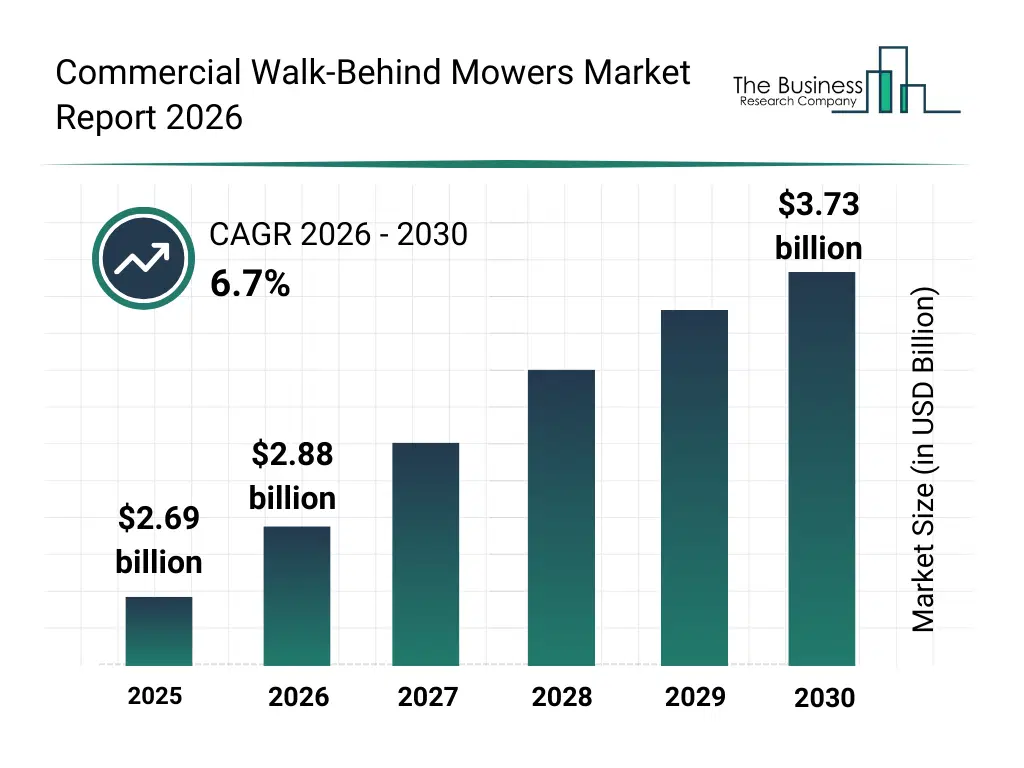
What Is The Commercial Walk-Behind Mowers Market Size and Share 2026?
The commercial walk-behind mowers market size has grown strongly in recent years. It will grow from $2.69 billion in 2025 to $2.88 billion in 2026 at a compound annual growth rate (CAGR) of 7.0%. The growth in the historic period can be attributed to urban landscaping demand, municipal green space development, commercial property maintenance needs, sports facility expansion, gasoline powered equipment adoption.What Is The Commercial Walk-Behind Mowers Market Growth Forecast?
The commercial walk-behind mowers market size is expected to see strong growth in the next few years. It will grow to $3.73 billion in 2030 at a compound annual growth rate (CAGR) of 6.7%. The growth in the forecast period can be attributed to electrification of landscaping equipment, sustainability regulations, smart lawn equipment adoption, growth of commercial real estate, declining battery costs. Major trends in the forecast period include shift toward battery powered mowers, demand for low emission landscaping equipment, growth of professional landscaping services, improved ergonomic and safety features, expansion of smart maintenance technologies.Tariff Impact On Commercial Walk-Behind Mowers Market
Tariffs have affected the commercial walk behind mowers market by increasing costs of imported engines, batteries, and electronic components. Battery powered and electric mowers are most impacted, particularly in asia pacific supply chains. Elevated prices have influenced purchasing decisions for landscaping firms. At the same time, tariffs are driving local assembly and product innovation.
Global Commercial Walk-Behind Mowers Market Segmentation
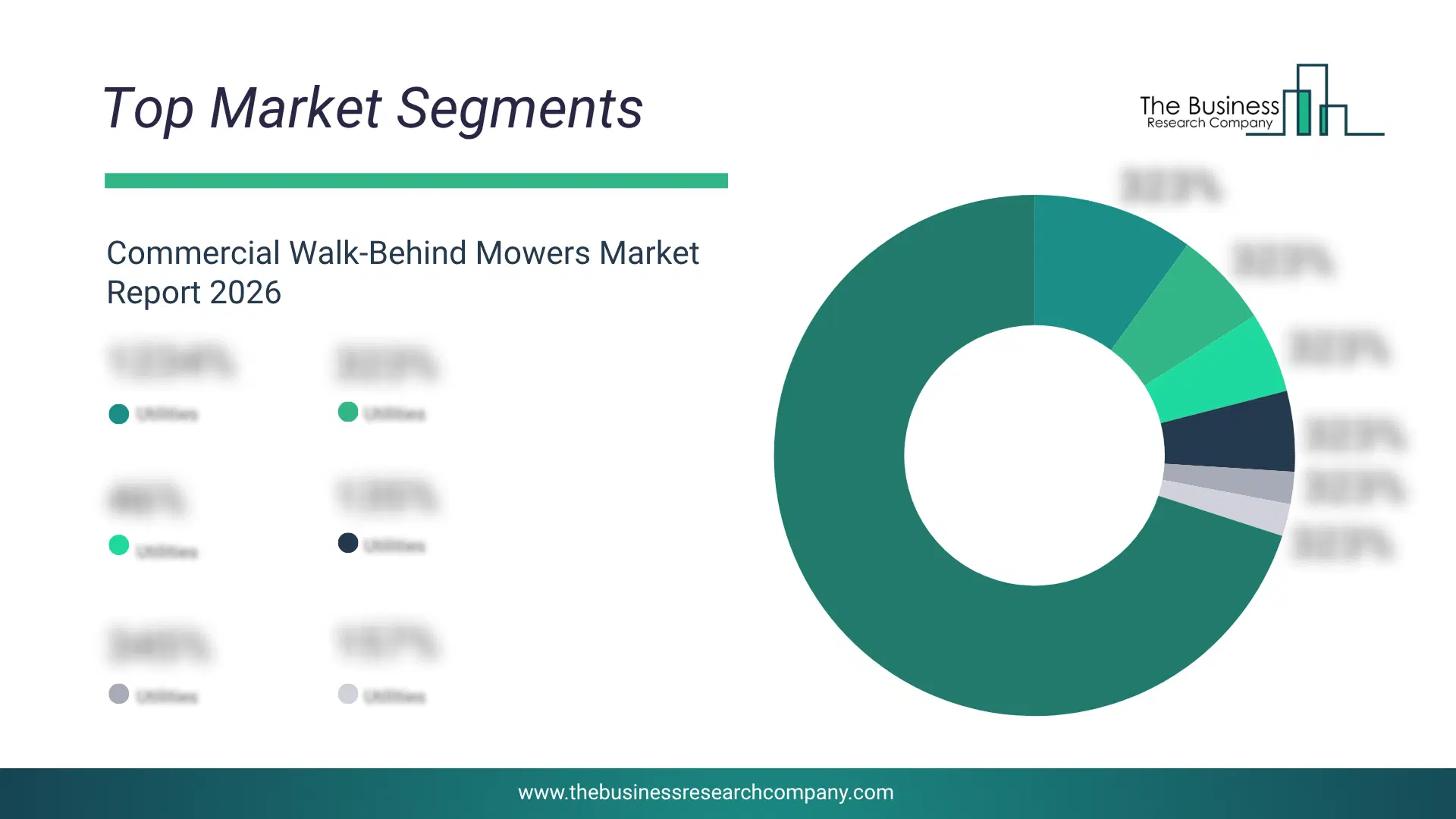
1) By Product Type: Gas-Powered, Battery-Powered 2) By Distribution Channel: Online Stores, Specialty Stores, Retail Stores 3) By Application: Commercial, Municipal 4) By End-User: Landscaping Services, Sports Facilities, Government And Municipalities, Other End-Users Subsegments: 1) By Gas-Powered: Single-Speed Gas Mowers, Variable-Speed Gas Mowers, Self-Propelled Gas Mowers 2) By Battery-Powered: Lithium-Ion Battery Mowers, Push-Type Battery MowersWhat Are The Drivers Of The Commercial Walk-Behind Mowers Market?
The growing popularity of sports and recreational activities is expected to propel the growth of the commercial walk-behind mower market going forward. Sports and recreational activities refer to physical or leisure pursuits that people engage in for enjoyment, relaxation, fitness, or competition, such as playing games, exercising, or participating in organized sports. The growing popularity of sports and recreational activities is primarily due to increasing health awareness, as more people recognize the importance of physical fitness, mental well-being, and an active lifestyle in preventing chronic diseases. Commercial walk-behind mowers support sports and recreational activities by ensuring well-maintained, safe, and aesthetically pleasing outdoor spaces such as parks, sports fields, and recreational grounds. For instance, in February 2025, according to the Sports and Fitness Industry Association, a US-based non-profit organization, in 2024, pickleball attracted 19.8 million participants in the United States, marking a 45.8% rise compared to 2023 and a staggering 311% growth over the past three years. Therefore, the growing popularity of sports and recreational activities is driving the growth of the commercial walk-behind mower industry. The expansion of green spaces in urban areas is expected to propel the growth of the commercial walk-behind mower market going forward. Green spaces in urban areas refer to natural or landscaped areas such as parks, gardens, green roofs, and tree-lined streets that provide environmental, recreational, and health benefits within cities. The expansion of green spaces in urban areas is primarily due to increasing awareness of environmental sustainability, public health benefits, and the need to combat urban pollution and climate change. Commercial walk-behind mowers support green spaces in urban areas by enabling efficient maintenance of lawns and parks, thereby enhancing the overall environmental quality and aesthetic appeal of cities. For instance, in 2025, according to the American Society of Civil Engineers, a US-based professional society, in 2022, the 100 largest U.S. cities allocated $9.7 billion to their parks, and by 2023, that investment rose to $11.2 billion, adjusted for inflation. Therefore, the expansion of green spaces in urban areas is driving the growth of the commercial walk-behind mower industry.Key Players In The Global Commercial Walk-Behind Mowers Market
Major companies operating in the commercial walk-behind mowers market are The Toro Company, Exmark Manufacturing Company Inc., John Deere, Honda Motor Co., Ltd., Ariens Company, Scag Power Equipment, Wright Manufacturing Inc., Ferris, Cub Cadet Commercial, Snapper Pro, Hustler Turf Equipment, Grasshopper Mowers, Greenworks Commercial, Bad Boy Mowers, Billy Goat Industries, Swisher Inc., ECHO Incorporated, Walker Manufacturing Company, Masport Limited, Weibang Machinery Co., Ltd., AL-KO Gardentech Group, Robomow Commercial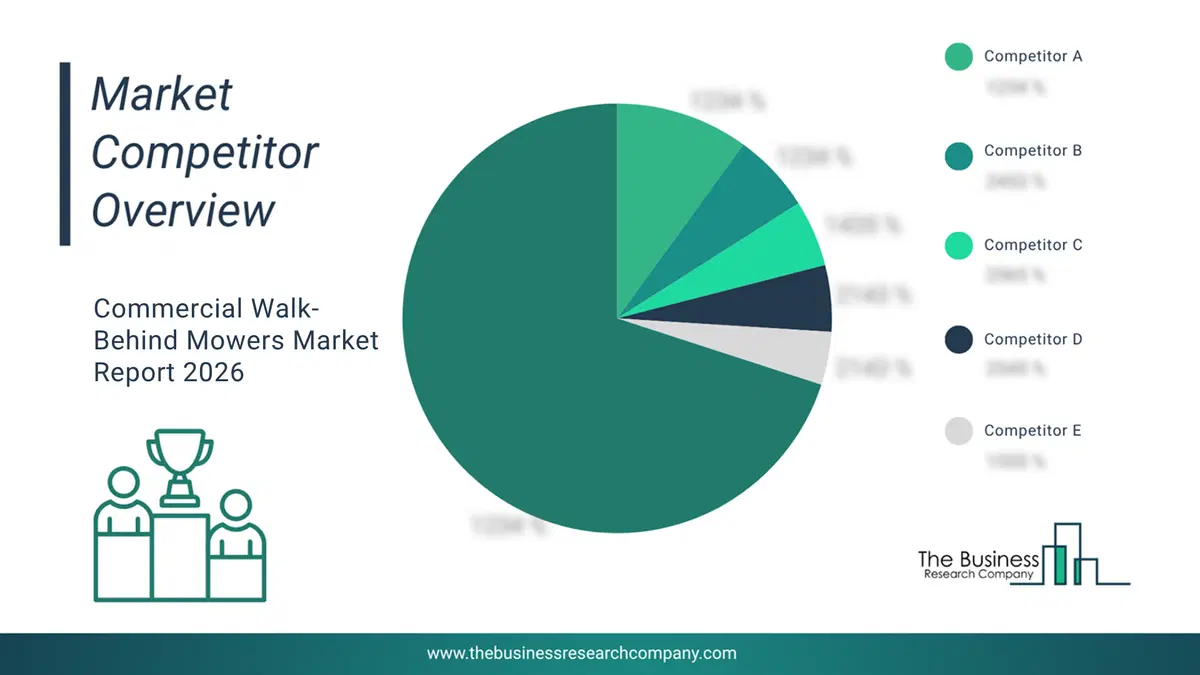
This chart is for illustrative purposes; the full report includes a detailed competitor analysis and comprehensive overview of the top 10 companies in the market.
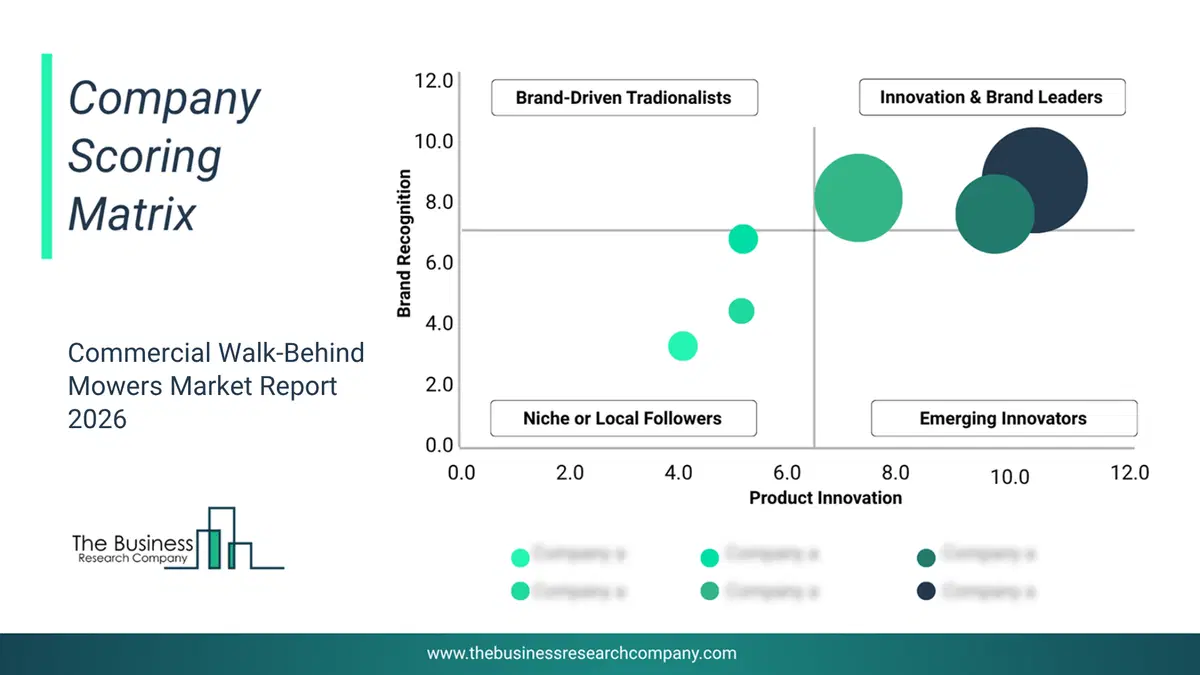
This chart maps companies by product innovation and brand strength, with bubble size indicating relative revenue, helping identify market leaders, challengers, and niche players. This is an illustrative chart; the full report provides a complete and accurate competitive analysis.
Global Commercial Walk-Behind Mowers Market Trends and Insights
Major companies operating in the commercial walk-behind mowers market are focusing on incorporating electrification such as battery-powered electric motor systems to enhance efficiency, lower emissions, and reduce maintenance requirements. Battery-powered electric motor systems use rechargeable lithium-ion batteries to power brushless motors that replace traditional gasoline engines, enabling capabilities such as quiet operation, zero-emissions mowing, and longer and more consistent torque delivery. For instance, in October 2024, Honda Motor Co. Ltd., a Japan-based outdoor power equipment manufacturer, introduced its HRX, HRN, and HRC battery-powered walk-behind lawn mowers, a new electric motor system designed to deliver professional-level cutting performance and user convenience, featuring a microcut twin-blade system for precise mulching and bagging, self-propelled variable-speed drive for improved maneuverability, and dual-battery options for extended runtime. The new series improves operational efficiency, reduces noise and environmental impact, and ensures high-quality cutting results with simplified maintenance.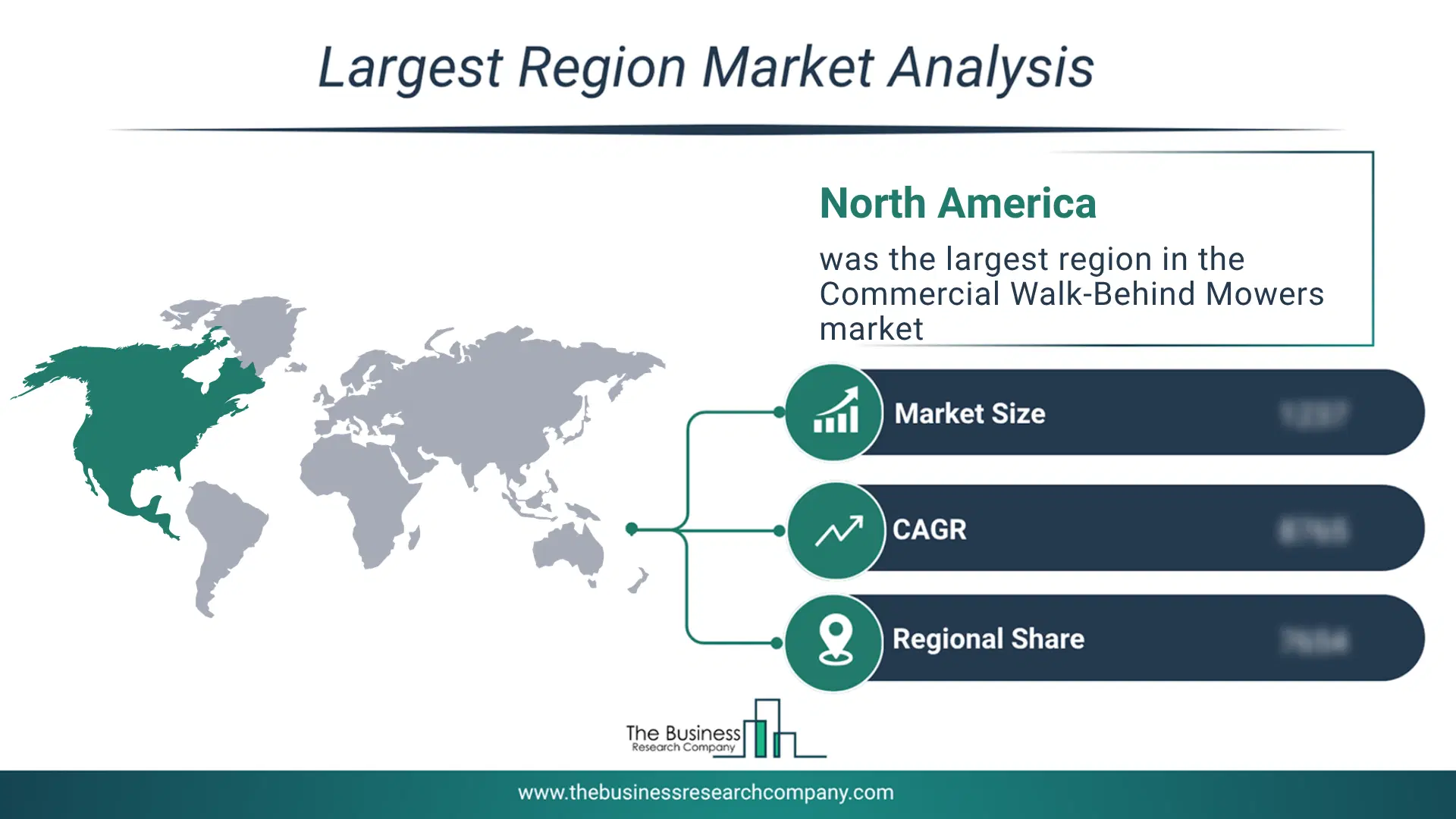
Regional Outlook
North America was the largest region in the commercial walk-behind mowers market in 2025. Asia-Pacific is expected to be the fastest-growing region in the forecast period. The regions covered in this market report are Asia-Pacific, South East Asia, Western Europe, Eastern Europe, North America, South America, Middle East, Africa The countries covered in this market report are Australia, Brazil, China, France, Germany, India, Indonesia, Japan, Taiwan, Russia, South Korea, UK, USA, Canada, Italy, Spain.What Defines the Commercial Walk-Behind Mowers Market?
The commercial walk-behind mowers market consists of sales of hydrostatic walk-behind mowers, gear-driven walk-behind mowers, wide-area walk-behind mowers, floating deck walk-behind mowers, and high-vacuum walk-behind mowers. Values in this market are ‘factory gate’ values, that is, the value of goods sold by the manufacturers or creators of the goods, whether to other entities (including downstream manufacturers, wholesalers, distributors, and retailers) or directly to end customers. The value of goods in this market includes related services sold by the creators of the goods.How is Market Value Defined and Measured?
The market value is defined as the revenues that enterprises gain from the sale of goods and/or services within the specified market and geography through sales, grants, or donations in terms of the currency (in USD unless otherwise specified). The revenues for a specified geography are consumption values that are revenues generated by organizations in the specified geography within the market, irrespective of where they are produced. It does not include revenues from resales along the supply chain, either further along the supply chain or as part of other products.
This chart presents market attractiveness based on a quantitative evaluation of growth, competition, strategic alignment, and risk, offering a clear view of opportunity areas for decision-making. This chart is for illustrative purposes; the full report contains the complete analysis.

This chart highlights the Total Addressable Market (TAM) by estimating the maximum revenue opportunity using an assumption-driven approach, supporting strategic planning and opportunity sizing across markets. The chart is illustrative; the full report provides a more comprehensive analysis.
What Key Data and Analysis Are Included in the Commercial Walk-Behind Mowers Market Report 2026?
The commercial walk-behind mowers market research report is one of a series of new reports from The Business Research Company that provides market statistics, including industry global market size, regional shares, competitors with the market share, detailed market segments, market trends and opportunities, and any further data you may need to thrive in the commercial walk-behind mowers industry. The market research report delivers a complete perspective of everything you need, with an in-depth analysis of the current and future state of the industry.Commercial Walk Behind Mowers Market Report Forecast Analysis
| Report Attribute | Details |
|---|---|
| Market Size Value In 2026 | $2.88 billion |
| Revenue Forecast In 2030 | $3.73 billion |
| Base Year For Estimation | 2025 |
| Actual Estimates/Historical Data | 2020-2025 |
| Forecast Period | 2026 - 2030 |
| Market Representation | Revenue in USD Billion and CAGR from 2026 to 2030 |
| Segments Covered | Product Type, Distribution Channel, Application, End-User |
| Regional Scope | Asia-Pacific, Western Europe, Eastern Europe, North America, South America, Middle East, Africa |
| Key Companies Profiled | The Toro Company, Exmark Manufacturing Company Inc., John Deere, Honda Motor Co., Ltd., Ariens Company, Scag Power Equipment, Wright Manufacturing Inc., Ferris, Cub Cadet Commercial, Snapper Pro, Hustler Turf Equipment, Grasshopper Mowers, Greenworks Commercial, Bad Boy Mowers, Billy Goat Industries, Swisher Inc., ECHO Incorporated, Walker Manufacturing Company, Masport Limited, Weibang Machinery Co., Ltd., AL-KO Gardentech Group, Robomow Commercial |
| Customization Scope | Request for Customization |
| Pricing And Purchase Options | Explore Purchase Options |