

Commercial Wireless Detonator Market Report 2026
Global Outlook – By Detonator Type (Electric Detonators, Non-Electric Detonators, Smart Detonators, Conventional Detonators), By Technology (Wireless Firing Systems, Remote Control Systems, Bluetooth-Enabled Detonators, Cellular Communication Detonators), By End-User Industry (Mining Industry, Infrastructure Development, Oil And Gas Sector, Construction Industry, Public Works And Utility Services) – Market Size, Trends, Strategies, and Forecast to 2030
Commercial Wireless Detonator Market Overview
• Commercial Wireless Detonator market size has reached to $1.21 billion in 2025 • Expected to grow to $1.83 billion in 2030 at a compound annual growth rate (CAGR) of 8.7% • Growth Driver: Rising Mining Production Driving Growth Of The Market Due To Expanding Infrastructure And Raw Material Demand • Market Trend: Wireless Initiation Systems Accelerating Advanced Deployment • North America was the largest region in 2025 and Asia-Pacific is the fastest growing region.What Is Covered Under Commercial Wireless Detonator Market?
A commercial wireless detonator refers to a remotely controlled device used to safely initiate explosives without the need for physical wires connecting the detonator to the blasting control system. These detonators communicate wirelessly, enhancing safety, flexibility, and efficiency in commercial blasting operations such as mining, construction, and demolition. The main types of detonators in commercial wireless detonators are electric detonators, non-electric detonators, smart detonators, and conventional detonators. Electric detonators use an electrical current to ignite a small explosive charge that sets off a larger explosion. It includes various technologies, such as wireless firing systems, remote control systems, bluetooth-enabled detonators, and cellular communication detonators, and caters to a range of end users, including the mining industry, infrastructure development, oil and gas sector, construction industry, public works, and utility services.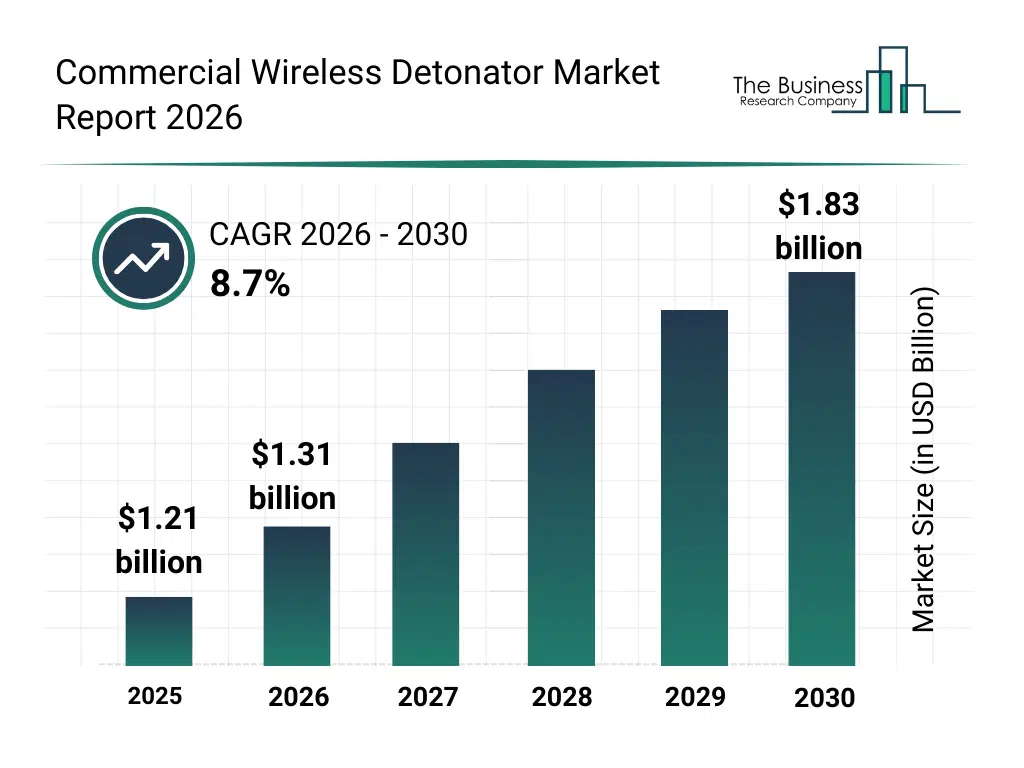
What Is The Commercial Wireless Detonator Market Size and Share 2026?
The commercial wireless detonator market size has grown strongly in recent years. It will grow from $1.21 billion in 2025 to $1.31 billion in 2026 at a compound annual growth rate (CAGR) of 8.3%. The growth in the historic period can be attributed to growing adoption of remote blasting practices, reliance on electronic detonation modules, increased use of wireless communication systems, expansion of commercial mining operations, rising need for controlled blasting solutions.What Is The Commercial Wireless Detonator Market Growth Forecast?
The commercial wireless detonator market size is expected to see strong growth in the next few years. It will grow to $1.83 billion in 2030 at a compound annual growth rate (CAGR) of 8.7%. The growth in the forecast period can be attributed to increasing demand for automated blasting workflows, expansion of smart mining initiatives, development of advanced encrypted detonator systems, rising use of cloud-based blast data platforms,. Major trends in the forecast period include integration of AI-based blast timing optimization, deployment of digitally connected detonation networks, expansion of secure wireless communication protocols, growth in cloud-driven blast data analytics, adoption of remote autonomous firing technologies.
Global Commercial Wireless Detonator Market Segmentation
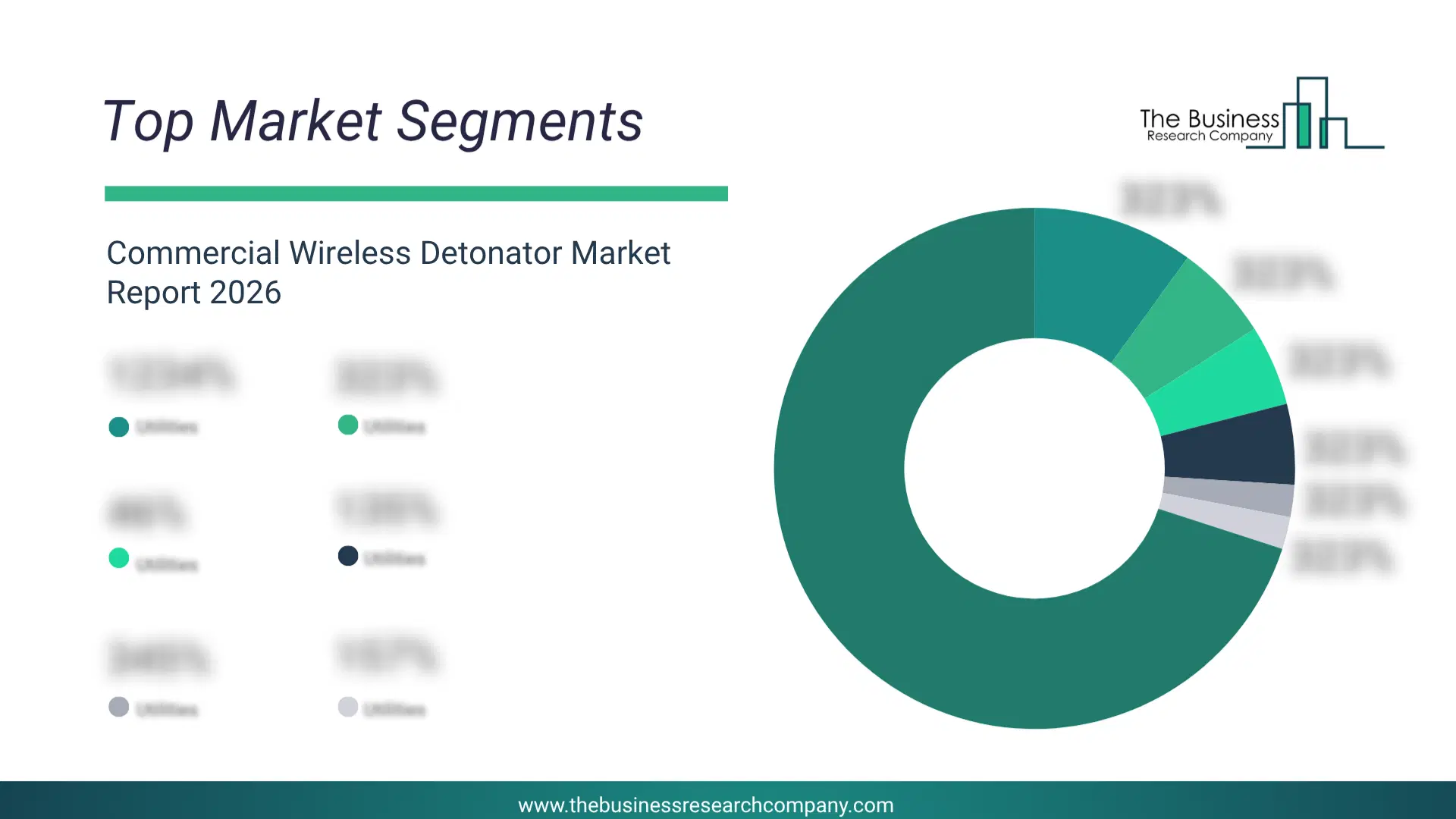
1) By Detonator Type: Electric Detonators, Non-Electric Detonators, Smart Detonators, Conventional Detonators 2) By Technology: Wireless Firing Systems, Remote Control Systems, Bluetooth-Enabled Detonators, Cellular Communication Detonators 3) By End-User Industry: Mining Industry, Infrastructure Development, Oil And Gas Sector, Construction Industry, Public Works And Utility Services Subsegments: 1) By Electric Detonators: Instantaneous Electric Detonators, Delay Electric Detonators, Electronic Electric Detonators, Bridge Wire Electric Detonators 2) By Non-Electric Detonators: Shock Tube Detonators, Surface Delay Connectors, In-Hole Delay Detonators, Nonel Trunkline Assemblies 3) By Smart Detonators: Programmable Delay Detonators, Wireless Digital Detonators, GPS-Integrated Detonators, Sensor-Based Detonators 4) By Conventional Detonators: Fuse Cap Detonators, Safety Fuse Assemblies, Time-Delay Fuse Detonators, Pyrotechnic Delay DetonatorsWhat Is The Driver Of The Commercial Wireless Detonator Market?
The increasing demand for mining production is expected to propel the growth of the commercial wireless detonator market going forward. Mining production refers to the extraction and processing of minerals, metals, and other geological materials from the earth to produce raw materials for industrial use. The demand for mining production is rising as rapid urbanization across emerging economies is fueling large-scale infrastructure projects, leading to a higher requirement for essential raw materials such as iron ore, copper, and coal used in construction, transportation, and energy generation. Commercial wireless detonators improve mining operations by enabling safe, remote-controlled blasting without physical wires, increasing efficiency and reducing risks for workers. For instance, in April 2025, according to the British Geological Survey, a UK-based government agency, lithium experienced the highest growth in 2023, with production rising by 30% compared to 2022, while cobalt production also saw a notable increase of nearly 23% during the same period. Therefore, the increasing demand for mining production is driving the growth of the commercial wireless detonator industry.Key Players In The Global Commercial Wireless Detonator Market
Major companies operating in the commercial wireless detonator market are Hanwha Corporation, Orica Limited, CEA-Leti, MaxamCorp Holding S.L., NOF Corporation, Austin Powder Company, Dyno Nobel Inc., Solar Industries India Limited, Enaex S.A., Hunan Nanling Industry Explosive Material Co. Ltd., Titanobel S.A.S., PT Trifita Perkasa, IDEAL Industrial Explosives Ltd., Nitroerg S.A., AECI Mining Services Limited, Davey Bickford Enaex, Omnia Holdings Limited, BME Mining Pty Ltd., IRT Nanoelec, EPC Groupe.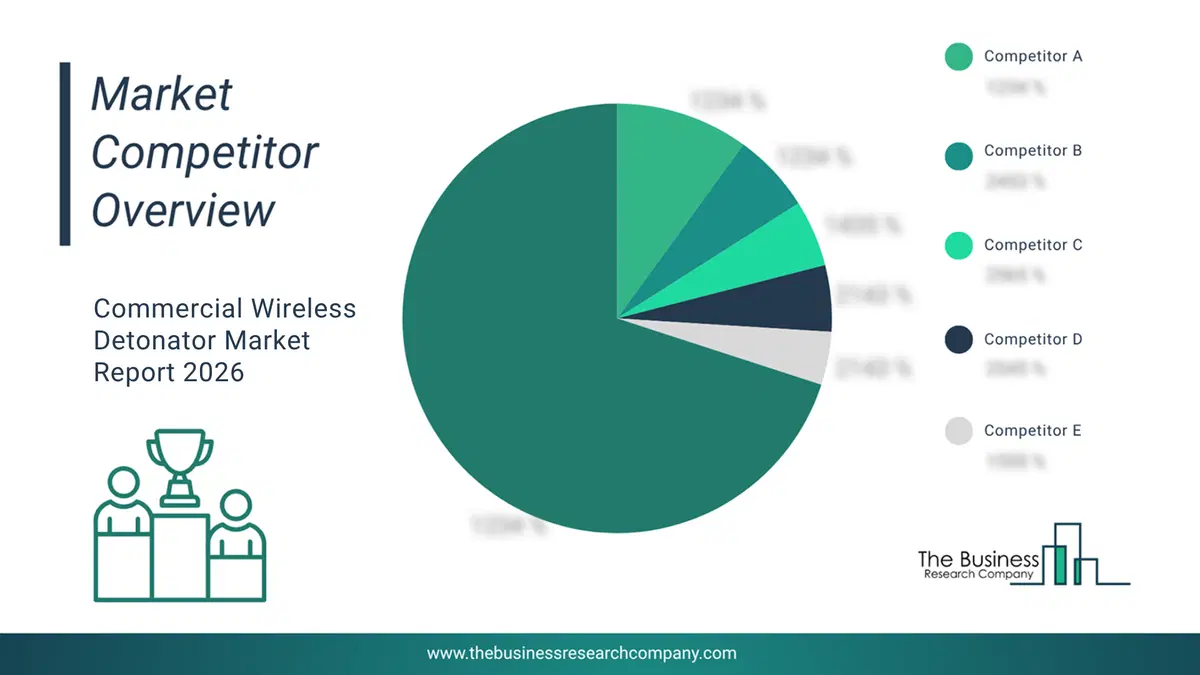
This chart is for illustrative purposes; the full report includes a detailed competitor analysis and comprehensive overview of the top 10 companies in the market.
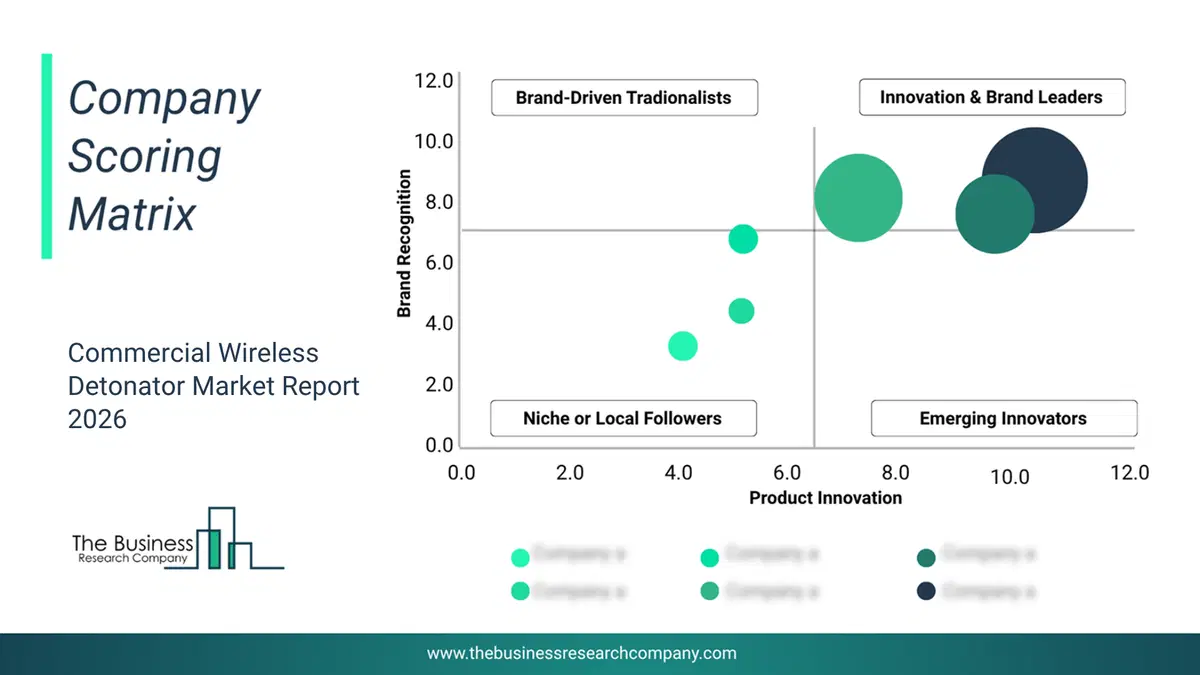
This chart maps companies by product innovation and brand strength, with bubble size indicating relative revenue, helping identify market leaders, challengers, and niche players. This is an illustrative chart; the full report provides a complete and accurate competitive analysis.
Global Commercial Wireless Detonator Market Trends and Insights
Major companies operating in the commercial wireless detonator market are focusing on developing innovative solutions, such as wireless initiation systems initiating modules that communicate via encrypted coded signals without physical detonation lines to trigger detonators remotely, to gain a competitive advantage. For instance, in March 2023, Orica Limited, an Australia-based mining solutions company, introduced the WebGen 200 Surface Wireless Initiating System with features including encoded Blast-ID programming, lithium battery power packs, and full elimination of physical wired connections to a blast pattern. This trend enhances safety by reducing personnel exposure around loaded holes, improves productivity by enabling simultaneous haul-road and blast operations, and supports operational flexibility even during lightning storms. On the downside, adoption of wireless initiation systems requires upfront investment in compatible equipment and training, and some mine sites may face regulatory or infrastructure integration challenges.What Are Latest Mergers And Acquisitions In The Commercial Wireless Detonator Market?
In September 2024, FORCIT Group, a Finland-based provider of civil explosives, blasting solutions, and related safety services, acquired a portion of Orica Limited’s business operations in Finland and Sweden for an undisclosed amount. With this acquisition, FORCIT aims to strengthen its regional presence in the Nordic market, enhance its service capabilities, and expand access to Orica’s advanced wireless detonator and blasting technologies. Orica Limited is an Australia-based provider of commercial explosives, blasting systems, and digital blasting solutions for mining, quarrying, and infrastructure sectors worldwide.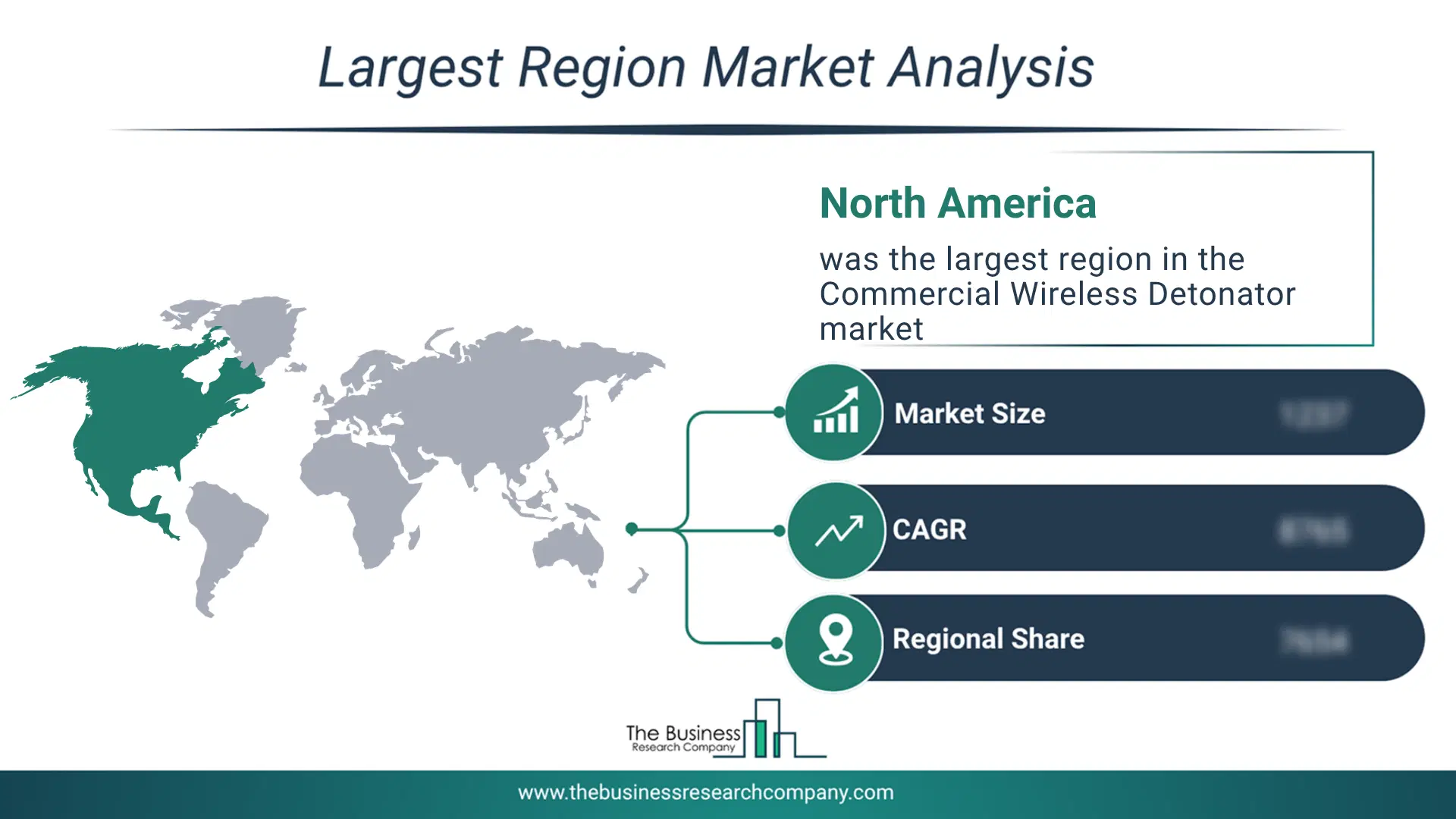
Regional Insights
North America was the largest region in the commercial wireless detonator market in 2025. Asia-Pacific is expected to be the fastest-growing region in the forecast period. The regions covered in this market report are Asia-Pacific, South East Asia, Western Europe, Eastern Europe, North America, South America, Middle East, Africa. The countries covered in this market report are Australia, Brazil, China, France, Germany, India, Indonesia, Japan, Taiwan, Russia, South Korea, UK, USA, Canada, Italy, Spain.What Defines the Commercial Wireless Detonator Market?
The commercial wireless detonator market consists of revenues earned by entities by providing services such as digital blast design support, wireless synchronization consulting, safety auditing for remote blasting, training for electronic blast control, and post-detonation data analysis. The market value includes the value of related goods sold by the service provider or included within the service offering. The commercial wireless detonator market also includes sales of programmable timing modules, encrypted control units, handheld blasting transmitters, long-range initiation systems, compact receiver units, and multi-channel detonation controllers. Values in this market are ‘factory gate’ values, that is, the value of goods sold by the manufacturers or creators of the goods, whether to other entities (including downstream manufacturers, wholesalers, distributors, and retailers) or directly to end customers. The value of goods in this market includes related services sold by the creators of the goods.How is Market Value Defined and Measured?
The market value is defined as the revenues that enterprises gain from the sale of goods and/or services within the specified market and geography through sales, grants, or donations in terms of the currency (in USD unless otherwise specified). The revenues for a specified geography are consumption values that are revenues generated by organizations in the specified geography within the market, irrespective of where they are produced. It does not include revenues from resales along the supply chain, either further along the supply chain or as part of other products.
This chart presents market attractiveness based on a quantitative evaluation of growth, competition, strategic alignment, and risk, offering a clear view of opportunity areas for decision-making. This chart is for illustrative purposes; the full report contains the complete analysis.

This chart highlights the Total Addressable Market (TAM) by estimating the maximum revenue opportunity using an assumption-driven approach, supporting strategic planning and opportunity sizing across markets. The chart is illustrative; the full report provides a more comprehensive analysis.
What Key Data and Analysis Are Included in theCommercial Wireless Detonator Market Report 2026?
The commercial wireless detonator market research report is one of a series of new reports from The Business Research Company that provides market statistics, including industry global market size, regional shares, competitors with the market share, detailed market segments, market trends and opportunities, and any further data you may need to thrive in the commercial wireless detonator industry. The market research report delivers a complete perspective of everything you need, with an in-depth analysis of the current and future state of the industry.Commercial Wireless Detonator Market Report Forecast Analysis
| Report Attribute | Details |
|---|---|
| Market Size Value In 2026 | $1.31 billion |
| Revenue Forecast In 2030 | $1.83 billion |
| Growth Rate | CAGR of 8.3% from 2026 to 2030 |
| Base Year For Estimation | 2025 |
| Actual Estimates/Historical Data | 2020-2025 |
| Forecast Period | 2026 - 2030 |
| Market Representation | Revenue in USD Billion and CAGR from 2026 to 2030 |
| Segments Covered | Detonator Type, Technology, End-User Industry |
| Regional Scope | Asia-Pacific, Western Europe, Eastern Europe, North America, South America, Middle East, Africa |
| Country Scope | The countries covered in this market report are Australia, Brazil, China, France, Germany, India, Indonesia, Japan, Taiwan, Russia, South Korea, UK, USA, Canada, Italy, Spain |
| Key Companies Profiled | Hanwha Corporation, Orica Limited, CEA-Leti, MaxamCorp Holding S.L., NOF Corporation, Austin Powder Company, Dyno Nobel Inc., Solar Industries India Limited, Enaex S.A., Hunan Nanling Industry Explosive Material Co. Ltd., Titanobel S.A.S., PT Trifita Perkasa, IDEAL Industrial Explosives Ltd., Nitroerg S.A., AECI Mining Services Limited, Davey Bickford Enaex, Omnia Holdings Limited, BME Mining Pty Ltd., IRT Nanoelec, EPC Groupe. |
| Customization Scope | Request for Customization |
| Pricing And Purchase Options | Explore Purchase Options |