
Commodity Trade Finance Market Report 2026
Global Outlook – By Product Type (Letters Of Credit, Guarantees, Documentary Collection, Supply Chain Finance, Structured Trade Finance), By Provider (Banks, Trade Finance Houses, Non-Banking Institutions, Financial Technology Platforms, Other Providers), By Trade Type (Domestic Commodity Trade, International Commodity Trade), By Risk Management Solution (Commodity Price Hedging, Foreign Exchange Risk Management, Credit Insurance and Guarantees, Counterparty Risk Mitigation, Political Risk Insurance, Transport and Cargo Insurance), By End-User (Commodity Producers and Miners, Commodity Trading Houses, Agricultural Cooperatives, Food and Beverage Processors, Metal and Mineral Refiners, Energy Companies and Utilities, Manufacturing and Industrial Users, Importers and Exporters) – Market Size, Trends, Strategies, and Forecast to 2030
Commodity Trade Finance Market Overview
• Commodity Trade Finance market size has reached to $55.36 billion in 2025 • Expected to grow to $81.45 billion in 2030 at a compound annual growth rate (CAGR) of 8.1% • Growth Driver: Growth In International Trade Volumes Driving The Market Growth Due To Increasing Cross-Border Transactions And Duty Compliance • Market Trend: Non-Bank Capital Providers Strengthen Commodity Credit Access Through Structured Financing Solutions • North America was the largest region in 2025 and Asia-Pacific is the fastest growing region.What Is Covered Under Commodity Trade Finance Market?
Commodity trade finance refers to the financing solutions used to support the buying, selling, and trading of physical commodities such as oil, metals, and agricultural products. It provides short-term credit and risk mitigation tools to facilitate smooth transactions between producers, traders, and buyers across global supply chains. The main product types of commodity trade finance include letters of credit, guarantees, documentary collection, supply chain finance, and structured trade finance. Letters of credit refer to bank-issued guarantees that ensure payment to sellers in commodity trade finance transactions. These solutions are provided by banks, trade finance houses, non-banking institutions, financial technology platforms, and others, and support both domestic and international commodity trade. They incorporate various risk management solutions, including commodity price hedging, foreign exchange risk management, credit insurance and guarantees, counterparty risk mitigation, political risk insurance, and transport and cargo insurance. The key end users include commodity producers and miners, commodity trading houses, agricultural cooperatives, food and beverage processors, metal and mineral refiners, energy companies and utilities, manufacturing and industrial users, and importers and exporters.
What Is The Commodity Trade Finance Market Size and Share 2026?
The commodity trade finance market size has grown strongly in recent years. It will grow from $55.36 billion in 2025 to $59.7 billion in 2026 at a compound annual growth rate (CAGR) of 7.8%. The growth in the historic period can be attributed to increasing globalization of commodity trade, rising demand for letters of credit in international trade, growth of banking sector participation in trade finance, expansion of agricultural and energy commodity markets, increasing reliance on traditional documentary trade finance instruments.What Is The Commodity Trade Finance Market Growth Forecast?
The commodity trade finance market size is expected to see strong growth in the next few years. It will grow to $81.45 billion by 2030 at a compound annual growth rate (CAGR) of 8.1%. The growth in the forecast period can be attributed to growing digitization of trade finance processes, increasing adoption of blockchain-based trade settlement systems, rising demand for real-time risk monitoring in commodity trading, expansion of fintech-enabled lending platforms, increasing cross-border commodity trade volumes. Major trends in the forecast period include increasing adoption of supply chain finance platforms for commodity trading, rising use of structured trade finance for cross-border transactions, growing demand for risk mitigation instruments in volatile commodity markets, expansion of fintech-based trade financing solutions for smes and traders, rising integration of automated credit assessment in trade finance processes.
Global Commodity Trade Finance Market Segmentation
1) By Product Type: Letters Of Credit, Guarantees, Documentary Collection, Supply Chain Finance, Structured Trade Finance 2) By Provider: Banks, Trade Finance Houses, Non-Banking Institutions, Financial Technology Platforms, Other Providers 3) By Trade Type: Domestic Commodity Trade, International Commodity Trade 4) By Risk Management Solution: Commodity Price Hedging, Foreign Exchange Risk Management, Credit Insurance and Guarantees, Counterparty Risk Mitigation, Political Risk Insurance, Transport and Cargo Insurance 5) By End-User: Commodity Producers and Miners, Commodity Trading Houses, Agricultural Cooperatives, Food and Beverage Processors, Metal and Mineral Refiners, Energy Companies and Utilities, Manufacturing and Industrial Users, Importers and Exporters Subsegments: 1) By Letters Of Credit: Sight Letters Of Credit, Deferred Payment Letters Of Credit, Revolving Letters Of Credit, Standby Letters Of Credit, Transferable Letters Of Credit 2) By Guarantees: Performance Guarantees, Financial Guarantees, Bid Bond Guarantees, Advance Payment Guarantees, Customs And Tax Guarantees 3) By Documentary Collection: Sight Documentary Collections, Usance Documentary Collections, Clean Collections, Document Against Payment Collections, Document Against Acceptance Collections 4) By Supply Chain Finance: Invoice Discounting, Factoring Solutions, Reverse Factoring, Payables Finance, Dynamic Discounting 5) By Structured Trade Finance: Pre Export Finance, Post Shipment Finance, Commodity Finance, Syndicated Trade Finance, Project Linked Trade FinanceWhat Is The Driver Of The Commodity Trade Finance Market?
The growth in international trade volumes is expected to propel the growth of the commodity trade finance market going forward. International trade volumes refer to the total quantity and value of goods and services that are bought and sold across countries in a given period. International trade volumes are rising due to increasing global economic integration and improvements in logistics and trade policies, which make cross-border transactions faster, easier, and more efficient. International trade volumes, by increasing the flow and frequency of cross-border transactions, directly expand the demand for commodity trade finance as more working capital is required to support larger, faster, and more complex global supply chains. For instance, in December 2024, according to UN Trade and Development, a Switzerland-based intergovernmental organization, global trade reached a record nearly $33 trillion, surging $1 trillion from the previous year. Therefore, the growth in international trade volumes is driving the growth of the commodity trade finance industry.Key Players In The Global Commodity Trade Finance Market
Major companies operating in the commodity trade finance market are Industrial and Commercial Bank of China, JPMorgan Chase And Co., HSBC Holdings plc, Banco Santander S.A., Wells Fargo And Company, China Construction Bank Corporation, Agricultural Bank of China Limited, UBS Group AG, Citigroup Inc., The Toronto-Dominion Bank, BNP Paribas, ING Group N.V., UniCredit S.p.A., Sumitomo Mitsui Banking Corporation, Mitsubishi UFJ Financial Group Inc., Royal Bank of Canada, Deutsche Bank AG, Crédit Agricole S.A. Group, Société Générale S.A., Intesa Sanpaolo S.p.A., Commerzbank AG, First Abu Dhabi Bank PJSC, Coöperatieve Rabobank U.A., Standard Chartered PLC, Standard Bank Group Limited, ABN AMRO Bank N.V., Natixis S.A., Macquarie Group Limited.
This chart is for illustrative purposes; the full report includes a detailed competitor analysis and comprehensive overview of the top 10 companies in the market.
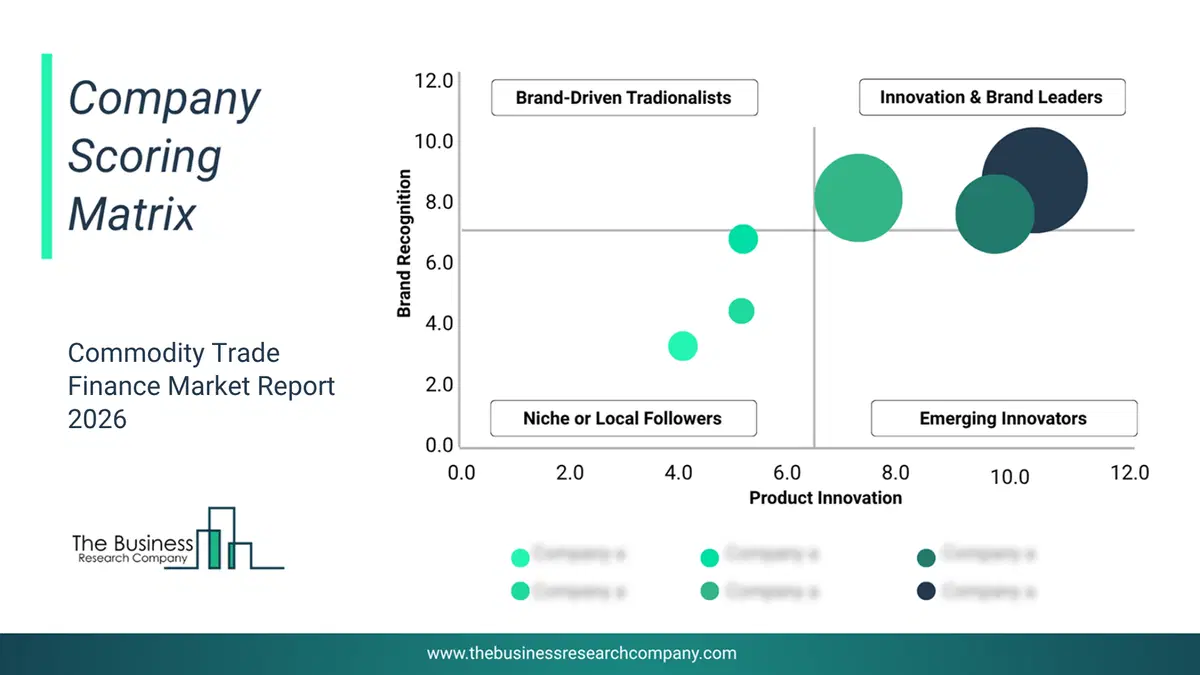
This chart maps companies by product innovation and brand strength, with bubble size indicating relative revenue, helping identify market leaders, challengers, and niche players. This is an illustrative chart; the full report provides a complete and accurate competitive analysis.
Global Commodity Trade Finance Market Trends and Insights
Major companies operating in the commodity trade finance market are focusing on developing innovative solutions, such as commodities-focused investment funds, to expand non-bank lending capacity, bridge trade finance funding gaps, and enhance access to structured commodity credit. A commodities-focused investment fund is a fund that pools capital to invest in commodity-related assets such as physical commodities, commodity-linked loans, and trade finance or structured credit tied to sectors like energy, metals, and agriculture. For instance, in February 2025, Gemcorp Capital Management Limited, a UK-based investment and trade finance firm, launched the Gemcorp Commodities Alternative Products Fund to provide investors with exposure to commodity-linked credit and structured trade finance assets. The fund focuses on financing sectors such as energy, metals, agriculture, and critical minerals through short-term lending and structured credit instruments. It aims to address the funding gap left by traditional banks by supporting commodity producers and traders with flexible financing solutions. This initiative reflects the growing trend of alternative asset managers entering the commodity trade finance market to enhance liquidity and expand non-bank lending capacity.What Are Latest Mergers And Acquisitions In The Commodity Trade Finance Market?
In September 2025, MineHub Technologies Inc., a Canada-based digital supply chain company, partnered with Surecomp to deliver an integrated post-trade and trade finance solution for global commodity markets. This partnership aims to bridge the gap between commodity trade execution and financing by combining MineHub’s real-time trade and logistics data capabilities with Surecomp’s digital trade finance processing and workflow automation solutions, enabling a seamless contract-to-cash digital ecosystem. Surecomp Business Solutions Ltd. is an Israel-based financial technology company specializing in providing trade finance solutions that explicitly include commodity trade finance.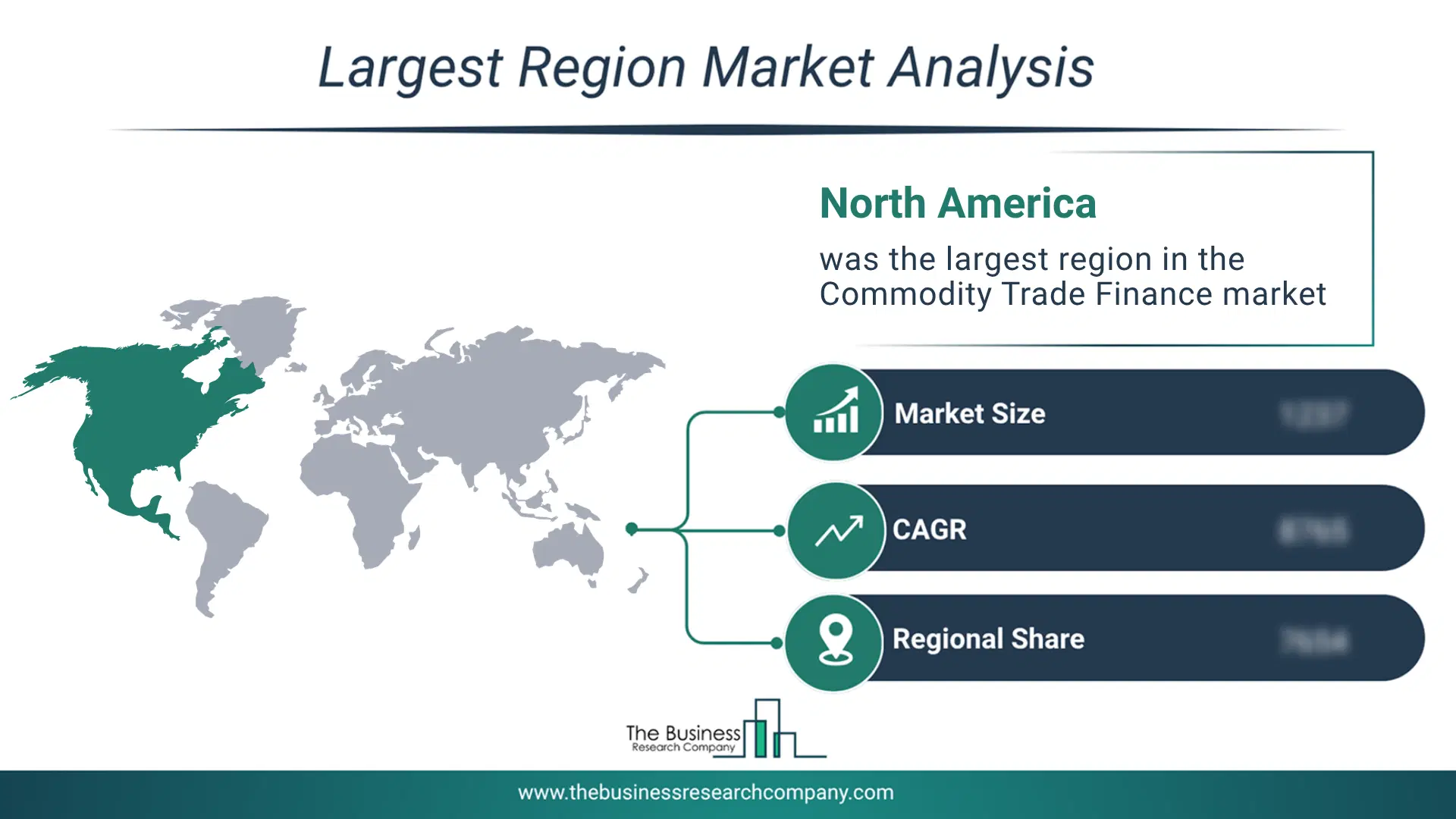
Regional Insights
North America was the largest region in the commodity trade finance market in 2025. Asia-Pacific is expected to be the fastest-growing region in the forecast period. The regions covered in this market report are Asia-Pacific, South East Asia, Western Europe, Eastern Europe, North America, South America, Middle East, Africa. The countries covered in this market report are Australia, Brazil, China, France, Germany, India, Indonesia, Japan, Taiwan, Russia, South Korea, UK, USA, Canada, Italy, Spain.What Defines the Commodity Trade Finance Market?
The commodity trade finance market includes revenues earned by entities through short-term trade financing fees, letters of credit (lc) charges, discounting and factoring services, risk mitigation and insurance services, and commodity-backed lending interest. The market value includes the value of related goods sold by the service provider or included within the service offering. Only goods and services traded between entities or sold to end consumers are included.How is Market Value Defined and Measured?
The market value is defined as the revenues that enterprises gain from the sale of goods and/or services within the specified market and geography through sales, grants, or donations in terms of the currency (in USD unless otherwise specified). The revenues for a specified geography are consumption values that are revenues generated by organizations in the specified geography within the market, irrespective of where they are produced. It does not include revenues from resales along the supply chain, either further along the supply chain or as part of other products.
This chart presents market attractiveness based on a quantitative evaluation of growth, competition, strategic alignment, and risk, offering a clear view of opportunity areas for decision-making. This chart is for illustrative purposes; the full report contains the complete analysis.

This chart highlights the Total Addressable Market (TAM) by estimating the maximum revenue opportunity using an assumption-driven approach, supporting strategic planning and opportunity sizing across markets. The chart is illustrative; the full report provides a more comprehensive analysis.
What Key Data and Analysis Are Included in the Commodity Trade Finance Market Report 2026?
The commodity trade finance market research report is one of a series of new reports from The Business Research Company that provides market statistics, including industry global market size, regional shares, competitors with the market share, detailed market segments, market trends and opportunities, and any further data you may need to thrive in the commodity trade finance industry. The market research report delivers a complete perspective of everything you need, with an in-depth analysis of the current and future state of the industry.Commodity Trade Finance Market Report Forecast Analysis
| Report Attribute | Details |
|---|---|
| Market Size Value In 2026 | $59.7 billion |
| Revenue Forecast In 2030 | $81.45 billion |
| Growth Rate | CAGR of 7.8% from 2026 to 2030 |
| Base Year For Estimation | 2025 |
| Actual Estimates/Historical Data | 2020-2025 |
| Forecast Period | 2026 - 2030 |
| Market Representation | Revenue in USD Billion and CAGR from 2026 to 2030 |
| Segments Covered | Product Type, Provider, Trade Type, Risk Management Solution, End-User |
| Regional Scope | Asia-Pacific, Western Europe, Eastern Europe, North America, South America, Middle East, Africa |
| Country Scope | The countries covered in the report are Australia, Brazil, China, France, Germany, India, Indonesia, Japan, Taiwan, Russia, South Korea, UK, USA, Canada, Italy, Spain. |
| Key Companies Profiled | Industrial and Commercial Bank of China, JPMorgan Chase And Co., HSBC Holdings plc, Banco Santander S.A., Wells Fargo And Company, China Construction Bank Corporation, Agricultural Bank of China Limited, UBS Group AG, Citigroup Inc., The Toronto-Dominion Bank, BNP Paribas, ING Group N.V., UniCredit S.p.A., Sumitomo Mitsui Banking Corporation, Mitsubishi UFJ Financial Group Inc., Royal Bank of Canada, Deutsche Bank AG, Crédit Agricole S.A. Group, Société Générale S.A., Intesa Sanpaolo S.p.A., Commerzbank AG, First Abu Dhabi Bank PJSC, Coöperatieve Rabobank U.A., Standard Chartered PLC, Standard Bank Group Limited, ABN AMRO Bank N.V., Natixis S.A., Macquarie Group Limited. |
| Customization Scope | Request for Customization |
| Pricing And Purchase Options | Explore Purchase Options |