
Community Housing Services Market Report 2026
Global Outlook – By Housing Type (Community-Owned Single-Family Homes, Community-Owned Multi-Family Housing, Community-Owned Transitional Housing Facilities, Community-Owned Group Homes And Supported Living Facilities), By Service Type (Emergency And Crisis Housing Services, Transitional Housing And Assisted Living Services, Permanent Affordable Housing And Tenancy Support Services, Housing Maintenance, Repair And Rehabilitation Services, Supportive Services), By Ownership And Funding Model (Not-For-Profit Community Housing Organizations, Government-Funded Or Government-Backed Community Housing, Public–Community Partnership Housing Programs), By End-User Group (Homeless Individuals, Low-Income Individuals And Families, Victims Of Domestic Violence, Abuse Or Sexual Assault, Elderly Individuals, Disabled Individuals, At-Risk Youth And Runaway Youths) – Market Size, Trends, Strategies, and Forecast to 2030
Community Housing Services Market Overview
• Community Housing Services market size has reached to $86.61 billion in 2025 • Expected to grow to $107.58 billion in 2030 at a compound annual growth rate (CAGR) of 4.6% • Growth Driver: Crisis Response And Community Housing Services Market Growth • Market Trend: Innovation In Tech-Enabled Community Housing Services • Western Europe was the largest region in 2025 and Asia-Pacific is the fastest growing region.What Is Covered Under Community Housing Services Market?
Community housing refers to social housing provided by not-for-profit community organizations with the help of government grants to the homeless and needy. Community housing is owned by, or under the legal control of, a community housing organization. These organizations are generally, but not always, not-for-profit. The main service types of community housing services are temporary and emergency shelter services, permanent housing support services, transitional and assisted housing services, volunteer construction or repair services, and others. Permanent housing support services combine low-cost housing with best-practice services for individuals and families with disabilities and a history of homelessness. The different types of products include single-section homes and multi-section homes. The various end users of the services include victims of domestic violence, sexual assault or child abuse, homeless, runaway youths, parents and families caught in medical crises, low-income individuals and families, the and elderly, and the disabled.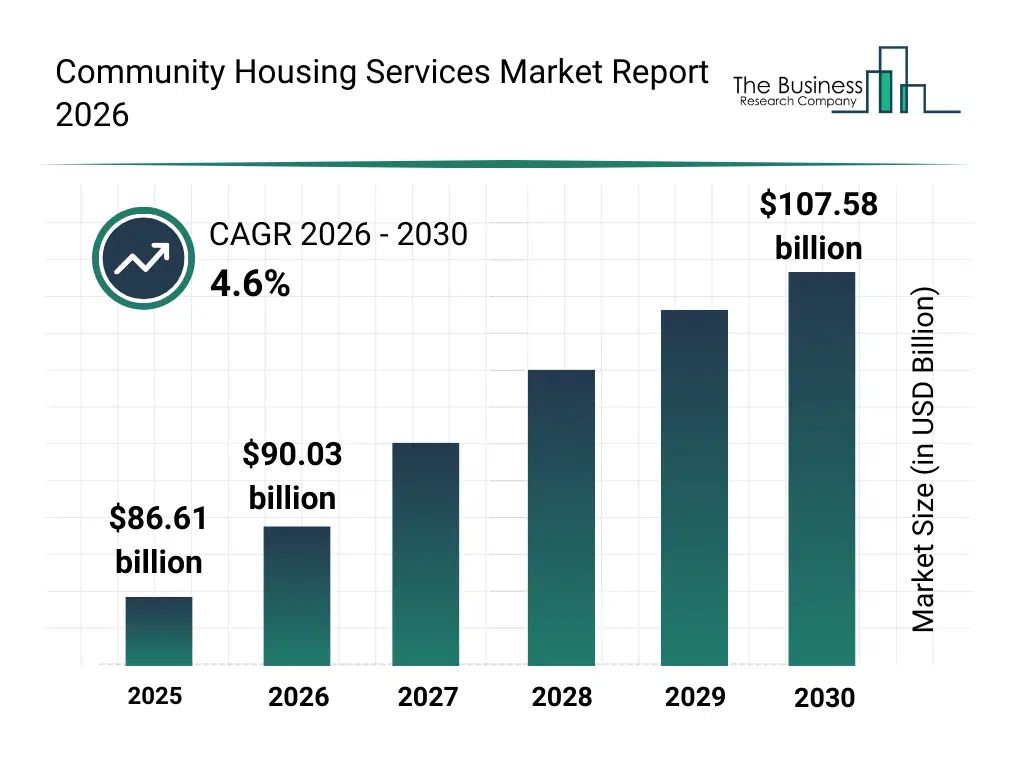
What Is The Community Housing Services Market Size and Share 2026?
The community housing services market size has grown steadily in recent years. It will grow from $86.61 billion in 2025 to $90.03 billion in 2026 at a compound annual growth rate (CAGR) of 3.9%. The growth in the historic period can be attributed to expansion of government housing grants, growth of nonprofit housing organizations, rising urban housing shortages, increased demand for social housing, development of manufactured housing technologies.What Is The Community Housing Services Market Growth Forecast?
The community housing services market size is expected to see steady growth in the next few years. It will grow to $107.58 billion in 2030 at a compound annual growth rate (CAGR) of 4.6%. The growth in the forecast period can be attributed to expansion of sustainable housing initiatives, increasing use of smart housing management tools, rising investment in low-income housing programs, growth of public-private housing partnerships, increasing focus on energy-efficient housing designs. Major trends in the forecast period include increasing adoption of modular and manufactured housing solutions, rising focus on long-term affordable housing models, growing use of digital tenant management systems, expansion of community-led housing developments, enhanced emphasis on housing quality and safety standards.
Global Community Housing Services Market Segmentation
1) By Housing Type: Community-Owned Single-Family Homes, Community-Owned Multi-Family Housing, Community-Owned Transitional Housing Facilities, Community-Owned Group Homes And Supported Living Facilities 2) By Service Type: Emergency And Crisis Housing Services, Transitional Housing And Assisted Living Services, Permanent Affordable Housing And Tenancy Support Services, Housing Maintenance, Repair And Rehabilitation Services, Supportive Services 3) By Ownership And Funding Model: Not-For-Profit Community Housing Organizations, Government-Funded Or Government-Backed Community Housing, Public–Community Partnership Housing Programs 4) By End-User Group: Homeless Individuals, Low-Income Individuals And Families, Victims Of Domestic Violence, Abuse Or Sexual Assault, Elderly Individuals, Disabled Individuals, At-Risk Youth And Runaway Youths Subsegments: 1) By Community-Owned Single-Family Homes: Detached Single-Family Community Homes, Semi-Detached And Duplex Community Homes, Scattered-Site Community Housing Units 2) By Community-Owned Multi-Family Housing: Low-Rise Apartment Buildings, Mid-Rise Apartment Buildings, High-Density Affordable Housing Complexes 3) By Community-Owned Transitional Housing Facilities: Short-Term Transitional Housing Units, Assisted Transitional Housing Facilities, Bridge Housing Facilities 4) By Community-Owned Group Homes And Supported Living Facilities: Group Homes For Elderly Residents, Supported Living Facilities For Disabled Individuals, Supervised Housing For At-Risk YouthWhat Is The Driver Of The Community Housing Services Market?
The increasing number of crises, such as natural disasters and pandemics, is expected to propel the growth of the community housing services market going forward. A crisis is a critical or crucial situation, often characterized by an unexpected, dangerous, or challenging event that demands immediate attention and decisive action to mitigate its negative consequences and restore stability or normalcy. Community housing services become essential during the escalation of crises like natural disasters and pandemics by providing temporary shelter, support, and resources to affected individuals, contributing to disaster resilience and public health response efforts. For instance, in January 2024, according to the Climate.gov from National Oceanic and Atmospheric Administration, a US-based government agency, in 2023, the U.S. experienced 28 weather and climate disasters costing at least $1 billion, a sharp increase from 18 such disasters in 2022. Therefore, the increasing number of crises, such as natural disasters and pandemics, is driving the growth of the community housing services industry.Key Players In The Global Community Housing Services Market
Major companies operating in the community housing services market are The Community Builders Inc., Community Housing Partners, Community Housing Ltd., La Casa Inc., Housing Resources Inc., Knox Housing Partnership Inc., Kalamazoo Neighborhood Housing Services, Crossroads Villa Inc., Mercy Housing, Habitat for Humanity International, Home Forward, Toronto Community Housing, Peabody Trust, L&Q Group, Clarion Housing Group, Anchor Hanover Group, New York City Housing Authority, Chicago Housing Authority, New South Wales Land and Housing Corporation, Housing Development Finance Corporation Ltd.
This chart is for illustrative purposes; the full report includes a detailed competitor analysis and comprehensive overview of the top 10 companies in the market.
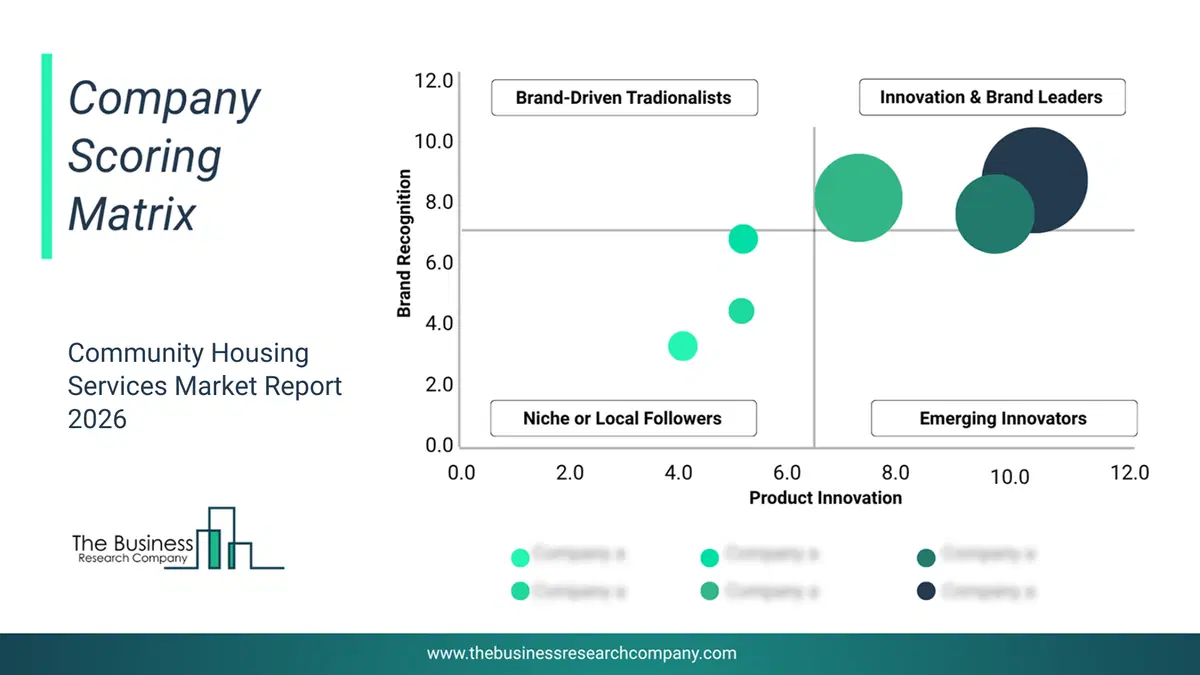
This chart maps companies by product innovation and brand strength, with bubble size indicating relative revenue, helping identify market leaders, challengers, and niche players. This is an illustrative chart; the full report provides a complete and accurate competitive analysis.
Global Community Housing Services Market Trends and Insights
Major companies and organizations operating in the Community Housing Services market are increasingly focusing on developing innovative solutions, such as tech-enabled resident services platforms, to meet the rising demand for efficient, scalable, and personalized housing support driven by growing affordable housing needs, homelessness mitigation programs, and an emphasis on social equity and community well-being. Tech-enabled resident services platforms are integrated digital systems designed to connect residents with housing providers, social services, financial counseling, health programs, and community resources, providing more responsive and data-driven support than traditional manual case management models that often suffer from fragmentation and limited reach. For instance, in January 2025, Ounce of Care, a Washington, United States–based resident services provider, in partnership with Standard Communities, one of the largest affordable housing owners in the U.S., launched the Ounce Hub, a national platform designed to deliver coordinated services across more than 50 properties serving over 10,000 residents. The Ounce Hub combines a custom digital interface with onsite Community Navigators, enabling real-time reporting, resident engagement, and access to programs for financial stability, health and wellness, and community safety, improving both operational efficiency for housing providers and quality of life for residents. Its scalable design allows housing organizations to monitor and respond to resident needs proactively, fostering stronger community connections while streamlining the delivery of essential services compared with conventional, paper-based, or ad-hoc systems. This launch reflects the broader market trend toward digital transformation in community housing services, where automation, data integration, and innovative service delivery models are driving greater impact, improving resident outcomes, and helping organizations meet sustainability and social responsibility goals.What Are Latest Mergers And Acquisitions In The Community Housing Services Market?
In May 2023, Apollo Global Management's impact investing fund, Apollo Impact, an Italy-based financial service company, acquired United Living Group for approximately $370 million. With this acquisition, Apollo's fund has invested and made acquisition in a community housing provider with an exceptional reputation for quality, reliability, and impact on affordable housing residents and their broader communities. United Living Group is a UK-based provider of essential infrastructure, social housing maintenance, and construction services.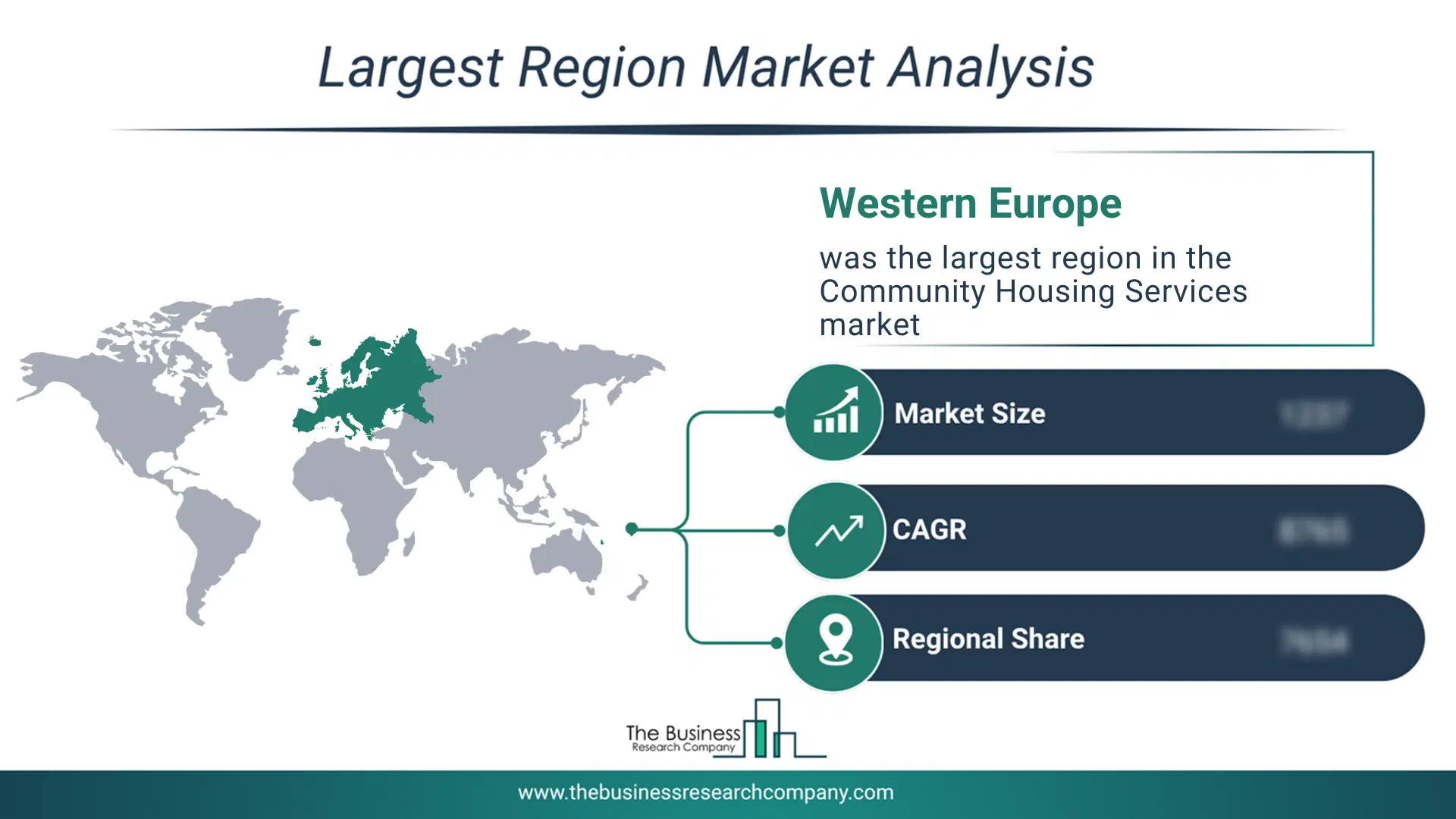
Regional Outlook
Western Europe was the largest region in the community housing services market share in 2025. Asia-Pacific was the second-largest region in the global community housing services market. The regions covered in this market report are Asia-Pacific, South East Asia, Western Europe, Eastern Europe, North America, South America, Middle East, Africa. The countries covered in this market report are Australia, Brazil, China, France, Germany, India, Indonesia, Japan, Taiwan, Russia, South Korea, UK, USA, Canada, Italy, Spain.What Defines the Community Housing Services Market?
The community housing services market consists of revenues earned by entities that provide short term shelter for victims of domestic violence, sexual assault or child abuse, temporary residential shelter for the homeless, runaway youths, and patients and families caught in medical crisis, and transitional housing for low-income individuals and families. The community housing market includes establishments such as shelter homes. Volunteer housing repair organizations that provide low-cost housing in partnership with the homeowner, who assists in construction or repair of a home, and that repair homes for elderly or disabled homeowners, are also included in this market. The market value includes the value of related goods sold by the service provider or included within the service offering. Only goods and services traded between entities or sold to end consumers are included.How is Market Value Defined and Measured?
The market value is defined as the revenues that enterprises gain from the sale of goods and/or services within the specified market and geography through sales, grants, or donations in terms of the currency (in USD unless otherwise specified). The revenues for a specified geography are consumption values that are revenues generated by organizations in the specified geography within the market, irrespective of where they are produced. It does not include revenues from resales along the supply chain, either further along the supply chain or as part of other products.
This chart presents market attractiveness based on a quantitative evaluation of growth, competition, strategic alignment, and risk, offering a clear view of opportunity areas for decision-making. This chart is for illustrative purposes; the full report contains the complete analysis.

This chart highlights the Total Addressable Market (TAM) by estimating the maximum revenue opportunity using an assumption-driven approach, supporting strategic planning and opportunity sizing across markets. The chart is illustrative; the full report provides a more comprehensive analysis.
What Key Data and Analysis Are Included in the Community Housing Services Market Report 2026?
The community housing services market research report is one of a series of new reports from The Business Research Company that provides market statistics, including industry global market size, regional shares, competitors with the market share, detailed market segments, market trends and opportunities, and any further data you may need to thrive in the community housing services industry. The market research report delivers a complete perspective of everything you need, with an in-depth analysis of the current and future state of the industry.Community Housing Services Market Report Forecast Analysis
| Report Attribute | Details |
|---|---|
| Market Size Value In 2026 | $90.03 billion |
| Revenue Forecast In 2030 | $107.58 billion |
| Growth Rate | CAGR of 4.6% from 2026 to 2030 |
| Base Year For Estimation | 2025 |
| Actual Estimates/Historical Data | 2020-2025 |
| Forecast Period | 2026 - 2030 - 2030 |
| Market Representation | Revenue in USD Billion and CAGR from 2026 to 2030 |
| Segments Covered | Housing Type, Service Type, Ownership And Funding Model, End-User Group |
| Regional Scope | Asia-Pacific, Western Europe, Eastern Europe, North America, South America, Middle East, Africa |
| Country Scope | The countries covered in the report are Australia, Brazil, China, France, Germany, India, Indonesia, Japan, Taiwan, Russia, South Korea, UK, USA, Canada, Italy, Spain. |
| Key Companies Profiled | The Community Builders Inc., Community Housing Partners, Community Housing Ltd., La Casa Inc., Housing Resources Inc., Knox Housing Partnership Inc., Kalamazoo Neighborhood Housing Services, Crossroads Villa Inc., Mercy Housing, Habitat for Humanity International, Home Forward, Toronto Community Housing, Peabody Trust, L&Q Group, Clarion Housing Group, Anchor Hanover Group, New York City Housing Authority, Chicago Housing Authority, New South Wales Land and Housing Corporation, Housing Development Finance Corporation Ltd. |
| Customization Scope | Request for Customization |
| Pricing And Purchase Options | Explore Purchase Options |