
Companion Diagnostic Technologies Market Report 2026
Global Outlook – By Type (Immunohistochemistry, Molecular Diagnostics), By Sample Type (Tissue, Blood, Saliva, Other Sample Types), By Technology (Polymerase Chain Reaction, Next Generation Sequencing, Immunohistochemistry, In Situ Hybridization, Microarrays, Liquid Biopsy), By Distribution Channel (Direct Sales, Distributors), By Application (Oncology, Cardiovascular, Central Nervous System, Autoimmune And Inflammation, Virology, Other Applications) – Market Size, Trends, Strategies, and Forecast to 2035
Companion Diagnostic Technologies Market Overview
• Companion Diagnostic Technologies market size has reached to $4.44 billion in 2025 • Expected to grow to $7.89 billion in 2030 at a compound annual growth rate (CAGR) of 12.2% • Growth Driver: Surge In Demand For Targeted Therapies Fueling The Growth Of The Market Due To Increasing Need For Precise Patient Selection, Biomarker Identification, And Improving Treatment Efficacy • Market Trend: Innovations In Genomic Testing Technologies Enhance Precision Medicine And Targeted Therapy Selection In Companion Diagnostics • North America was the largest region in 2025 and Asia-Pacific is the fastest growing region.What Is Covered Under Companion Diagnostic Technologies Market?
Companion diagnostic technologies refer to specialized diagnostic tools and tests designed to identify specific biomarkers that predict a patient’s response to a particular treatment. These technologies are used to support the safe and effective use of targeted therapies by matching the right drug to the right patient based on their molecular or genetic profile. They play a critical role in enabling precision medicine by improving treatment outcomes and reducing the risk of adverse effects. The main types of companion diagnostic technologies include immunohistochemistry and molecular diagnostics. Immunohistochemistry refers to diagnostic techniques used to detect specific antigens in tissue samples using antigen–antibody interactions for disease identification and treatment selection. These products are categorized by sample type including tissue, blood, saliva, and other sample types and are based on technologies such as polymerase chain reaction, next generation sequencing, immunohistochemistry, in situ hybridization, microarrays, and liquid biopsy. They are distributed through direct sales and distributors and are used in applications such as oncology, cardiovascular, central nervous system, autoimmune and inflammation, virology, and others.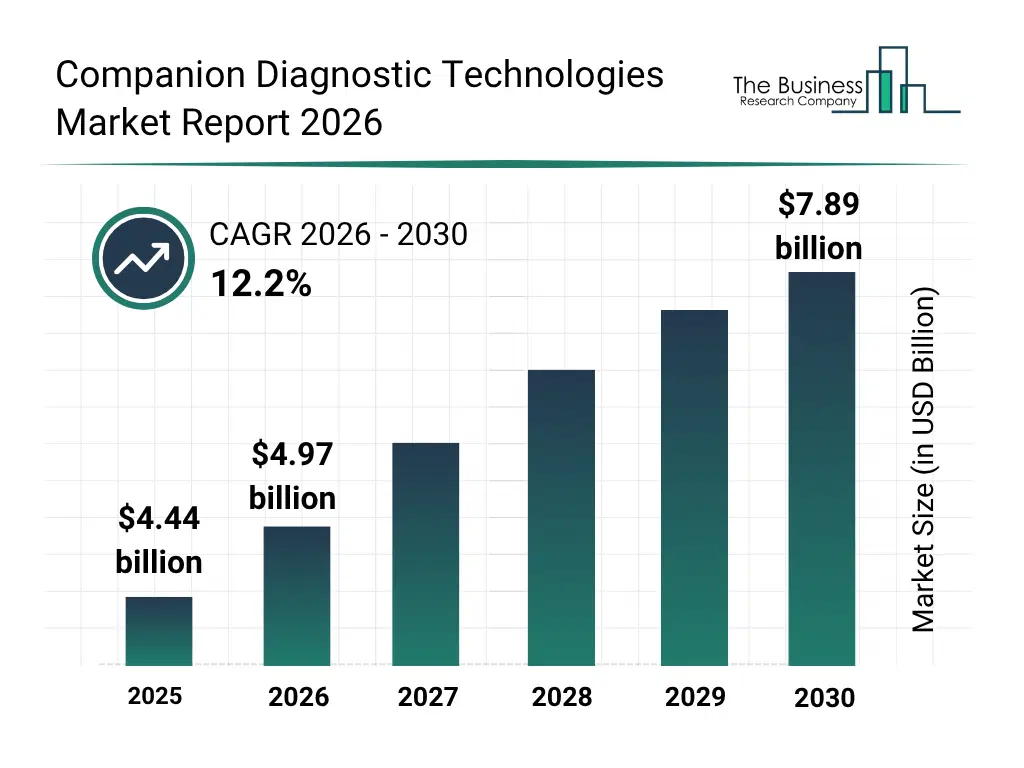
What Is The Companion Diagnostic Technologies Market Size and Share 2026?
The companion diagnostic technologies market size has grown rapidly in recent years. It will grow from $4.44 billion in 2025 to $4.97 billion in 2026 at a compound annual growth rate (CAGR) of 12.0%. The growth in the historic period can be attributed to growth in precision medicine adoption, rising prevalence of cancer and chronic diseases, increasing demand for targeted therapeutic solutions, expansion of molecular diagnostics research activities, growing investment in biomarker discovery programs.What Is The Companion Diagnostic Technologies Market Growth Forecast?
The companion diagnostic technologies market size is expected to see rapid growth in the next few years. It will grow to $7.89 billion in 2030 at a compound annual growth rate (CAGR) of 12.2%. The growth in the forecast period can be attributed to rising development of personalized treatment regimens, increasing adoption of AI enabled diagnostic interpretation platforms, growing demand for non invasive liquid biopsy diagnostics, expansion of pharmaceutical and diagnostic company collaborations, increasing regulatory approvals for companion diagnostic assays. Major trends in the forecast period include increasing adoption of biomarker based targeted therapy selection, rising demand for next generation sequencing companion diagnostics, growing use of liquid biopsy testing solutions, expansion of personalized oncology treatment approaches, increasing integration of multiplex molecular diagnostic testing.
Global Companion Diagnostic Technologies Market Segmentation
1) By Type: Immunohistochemistry, Molecular Diagnostics 2) By Sample Type: Tissue, Blood, Saliva, Other Sample Types 3) By Technology: Polymerase Chain Reaction, Next Generation Sequencing, Immunohistochemistry, In Situ Hybridization, Microarrays, Liquid Biopsy 4) By Distribution Channel: Direct Sales, Distributors 5) By Application: Oncology, Cardiovascular, Central Nervous System, Autoimmune And Inflammation, Virology, Other Applications Subsegments: 1) By Immunohistochemistry: Antibody Based Staining Techniques, Chromogenic Detection Methods, Fluorescent Detection Methods 2) By Molecular Diagnostics: Deoxyribonucleic Acid Based Testing, Ribonucleic Acid Based Testing, Protein Biomarker AnalysisWhat Is The Driver Of The Companion Diagnostic Technologies Market?
The increasing demand for targeted therapies is expected to propel the growth of the companion diagnostic technologies market going forward. Targeted therapies refer to a form of medical treatment that uses drugs or other substances to precisely identify and attack specific cancer cells or molecular targets, minimizing damage to healthy cells. The demand for targeted therapies is rising due to their ability to precisely attack disease-specific pathways, resulting in improved efficacy with fewer side effects. Companion diagnostic technologies support targeted therapies by enabling the identification of specific genetic mutations, biomarkers, and molecular profiles, thereby helping in selecting the most effective targeted treatment for individual patients, improving treatment accuracy, and enhancing clinical decision-making in oncology and other disease areas. For instance, in July 2023, according to the report published by the American Society of Gene & Cell Therapy (ASGCT), a US-based professional membership organization, at the end of the first quarter (Q1) 2023, there were 247 gene therapies in Phase II, but this number rose by 5% to reach 260 by the end of the second quarter(Q2). Therefore, the increasing demand for targeted therapies is driving the growth of the companion diagnostic technologies industry.Key Players In The Global Companion Diagnostic Technologies Market
Major companies operating in the companion diagnostic technologies market are F. Hoffmann-La Roche AG, Thermo Fisher Scientific Inc., Abbott Laboratories, Siemens Healthineers AG, Danaher Corporation, Becton Dickinson and Company, BioGenex Laboratories Inc., Quest Diagnostics Incorporated, Agilent Technologies Inc., Illumina Inc., bioMérieux S.A., Shimadzu Corporation, Sysmex Corporation, Bio-Rad Laboratories Inc., QIAGEN N.V., DiaSorin S.p.A., Caris Life Sciences Inc., Myriad Genetics Inc., Servier Laboratories, Pillar Biosciences Inc., EntroGen Inc.Global Companion Diagnostic Technologies Market Trends and Insights
Major companies operating in the companion diagnostic technologies market are focusing on developing advanced genomic testing solutions, such as liquid biopsy-based companion diagnostics, to enhance precision medicine, improve targeted therapy selection, and enable more accurate cancer treatment decision-making. Liquid biopsy-based companion diagnostics refer to blood- or fluid-based tests used to detect specific biomarkers that guide and match patients to appropriate targeted therapies. For instance, in October 2024, Foundation Medicine, Inc., a US-based molecular information company, announced the Food and Drug Administration (FDA) approved its Liquid CDx test in combination with Itovebi, strengthening its role in precision oncology diagnostics. The solution is made to help doctors choose better treatments and make clinical decisions by using a blood test that looks at a wide range of genes, which helps them find important mutations and direct cancer treatments more effectively.What Are Latest Mergers And Acquisitions In The Companion Diagnostic Technologies Market?
In September 2025, Lunit, a South Korea-based provider of AI-powered digital pathology and imaging tools, collaborated with Agilent Technologies Inc. to accelerate precision medicine through AI-powered companion diagnostics. The partnership aims to integrate Lunit’s AI-driven cancer analysis with Agilent Technologies’ diagnostic and genomics capabilities to develop more accurate and efficient companion diagnostic solutions for targeted therapies. Agilent Technologies Inc. is a US-based company that specializes in the development and commercialization of companion diagnostics (CDx).Regional Outlook/Insights
North America was the largest region in the companion diagnostic technologies market in 2025. Asia-Pacific is expected to be the fastest-growing region in the forecast period. The regions covered in this market report are Asia-Pacific, South East Asia, Western Europe, Eastern Europe, North America, South America, Middle East, Africa. The countries covered in this market report are Australia, Brazil, China, France, Germany, India, Indonesia, Japan, Taiwan, Russia, South Korea, UK, USA, Canada, Italy, Spain.What Defines the Companion Diagnostic Technologies Market?
The companion diagnostic technologies market consists of revenues earned by entities by providing services such as patient stratification for targeted therapies, biomarker validation support, therapy response monitoring, and clinical trial enrichment. The market value includes the value of related goods sold by the service provider or included within the service offering. The companion diagnostic technologies market also includes sales of consumable test strips, staining reagent kits, and nucleic acid extraction kits. Values in this market are ‘factory gate’ values, that is, the value of goods sold by the manufacturers or creators of the goods, whether to other entities (including downstream manufacturers, wholesalers, distributors, and retailers) or directly to end customers. The value of goods in this market includes related services sold by the creators of the goods.How is Market Value Defined and Measured?
The market value is defined as the revenues that enterprises gain from the sale of goods and/or services within the specified market and geography through sales, grants, or donations in terms of the currency (in USD unless otherwise specified). The revenues for a specified geography are consumption values that are revenues generated by organizations in the specified geography within the market, irrespective of where they are produced. It does not include revenues from resales along the supply chain, either further along the supply chain or as part of other products.What Key Data and Analysis Are Included in the Companion Diagnostic Technologies Market Report 2026?
The companion diagnostic technologies market research report is one of a series of new reports from The Business Research Company that provides market statistics, including industry global market size, regional shares, competitors with the market share, detailed market segments, market trends and opportunities, and any further data you may need to thrive in the companion diagnostic technologies industry. The market research report delivers a complete perspective of everything you need, with an in-depth analysis of the current and future state of the industry.Companion Diagnostic Technologies Market Report Forecast Analysis
| Report Attribute | Details |
|---|---|
| Market Size Value In 2026 | $4.97 billion |
| Revenue Forecast In 2035 | $7.89 billion |
| Growth Rate | CAGR of 12.2% from 2026 to 2035 |
| Base Year For Estimation | 2025 |
| Actual Estimates/Historical Data | 2020-2025 |
| Forecast Period | 2026 - 2030 - 2035 |
| Market Representation | Revenue in USD Billion and CAGR from 2026 to 2035 |
| Segments Covered | Type, Sample Type, Technology, Distribution Channel, Application |
| Regional Scope | Asia-Pacific, Western Europe, Eastern Europe, North America, South America, Middle East, Africa |
| Country Scope | The countries covered in the report are Australia, Brazil, China, France, Germany, India, Indonesia, Japan, Taiwan, Russia, South Korea, UK, USA, Canada, Italy, Spain. |
| Key Companies Profiled | F. Hoffmann-La Roche AG, Thermo Fisher Scientific Inc., Abbott Laboratories, Siemens Healthineers AG, Danaher Corporation, Becton Dickinson and Company, BioGenex Laboratories Inc., Quest Diagnostics Incorporated, Agilent Technologies Inc., Illumina Inc., bioMérieux S.A., Shimadzu Corporation, Sysmex Corporation, Bio-Rad Laboratories Inc., QIAGEN N.V., DiaSorin S.p.A., Caris Life Sciences Inc., Myriad Genetics Inc., Servier Laboratories, Pillar Biosciences Inc., EntroGen Inc. |
| Customization Scope | Request for Customization |
| Pricing And Purchase Options | Explore Purchase Options |