Contact Us
  Search
The Business Research Company Logo
Composable Infrastructure Market 2025
Published :May 2025
Pages :323
Format :PDF
Delivery Time :2-3 Business Days
Why 2-3 days? We update the report with the latest data and news before delivery. Let us know if you need us to expedite.
Report Price :$4,490.00

Composable Infrastructure Market 2025

By Component Outlook (Software, Hardware), By Cloud (Public, Private, Hybrid), By Vertical (BFSI (Banking, Financial Services And Insurance), IT (Information Technology) And Telecom, Government, Healthcare, Manufacturing, Other Verticals), And By Region, Opportunities And Strategies – Global Forecast To 2035

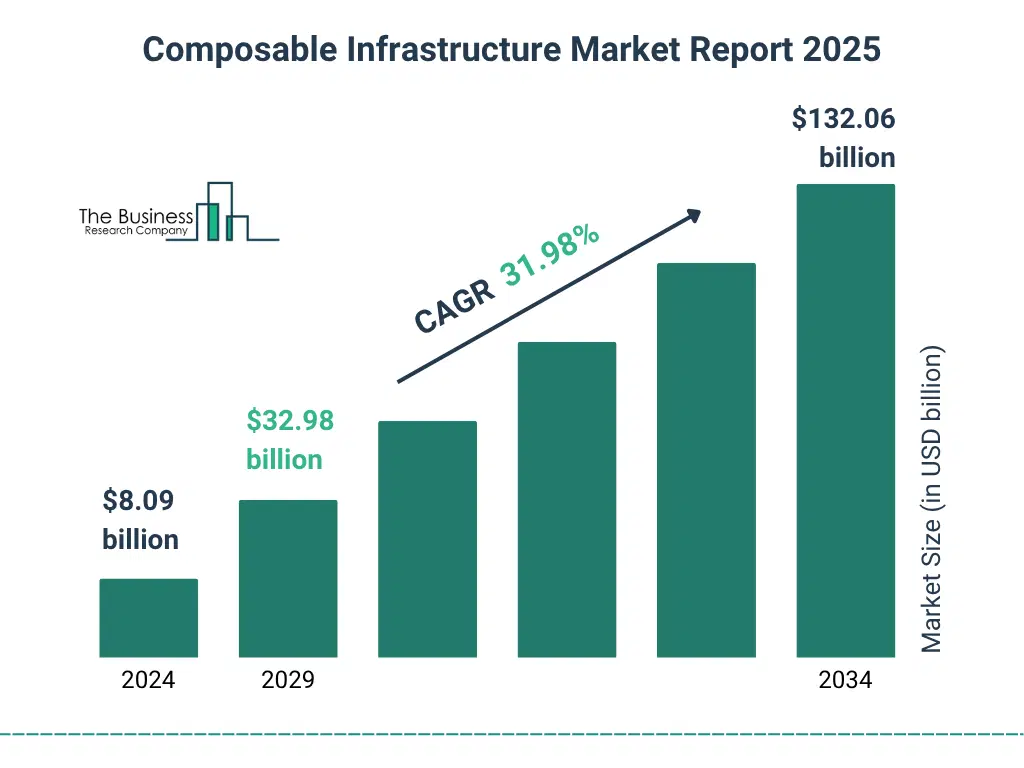
Composable Infrastructure Market Size and growth rate 2025 to 2029: Graph

Composable Infrastructure Market Definition

Composable infrastructure is a modern approach to IT infrastructure that enables organizations to dynamically allocate and manage computing, storage and networking resources through software-defined means. This technology allows businesses to treat their physical hardware as a set of fluid, programmable resources, making it easier to optimize workloads and improve efficiency. The composable infrastructure market consists of sales by entities (organizations, sole traders and partnerships) of composable infrastructure products and services that are widely used by enterprises and data centers that require scalable and flexible computing environments, including businesses in banking and finance, IT (information technology) and telecom, healthcare, manufacturing and government sectors.


Research Expert

Book your 30 minutes free consultation with our research experts

Composable Infrastructure Market Size

The global composable infrastructure market reached a value of nearly $8,092.16 million in 2024, having grown at a compound annual growth rate (CAGR) of 36.40% since 2019. The market is expected to grow from $8,092.16 million in 2024 to $32,978.64 million in 2029 at a rate of 32.44%. The market is then expected to grow at a CAGR of 31.98% from 2029 and reach $132,062.76 million in 2034. Growth in the historic period resulted from the rising adoption of AI and automation, increasing adoption of digital transformation, demand for enhanced security and compliance and expansion of edge computing. Factors that negatively affected growth in the historic period were lack of standardized infrastructure facilities and stringent regulations and compliance. Going forward, the adoption of 5G networks, increase in cloud adoption, rise in remote work and rising volume of data generation will drive the growth. Factor that could hinder the growth of the composable infrastructure market in the future include data security challenges and risk of single point of failure.

Composable Infrastructure Market Drivers

The key drivers of the composable infrastructure market include: Adoption of 5G Networks The growing adoption of 5G networks is set to drive the expansion of the composable infrastructure market during forecast period. 5G technology, the fifth generation of mobile networks, delivers ultra-fast speeds, low latency and enhanced connectivity, supporting innovations such as IoT, autonomous vehicles and smart cities. The rising deployment of 5G is fueled by the increasing demand for high-speed, low-latency connectivity to enable advanced applications across various industries. By providing seamless, high-performance connectivity, 5G facilitates dynamic allocation of compute, storage and networking resources, enhancing the efficiency of AI, IoT and cloud-native applications within composable infrastructure. For instance, according to Ericsson, a Sweden-based company specializing in networking and telecommunications, 300 5G networks have been launched worldwide in 2023, covering approximately 40% of the global population outside mainland China. This is projected to increase to 80% by 2029. Therefore, the adoption of 5G networks is driving the growth of composable infrastructure market.

Composable Infrastructure Market Restraints

The key restraints on the composable infrastructure market include: Data Security Challenges The data security challenges are expected to hamper the growth of the composable infrastructure market during the forecast period. Data security concerns present a significant barrier to the growth of the digital circular economy by heightening the risks of cyberattacks, data breaches and unauthorized access to sensitive information. Data security challenges hamper composable infrastructure by increasing the attack surface, complicating compliance, creating risks of data breaches and misconfigurations and limiting the effectiveness of traditional security tools in dynamic, rapidly reconfigurable environments. For instance, in February 2025, according to the ASEE group, a Poland-based IT service management company, cybercrime-related damages are predicted to surge to $15.63 trillion by 2029, a significant increase from $10.5 trillion in 2025. Therefore, data security challenges are expected to hinder the growth of the composable infrastructure market.

Need data on a specific region in this market?

Opportunities And Recommendations In The Composable Infrastructure Market

Opportunities – The top opportunities in the composable infrastructure market segmented by component outlook will arise in the hardware segment, which will gain $16,134.07 million of global annual sales by 2029. The top opportunities in the composable infrastructure market segmented by cloud will arise in the hybrid segment, which will gain $9,522.85 million of global annual sales by 2029. The top opportunities in the composable infrastructure market segmented by vertical will arise in the IT & telecom segment, which will gain $8,772.66 million of global annual sales by 2029. The composable infrastructure market size will gain the most in the USA at $7,282.37 million. Recommendations- To take advantage of the opportunities, The Business Research Company recommends the composable infrastructure to focus on developing composable data activation platforms, focus on advancing data infrastructure as a service (DIaaS) solutions, focus on advancing composable disaggregated infrastructure (CDI), focus on developing AI and HPC-driven composable solution, focus on the fast-growing software market segment, focus on the fast-growing hybrid cloud market segment, expand in emerging markets, focus on expanding distribution channels through strategic partnerships, focus on competitive and value-based pricing strategies, implement targeted, data-driven promotional strategies, leverage co-marketing partnerships to expand promotional reach and focus on the fast-growing BFSI market segment.
Chat with us