

Composite Hull Repair Market Report 2026
Global Outlook – By Type (Structural Repair, Semi-Structural Repair, Cosmetic Repair), By Material Type (Carbon Fiber, Glass Fiber, Aramid Fiber, Hybrid Composites, Other Materials), By Repair Method (Patch Repair, Resin Injection, Lamination, Other Repair Methods), By Service Type (Original Equipment Manufacturers, Maintenance Repair And Overhaul Providers, Third Party Repair Service Providers, Infrastructure Operators), By Application (Marine Vessels, Offshore Platforms, Naval Ships, Recreational Boats, Other Applications) – Market Size, Trends, Strategies, and Forecast to 2030
Composite Hull Repair Market Overview
• Composite Hull Repair market size has reached to $1.28 billion in 2025 • Expected to grow to $1.97 billion in 2030 at a compound annual growth rate (CAGR) of 9% • Growth Driver: Surge In Adoption Of Composite Materials In Marine And Aerospace Structures Driving The Growth Of The Market Due To Lightweight Performance Demand • Market Trend: Advanced Paste Adhesive Innovation Improves High-Temperature Structural Bonding Efficiency • North America was the largest region in 2025 and Asia-Pacific is the fastest growing region.What Is Covered Under Composite Hull Repair Market?
Composite hull repair refers to the process of restoring the structural integrity, strength, and serviceability of damaged composite hull structures. It involves identifying and repairing defects such as cracks, delamination, impact damage, or fatigue-related deterioration to ensure the hull regains its original load-bearing capacity and watertight performance. Composite hull repair is essential for maintaining operational safety, extending vessel lifespan, and preserving the hydrodynamic efficiency of marine vessels. The main types of composite hull repair include structural repair, semi-structural repair, and cosmetic repair. Structural repair refers to restoration processes designed to recover the full load-bearing strength and integrity of composite hull structures used in marine and offshore applications. These repairs use material types such as carbon fiber, glass fiber, aramid fiber, hybrid composites, and other materials and are carried out through repair methods including patch repair, resin injection, lamination, and other repair methods. They are carried out through service types including original equipment manufacturers, maintenance repair and overhaul providers, third party repair service providers, and infrastructure operators and the key applications of marine vessels, offshore platforms, naval ships, recreational boats, and others.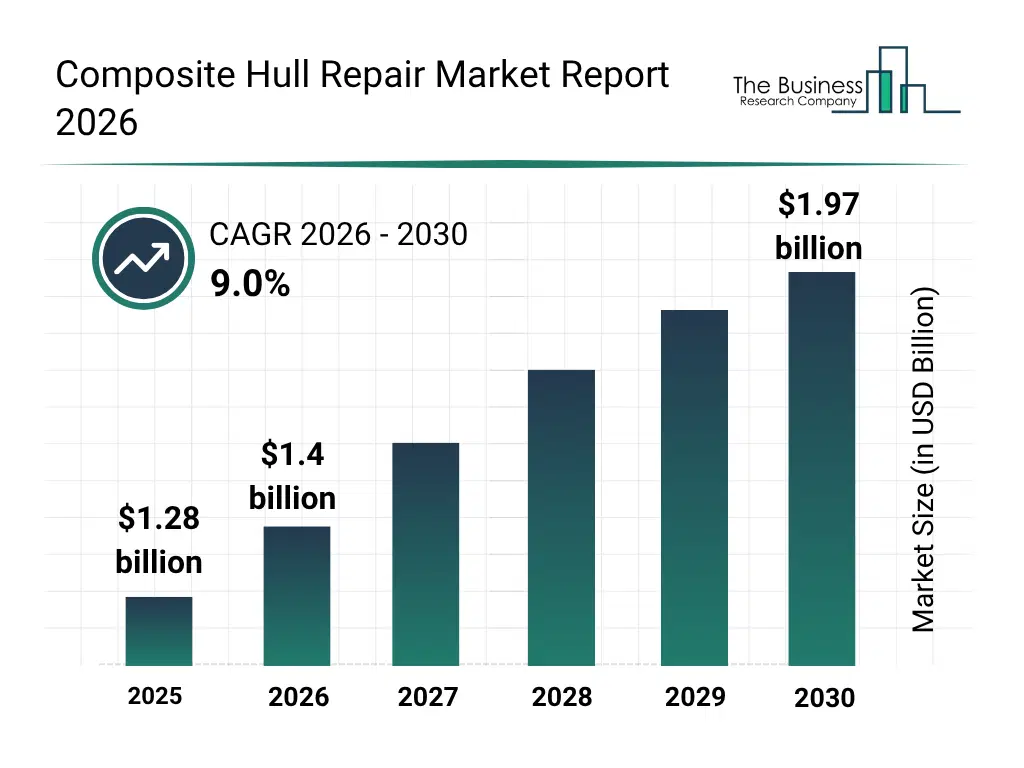
What Is The Composite Hull Repair Market Size and Share 2026?
The composite hull repair market size has grown strongly in recent years. It will grow from $1.28 billion in 2025 to $1.4 billion in 2026 at a compound annual growth rate (CAGR) of 9.4%. The growth in the historic period can be attributed to increasing use of composite materials in marine vessels, growing investments in marine maintenance activities, rising demand for vessel lifespan extension, increasing expansion of offshore marine infrastructure, growing focus on operational safety standards.What Is The Composite Hull Repair Market Growth Forecast?
The composite hull repair market size is expected to see strong growth in the next few years. It will grow to $1.97 billion in 2030 at a compound annual growth rate (CAGR) of 9.0%. The growth in the forecast period can be attributed to rising demand for high-strength repair materials, increasing adoption of predictive maintenance solutions, growing investment in naval fleet modernization programs, increasing focus on cost-efficient repair technologies, expansion of recreational and commercial marine activities. Major trends in the forecast period include increasing adoption of lightweight composite repair materials, growing demand for advanced damage assessment techniques, rising focus on extending vessel operational lifespan, increasing use of high-performance resin systems in repairs, growing demand for corrosion-resistant marine repair solutions.
Global Composite Hull Repair Market Segmentation
1) By Type: Structural Repair; Semi-Structural Repair; Cosmetic Repair 2) By Material Type: Carbon Fiber; Glass Fiber; Aramid Fiber; Hybrid Composites; Other Materials 3) By Repair Method: Patch Repair; Resin Injection; Lamination; Other Repair Methods 4) By Service Type: Original Equipment Manufacturers; Maintenance Repair And Overhaul Providers; Third Party Repair Service Providers; Infrastructure Operators 5) By Application: Marine Vessels; Offshore Platforms; Naval Ships; Recreational Boats; Other Applications Subsegments: 1) By Structural Repair: Hull Crack Repair; Impact Damage Repair; Delamination Repair; Core Structure Repair; Fiber Reinforcement Repair; Load Bearing Section Repair; Keel Structure Repair; Transom Repair 2) By Semi-Structural Repair: Deck Panel Repair; Bulkhead Repair; Joint Reinforcement Repair; Surface Layer Restoration; Edge Structure Repair; Compartment Section Repair; Moderate Stress Area Repair; Internal Support Repair 3) By Cosmetic Repair: Surface Scratch Repair; Gelcoat Restoration; Paint Finish Repair; Surface Polishing Repair; Minor Dent Repair; Color Matching Repair; Surface Crack Filling; Protective Coating RestorationWhat Is The Driver Of The Composite Hull Repair Market?
The increasing adoption of composite materials in marine and aerospace structures is expected to propel the growth of the composite hull repair market going forward. Composite materials refer to advanced engineered materials made by combining two or more constituent materials to achieve superior strength, lightweight performance, and durability. The rising adoption of composite materials in marine and aerospace structures is driven by the demand for improved fuel efficiency, higher structural performance, and reduced overall weight, which is further accelerating the shift toward advanced material usage across high-performance industries. Composite hull repair supports the transition of composite materials by enabling efficient restoration of damaged composite components, extending the service life of structures, and preserving the lightweight and high-strength characteristics essential for marine and aerospace applications. For instance, in January 2026, according to NCCUK, a UK-based government organization, in the UK aerospace and defense sector, composites have already become dominant structural materials, with more than 50% of modern aircraft structures now manufactured using composite materials. Therefore, the increasing adoption of composite materials in marine and aerospace structures is driving the growth of the composite hull repair industry.Key Players In The Global Composite Hull Repair Market
Major companies operating in the composite hull repair market are BAE Systems plc (Naval Ship Repair); Subsea7 S.A.; Oceaneering International Inc.; Feadship Royal Dutch Shipyards; Sanlorenzo S.p.A.; Oceanco B.V.; MB92 Group S.L.; Amico & Co S.p.A.; Monaco Marine S.A.S.; Damen Yachting B.V.; Lloyd Werft Bremerhaven GmbH; Incat Tasmania Pty Ltd; Pendennis Limited; Derecktor Shipyards Connecticut LLC; Baltic Yachts Oy Ab Ltd; Rossinavi S.r.l.; Ancasta Yacht Services Limited; McMullen & Wing Limited; KRM Yacht Refit & Rebuild; BMComposites; Arena Yacht A.M.Y.; Composite Yacht; Pons Composites S.L.Global Composite Hull Repair Market Trends and Insights
Major companies operating in the composite hull repair market are focusing on developing innovative material solutions, such as epoxy-based structural paste adhesives, to enable rapid structural bonding and repair of metallic and composite components and improve scalability for high-rate production environments. The epoxy-based structural paste adhesives are advanced bonding materials designed to combine film-like mechanical performance with easy dispensing and controlled flow characteristics, enabling faster and more flexible manufacturing compared to traditional film adhesives while maintaining excellent high-temperature strength and structural integrity. For instance, in May 2024, Syensqo, a Belgium-based advanced materials and specialty chemicals company, launched AeroPaste 1003, a next-generation epoxy-based structural paste adhesive designed for structural bonding of metallic and composite parts, rapid assembly, and repair applications with suitability for out-of-autoclave processing. It offers excellent high-temperature strength, simplified mixing with controlled flow for easy dispensing, and performance comparable to or superior to leading film adhesives, while also supporting automation-driven manufacturing to increase industrial efficiency and production output in aerospace applications.What Are Latest Mergers And Acquisitions In The Composite Hull Repair Market?
In December 2023, Pinmar Yacht Supply (PYS), a Spain-based superyacht supply company, entered into a partnership with BM Composites to sell Gurit epoxy resin products across its outlets in Spain. Through this partnership, Pinmar Yacht Supply aims to strengthen its portfolio of advanced composite material solutions by providing customers with access to high-performance epoxy resins, technical support, and product expertise for composite-related marine projects, including yacht construction and repair applications. BM Composites is a Spain-based composite engineering and manufacturing company that provides structural composite repair services, including hull repairs, keel box rebuilds, and carbon fiber restoration.Regional Outlook
North America was the largest region in the composite hull repair market in 2025. Asia-Pacific is expected to be the fastest-growing region in the forecast period. The regions covered in this market report are Asia-Pacific, South East Asia, Western Europe, Eastern Europe, North America, South America, Middle East, Africa. The countries covered in this market report are Australia, Brazil, China, France, Germany, India, Indonesia, Japan, Taiwan, Russia, South Korea, UK, USA, Canada, Italy, Spain.What Defines the Composite Hull Repair Market?
The composite hull repair market includes revenues earned by entities by providing services such as inspection and damage assessment, non-destructive testing, structural analysis and engineering support, composite material repair and patching, resin infusion and curing services, surface preparation and finishing, coating and corrosion protection, welding and bonding services, underwater repair services, maintenance and refurbishment, quality assurance and testing and emergency repair services. The market value includes the value of related goods sold by the service provider or included within the service offering. Only goods and services traded between entities or sold to end consumers are included.How is Market Value Defined and Measured?
The market value is defined as the revenues that enterprises gain from the sale of goods and/or services within the specified market and geography through sales, grants, or donations in terms of the currency (in USD unless otherwise specified). The revenues for a specified geography are consumption values that are revenues generated by organizations in the specified geography within the market, irrespective of where they are produced. It does not include revenues from resales along the supply chain, either further along the supply chain or as part of other products.What Key Data and Analysis Are Included in the Composite Hull Repair Market Report 2026?
The composite hull repair market research report is one of a series of new reports from The Business Research Company that provides market statistics, including industry global market size, regional shares, competitors with the market share, detailed market segments, market trends and opportunities, and any further data you may need to thrive in the composite hull repair industry. The market research report delivers a complete perspective of everything you need, with an in-depth analysis of the current and future state of the industry.Composite Hull Repair Market Report Forecast Analysis
| Report Attribute | Details |
|---|---|
| Market Size Value In 2026 | $1.4 billion |
| Revenue Forecast In 2030 | $1.97 billion |
| Growth Rate | CAGR of 9% from 2026 to 2030 |
| Base Year For Estimation | 2025 |
| Actual Estimates/Historical Data | 2020-2025 |
| Forecast Period | 2026 - 2030 |
| Market Representation | Revenue in USD Billion and CAGR from 2026 to 2030 |
| Segments Covered | Type, Material Type, Repair Method, Service Type, Application |
| Regional Scope | Asia-Pacific, Western Europe, Eastern Europe, North America, South America, Middle East, Africa |
| Country Scope | The countries covered in the report are Australia, Brazil, China, France, Germany, India, ... |
| Key Companies Profiled | BAE Systems plc (Naval Ship Repair); Subsea7 S.A.; Oceaneering International Inc.; Feadship Royal Dutch Shipyards; Sanlorenzo S.p.A.; Oceanco B.V.; MB92 Group S.L.; Amico & Co S.p.A.; Monaco Marine S.A.S.; Damen Yachting B.V.; Lloyd Werft Bremerhaven GmbH; Incat Tasmania Pty Ltd; Pendennis Limited; Derecktor Shipyards Connecticut LLC; Baltic Yachts Oy Ab Ltd; Rossinavi S.r.l.; Ancasta Yacht Services Limited; McMullen & Wing Limited; KRM Yacht Refit & Rebuild; BMComposites; Arena Yacht A.M.Y.; Composite Yacht; Pons Composites S.L. |
| Customization Scope | Request for Customization |
| Pricing And Purchase Options | Explore Purchase Options |