
Compressed Air Monitoring Market Report 2026
Global Outlook – By Component (Hardware, Software, Services), By Monitoring Type (Continuous, Periodic), By Application (Industrial Manufacturing, Food And Beverage, Pharmaceuticals, Healthcare, Automotive, Electronics, Other Applications), By End-User (Small And Medium Enterprises, Large Enterprises) – Market Size, Trends, Strategies, and Forecast to 2030
Compressed Air Monitoring Market Overview
• Compressed Air Monitoring market size has reached to $3.88 billion in 2025 • Expected to grow to $6.37 billion in 2030 at a compound annual growth rate (CAGR) of 10.4% • Growth Driver: Growing Focus On Energy Efficiency Driving Market Growth Due To Rising Industrial Energy Costs • Market Trend: Enhancing System Performance Through Intelligent Sensor Technology • North America was the largest region in 2025 and Asia-Pacific is the fastest growing region.What Is Covered Under Compressed Air Monitoring Market?
Compressed air monitoring is the process of continuously measuring and analyzing compressed air to ensure it meets quality standards. It tracks parameters such as pressure, temperature, humidity, and airflow to detect leaks, inefficiencies, or potential equipment issues. Advanced sensors and digital tools provide real-time data and alerts, enabling timely interventions and improved system performance. The main components of compressed air monitoring are hardware, software, and services. Hardware in compressed air systems comprises advanced sensors, meters, and controllers that ensure accurate monitoring, control, and optimization of air quality and system performance. It includes two monitoring types: continuous and periodic. These systems are used in various applications, including industrial manufacturing, food and beverage, pharmaceuticals, healthcare, automotive, electronics, and others, and are adopted by various end-users such as small and medium enterprises and large enterprises.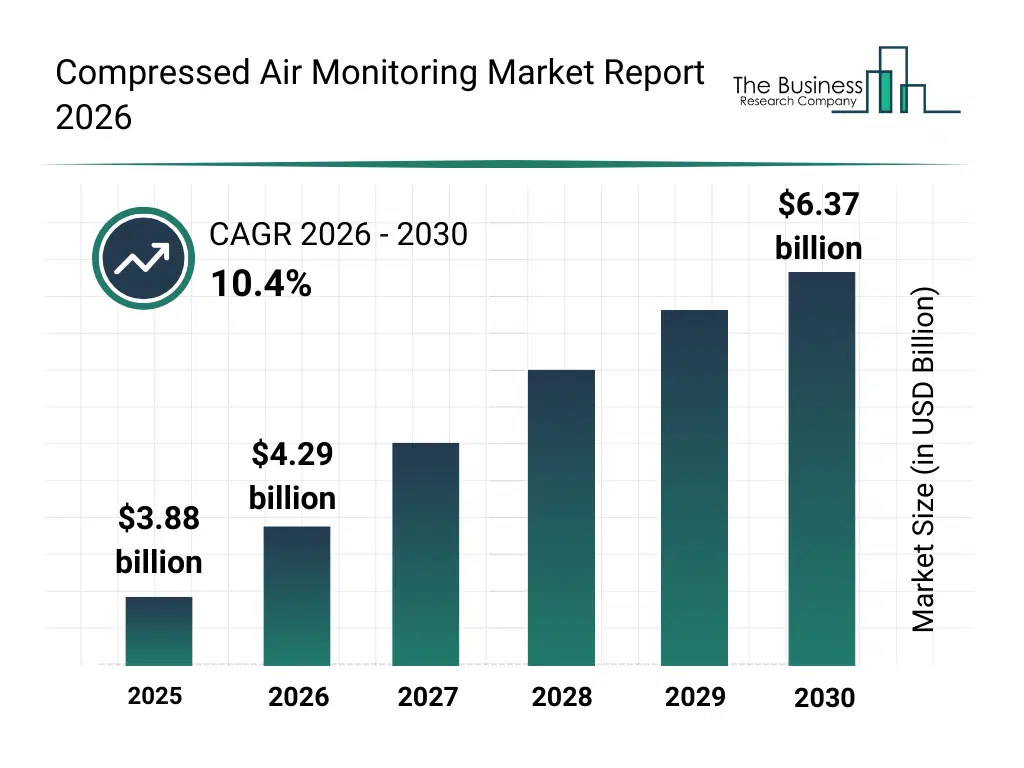
What Is The Compressed Air Monitoring Market Size and Share 2026?
The compressed air monitoring market size has grown rapidly in recent years. It will grow from $3.88 billion in 2025 to $4.29 billion in 2026 at a compound annual growth rate (CAGR) of 10.7%. The growth in the historic period can be attributed to increasing industrial automation, rising focus on energy efficiency, expansion of compressed air systems in manufacturing, availability of digital monitoring platforms, growing awareness of operational losses.What Is The Compressed Air Monitoring Market Growth Forecast?
The compressed air monitoring market size is expected to see rapid growth in the next few years. It will grow to $6.37 billion in 2030 at a compound annual growth rate (CAGR) of 10.4%. The growth in the forecast period can be attributed to increasing adoption of smart factories, rising investments in energy management systems, growing regulatory focus on emissions reduction, expansion of digital twins in industrial systems, increasing use of AI-driven analytics. Major trends in the forecast period include adoption of real-time air quality monitoring systems, rising use of leak detection analytics, integration of predictive maintenance platforms, expansion of energy efficiency optimization tools, growing deployment of smart sensors.Tariff Impact On Compressed Air Monitoring Market
Tariffs are influencing the compressed air monitoring market by increasing costs of imported sensors, flow meters, monitoring hardware, data acquisition units, and advanced analytics software components. Industrial facilities in North America and Europe are most affected due to reliance on imported precision instrumentation, while Asia-Pacific manufacturers face export competitiveness challenges. These tariffs are increasing system deployment costs and slowing adoption in cost-sensitive industries. At the same time, they are encouraging local manufacturing of monitoring hardware, regional software development, and innovation in scalable and modular compressed air monitoring solutions.
Global Compressed Air Monitoring Market Segmentation
1) By Component: Hardware, Software, Services 2) By Monitoring Type: Continuous, Periodic 3) By Application: Industrial Manufacturing, Food And Beverage, Pharmaceuticals, Healthcare, Automotive, Electronics, Other Applications 4) By End-User: Small And Medium Enterprises, Large Enterprises Subsegments: 1) By Hardware: Advanced Sensors, Flow Meters, Pressure Controllers, Quality Monitoring Devices 2) By Software: Monitoring Platforms, Data Analytics Software, Predictive Maintenance Tools, Visualization Dashboards 3) By Services: Installation Services, Maintenance Services, Consulting Services, System Optimization ServicesWhat Is The Driver Of The Compressed Air Monitoring Market?
The growing focus on energy efficiency is expected to propel the growth of the compressed air monitoring market going forward. Energy efficiency refers to the practice of using less energy to perform the same task or produce the same outcome, thereby reducing energy waste and operational costs. The emphasis on energy efficiency is growing due to rising industrial energy costs, resulting manufacturers to adopt innovative technologies, optimize production processes, and implement sustainable practices to reduce operational expenses, enhance profitability, and maintain competitiveness in the market. Energy efficiency supports compressed air monitoring by enabling continuous measurement and analysis of system performance, helping identify wastage, optimize compressor operations, and reduce unnecessary energy consumption. For instance, in March 2024, according to the Department for Energy Security and Net Zero, a UK-based government department, energy company obligation (ECO) continues to be the largest energy efficiency scheme and measures delivered through this scheme accounted for 83% of all installations in 2023. Therefore, the growing focus on energy efficiency is driving the growth of the compressed air monitoring industry.Key Players In The Global Compressed Air Monitoring Market
Major companies operating in the compressed air monitoring market are Siemens AG, Schneider Electric SE, Atlas Copco AB, Emerson Electric Co., Ingersoll Rand Inc., Parker Hannifin Corporation, Endress+Hauser Group, Kaeser Kompressoren SE, SICK AG, Beko Technologies GmbH, CS Instruments GmbH & Co. KG, VPInstruments B.V., Process Sensing Technologies Ltd., Donaldson Company Inc., Halma plc, Forbes Marshall Pvt. Ltd., Pentair plc, Teledyne Technologies Incorporated, Gardner Denver Inc., Bauer Kompressoren GmbH, ABB Ltd., Honeywell International Inc.
This chart is for illustrative purposes; the full report includes a detailed competitor analysis and comprehensive overview of the top 10 companies in the market.
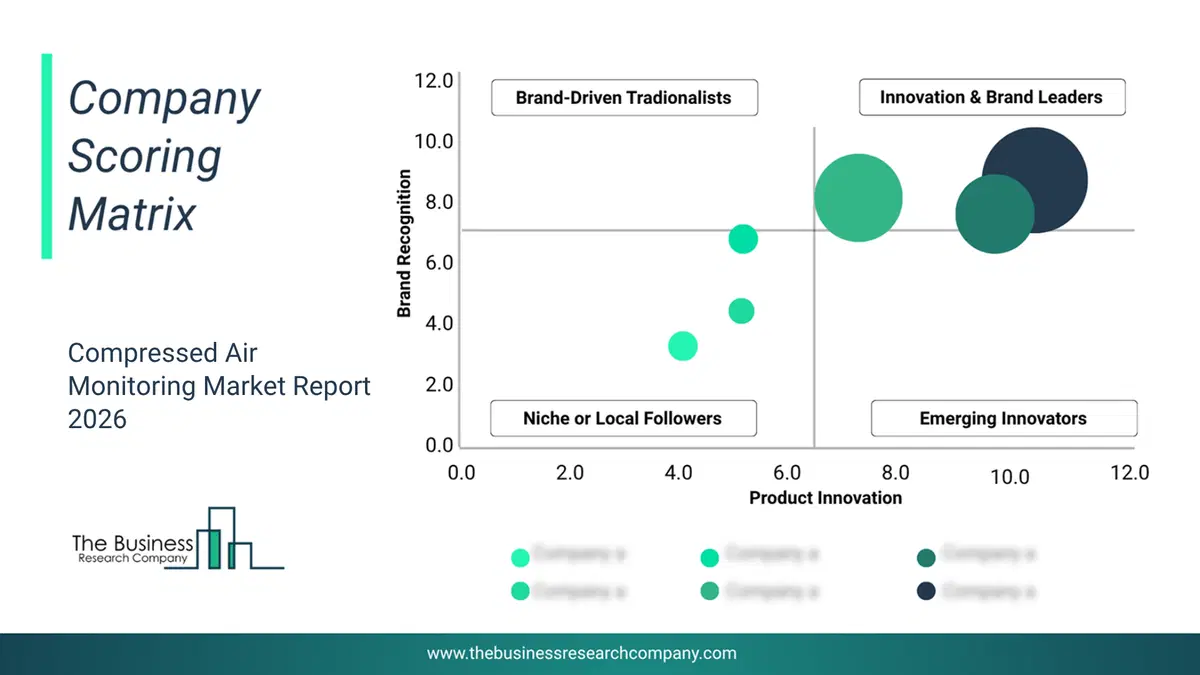
This chart maps companies by product innovation and brand strength, with bubble size indicating relative revenue, helping identify market leaders, challengers, and niche players. This is an illustrative chart; the full report provides a complete and accurate competitive analysis.
Global Compressed Air Monitoring Market Trends and Insights
Major companies operating in the compressed air monitoring market are focusing on leveraging innovative technologies such as internet of things (IoT)-enabled sensors to optimize system performance and reduce energy consumption. Internet of things (IoT)-enabled sensors are smart devices that collect and transmit real-time data over the internet, helping to optimize performance, detect issues early, reduce energy consumption, and enable data-driven decision-making. For instance, in May 2024, Kaeser Compressors Inc., a US-based manufacturing company, launched Kaeser Measurement Technology (KMT), a suite of intelligent sensors designed to provide real-time insights into compressed air systems. The KMT enables seamless integration with Kaeser’s Sigma Network and other industrial automation systems, allowing companies to monitor energy usage, detect inefficiencies, and implement automated adjustments to optimize system performance and reduce operational costs. Featuring Power over Ethernet connectivity, real-time data streaming from energy and flow analyzers, and compatibility with Modbus protocols, the KMT provides unparalleled visibility into system health. It also supports predictive maintenance, helping businesses address potential issues before they cause downtime, while enhancing energy efficiency and sustainability efforts.What Are Latest Mergers And Acquisitions In The Compressed Air Monitoring Market?
In June 2024, Ingersoll Rand Inc., a US-based industrial manufacturing company, acquired Compressed Air and Power Solutions (CAPS) Australia Pty Ltd for an undisclosed amount. With this acquisition, Ingersoll Rand aims to strengthen its presence in the Australian market and enhance its ability to deliver comprehensive air and power solutions by combining CAPS’ local expertise with Ingersoll Rand’s resources and innovation, driving greater operational efficiency, expanding product offerings, and delivering even more value and support to customers across Australia and beyond. CAPS Australia Pty Ltd is an Australia-based manufacturing company that specializes in providing compressed air and power generation solutions, including products, engineering services, and rental equipment.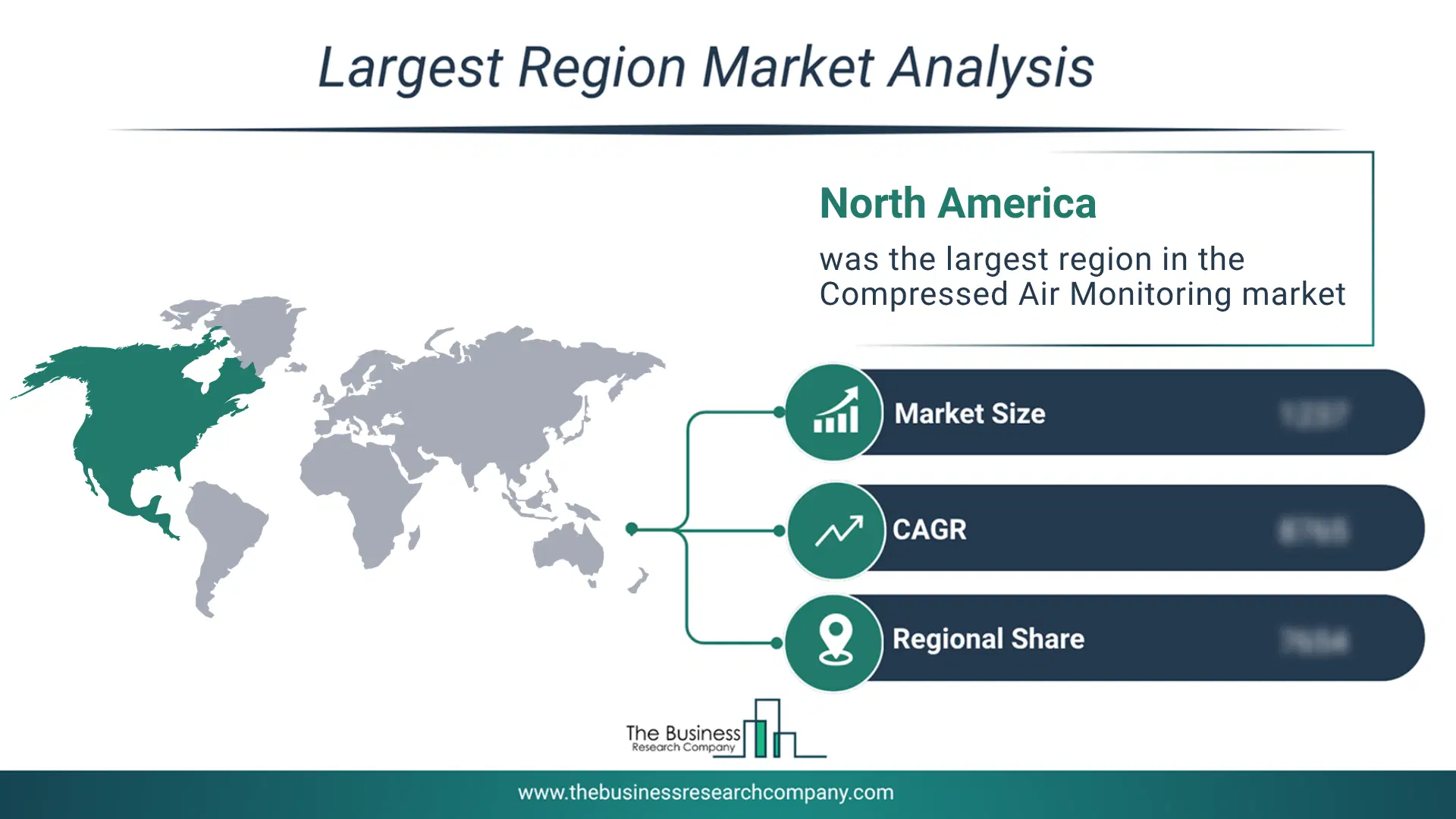
Regional Outlook
North America was the largest region in the compressed air monitoring market in 2025. Asia-Pacific is expected to be the fastest-growing region in the forecast period. The regions covered in this market report are Asia-Pacific, South East Asia, Western Europe, Eastern Europe, North America, South America, Middle East, Africa The countries covered in this market report are Australia, Brazil, China, France, Germany, India, Indonesia, Japan, Taiwan, Russia, South Korea, UK, USA, Canada, Italy, Spain.What Defines the Compressed Air Monitoring Market?
The compressed air monitoring market consists of revenues earned by providing services such as compressed air auditing services, integration services, predictive maintenance services, compliance and audit reporting services, remote monitoring and data management services. The market value includes the value of related goods sold by the service provider or included within the service offering. The compressed air monitoring market also includes sales of leak detection tools, vibration monitoring tools, flow measurement tools, pressure and temperature test tools, and portable air quality testers. Values in this market are ‘factory gate’ values, that is the value of goods sold by the manufacturers or creators of the goods, whether to other entities (including downstream manufacturers, wholesalers, distributors and retailers) or directly to end customers. The value of goods in this market includes related services sold by the creators of the goods.How is Market Value Defined and Measured?
The market value is defined as the revenues that enterprises gain from the sale of goods and/or services within the specified market and geography through sales, grants, or donations in terms of the currency (in USD unless otherwise specified). The revenues for a specified geography are consumption values that are revenues generated by organizations in the specified geography within the market, irrespective of where they are produced. It does not include revenues from resales along the supply chain, either further along the supply chain or as part of other products.
This chart presents market attractiveness based on a quantitative evaluation of growth, competition, strategic alignment, and risk, offering a clear view of opportunity areas for decision-making. This chart is for illustrative purposes; the full report contains the complete analysis.

This chart highlights the Total Addressable Market (TAM) by estimating the maximum revenue opportunity using an assumption-driven approach, supporting strategic planning and opportunity sizing across markets. The chart is illustrative; the full report provides a more comprehensive analysis.
What Key Data and Analysis Are Included in the Compressed Air Monitoring Market Report 2026?
The compressed air monitoring market research report is one of a series of new reports from The Business Research Company that provides market statistics, including industry global market size, regional shares, competitors with the market share, detailed market segments, market trends and opportunities, and any further data you may need to thrive in the compressed air monitoring industry. The market research report delivers a complete perspective of everything you need, with an in-depth analysis of the current and future state of the industry.Compressed Air Monitoring Market Report Forecast Analysis
| Report Attribute | Details |
|---|---|
| Market Size Value In 2026 | $4.29 billion |
| Revenue Forecast In 2030 | $6.37 billion |
| Growth Rate | CAGR of 10.4% from 2026 to 2030 |
| Base Year For Estimation | 2025 |
| Actual Estimates/Historical Data | 2020-2025 |
| Forecast Period | 2026 - 2030 |
| Market Representation | Revenue in USD Billion and CAGR from 2026 to 2030 |
| Segments Covered | Component, Monitoring Type, Application, End-User |
| Regional Scope | Asia-Pacific, Western Europe, Eastern Europe, North America, South America, Middle East, Africa |
| Key Companies Profiled | Siemens AG, Schneider Electric SE, Atlas Copco AB, Emerson Electric Co., Ingersoll Rand Inc., Parker Hannifin Corporation, Endress+Hauser Group, Kaeser Kompressoren SE, SICK AG, Beko Technologies GmbH, CS Instruments GmbH & Co. KG, VPInstruments B.V., Process Sensing Technologies Ltd., Donaldson Company Inc., Halma plc, Forbes Marshall Pvt. Ltd., Pentair plc, Teledyne Technologies Incorporated, Gardner Denver Inc., Bauer Kompressoren GmbH, ABB Ltd., Honeywell International Inc. |
| Customization Scope | Request for Customization |
| Pricing And Purchase Options | Explore Purchase Options |