
Compressed Natural Gas Market Report 2026
Global Outlook – By Gas Origin (Non-Associated Gas, Associated Gas, Unconventional Sources), By Product Type (Dedicated Fuel, Bi-Fuel, Dual Fuel), By Application (Light Passenger Vehicles, Medium Or Heavy Duty Vehicles, Other Applications) – Market Size, Trends, Strategies, and Forecast to 2030
Compressed Natural Gas Market Overview
• Compressed Natural Gas market size has reached to $211.06 billion in 2025 • Expected to grow to $379.84 billion in 2030 at a compound annual growth rate (CAGR) of 12.7% • Growth Driver: Surging Number Of CNG-Powered Vehicles Drives Growth In The Compressed Natural Gas Market • Market Trend: Advancements In Decentralized, Low-Emission Gas Compression Technologies Driving Cleaner Fuel Adoption • Asia-Pacific was the largest region in 2025.Market Gains By 2030 – Top Opportunities By Segment
Market Gain identifies the most promising market opportunities by highlighting the segments or products expected to generate the highest incremental revenue growth over the next five years.
What Is Covered Under Compressed Natural Gas Market?
Compressed natural gas refers to a mixture of hydrocarbon gases and vapors that is predominantly made up of compressed methane in gaseous form for use as a fuel to power automobiles. Compressed natural gas is employed in a variety of light-, medium-, and heavy-duty uses to achieve almost the same fuel efficiency as normal gasoline. The main types of compressed natural gas are non-associated gas, associated gas, and unconventional sources. Non-associated gas refers to natural gas derived from a gas-targeted or natural gas well as opposed to an oil well and it is commonly used to produce natural gas that is used as a fuel source. Major product types are dedicated fuel, bi-fuel, and dual fuel that is used in various applications such as light passenger vehicles, medium or heavy-duty vehicles, and others.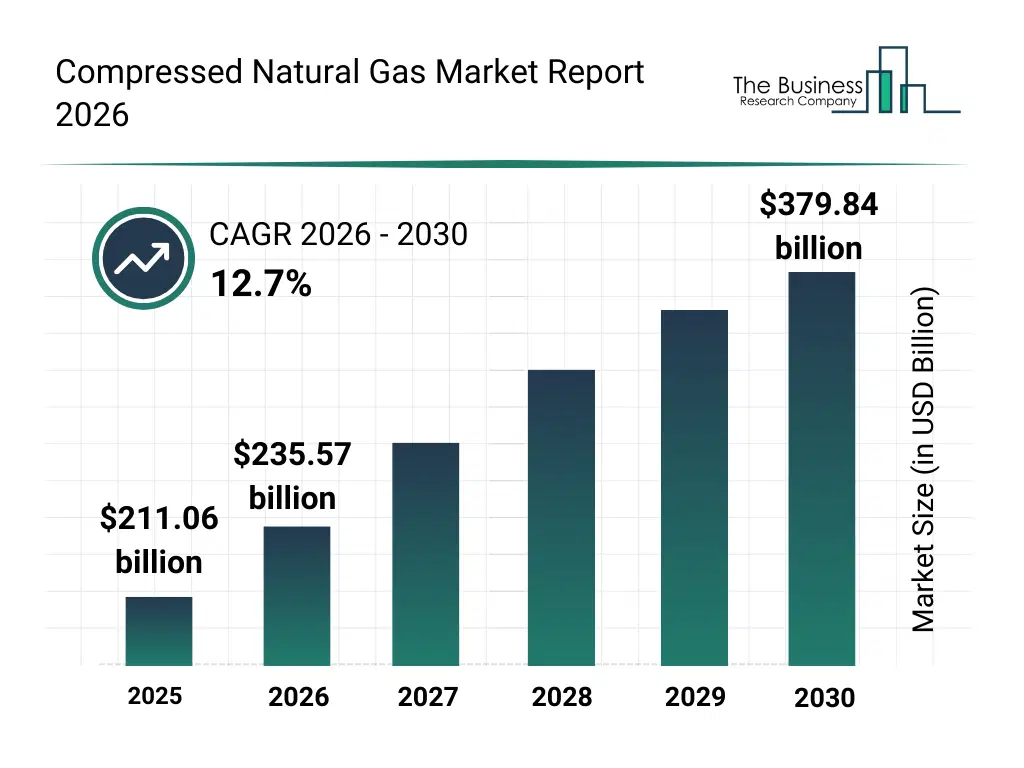
What Is The Compressed Natural Gas Market Size and Share 2026?
The compressed natural gas market size has grown rapidly in recent years. It will grow from $211.06 billion in 2025 to $235.57 billion in 2026 at a compound annual growth rate (CAGR) of 11.6%. The growth in the historic period can be attributed to high gasoline and diesel prices, availability of natural gas reserves, early adoption in public transport fleets, government incentives for clean fuels, development of city gas networks.What Is The Compressed Natural Gas Market Growth Forecast?
The compressed natural gas market size is expected to see rapid growth in the next few years. It will grow to $379.84 billion in 2030 at a compound annual growth rate (CAGR) of 12.7%. The growth in the forecast period can be attributed to stringent vehicle emission norms, expansion of urban gas infrastructure, rising demand for cost effective fuels, growth of commercial vehicle fleets, integration of renewable natural gas. Major trends in the forecast period include rising adoption of cng powered vehicles, expansion of cng refueling infrastructure, growing use of cng in public transportation, increasing adoption of bi fuel and dual fuel vehicles, rising demand for low emission automotive fuels.
Global Compressed Natural Gas Market Segmentation
1) By Gas Origin: Non-Associated Gas, Associated Gas, Unconventional Sources 2) By Product Type: Dedicated Fuel, Bi-Fuel, Dual Fuel 3) By Application: Light Passenger Vehicles, Medium Or Heavy Duty Vehicles, Other Applications Subsegments: 1) By Non-Associated Gas: Dry Gas, Wet Gas 2) By Associated Gas: Gas Produced With Oil (Associated Gas), Gas From Oil Fields 3) By Unconventional Sources: Shale Gas, Coalbed Methane (CBM), Tight Gas The top segments in the compressed natural gas market will be: • Non-Associated Gas will reach $200.2 Billion by 2030. • Associated Gas will reach $125.73 Billion by 2030. • Unconventional Sources will reach $53.17 Billion by 2030.What Is The Driver Of The Compressed Natural Gas Market?
The rise in the number of CNG-powered vehicles is expected to propel the growth of the compressed natural gas market going forward. CNG-powered vehicles are vehicles that are fueled solely by the combustion of compressed natural gas (CNG) as an alternative to other fossil fuels. The number of CNG-powered vehicles is rising because CNG offers a cleaner-burning and more cost-effective alternative to conventional petrol and diesel, helping reduce fuel expenses while lowering vehicular emissions. Compressed natural gas (CNG), by providing a cleaner, efficient, and high-energy-density fuel alternative, supports CNG-powered vehicles by reducing greenhouse gas emissions, lowering operating costs, extending engine life, and enabling sustainable transportation solutions for both urban and long-distance mobility. For instance, in March 2024, according to Autocar Professional an India-based B2B automotive industry publication, total sales of CNG-powered vehicles in FY2023 were 6,79,822 which increased by 38% and reached 9,39,615 in FY2024. Therefore, the rise in CNG-powered vehicles is driving the growth of the compressed natural gas industry.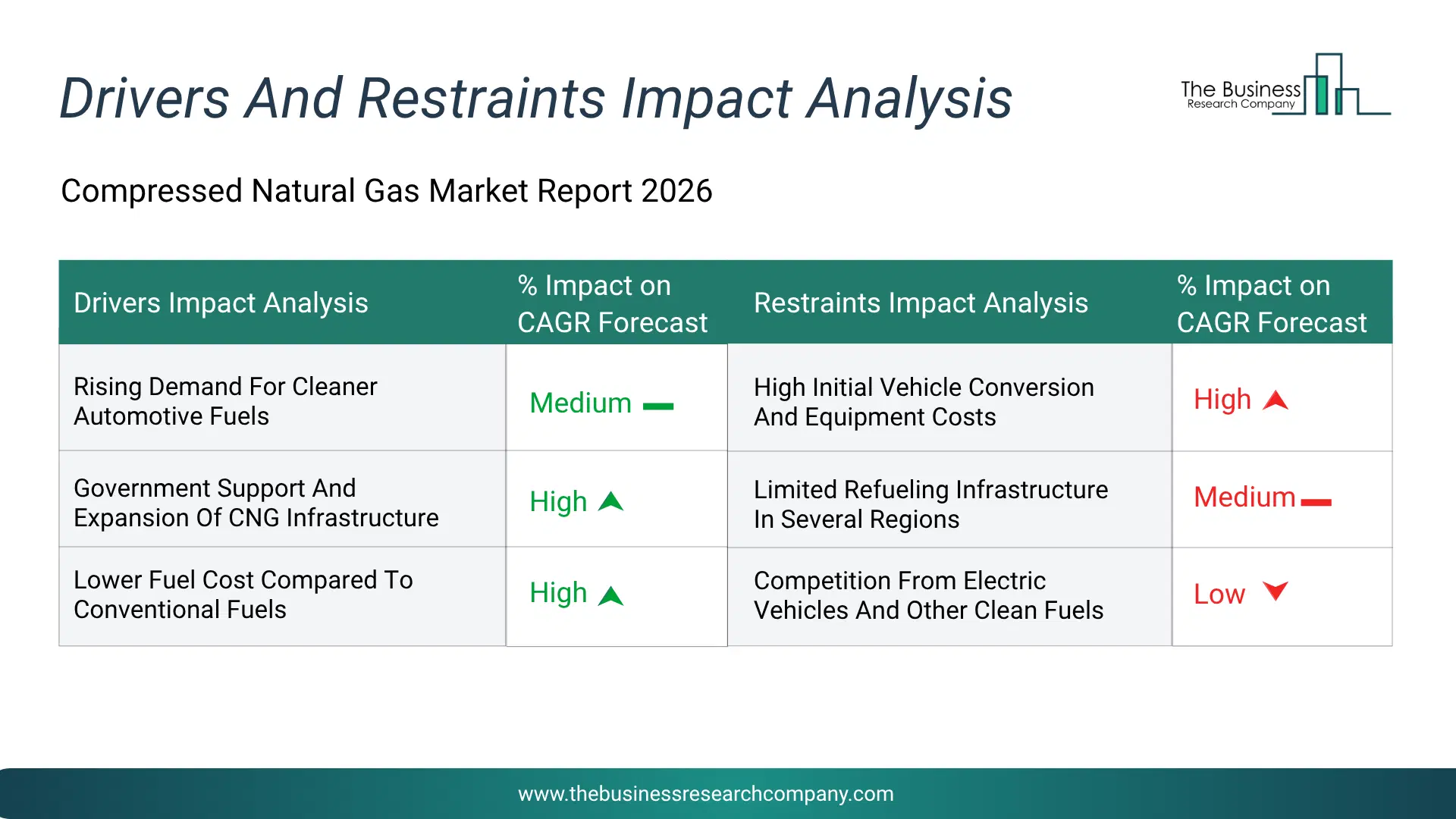
Infographic Chart Showing Key Market Drivers Analysis And Restraints For Compressed Natural Gas Market
The chart presents an impact analysis of key drivers and restraints, quantifying their relative influence on the market's growth rate and helping assess the balance between growth enablers and limiting factors. This chart offers a high-level perspective; the full report contains more detailed insights.
How Will The Drivers Impact Growth In The Global Compressed Natural Gas Market?
• Rising Demand For Cleaner Automotive Fuels (Medium) – During the forecast period, the rising demand for cleaner automotive fuels is expected to become a key growth driver for the compressed natural gas market by 2030. Transportation operators are increasingly adopting CNG as a lower-emission alternative to conventional liquid fuels to reduce environmental impact and comply with evolving sustainability objectives. CNG-powered vehicles generate fewer particulate emissions and greenhouse gases, making them attractive for urban transportation and commercial fleet applications. Growing awareness of air quality concerns and corporate decarbonization commitments is further strengthening market adoption. • Government Support And Expansion Of CNG Infrastructure (High) – During the forecast period, the government support and expansion of CNG infrastructure is expected to emerge as a major factor driving the expansion of the compressed natural gas market by 2030. Public and private sector investments are accelerating the deployment of refueling stations, pipeline connectivity, and gas distribution systems to improve accessibility and fuel availability. Regulatory initiatives promoting alternative fuel usage are encouraging fleet operators and consumers to transition toward natural gas-powered vehicles. Enhanced infrastructure coverage is also reducing operational barriers and increasing confidence in long-term CNG utilization. • Lower Fuel Cost Compared To Conventional Fuels (High) – During the forecast period, the lower fuel cost compared to conventional fuels is expected to act as a key growth catalyst for the compressed natural gas market by 2030. Businesses and vehicle owners are increasingly seeking economical fuel alternatives to manage transportation expenses and improve operating margins. CNG offers significant cost advantages over gasoline and diesel in many markets, making it particularly attractive for high-mileage commercial fleets. The potential for long-term fuel savings is encouraging broader adoption across passenger and commercial vehicle segments.How Will The Restraints Impact Growth In The Global Compressed Natural Gas Market?
• High Initial Vehicle Conversion And Equipment Costs (Medium) – During the forecast period, the high initial vehicle conversion and equipment costs are a major restraint for the compressed natural gas (CNG) market. Adopting CNG often requires purchasing CNG-compatible vehicles or converting existing vehicles using specialized kits, cylinders, and fuel systems. These upfront expenses can be significant for individual consumers and fleet operators, especially in price-sensitive markets. Additional costs for maintenance, certification, and refueling equipment may further discourage adoption. As a result, high initial investment requirements can slow the wider growth of the CNG market. • Limited Refueling Infrastructure In Several Regions (High) – During the forecast period, the limited refueling infrastructure in several regions is a key restraint for the compressed natural gas (CNG) market. Many countries and local markets still lack an adequate number of CNG filling stations, making fuel access less convenient for vehicle owners. This can create concerns about travel range, longer waiting times, and route limitations, especially in rural or underdeveloped areas. Fleet operators may also hesitate to expand CNG vehicle adoption without reliable refueling networks. As a result, insufficient infrastructure can slow market penetration and broader CNG adoption.. • Competition From Electric Vehicles And Other Clean Fuels (High) – During the forecast period, the competition from electric vehicles and other clean fuels is a major restraint for the compressed natural gas (CNG) market. Rapid adoption of electric vehicles, hybrids, hydrogen fuel technologies, and biofuels is providing alternative low-emission transportation options. Many governments and automakers are prioritizing electric mobility through incentives, charging infrastructure, and long-term decarbonization strategies. These trends can reduce investment focus and consumer interest in CNG-powered vehicles. As a result, growing competition from alternative clean fuels may limit future demand growth for the CNG market.Key Players In The Global Compressed Natural Gas Market
Major companies operating in the compressed natural gas market are Royal Dutch Shell plc, TotalEnergies SE, Chevron Corporation, Phillips 66 Company, PJSC Gazprom, ConocoPhillips Company, Parker Hannifin Corporation, Trillium Energy Partners LLC, Chart Industries Inc., Cavagna Group SpA, NeoGas Inc., Luxfer Holdings plc, Clean Energy Fuels Corp., J-W Power Company, Hexagon Composites ASA, Oasis Engineering Ltd., Agility Fuel Solutions LLC, Galileo Technologies S.A., Xebec Adsorption Inc., ANGI Energy Systems LLC, NG Advantage LLC, TGT Fuel Technologies Private Limited, National Iranian Gas Company, Pakistan State Oil Company Limited, Quantum Fuel Systems LLC, Compressed Natural Gas Services Ltd., Tomasetto Achille S.p.A.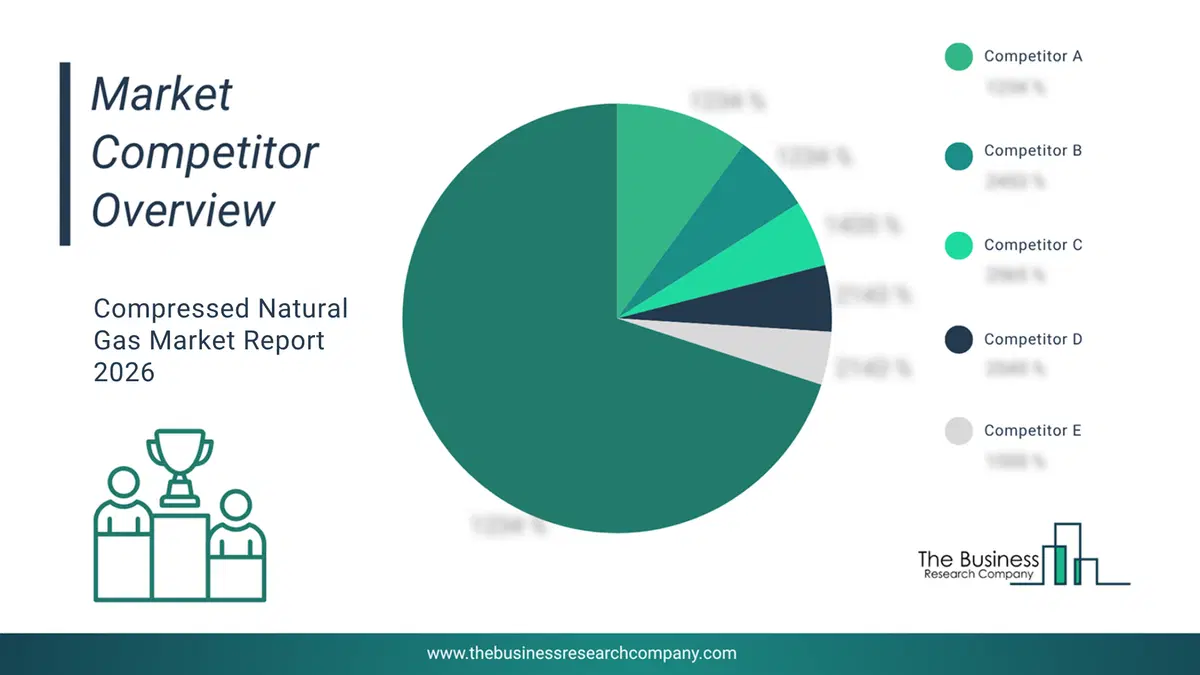
This chart is for illustrative purposes; the full report includes a detailed competitor analysis and comprehensive overview of the top 10 companies in the market.
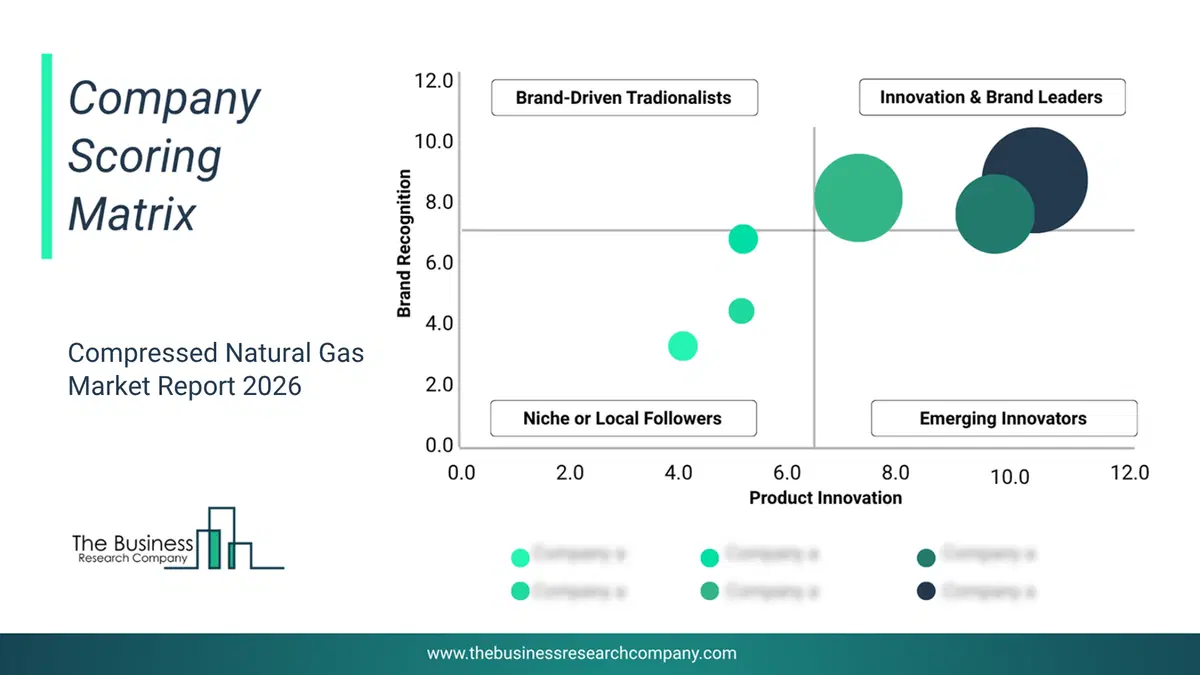
This chart maps companies by product innovation and brand strength, with bubble size indicating relative revenue, helping identify market leaders, challengers, and niche players. This is an illustrative chart; the full report provides a complete and accurate competitive analysis.
Global Compressed Natural Gas Market Trends and Insights
Major companies operating in the compressed natural gas (CNG) market are focusing on developing innovative solutions such as advanced CNG production technologies to enable cleaner, decentralized energy and reduce reliance on conventional compressors. Advanced CNG production technologies harness naturally occurring high pressures from deep shale formations to compress natural gas efficiently, lowering capital and operating costs while minimizing environmental impact. For instance, in April 2024, CNX Resources Corporation, a US-based natural gas development and technology company, launched ZeroHP CNG, a first-of-its-kind system that uses geobaric pressure from shale to fill virtual pipeline trailers rapidly. This innovative system reduces emissions, cuts maintenance requirements, and allows deployment in remote locations, compared with traditional compressor-based systems, while supporting faster, more economical access to CNG.What Are Latest Mergers And Acquisitions In The Compressed Natural Gas Market?
In February 2023, Shell Petroleum N.V., a US-based energy and petrochemical company acquired Nature Energy Biogas A/S for a deal of $2 billion. Through this acquisition, Shell Petroleum N.V. aims to establish a globally integrated value chain and to economically expand its low-carbon products to consumers across numerous industries. Nature Energy Biogas A/S is a Denmark-based producer of natural gases including CNG and biogases.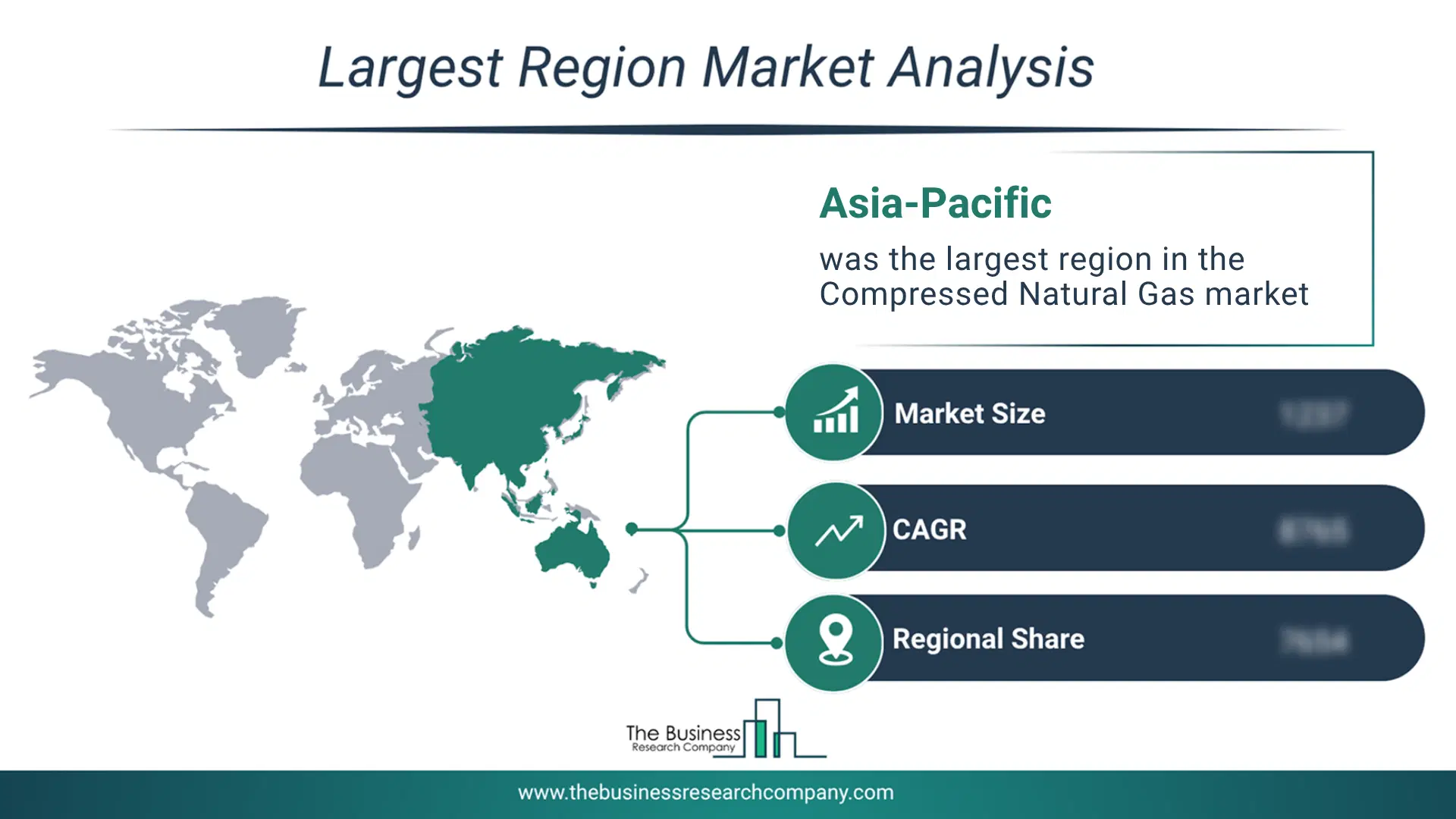
Regional Outlook
Asia-Pacific was the largest region in the compressed natural gas market in 2025. The regions covered in this market report are Asia-Pacific, South East Asia, Western Europe, Eastern Europe, North America, South America, Middle East, Africa. The countries covered in this market report are Australia, Brazil, China, France, Germany, India, Indonesia, Japan, Taiwan, Russia, South Korea, UK, USA, Canada, Italy, SpainWhat Defines the Compressed Natural Gas Market?
The compressed natural gas market consists of sales of compressed natural gas used to power motor vehicles. Values in this market are ‘factory gate’ values, that is, the value of goods sold by the manufacturers or creators of the goods, whether to other entities (including downstream manufacturers, wholesalers, distributors, and retailers) or directly to end customers. The value of goods in this market includes related services sold by the creators of the goods.How is Market Value Defined and Measured?
The market value is defined as the revenues that enterprises gain from the sale of goods and/or services within the specified market and geography through sales, grants, or donations in terms of the currency (in USD unless otherwise specified). The revenues for a specified geography are consumption values that are revenues generated by organizations in the specified geography within the market, irrespective of where they are produced. It does not include revenues from resales along the supply chain, either further along the supply chain or as part of other products.
This chart presents market attractiveness based on a quantitative evaluation of growth, competition, strategic alignment, and risk, offering a clear view of opportunity areas for decision-making. This chart is for illustrative purposes; the full report contains the complete analysis.

This chart highlights the Total Addressable Market (TAM) by estimating the maximum revenue opportunity using an assumption-driven approach, supporting strategic planning and opportunity sizing across markets. The chart is illustrative; the full report provides a more comprehensive analysis.
What Key Data and Analysis Are Included in the Compressed Natural Gas Market Report 2026?
The compressed natural gas market research report is one of a series of new reports from The Business Research Company that provides market statistics, including industry global market size, regional shares, competitors with the market share, detailed market segments, market trends and opportunities, and any further data you may need to thrive in the compressed natural gas industry. The market research report delivers a complete perspective of everything you need, with an in-depth analysis of the current and future state of the industry.Compressed Natural Gas Market Report Forecast Analysis
| Report Attribute | Details |
|---|---|
| Market Size Value In 2026 | $235.57 billion |
| Revenue Forecast In 2030 | $379.84 billion |
| Growth Rate | CAGR of 12.7% from 2026 to 2030 |
| Base Year For Estimation | 2025 |
| Actual Estimates/Historical Data | 2020-2025 |
| Forecast Period | 2026 - 2030 |
| Market Representation | Revenue in USD Billion and CAGR from 2026 to 2030 |
| Segments Covered | Gas Origin, Product Type, Application |
| Regional Scope | Asia-Pacific, Western Europe, Eastern Europe, North America, South America, Middle East, Africa |
| Country Scope | The countries covered in the report are Australia, Brazil, China, France, Germany, India, Indonesia, Japan, Taiwan, Russia, South Korea, UK, USA, Canada, Italy, Spain. |
| Key Companies Profiled | Royal Dutch Shell plc, TotalEnergies SE, Chevron Corporation, Phillips 66 Company, PJSC Gazprom, ConocoPhillips Company, Parker Hannifin Corporation, Trillium Energy Partners LLC, Chart Industries Inc., Cavagna Group SpA, NeoGas Inc., Luxfer Holdings plc, Clean Energy Fuels Corp., J-W Power Company, Hexagon Composites ASA, Oasis Engineering Ltd., Agility Fuel Solutions LLC, Galileo Technologies S.A., Xebec Adsorption Inc., ANGI Energy Systems LLC, NG Advantage LLC, TGT Fuel Technologies Private Limited, National Iranian Gas Company, Pakistan State Oil Company Limited, Quantum Fuel Systems LLC, Compressed Natural Gas Services Ltd., Tomasetto Achille S.p.A. |
| Customization Scope | Request for Customization |
| Pricing And Purchase Options | Explore Purchase Options |