

Compressor Oil Market Report 2026
Global Outlook – By Base Oil (Mineral, Synthetic, Semi-Synthetic), By Compressor Type (Positive Displacement, Reciprocating, Rotary Screw, Other Compressors, Dynamic, Radial Flow, Axial Flow), By End-Use Industry (Manufacturing, Oil And Gas, Power Generation, Automotive, Other End-Use Industries) – Market Size, Trends, Strategies, and Forecast to 2030
Compressor Oil Market Overview
• Compressor Oil market size has reached to $10.13 billion in 2025 • Expected to grow to $14.04 billion in 2030 at a compound annual growth rate (CAGR) of 6.6% • Growth Driver: Petroleum And Natural Gas Sector Drive Surge In Compressor Oil Market • Market Trend: Advancements In Compressor Oil Technology • Asia-Pacific was the largest region and fastest growing region.What Is Covered Under Compressor Oil Market?
Compressor oil is a fluid composed of refined paraffinic base oils and additives that provide excellent lubrication for a wide range of rotary and reciprocating air compressors. The fluids' thermal stability and oxidation resistance can help keep compressors cleaner, allowing for longer periods between scheduled maintenance and oil changes. The base oils of the compressor oil market are mineral, synthetic, and semi-synthetic. Mineral oil refers to high-performance compressor oils with superior lubrication, outstanding low-foaming properties, excellent oxidation and thermal stability, excellent rust and corrosion resistance, and impressive water separation properties. The compressor involves positive displacement, reciprocating, a rotary screw, other type (centrifugal), dynamic, radial flow, and axial flow. The end-use includes manufacturing, oil and gas, power generation, automotive use, and other end-uses.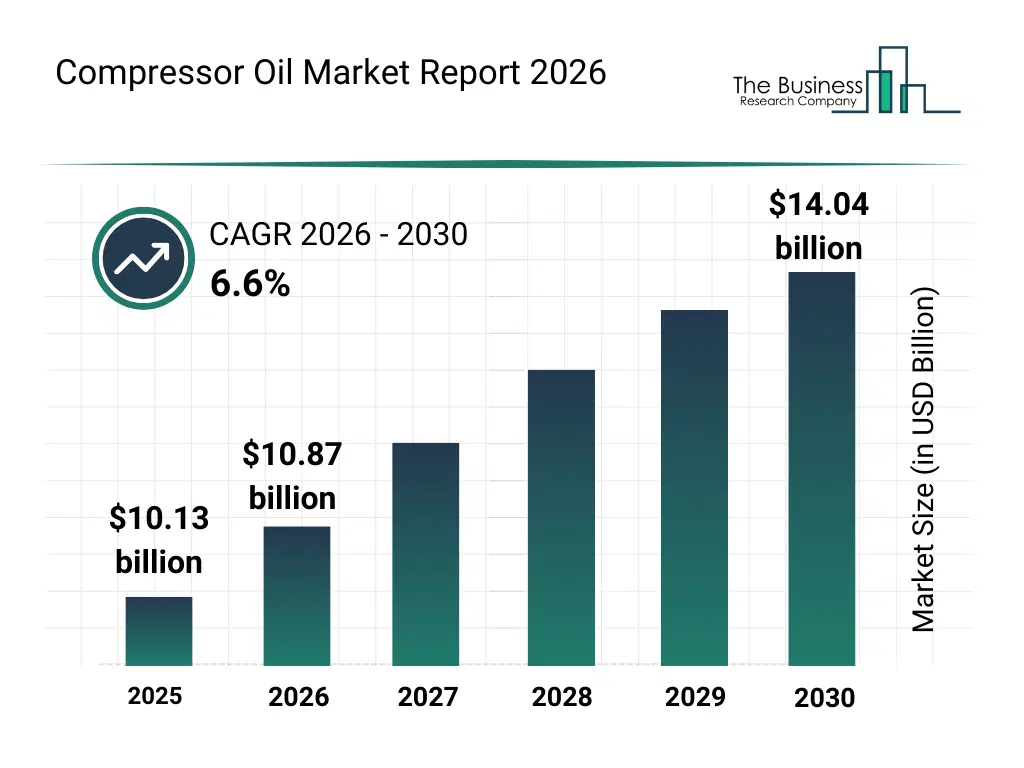
What Is The Compressor Oil Market Size and Share 2026?
The compressor oil market size has grown strongly in recent years. It will grow from $10.13 billion in 2025 to $10.87 billion in 2026 at a compound annual growth rate (CAGR) of 7.3%. The growth in the historic period can be attributed to expansion of industrial manufacturing activity, increasing deployment of rotary screw compressors, growth of oil and gas processing facilities, rising demand for reliable compressor maintenance, availability of advanced lubricant formulations.What Is The Compressor Oil Market Growth Forecast?
The compressor oil market size is expected to see strong growth in the next few years. It will grow to $14.04 billion in 2030 at a compound annual growth rate (CAGR) of 6.6%. The growth in the forecast period can be attributed to increasing focus on energy-efficient industrial systems, rising adoption of synthetic and semi-synthetic oils, expansion of predictive maintenance practices, growing demand from power generation facilities, increasing investments in industrial automation. Major trends in the forecast period include increasing adoption of high-performance synthetic compressor oils, rising demand for extended oil drain intervals, growing focus on oxidation and thermal stability, expansion of energy-efficient compressor operations, enhanced monitoring of lubrication performance.
Global Compressor Oil Market Segmentation
1) By Base Oil: Mineral, Synthetic, Semi-Synthetic 2) By Compressor Type: Positive Displacement, Reciprocating, Rotary Screw, Other Compressors, Dynamic, Radial Flow, Axial Flow 3) By End-Use Industry: Manufacturing, Oil And Gas, Power Generation, Automotive, Other End-Use Industries Subsegments: 1) By Mineral: Group I, Group II, Group III 2) By Synthetic: PAO (Polyalphaolefin), Ester-Based 3) By Semi-Synthetic: Blend Of Mineral And Synthetic OilsWhat Is The Driver Of The Compressor Oil Market?
Growing demand from the petroleum and natural gas industry is expected to propel the compressor oil market going forward. Petroleum and natural gas refer to nonrenewable sources of energy. Petroleum is a liquid mixture found underground that can be used to make gasoline and diesel fuel, whereas natural gas is a fossil fuel energy source. Compressor oil is used in the petrochemical industry to prevent premature wear and tear in air compressors that are necessary to increase the pressure of the gas being transported as it travels through the pipes to the source. For instance, in April 2024, according to the U.S. Energy Information Administration (EIA), a US-based principal agency of the U.S. Federal Statistical System, in 2023, U.S. natural gas exports reached a record average of 20.9 billion cubic feet per day (Bcf/d), marking an increase of approximately 10% over 2022. Among these exports, liquefied natural gas (LNG) shipments rose by around 12%, or roughly 1.3 Bcf/d, compared with the previous year. Therefore, the growing demand from the petroleum and natural gas industry is driving the growth of the compressor oil industry.Key Players In The Global Compressor Oil Market
Major companies operating in the compressor oil market are Shell plc, Chevron Corporation, Exxon Mobil Corporation, Fuchs Group, TotalEnergies SE, British Petroleum Public Limited Company, ENEOS Corporation, BASF SE, Valvoline Cummins Inc., CASTROL Limited, Sasol Limited, HP Lubricants, Morris Lubricants, Idemitsu Kosan Co. Ltd., Repsol S.A., Lubrizol Corporation, Lukoil, Quaker Houghton, Petro-Canada, Gulf Oil Corporation Limited, Kluber Lubrication, Indian Oil Corporation Limited, Sinopec Group, Cosmo Oil Marketing Co. Ltd., National Petroleum Limited- Petronas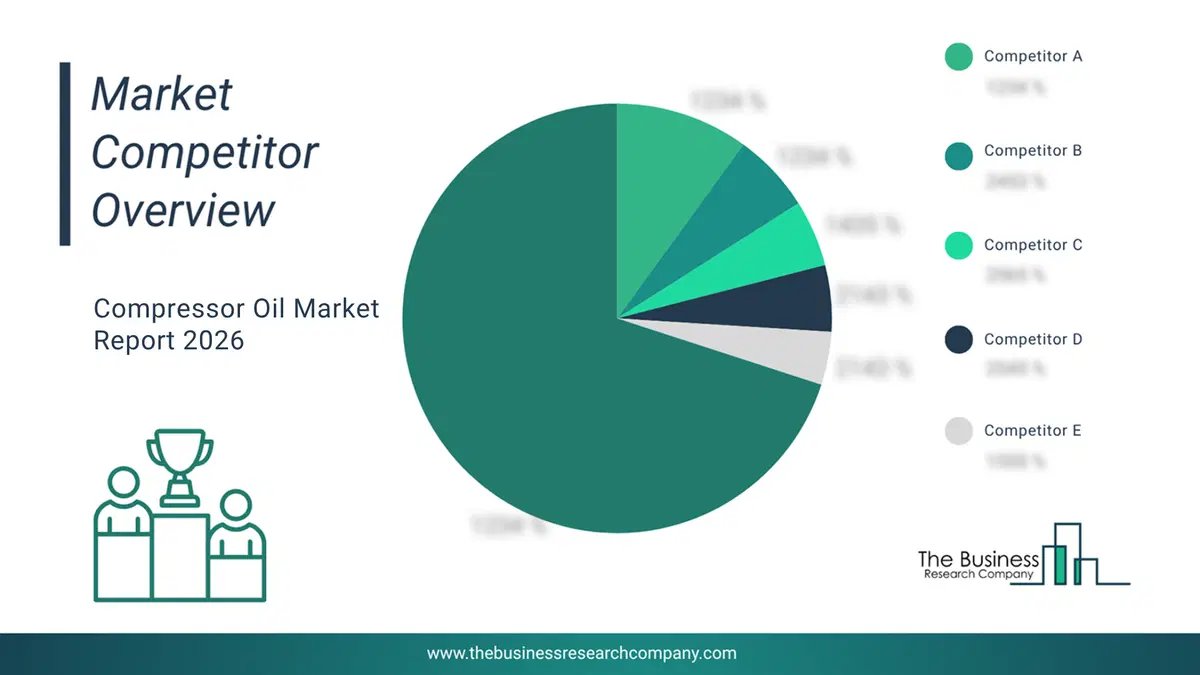
This chart is for illustrative purposes; the full report includes a detailed competitor analysis and comprehensive overview of the top 10 companies in the market.
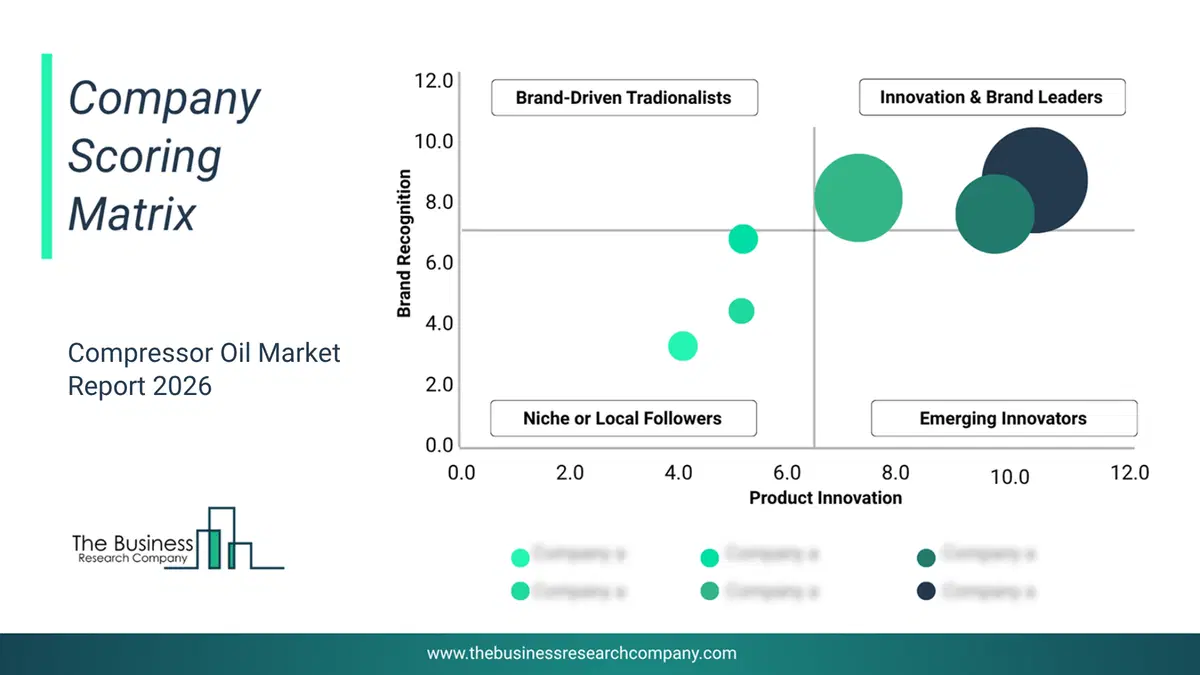
This chart maps companies by product innovation and brand strength, with bubble size indicating relative revenue, helping identify market leaders, challengers, and niche players. This is an illustrative chart; the full report provides a complete and accurate competitive analysis.
Global Compressor Oil Market Trends and Insights
Major companies operating in the compressor oil market are focusing on developing advanced lubricants to improve operational efficiency, reduce equipment wear, and meet environmental regulations. High-performance compressor oils are designed to provide superior thermal stability, reduce friction, and enhance biodegradability, supporting both sustainability and maintenance optimization. For instance, in October 2024, Idemitsu Lubricants America, a US-based lubricant manufacturer, launched a new range of Polyalkylene Glycol (PAG) compressor oils. These oils are engineered for high energy efficiency and reduced friction, offering enhanced biodegradability to comply with environmental standards. The company highlighted that these products feature exceptional thermal stability, extending the lifespan of compressors while minimizing maintenance needs.What Are Latest Mergers And Acquisitions In The Compressor Oil Market?
In May 2023, AMSOIL Inc., a US-based fuel company, acquired Benz Oil for an undisclosed amount. This acquisition expands AMSOIL's industrial business unit, boosting its capabilities and expertise with industrial fluids. Benz Oil is a US-based company specializing in the development, manufacture, and supply of industrial and metalworking fluids.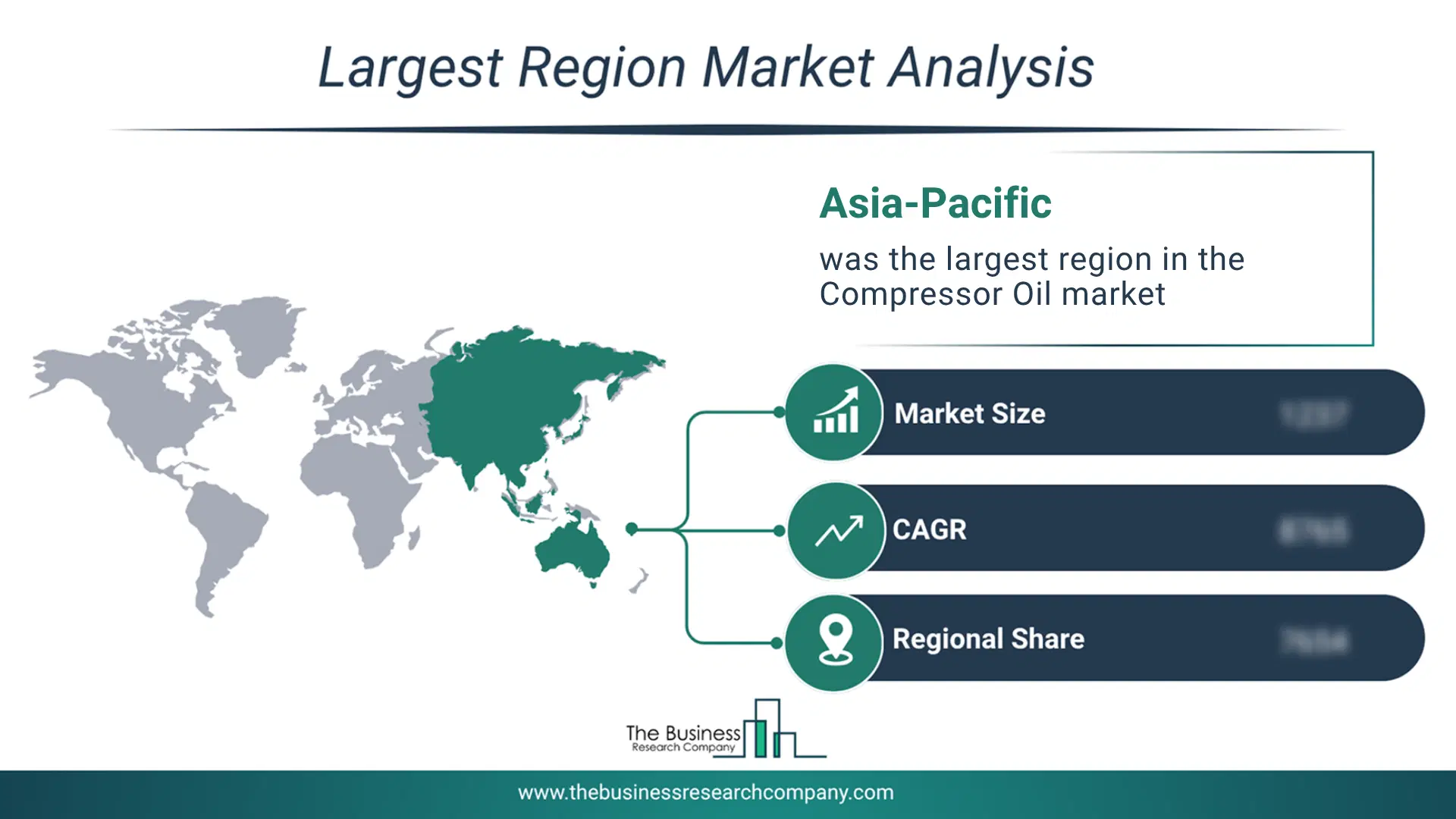
Regional Insights
Asia-Pacific was the largest region in the compressor oil market in 2025 and is expected to be the fastest-growing region in the forecast period. The regions covered in this market report are Asia-Pacific, South East Asia, Western Europe, Eastern Europe, North America, South America, Middle East, Africa The countries covered in this market report are Australia, Brazil, China, France, Germany, India, Indonesia, Japan, Taiwan, Russia, South Korea, UK, USA, Canada, Italy, SpainWhat Defines the Compressor Oil Market?
The compressor oil market consists of sales of lubrication base oils, aromatic amine, alkylphenol, and tri-ester of dithiophosphoric acid. Values in this market are ‘factory gate’ values, that is the value of goods sold by the manufacturers or creators of the goods, whether to other entities (including downstream manufacturers, wholesalers, distributors, and retailers) or directly to end customers. The value of goods in this market includes related services sold by the creators of the goods.How is Market Value Defined and Measured?
The market value is defined as the revenues that enterprises gain from the sale of goods and/or services within the specified market and geography through sales, grants, or donations in terms of the currency (in USD unless otherwise specified). The revenues for a specified geography are consumption values that are revenues generated by organizations in the specified geography within the market, irrespective of where they are produced. It does not include revenues from resales along the supply chain, either further along the supply chain or as part of other products.
This chart presents market attractiveness based on a quantitative evaluation of growth, competition, strategic alignment, and risk, offering a clear view of opportunity areas for decision-making. This chart is for illustrative purposes; the full report contains the complete analysis.

This chart highlights the Total Addressable Market (TAM) by estimating the maximum revenue opportunity using an assumption-driven approach, supporting strategic planning and opportunity sizing across markets. The chart is illustrative; the full report provides a more comprehensive analysis.
What Key Data and Analysis Are Included in the Compressor Oil Market Report 2026?
The compressor oil market research report is one of a series of new reports from The Business Research Company that provides market statistics, including industry global market size, regional shares, competitors with the market share, detailed market segments, market trends and opportunities, and any further data you may need to thrive in the compressor oil industry. The market research report delivers a complete perspective of everything you need, with an in-depth analysis of the current and future state of the industry.Compressor Oil Market Report Forecast Analysis
| Report Attribute | Details |
|---|---|
| Market Size Value In 2026 | $10.87 billion |
| Revenue Forecast In 2030 | $14.04 billion |
| Growth Rate | CAGR of 7.3% from 2026 to 2030 |
| Base Year For Estimation | 2025 |
| Actual Estimates/Historical Data | 2020-2025 |
| Forecast Period | 2026 - 2030 |
| Market Representation | Revenue in USD Billion and CAGR from 2026 to 2030 |
| Segments Covered | Base Oil, Compressor Type, End-Use Industry |
| Regional Scope | Asia-Pacific, Western Europe, Eastern Europe, North America, South America, Middle East, Africa |
| Country Scope | The countries covered in this market report are Australia, Brazil, China, France, Germany, India, Indonesia, Japan, Taiwan, Russia, South Korea, UK, USA, Canada, Italy, Spain |
| Key Companies Profiled | Shell plc, Chevron Corporation, Exxon Mobil Corporation, Fuchs Group, TotalEnergies SE, British Petroleum Public Limited Company, ENEOS Corporation, BASF SE, Valvoline Cummins Inc., CASTROL Limited, Sasol Limited, HP Lubricants, Morris Lubricants, Idemitsu Kosan Co. Ltd., Repsol S.A., Lubrizol Corporation, Lukoil, Quaker Houghton, Petro-Canada, Gulf Oil Corporation Limited, Kluber Lubrication, Indian Oil Corporation Limited, Sinopec Group, Cosmo Oil Marketing Co. Ltd., National Petroleum Limited- Petronas |
| Customization Scope | Request for Customization |
| Pricing And Purchase Options | Explore Purchase Options |