
Computer-Based Sensing Market Report 2026
Global Outlook – By Component (Hardware, Software, Services), By Sensor Type (Vision Sensors, Motion Sensors, Temperature Sensors, Acoustic Sensors, Environmental Sensors, Proximity Sensors), By Technology (Artificial Intelligence Based Sensing, Machine Vision Technology, Sensor Fusion Technology, Internet Of Things Enabled Sensing, Edge Computing Based Sensing), By Application (Industrial Automation, Smart Cities, Autonomous Vehicles, Healthcare Monitoring, Security And Surveillance, Consumer Electronics), By End User (Manufacturing, Automotive, Healthcare, Consumer Electronics, Aerospace And Defense, Retail) – Market Size, Trends, Strategies, and Forecast to 2030
Computer-Based Sensing Market Overview
• Computer-Based Sensing market size has reached to $59.48 billion in 2025 • Expected to grow to $71.25 billion in 2030 at a compound annual growth rate (CAGR) of 20% • Growth Driver: Rising Adoption Of Robotics And Intelligent Machines Fueling The Growth Of The Market Due To Increasing Demand For Automation, Precision, And Smart Decision-making • Market Trend: On-Device AI Image Processing Accelerates Computer-Based Sensing Development • North America was the largest region in 2025 and Asia-Pacific is the fastest growing region.What Is Covered Under Computer-Based Sensing Market?
Computer-based sensing refers to advanced sensing systems that combine physical sensors with computational intelligence to detect, interpret, and analyze real-world signals. It integrates embedded computing, artificial intelligence, and signal processing to convert raw sensor inputs into meaningful digital insights for automated decision-making and real-time responsiveness. It enables highly accurate perception capabilities across connected devices, machines, and environments. The main components of computer-based sensing include hardware, software, and services. Hardware refers to physical devices used in computer-based sensing systems, such as sensors, cameras, and signal processors, that capture and convert real-world data into digital information. The sensor types include vision sensors, motion sensors, temperature sensors, acoustic sensors, environmental sensors, and proximity sensors, and the technologies include artificial intelligence-based sensing, machine vision technology, sensor fusion technology, internet of things enabled sensing, and edge computing-based sensing, and the applications include industrial automation, smart cities, autonomous vehicles, healthcare monitoring, security and surveillance, and consumer electronics, and the key end-users manufacturing, automotive, healthcare, consumer electronics, aerospace and defence, and retail.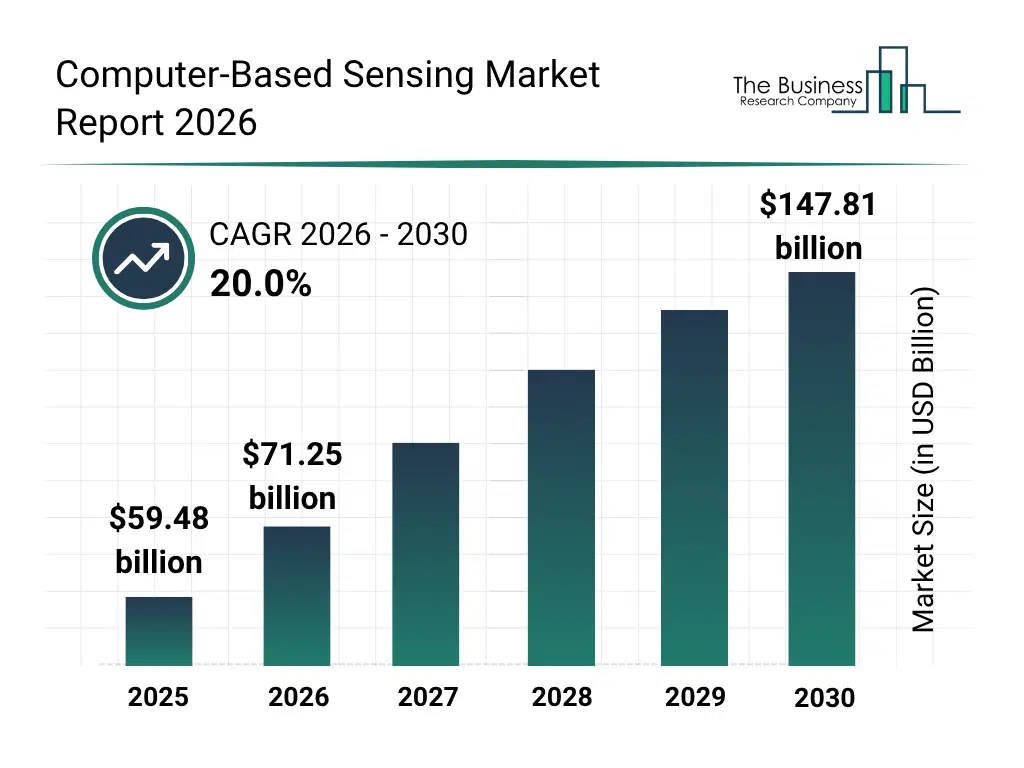
What Is The Computer-Based Sensing Market Size and Share 2026?
The computer-based sensing market size has grown rapidly in recent years. It will grow from $59.48 billion in 2025 to $71.25 billion in 2026 at a compound annual growth rate (CAGR) of 19.8%. The growth in the historic period can be attributed to basic sensor integration in industrial systems, growth of automation in manufacturing processes, rise of embedded systems in consumer electronics, increasing demand for real time monitoring, expansion of machine vision in quality inspection.What Is The Computer-Based Sensing Market Growth Forecast?
The computer-based sensing market size is expected to see exponential growth in the next few years. It will grow to $147.81 billion by 2030 at a compound annual growth rate (CAGR) of 20.0%. The growth in the forecast period can be attributed to rapid adoption of AI powered sensing systems, expansion of autonomous vehicles and robotics, growing demand for edge computing based analytics, increasing deployment of smart infrastructure systems, rising need for predictive maintenance solutions. Major trends in the forecast period include sensor fusion based intelligent perception systems, edge AI enabled real time sensing analytics, embedded vision and machine perception expansion, low power and miniaturized smart sensor development, context aware adaptive sensing architectures.
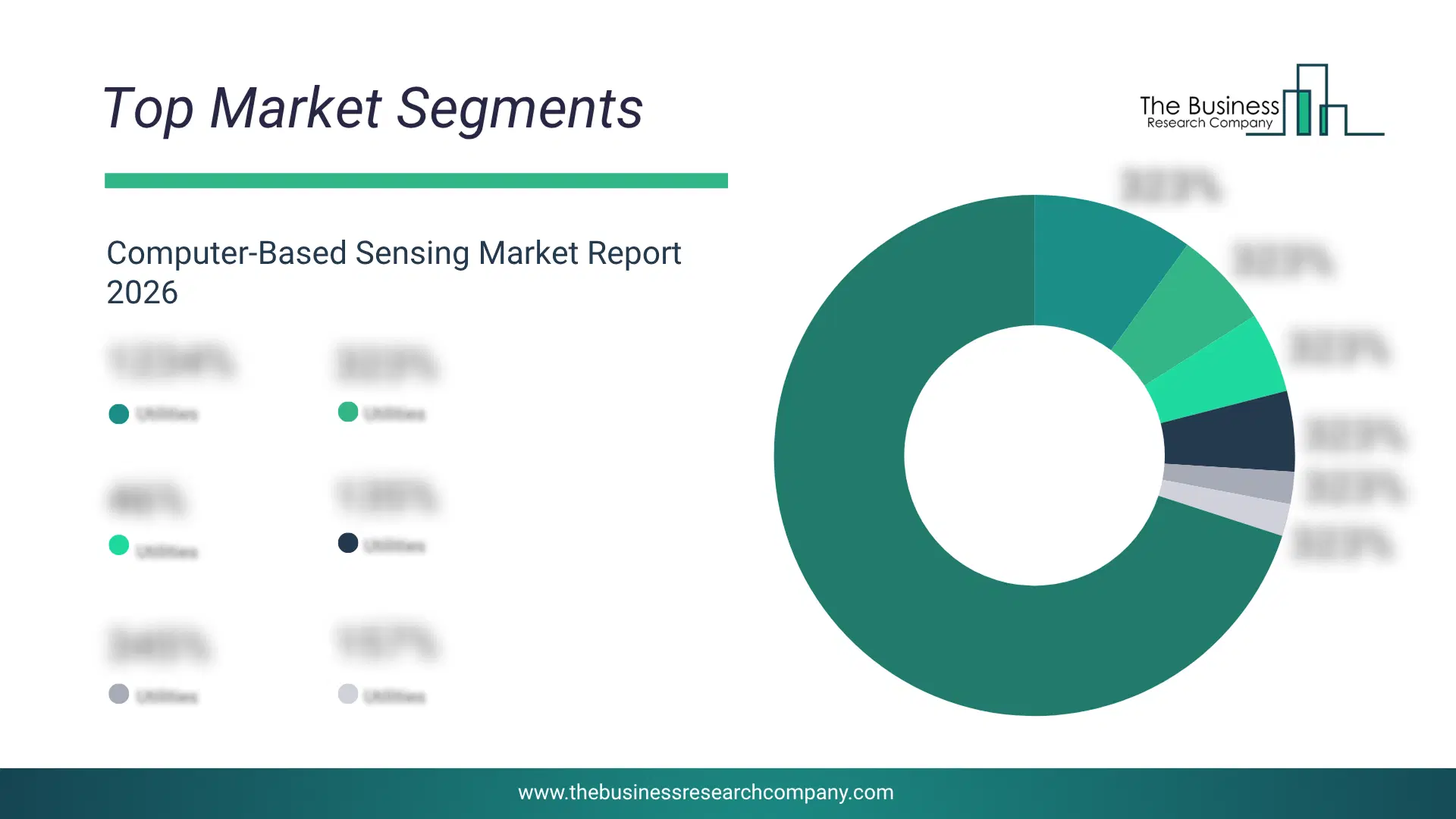
Global Computer-Based Sensing Market Segmentation
1) By Component: Hardware, Software, Services 2) By Sensor Type: Vision Sensors, Motion Sensors, Temperature Sensors, Acoustic Sensors, Environmental Sensors, Proximity Sensors 3) By Technology: Artificial Intelligence Based Sensing, Machine Vision Technology, Sensor Fusion Technology, Internet Of Things Enabled Sensing, Edge Computing Based Sensing 4) By Application: Industrial Automation, Smart Cities, Autonomous Vehicles, Healthcare Monitoring, Security And Surveillance, Consumer Electronics 5) By End User: Manufacturing, Automotive, Healthcare, Consumer Electronics, Aerospace And Defense, Retail Subsegments: 1) By Hardware: Sensors, Cameras, Processors, Data Acquisition Devices, Embedded Systems, Storage Devices 2) By Software: Data Processing Software, Image Processing Software, Signal Processing Software, Machine Learning Software, Data Visualization Software, Sensor Management Software 3) By Services: Consulting Services, System Integration Services, Deployment Services, Maintenance And Support Services, Training Services, Managed ServicesWhat Is The Driver Of The Computer-Based Sensing Market?
The rising adoption of robotics and intelligent machines is expected to propel the growth of the computer-based sensing market going forward. Robotics and intelligent machines refer to automated systems equipped with sensors, processors, and control technologies that allow machines to perceive environments and perform tasks with minimal human intervention. The adoption of robotics continues to increase as industries expand automation to improve operational efficiency, accuracy, and productivity in manufacturing, logistics, and healthcare operations. Robotics and intelligent machines drive the adoption of robotics and intelligent machines by automating tasks, improving productivity, enhancing accuracy, and enabling smarter decision-making across industries. For instance, in September 2024, according to the International Federation of Robotics, a Germany-based robotics industry association, the number of operational industrial robots worldwide reached approximately 4.28 million units in 2023, representing a 10% increase compared to 2022. Therefore, the rising adoption of robotics and intelligent machines is expected to drive the growth of the computer-based sensing industry.Key Players In The Global Computer-Based Sensing Market
Major companies operating in the computer-based sensing market are Keyence Corporation; Omron Corporation; Hexagon AB; Teledyne Technologies Incorporated; Trimble Inc.; ifm electronic GmbH; SICK AG; Innoviz Technologies Ltd.; Cognex Corporation; Datalogic S.p.A.; RoboSense Technology Co. Ltd.; Balluff GmbH; Luminar Technologies Inc.; Baumer Holding AG; Baraja Pty Ltd; Basler Aktiengesellschaft; Aeva Technologies Inc.; IDS Imaging Development Systems GmbH; Quanergy Systems Inc.; Seyond Inc.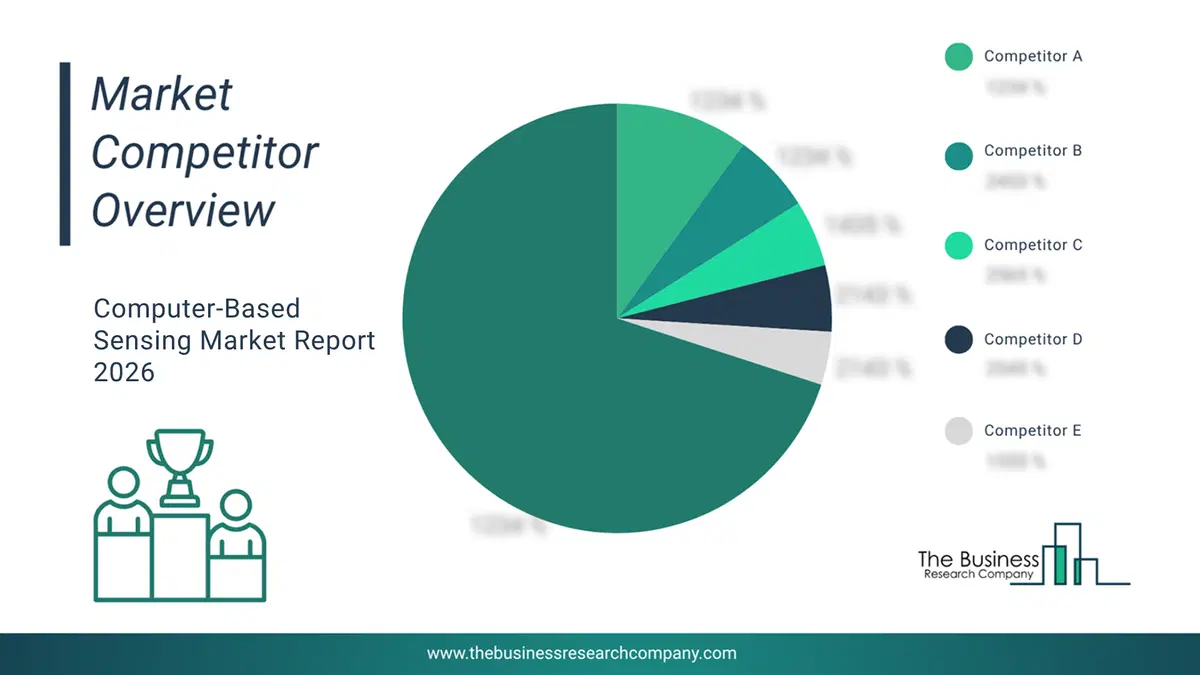
This chart is for illustrative purposes; the full report includes a detailed competitor analysis and comprehensive overview of the top 10 companies in the market.
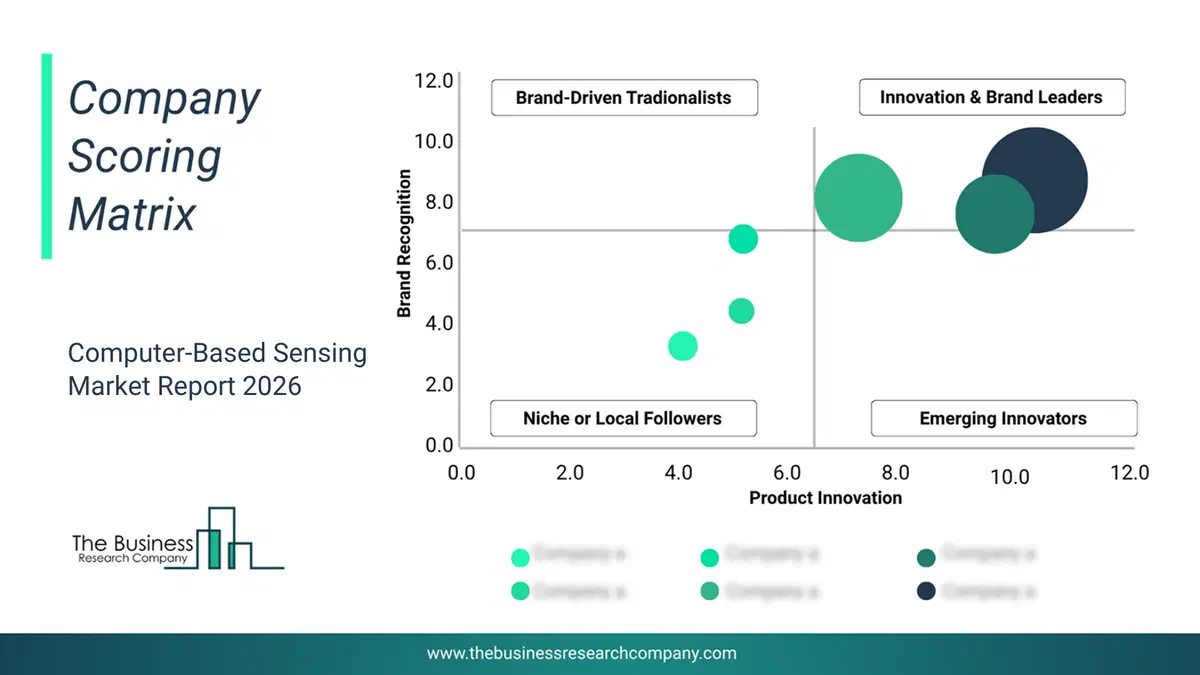
This chart maps companies by product innovation and brand strength, with bubble size indicating relative revenue, helping identify market leaders, challengers, and niche players. This is an illustrative chart; the full report provides a complete and accurate competitive analysis.
Global Computer-Based Sensing Market Trends and Insights
Major companies operating in the computer-based sensing market are focusing on advancements in edge AI-based sensing solutions, such as embedded edge-AI vision processing, to gain a competitive advantage. Embedded edge-AI vision processing refers to sensing systems that integrate artificial intelligence directly within sensors or cameras to analyze visual or environmental data locally without relying on cloud infrastructure. This technology enables real-time data processing, reduces latency, improves data privacy, and lowers bandwidth usage in applications such as industrial automation, robotics, and smart infrastructure. For instance, in September 2024, Sony Semiconductor Solutions Corporation, a Japan-based semiconductor technology company, launched the Raspberry Pi AI Camera in collaboration with Raspberry Pi. The camera integrates Sony’s intelligent vision sensing technology to perform on-device AI image processing, supports real-time object recognition directly at the edge, and enables developers to build AI-enabled sensing applications with low latency and minimal cloud dependence.What Are Latest Mergers And Acquisitions In The Computer-Based Sensing Market?
In July 2025, ZEISS, a Germany-based optics and optoelectronics technology company, acquired all equity shares of Pi Imaging Technology SA for an undisclosed amount. Through this acquisition, ZEISS aims to strengthen its sensing and imaging capabilities and accelerate the development of advanced sensor technologies used in scientific imaging, industrial inspection, and digital measurement systems. The integration of SPAD-based sensors enhances ZEISS’s ability to develop high-performance optical and computer-based sensing solutions for next-generation analytical and imaging applications. Pi Imaging Technology SA is a Switzerland-based company that provides computer-based sensing solutions through advanced photon-counting image sensors and high-speed imaging technologies for industrial, scientific, and machine vision applications.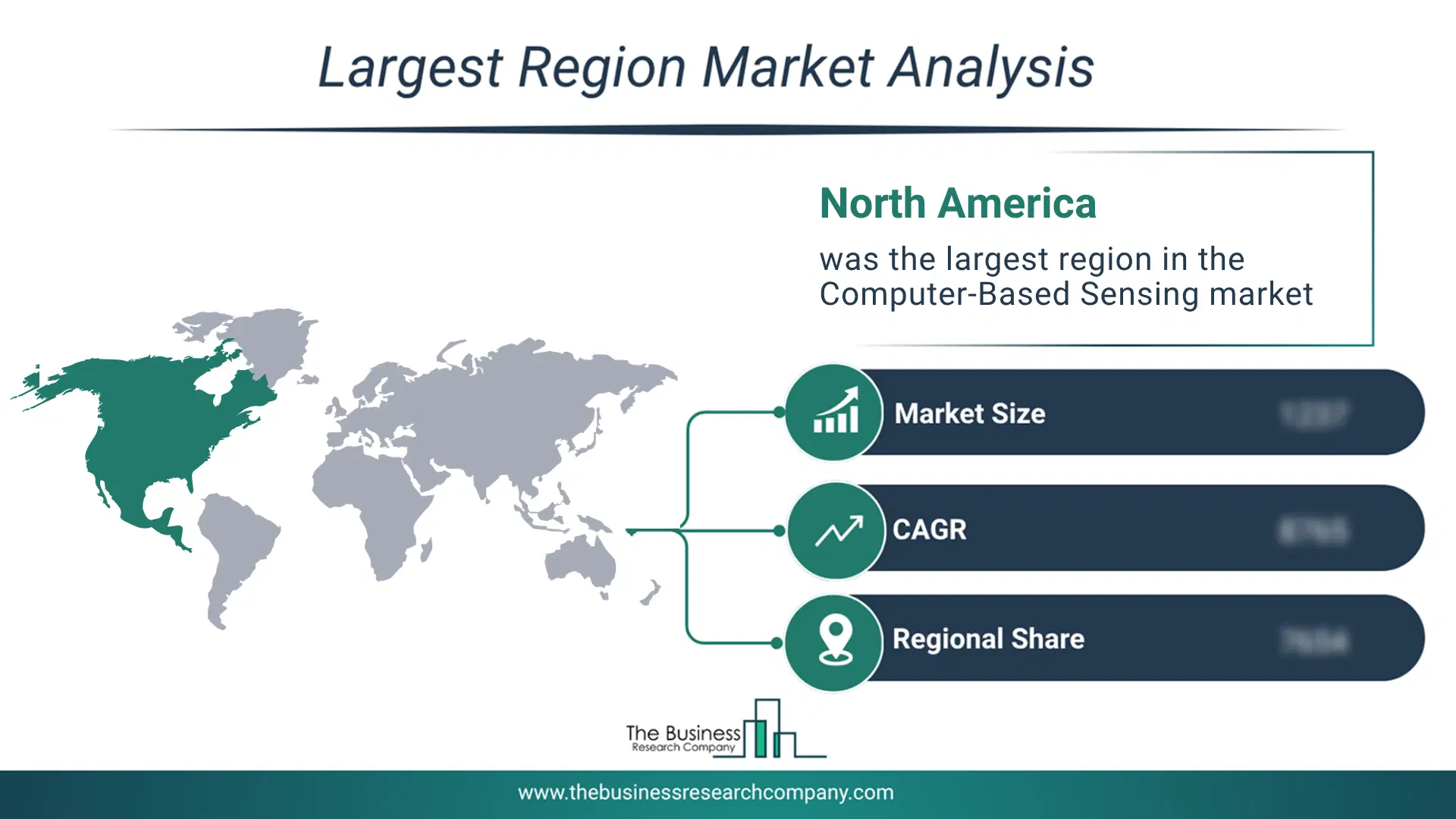
Regional Insights
North America was the largest region in the computer-based sensing market in 2025. Asia-Pacific is expected to be the fastest-growing region in the forecast period. The regions covered in this market report are Asia-Pacific, South East Asia, Western Europe, Eastern Europe, North America, South America, Middle East, Africa. The countries covered in this market report are Australia, Brazil, China, France, Germany, India, Indonesia, Japan, Taiwan, Russia, South Korea, UK, USA, Canada, Italy, Spain.What Defines the Computer-Based Sensing Market?
The computer-based sensing market consists of revenues earned by entities by providing services such as sensor-enabled data collection, real-time monitoring, machine vision solutions, IoT-based sensing integration, and AI-driven predictive sensing analytics. The market value includes the value of related goods sold by the service provider or included within the service offering. The computer-based sensing market also includes sales of imaging sensors, industrial cameras, optical sensing devices, processing hardware, and integrated sensing modules. Values in this market are ‘factory gate’ values, that is, the value of goods sold by the manufacturers or creators of the goods, whether to other entities (including downstream manufacturers, wholesalers, distributors, and retailers) or directly to end customers. The value of goods in this market includes related services sold by the creators of the goods.How is Market Value Defined and Measured?
The market value is defined as the revenues that enterprises gain from the sale of goods and/or services within the specified market and geography through sales, grants, or donations in terms of the currency (in USD unless otherwise specified). The revenues for a specified geography are consumption values that are revenues generated by organizations in the specified geography within the market, irrespective of where they are produced. It does not include revenues from resales along the supply chain, either further along the supply chain or as part of other products.
This chart presents market attractiveness based on a quantitative evaluation of growth, competition, strategic alignment, and risk, offering a clear view of opportunity areas for decision-making. This chart is for illustrative purposes; the full report contains the complete analysis.

This chart highlights the Total Addressable Market (TAM) by estimating the maximum revenue opportunity using an assumption-driven approach, supporting strategic planning and opportunity sizing across markets. The chart is illustrative; the full report provides a more comprehensive analysis.
What Key Data and Analysis Are Included in the Computer-Based Sensing Market Report 2026?
The computer-based sensing market research report is one of a series of new reports from The Business Research Company that provides market statistics, including industry global market size, regional shares, competitors with the market share, detailed market segments, market trends and opportunities, and any further data you may need to thrive in the computer-based sensing industry. The market research report delivers a complete perspective of everything you need, with an in-depth analysis of the current and future state of the industry.Computer-Based Sensing Market Report Forecast Analysis
| Report Attribute | Details |
|---|---|
| Market Size Value In 2026 | $71.25 billion |
| Revenue Forecast In 2030 | $147.81 billion |
| Growth Rate | CAGR of 20% from 2026 to 2030 |
| Base Year For Estimation | 2025 |
| Actual Estimates/Historical Data | 2020-2025 |
| Forecast Period | 2026 - 2030 |
| Market Representation | Revenue in USD Billion and CAGR from 2026 to 2030 |
| Segments Covered | Component, Sensor Type, Technology, Application, End User |
| Regional Scope | Asia-Pacific, Western Europe, Eastern Europe, North America, South America, Middle East, Africa |
| Country Scope | The Countries Covered In This Market Report Are Australia, Brazil, China, France, Germany, India, Indonesia, Japan, Taiwan, Russia, South Korea, Uk, Usa, Canada, Italy, Spain. |
| Key Companies Profiled | Keyence Corporation, Omron Corporation, Hexagon AB, Teledyne Technologies Incorporated, Trimble Inc., ifm electronic GmbH, SICK AG, Innoviz Technologies Ltd., Cognex Corporation, Datalogic S.p.A., RoboSense Technology Co. Ltd., Balluff GmbH, Luminar Technologies Inc., Baumer Holding AG, Baraja Pty Ltd, Basler Aktiengesellschaft, Aeva Technologies Inc., IDS Imaging Development Systems GmbH, Quanergy Systems Inc., Seyond Inc. |
| Customization Scope | Request for Customization |
| Pricing And Purchase Options | Explore Purchase Options |