
Computer Numerical Control (CNC) Sewing Machine Market Report 2026
Global Outlook – By Machine Configuration (Flatbed Computer Numerical Control (CNC) Sewing Machines, Cylinder Bed Computer Numerical Control (CNC) Sewing Machines, Post Bed Computer Numerical Control (CNC) Sewing Machines, Overlock Computer Numerical Control (CNC) Sewing Machines, Embroidery Computer Numerical Control (CNC) Sewing Machines), By Product Type (Industrial Computer Numerical Control (CNC) Sewing Machines, Domestic Computer Numerical Control (CNC) Sewing Machines), By Distribution Channel (Direct Sales, Authorized Dealers and Industrial Distributors, System Integrators and Automation Solution Providers, Aftermarket and Retrofit Service Providers), By End-User (Apparel Industry, Automotive Industry) – Market Size, Trends, Strategies, and Forecast to 2030
Computer Numerical Control (CNC) Sewing Machine Market Overview
• Computer Numerical Control (CNC) Sewing Machine market size has reached to $3.48 billion in 2025 • Expected to grow to $5.08 billion in 2030 at a compound annual growth rate (CAGR) of 7.8% • Growth Driver: The Growing Textile Industry Is Driving The Growth Of The Market Due To The Rising Demand For Fashion And Technical Textiles • Market Trend: Advanced CNC Sewing Units Enhancing Precision And Efficiency In Garment Manufacturing • North America was the largest region in 2025 and Asia-Pacific is the fastest growing region.What Is Covered Under Computer Numerical Control (CNC) Sewing Machine Market?
Computer numerical control (CNC) sewing machines are programmable sewing devices that automate stitching operations with high precision and consistency. It controls needle movement and fabric handling through computer instructions, ensuring accurate and repeatable patterns. Computer numerical control (CNC) sewing machines enhance productivity by reducing manual intervention and minimizing errors and provide manufacturers with reliable, efficient, and precise sewing performance. The main types of computer numerical control (CNC) sewing machines are flatbed computer numerical control (CNC) sewing machines, cylinder bed computer numerical control (CNC) sewing machines, post bed computer numerical control (CNC) sewing machines, overlock computer numerical control (CNC) sewing machines, and embroidery computer numerical control (CNC) sewing machines. Flatbed computer numerical control (CNC) sewing machines feature a flat work surface that allows fabric to move smoothly while enabling precise and automated stitching. The product types include industrial computer numerical control (CNC) sewing machines and domestic computer numerical control (CNC) sewing machines, with technologies such as computerized computer numerical control (CNC) sewing machines, mechanical computer numerical control (CNC) sewing machines, electronic computer numerical control (CNC) sewing machines, robotic computer numerical control (CNC) sewing machines, and hybrid computer numerical control (CNC) sewing machines. These machines are distributed through multiple distribution channels, including online stores, specialty stores, supermarkets or hypermarkets, and others, and are used by several end-users, including the apparel industry, automotive industry, home textile industry, footwear industry, and leather goods industry.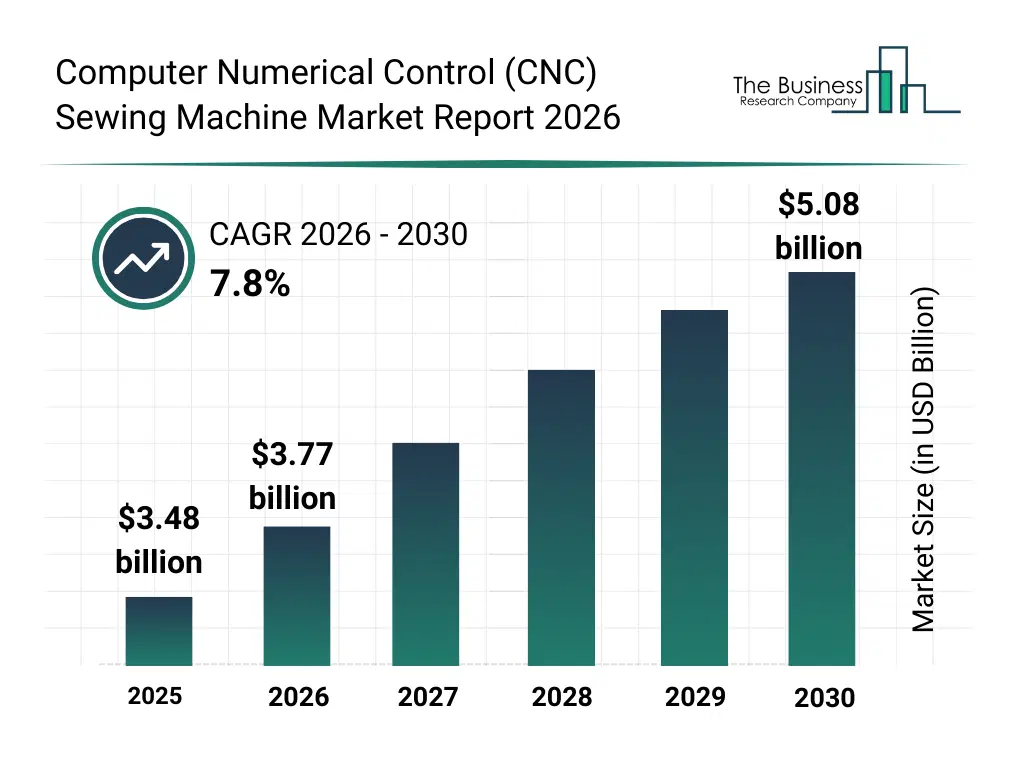
What Is The Computer Numerical Control (CNC) Sewing Machine Market Size and Share 2026?
The computer numerical control (CNC) sewing machine market size has grown strongly in recent years. It will grow from $3.48 billion in 2025 to $3.77 billion in 2026 at a compound annual growth rate (CAGR) of 8.1%. The growth in the historic period can be attributed to expansion of apparel manufacturing automation, growth in mass garment production, rising labor cost pressures, increasing demand for consistent stitching quality, availability of programmable sewing systems.What Is The Computer Numerical Control (CNC) Sewing Machine Market Growth Forecast?
The computer numerical control (CNC) sewing machine market size is expected to see strong growth in the next few years. It will grow to $5.08 billion in 2030 at a compound annual growth rate (CAGR) of 7.8%. The growth in the forecast period can be attributed to increasing adoption of smart apparel factories, rising demand for customization and short production runs, expansion of technical textiles, growing integration of AI-based pattern optimization, increasing use in automotive interiors. Major trends in the forecast period include increasing adoption of fully automated sewing lines, rising demand for high-speed precision stitching, growing integration of robotic fabric handling, expansion of programmable pattern customization, enhanced focus on production efficiency.Tariff Impact On Computer Numerical Control (CNC) Sewing Machine Market
Tariffs are impacting the CNC sewing machine market by increasing costs of imported motors, control units, sensors, and electronic components required for precision automation. Apparel and footwear manufacturing hubs in Asia-Pacific are most affected due to dependence on imported CNC systems, while North America and Europe face higher capital investment costs. These tariffs are slowing equipment replacement cycles and increasing production costs for manufacturers. At the same time, tariffs are supporting local machine assembly, regional supplier ecosystems, and innovation in cost-efficient CNC sewing technologies tailored to domestic manufacturing needs.
Global Computer Numerical Control (CNC) Sewing Machine Market Segmentation
1) By Machine Configuration: Flatbed Computer Numerical Control (CNC) Sewing Machines, Cylinder Bed Computer Numerical Control (CNC) Sewing Machines, Post Bed Computer Numerical Control (CNC) Sewing Machines, Overlock Computer Numerical Control (CNC) Sewing Machines, Embroidery Computer Numerical Control (CNC) Sewing Machines 2) By Product Type: Industrial Computer Numerical Control (CNC) Sewing Machines, Domestic Computer Numerical Control (CNC) Sewing Machines 4) By Distribution Channel: Direct Sales, Authorized Dealers and Industrial Distributors, System Integrators and Automation Solution Providers, Aftermarket and Retrofit Service Providers 5) By End-User: Apparel Industry, Automotive Industry, Home Textile Industry, Footwear Industry, Leather Goods Industry Subsegments: 1) By Flatbed Computer Numerical Control (CNC) Sewing Machines: Single Needle Flatbed Computer Numerical Control (CNC) Sewing Machines, Double Needle Flatbed Computer Numerical Control (CNC) Sewing Machines, Triple Needle Flatbed Computer Numerical Control (CNC) Sewing Machines, Multi-Needle Flatbed Computer Numerical Control (CNC) Sewing Machines 2) By Cylinder Bed Computer Numerical Control (CNC) Sewing Machines: Single Needle Cylinder Bed Computer Numerical Control (CNC) Sewing Machines, Double Needle Cylinder Bed Computer Numerical Control (CNC) Sewing Machines, Multi-Needle Cylinder Bed Computer Numerical Control (CNC) Sewing Machines 3) By Post Bed Computer Numerical Control (CNC) Sewing Machines: Single Needle Post Bed Computer Numerical Control (CNC) Sewing Machines, Double Needle Post Bed Computer Numerical Control (CNC) Sewing Machines, Multi-Needle Post Bed Computer Numerical Control (CNC) Sewing Machines 4) By Overlock Computer Numerical Control (CNC) Sewing Machines: 3-Thread Overlock Computer Numerical Control (CNC) Sewing Machines, 4-Thread Overlock Computer Numerical Control (CNC) Sewing Machines, 5-Thread Overlock Computer Numerical Control (CNC) Sewing Machines, 6-Thread Overlock Computer Numerical Control (CNC) Sewing Machines 5) By Embroidery Computer Numerical Control (CNC) Sewing Machines: Single Head Embroidery Computer Numerical Control (CNC) Sewing Machines, Multi-Head Embroidery Computer Numerical Control (CNC) Sewing Machines, Cap Embroidery Computer Numerical Control (CNC) Sewing Machines, Cylinder Embroidery Computer Numerical Control (CNC) Sewing MachinesWhat Is The Driver Of The Computer Numerical Control (CNC) Sewing Machine Market?
The growing textile industry is expected to propel the growth of the computer numerical control (CNC) sewing machine market going forward. The textile industry involves the creation, production, and distribution of fibers, yarns, and fabrics used in clothing, home furnishings, and industrial textile goods. The textile industry is rising due to increasing consumer demand for fashion and technical textiles, driven by urbanization and rising disposable incomes in developing economies. Computer numerical control (CNC) sewing machines boost the textile industry by automating stitching with high precision and consistency while increasing production speed and reducing human error, enabling complex designs and enhancing garment quality. For instance, in March 2025, according to the European Environment Agency, a Denmark-based government agency, in 2023, the European Union’s textile and clothing sector generated a remarkable turnover of $199.51 billion (€170 billion) while employing about 1.3 million people across 197,000 companies. A year earlier, in 2022, the EU had exported 4.0 million tons of finished textiles, with exports valued at $85.67 billion (€73 billion). Therefore, the growing textile industry is driving the growth of the computer numerical control (CNC) sewing machine industry.Key Players In The Global Computer Numerical Control (CNC) Sewing Machine Market
Major companies operating in the computer numerical control (CNC) sewing machine market are Brother Industries Ltd., JUKI Corporation, Jack Technology Co. Ltd., Shang Gong Group Co. Ltd., Feiyue Group Co. Ltd., JANOME Corporation, Barudan Co. Ltd., Pegasus Sewing Machine Mfg. Co. Ltd., Pfaff Industrial, Sunstar Co. Ltd., Singer Corporation, Bernina International AG, OSHIMA Taiwan Co. Ltd., Happy Industrial Corporation, DEMA Sewing Machine Co. LLC, Yamato Sewing Machine Mfg. Co. Ltd., Typical Industrial Sewing Machine Co. Ltd., Zoje Intelligent Technology Co. Ltd., Siruba Sewing Machine Industry Co. Ltd., Tajima Industries Ltd., Kansai Special Co. Ltd.
This chart is for illustrative purposes; the full report includes a detailed competitor analysis and comprehensive overview of the top 10 companies in the market.
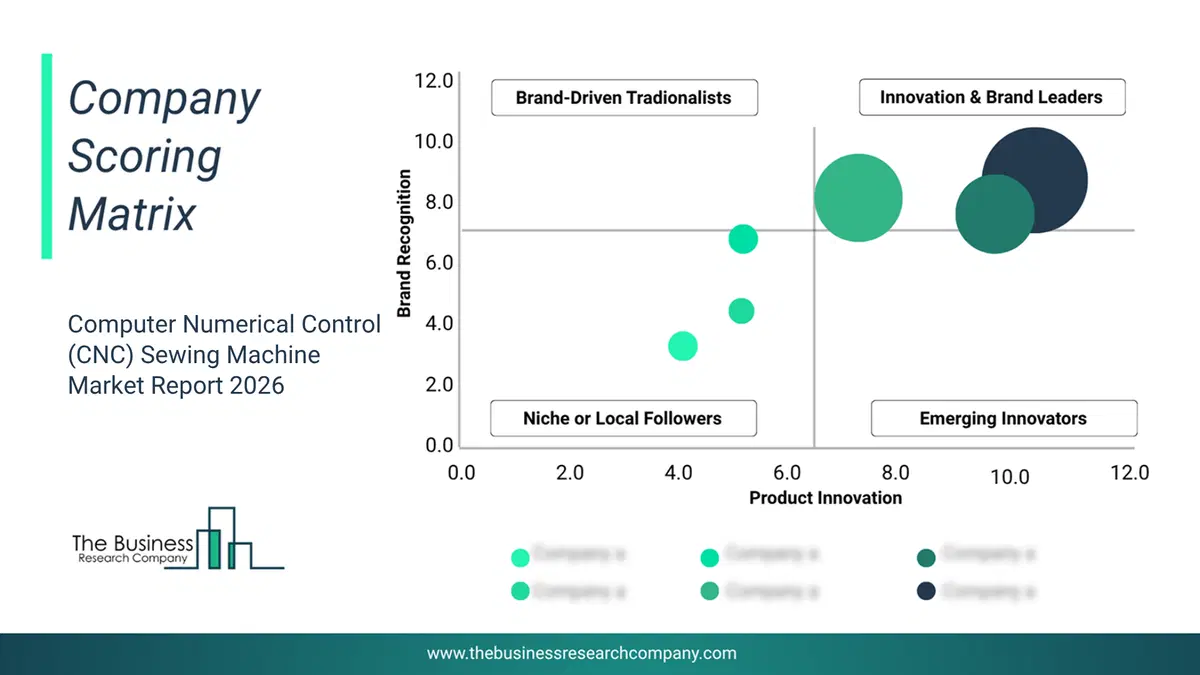
This chart maps companies by product innovation and brand strength, with bubble size indicating relative revenue, helping identify market leaders, challengers, and niche players. This is an illustrative chart; the full report provides a complete and accurate competitive analysis.
Global Computer Numerical Control (CNC) Sewing Machine Market Trends and Insights
Major companies operating in the computer numerical control (CNC) sewing machine market are focusing on developing advanced products such as CNC sewing units to meet the growing demands of the modern apparel industry. A CNC sewing unit is a computer-operated machine that automates stitching with high precision and consistency, allowing complex patterns and designs to be created efficiently while minimizing manual labor and errors in garment production. For instance, in February 2023, Pfaff, a Germany-based machine industry company, introduced the Pfaff 3686, designed for high-precision sewing of darts and waistband pleats, essential for garment fit and appearance. It features pre-programmed seam contours, operator-friendly handling, and technologies like a patented material take-over station, a feeding table for exact positioning, and options such as laser pointer positioning and suction devices for thread rests. This advanced unit ensures consistent quality, economic processing, and high repeat accuracy without the need for guide rails.What Are Latest Mergers And Acquisitions In The Computer Numerical Control (CNC) Sewing Machine Market?
In November 2024, Windsor Machines, an India-based provider of injection mounding machines, pipe extrusion systems, and blown film extrusion solutions, acquired Global CNC for $38.3 million (₹343.11 crore). With this acquisition, Windsor aims to broaden its machining capabilities, expand its product portfolio, and offer a wider range of advanced manufacturing solutions to customers under one roof. Global CNC is an India-based manufacturer of computer numerical control (CNC) turning machines, vertical machining centers, and special-purpose machines, serving industries such as textile, automotive, engineering, agriculture, medical, oil & gas, and railways.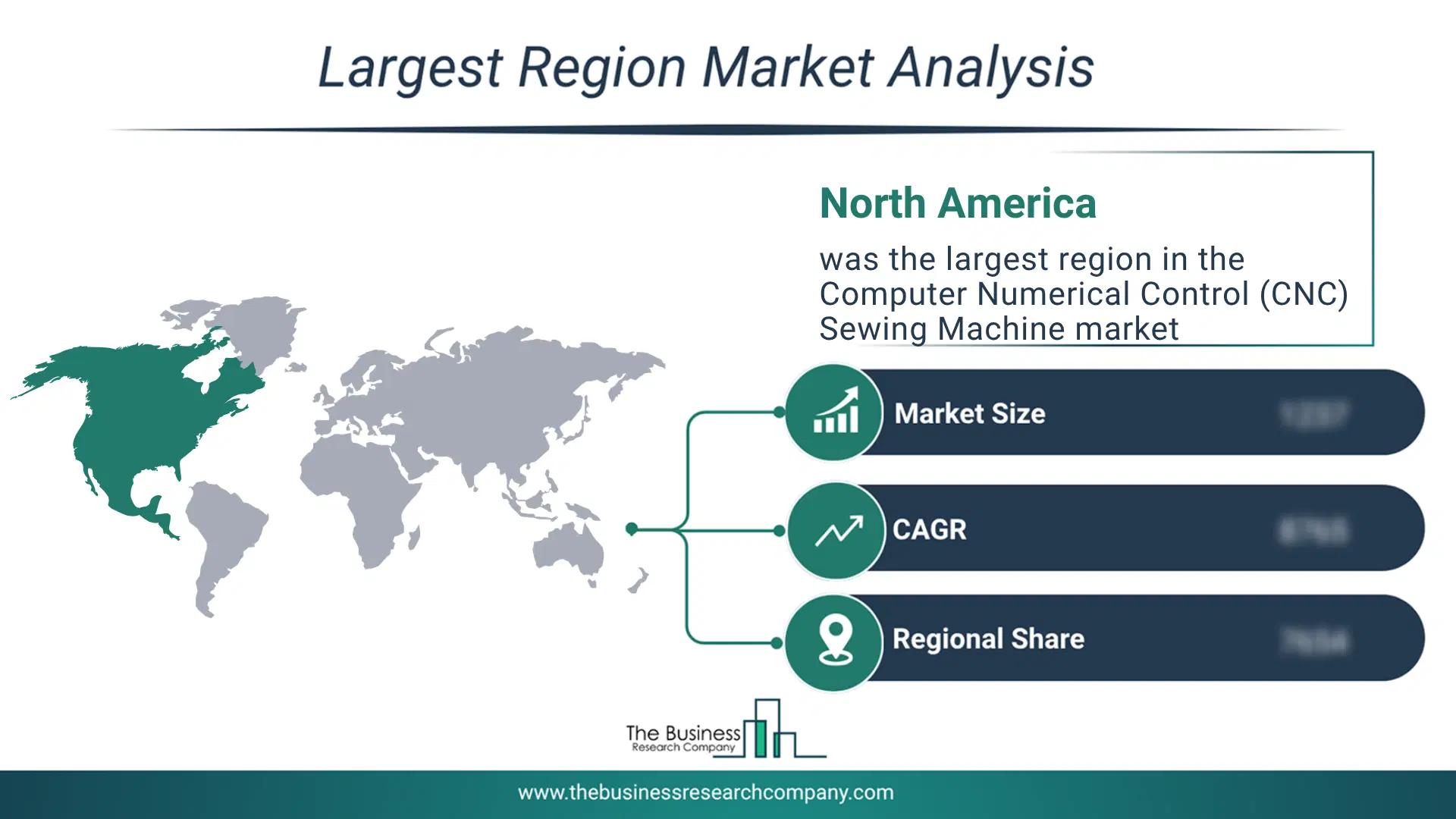
Regional Outlook
North America was the largest region in the computer numerical control (CNC) sewing machine market in 2025. Asia-Pacific is expected to be the fastest-growing region in the forecast period. The regions covered in this market report are Asia-Pacific, South East Asia, Western Europe, Eastern Europe, North America, South America, Middle East, Africa The countries covered in this market report are Australia, Brazil, China, France, Germany, India, Indonesia, Japan, Taiwan, Russia, South Korea, UK, USA, Canada, Italy, Spain.What Defines the Computer Numerical Control (CNC) Sewing Machine Market?
The computer numerical control (CNC) sewing machine market consists of revenues earned by entities by providing services such as installation and setup, training and technical support, maintenance and repair, software updates and upgrades, spare parts supply, and consultation and production optimization. The market value includes the value of related goods sold by the service provider or included within the service offering. The computer numerical control (CNC) sewing machine market also includes sales of CNC quilting machines, CNC embroidery machines, and CNC pattern sewing machines. Values in this market are ‘factory gate’ values, that is, the value of goods sold by the manufacturers or creators of the goods, whether to other entities (including downstream manufacturers, wholesalers, distributors, and retailers) or directly to end customers. The value of goods in this market includes related services sold by the creators of the goods.How is Market Value Defined and Measured?
The market value is defined as the revenues that enterprises gain from the sale of goods and/or services within the specified market and geography through sales, grants, or donations in terms of the currency (in USD unless otherwise specified). The revenues for a specified geography are consumption values that are revenues generated by organizations in the specified geography within the market, irrespective of where they are produced. It does not include revenues from resales along the supply chain, either further along the supply chain or as part of other products.
This chart presents market attractiveness based on a quantitative evaluation of growth, competition, strategic alignment, and risk, offering a clear view of opportunity areas for decision-making. This chart is for illustrative purposes; the full report contains the complete analysis.

This chart highlights the Total Addressable Market (TAM) by estimating the maximum revenue opportunity using an assumption-driven approach, supporting strategic planning and opportunity sizing across markets. The chart is illustrative; the full report provides a more comprehensive analysis.
What Key Data and Analysis Are Included in the Computer Numerical Control (CNC) Sewing Machine Market Report 2026?
The computer numerical control (cnc) sewing machine market research report is one of a series of new reports from The Business Research Company that provides market statistics, including industry global market size, regional shares, competitors with the market share, detailed market segments, market trends and opportunities, and any further data you may need to thrive in the computer numerical control (cnc) sewing machine industry. The market research report delivers a complete perspective of everything you need, with an in-depth analysis of the current and future state of the industry.Computer Numerical Control CNC Sewing Machine Market Report Forecast Analysis
| Report Attribute | Details |
|---|---|
| Market Size Value In 2026 | $3.77 billion |
| Revenue Forecast In 2030 | $5.08 billion |
| Base Year For Estimation | 2025 |
| Actual Estimates/Historical Data | 2020-2025 |
| Forecast Period | 2026 - 2030 |
| Market Representation | Revenue in USD Billion and CAGR from 2026 to 2030 |
| Segments Covered | Machine Configuration, Product Type, Distribution Channel, End-User |
| Regional Scope | Asia-Pacific, Western Europe, Eastern Europe, North America, South America, Middle East, Africa |
| Key Companies Profiled | Brother Industries Ltd., JUKI Corporation, Jack Technology Co. Ltd., Shang Gong Group Co. Ltd., Feiyue Group Co. Ltd., JANOME Corporation, Barudan Co. Ltd., Pegasus Sewing Machine Mfg. Co. Ltd., Pfaff Industrial, Sunstar Co. Ltd., Singer Corporation, Bernina International AG, OSHIMA Taiwan Co. Ltd., Happy Industrial Corporation, DEMA Sewing Machine Co. LLC, Yamato Sewing Machine Mfg. Co. Ltd., Typical Industrial Sewing Machine Co. Ltd., Zoje Intelligent Technology Co. Ltd., Siruba Sewing Machine Industry Co. Ltd., Tajima Industries Ltd., Kansai Special Co. Ltd. |
| Customization Scope | Request for Customization |
| Pricing And Purchase Options | Explore Purchase Options |