
Computer Vision in Healthcare Market Report 2026
Global Outlook – By Product (Software, Hardware, Network, Memory), By Application (Medical Imaging & Diagnostics, Surgeries, Clinical Trials, Patient Management and Research), By End Users (Healthcare Providers, Diagnostic Centers) – Market Size, Trends, Strategies, and Forecast to 2030
Computer Vision in Healthcare Market Overview
• Computer Vision in Healthcare market size has reached to $3.15 billion in 2025 • Expected to grow to $22.9 billion in 2030 at a compound annual growth rate (CAGR) of 48.7% • Growth Driver: Increasing Prevalence Of Chronic Diseases Fuels Growth Of Computer Vision In Healthcare Market • Market Trend: Revolutionizing Patient Care With Cutting-Edge Computer Vision Solutions • Europe was the largest region in 2025 and North America is the fastest growing region.What Is Covered Under Computer Vision in Healthcare Market?
Computer vision in healthcare refers to a branch of artificial intelligence that consists of methods for visual object detection, tracking, classification, depth estimation in images, instance and semantic segmentation, etc. The goal of computer vision (CV) is to simulate how the human brain receives and processes visual information. Computer vision uses algorithms for processing images to make the most accurate diagnosis in less time compared to a physician. The computer system in healthcare helps to transfer the complicated tasks and the time consumed for the tasks to machines, which allows the physician to focus on better patient care. The main types of computer vision in healthcare products include software, hardware, networks, and memory. Electronic health records and medical database software are some of the software that are used in the computer vision healthcare market. Applications of computer vision in healthcare include medical imaging and diagnostics, surgeries, clinical trials, and patient management and research. The major end-users of computer vision in healthcare are healthcare providers and diagnostic centers.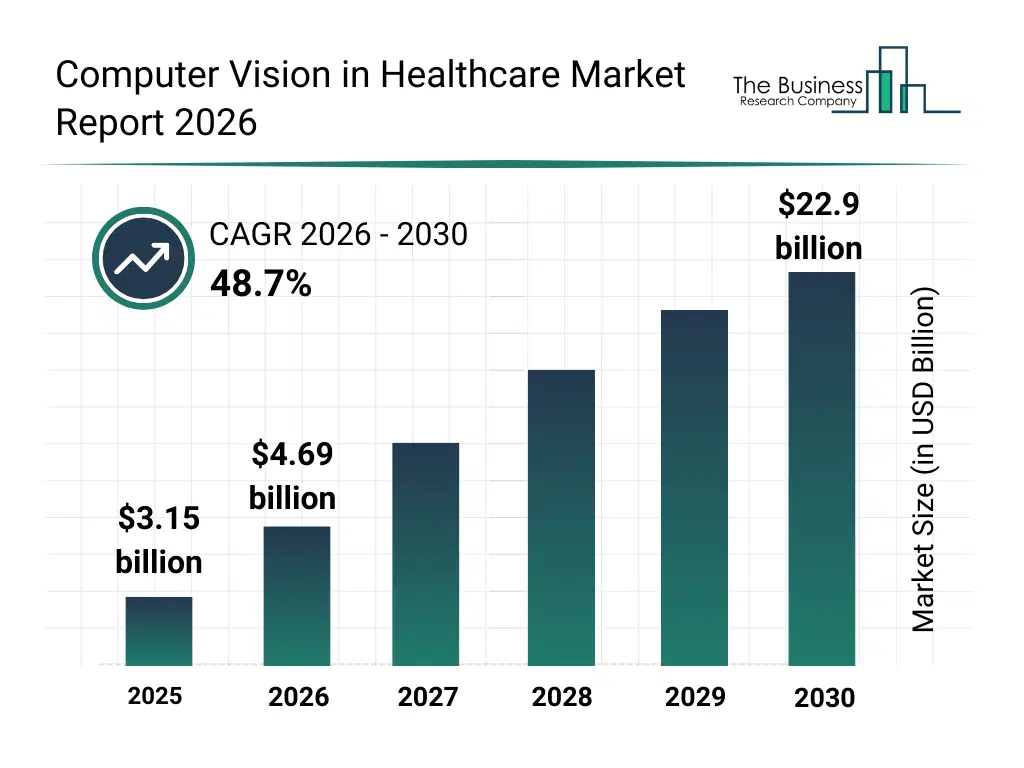
What Is The Computer Vision in Healthcare Market Size and Share 2026?
The computer vision in healthcare market size has grown exponentially in recent years. It will grow from $3.15 billion in 2025 to $4.69 billion in 2026 at a compound annual growth rate (CAGR) of 48.9%. The growth in the historic period can be attributed to increasing digitization of medical imaging data, rising demand for early disease detection, expansion of radiology imaging procedures, availability of large clinical image datasets, growing acceptance of ai-assisted diagnostics.What Is The Computer Vision in Healthcare Market Growth Forecast?
The computer vision in healthcare market size is expected to see exponential growth in the next few years. It will grow to $22.9 billion in 2030 at a compound annual growth rate (CAGR) of 48.7%. The growth in the forecast period can be attributed to increasing regulatory approvals for AI healthcare tools, rising investments in digital health platforms, expansion of precision diagnostics, growing integration of cv with electronic health records, increasing demand for workflow automation in healthcare. Major trends in the forecast period include increasing adoption of ai-assisted diagnostic imaging, rising use of automated image segmentation tools, growing deployment of real-time clinical decision support, expansion of computer vision in surgical workflows, enhanced focus on diagnostic accuracy and speed.
Global Computer Vision in Healthcare Market Segmentation
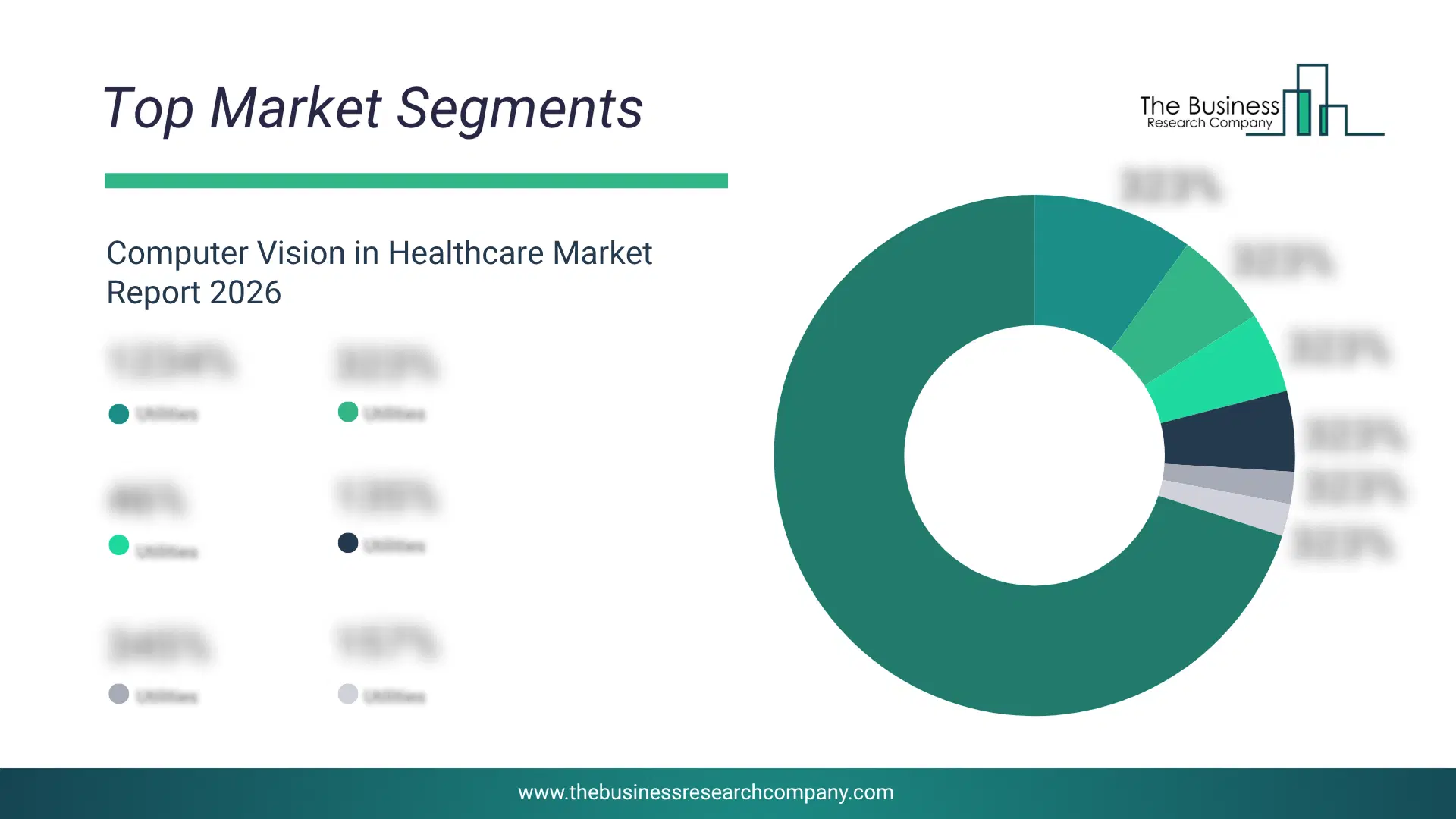
1) By Product: Software, Hardware, Network, Memory 2) By Application: Medical Imaging & Diagnostics, Surgeries, Clinical Trials, Patient Management and Research 3) By End Users: Healthcare Providers, Diagnostic Centers Subsegments: 1) By Software: Imaging Software, Diagnostic Software, Analytical Software 2) By Hardware: Imaging Devices, Processing Units 3) By Network: Cloud Services, Local Area Networks (LAN) 4) By Memory: Storage Solutions, Data Backup SystemsWhat Is The Driver Of The Computer Vision in Healthcare Market?
The increasing prevalence of chronic diseases is expected to propel the growth of computer vision in the healthcare market going forward. Chronic diseases are defined as problems that last a year or longer and necessitate continuing medical care, restricting everyday activities, or both. Heart disease, cancer, obesity, and diabetes are a few examples. Computer vision plays a vital role in healthcare for chronic diseases by enabling early detection and diagnosis through the analysis of medical images, such as X-rays and MRIs. It also assists in the continuous monitoring of chronic conditions, like diabetic retinopathy, by analyzing visual data to track disease progression and inform treatment decisions, ultimately improving patient outcomes and reducing healthcare costs. For instance, in June 2024, according to the National Health Service, a UK-based government department, 3,615,330 individuals registered with a general practitioner (GP) were diagnosed with non-diabetic hyperglycemia or pre-diabetes (a condition with elevated blood sugar levels, not high enough to be classified as diabetes) in 2023, marking an 18% increase from 3,065,825 cases in 2022. Therefore, the increasing prevalence of chronic diseases is driving growth in computer vision in the healthcare market.Key Players In The Global Computer Vision in Healthcare Market
Major companies operating in the computer vision in healthcare market are NVIDIA Corporation; International Business Machines Corporation (IBM); Alphabet Inc.; Microsoft Corporation; Intel Corporation; Basler AG; AiCure Technologies Inc.; iCAD Inc.; Xilinx Inc.; Arterys Inc.; Comofi Medtech Pvt. Ltd.; SenseTime Technologies Limited; GE Healthcare Technologies Inc.; Koninklijke Philips N. V.; Siemens AG; Butterfly Network Inc.; Caption Health Inc.; CureMetrix Inc.; Enlitic Inc.; Freenome Holdings Inc.; Gauss Surgical Inc.; Hologic Inc.; IDx Technologies Inc.; Imagen Technologies Inc.; Kheiron Medical Technologies Ltd.; MaxQ AI Ltd.; Medopad Ltd.; Paige. AI Inc.; Proscia Inc.; Riverain Technologies LLC; Viz. AI Inc.; Zebra Medical Vision Ltd.; Aidence B. V.; Deep Lens Inc.; EnsoData Inc.; Fovia Inc.; G42 Healthcare LLC; GNS Healthcare Inc.; HealthMyne Inc.; HeartFlow Inc.; Image Analysis Group LLC; Infinitt Healthcare Co. Ltd.; Kinetica Inc.; Lunit Inc.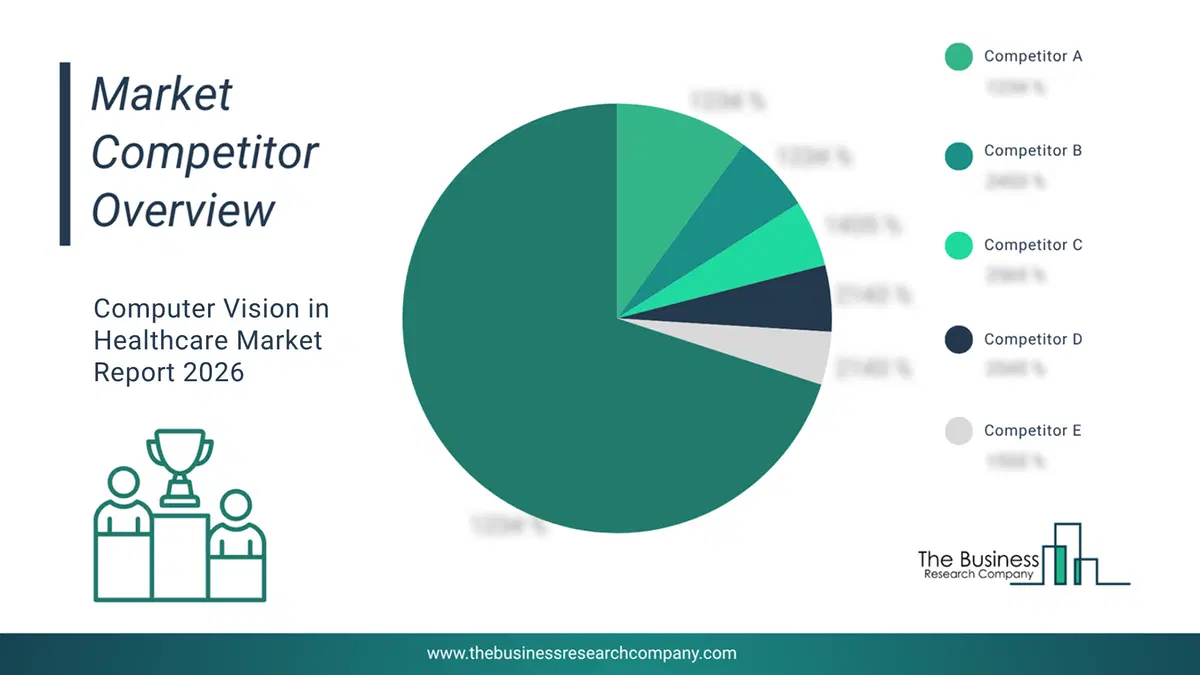
This chart is for illustrative purposes; the full report includes a detailed competitor analysis and comprehensive overview of the top 10 companies in the market.
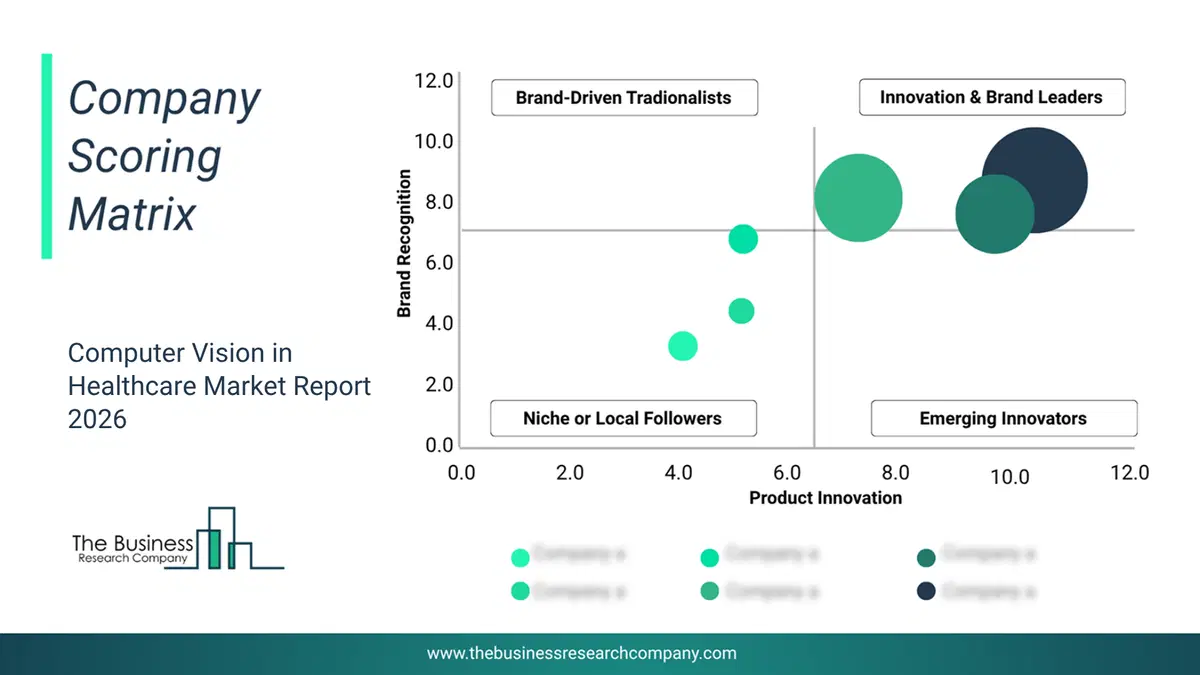
This chart maps companies by product innovation and brand strength, with bubble size indicating relative revenue, helping identify market leaders, challengers, and niche players. This is an illustrative chart; the full report provides a complete and accurate competitive analysis.
Global Computer Vision in Healthcare Market Trends and Insights
Major companies operating in computer vision in the healthcare market are increasing their focus on introducing advanced computer vision solutions using artificial intelligence to gain a competitive edge in the market. Advanced computer vision solutions in healthcare using artificial intelligence involve the application of deep learning algorithms to analyze medical images and videos for diagnosis, treatment planning, and disease monitoring. For instance, in March 2023, Kepler Vision Technologies, a US-based MedTech company, launched Kepler Night Nurse Edge Box, a vision platform for senior care. This innovative system utilizes vision technology to enable healthcare staff to monitor patients and respond promptly to signs of physical distress. The Edge Box is equipped with a processor designed to seamlessly integrate Kepler Vision's Night Nurse software and cutting-edge computer vision technology, enhancing patient safety. Night Nurse software employs artificial intelligence (AI) to continuously monitor patients and alert healthcare providers to potential issues, such as falls or other physical distress, while maintaining a non-intrusive approach with discreetly placed cameras to respect patient privacy.What Are Latest Mergers And Acquisitions In The Computer Vision in Healthcare Market?
In July 2024, Commure, Inc., a US-based healthcare technology company, acquired Augmedix Inc. for $139M. With this acquisition, Commure aims to continue innovating products to ease clinician burden with AI-enabled ambient scribing, advance revenue cycle automation, and consolidate an integrated platform for large language models. Augmedix, Inc. is a US-based health-tech company that provides medical documentation products and services to healthcare systems, hospitals, physician practices, and telemedicine practitioners.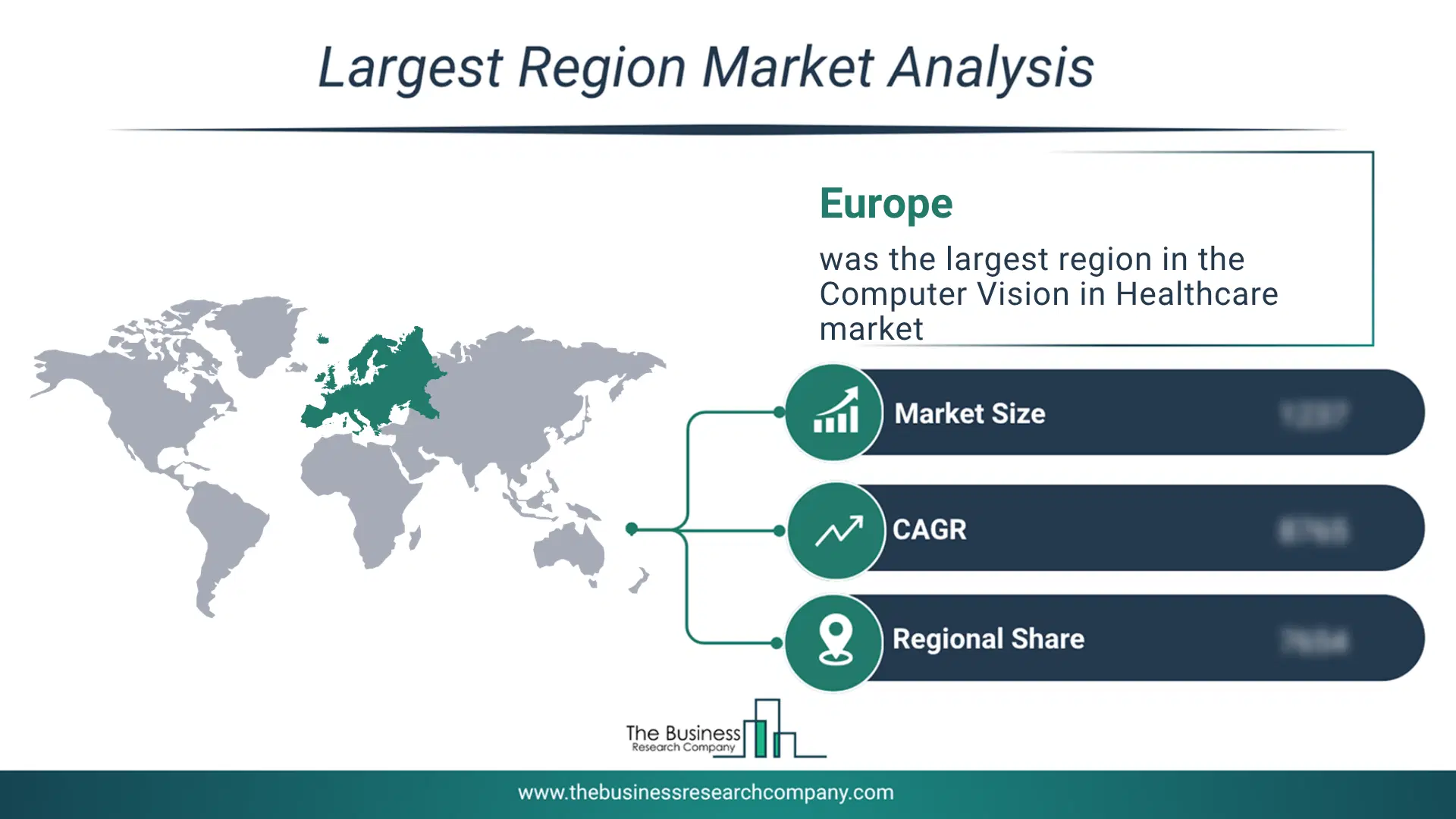
Regional Insights
Europe was the largest region in the computer vision in healthcare market in 2025. North America is expected to be the fastest-growing region in the forecast period. The regions covered in this market report are Asia-Pacific, South East Asia, Western Europe, Eastern Europe, North America, South America, Middle East, Africa. The countries covered in this market report are Australia, Brazil, China, France, Germany, India, Indonesia, Japan, Taiwan, Russia, South Korea, UK, USA, Canada, Italy, SpainWhat Defines the Computer Vision in Healthcare Market?
The computer vision healthcare market includes revenues earned by entities by detecting heart development anomalies and monitoring the progression of congenital heart diseases. The market value includes the value of related goods sold by the service provider or included within the service offering. Only goods and services traded between entities or sold to end consumers are included.How is Market Value Defined and Measured?
The market value is defined as the revenues that enterprises gain from the sale of goods and/or services within the specified market and geography through sales, grants, or donations in terms of the currency (in USD unless otherwise specified). The revenues for a specified geography are consumption values that are revenues generated by organizations in the specified geography within the market, irrespective of where they are produced. It does not include revenues from resales along the supply chain, either further along the supply chain or as part of other products.
This chart presents market attractiveness based on a quantitative evaluation of growth, competition, strategic alignment, and risk, offering a clear view of opportunity areas for decision-making. This chart is for illustrative purposes; the full report contains the complete analysis.

This chart highlights the Total Addressable Market (TAM) by estimating the maximum revenue opportunity using an assumption-driven approach, supporting strategic planning and opportunity sizing across markets. The chart is illustrative; the full report provides a more comprehensive analysis.
What Key Data and Analysis Are Included in the Computer Vision in Healthcare Market Report 2026?
The computer vision in healthcare market research report is one of a series of new reports from The Business Research Company that provides market statistics, including industry global market size, regional shares, competitors with the market share, detailed market segments, market trends and opportunities, and any further data you may need to thrive in the computer vision in healthcare industry. The market research report delivers a complete perspective of everything you need, with an in-depth analysis of the current and future state of the industry.Computer Vision in Healthcare Market Report Forecast Analysis
| Report Attribute | Details |
|---|---|
| Market Size Value In 2026 | $4.69 billion |
| Revenue Forecast In 2030 | $22.9 billion |
| Growth Rate | CAGR of 48.7% from 2026 to 2030 |
| Base Year For Estimation | 2025 |
| Actual Estimates/Historical Data | 2020-2025 |
| Forecast Period | 2026 - 2030 |
| Market Representation | Revenue in USD Billion and CAGR from 2026 to 2030 |
| Segments Covered | Product, Application, End Users |
| Regional Scope | Asia-Pacific, Western Europe, Eastern Europe, North America, South America, Middle East, Africa |
| Country Scope | The Countries Covered In This Market Report Are Australia, Brazil, China, France, Germany, India, Indonesia, Japan, Taiwan, Russia, South Korea, Uk, Usa, Canada, Italy, Spain. |
| Key Companies Profiled | NVIDIA Corporation, International Business Machines Corporation (IBM), Alphabet Inc., Microsoft Corporation, Intel Corporation, Basler AG, AiCure Technologies Inc., iCAD Inc., Xilinx Inc., Arterys Inc., Comofi Medtech Pvt. Ltd., SenseTime Technologies Limited, GE Healthcare Technologies Inc., Koninklijke Philips N. V., Siemens AG, Butterfly Network Inc., Caption Health Inc., CureMetrix Inc., Enlitic Inc., Freenome Holdings Inc., Gauss Surgical Inc., Hologic Inc., IDx Technologies Inc., Imagen Technologies Inc., Kheiron Medical Technologies Ltd., MaxQ AI Ltd., Medopad Ltd., Paige. AI Inc., Proscia Inc., Riverain Technologies LLC, Viz. AI Inc., Zebra Medical Vision Ltd., Aidence B. V., Deep Lens Inc., EnsoData Inc., Fovia Inc., G42 Healthcare LLC, GNS Healthcare Inc., HealthMyne Inc., HeartFlow Inc., Image Analysis Group LLC, Infinitt Healthcare Co. Ltd., Kinetica Inc., Lunit Inc. |
| Customization Scope | Request for Customization |
| Pricing And Purchase Options | Explore Purchase Options |