
Connected And Autonomous Mobility Vehicles Market Report 2026
Global Outlook – By Propulsion Type ( Semi-Autonomous, Fully Autonomous), By Vehicle Type ( Passenger Car, Commercial Vehicle), By Application ( Civil, Defense, Transportation And Logistics, Construction) – Market Size, Trends, Strategies, and Forecast to 2030
Connected And Autonomous Mobility Vehicles Market Overview
• Connected And Autonomous Mobility Vehicles market size has reached to $288.85 billion in 2025 • Expected to grow to $1686.91 billion in 2030 at a compound annual growth rate (CAGR) of 42.6% • Growth Driver: Addressing Road Safety Through The Growth Of Connected And Autonomous Mobility Vehicles • Market Trend: The Era Of Third-Generation Autonomous Driving Systems • North America was the largest region in 2025.What Is Covered Under Connected And Autonomous Mobility Vehicles Market?
Connected and autonomous mobility vehicles (CAVs) refer to vehicles that can communicate with each other and the surrounding infrastructure and operate without human intervention. These vehicles are equipped with a range of sensors, communication technologies, and artificial intelligence that allow them to sense their surroundings, interpret sensory information, and operate without human intervention. The main types of automation levels included in connected and autonomous mobility vehicles are level 1, level 2, level 3, level 4, and level 5. Level 1 automation involves basic driver assistance features that can control specific aspects of driving but require the driver to maintain overall control and attentiveness. The various types of propulsion are semi-autonomous and fully autonomous. These are used by passenger cars and commercial vehicles, that are utilized by civil, defense, transportation and logistics, and construction.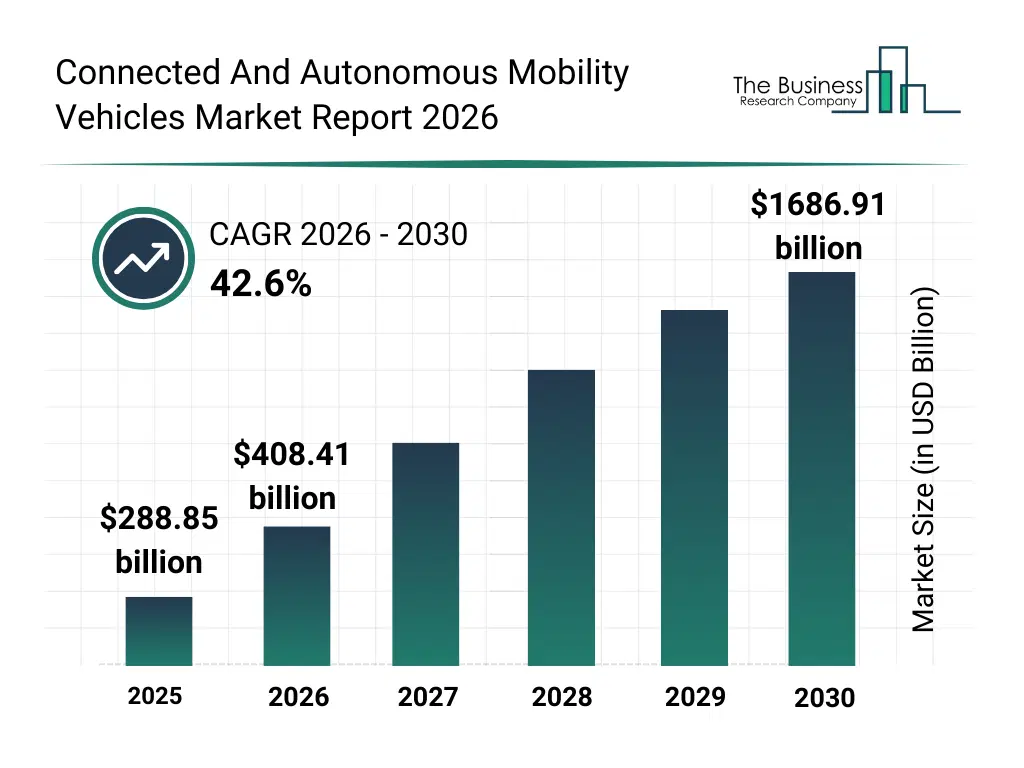
What Is The Connected And Autonomous Mobility Vehicles Market Size 2026 And Growth Rate?
The connected and autonomous mobility vehicles market size has grown exponentially in recent years. It will grow from $288.85 billion in 2025 to $408.41 billion in 2026 at a compound annual growth rate (CAGR) of 41.4%. The growth in the historic period can be attributed to early development of driver assistance systems, rise in connected car technologies, increasing investments in autonomous r&d, growth of electric vehicle infrastructure, expanding regulatory support for automation.What Is The Connected And Autonomous Mobility Vehicles Market Growth Forecast?
The connected and autonomous mobility vehicles market size is expected to see exponential growth in the next few years. It will grow to $1686.91 billion in 2030 at a compound annual growth rate (CAGR) of 42.6%. The growth in the forecast period can be attributed to increasing demand for autonomous logistics, rising adoption of smart city mobility solutions, growth of robo taxi deployments, advancements in AI driven navigation, expansion of commercial autonomous fleets. Major trends in the forecast period include growing integration of advanced sensor fusion systems, rising deployment of vehicle to everything (v2x) communication, increased adoption of autonomous fleet solutions, expansion of real time mapping and perception technologies, growth in safety redundancy and fail safe system designs.
Global Connected And Autonomous Mobility Vehicles Market Segmentation
1) By Propulsion Type: Semi-Autonomous, Fully Autonomous 2) By Vehicle Type: Passenger Car, Commercial Vehicle 3) By Application: Civil, Defense, Transportation And Logistics, Construction Subsegments: 1) By Semi-Autonomous: Level 2 (Partial Automation), Level 3 (Conditional Automation) 2) By Fully Autonomous: Level 4 (High Automation), Level 5 (Full Automation)What Is The Driver Of The Connected And Autonomous Mobility Vehicles Market?
The rising number of road accidents is expected to propel the growth of the connected and autonomous mobility vehicles market going forward. A road accident is an incident that resulted in property damage or personal injury and occurred at a location intended for public transportation or that is often used for transportation and in which at least one of the involved parties was a moving vehicle. Connected and autonomous vehicles (CAVs) can use their connectivity and automation to help prevent and mitigate road accidents by performing evasive maneuvers, monitoring the driver's attention, and taking over control of the vehicle if the driver is not paying attention. For instance, in December 2023, according to the World Health Organization, a Switzerland-based intergovernmental organization, there were approximately 1.19 million road traffic deaths globally, with the European Union reporting about 20,400 fatalities, a slight increase from 20,196 in 2022. Therefore, the rising number of road accidents is driving the growth of the connected and autonomous mobility vehicle industry.Key Players In The Global Connected And Autonomous Mobility Vehicles Market
Major companies operating in the connected and autonomous mobility vehicles market are Microsoft Corporation, General Motors (GM), Mercedes-Benz Group AG, Ford Motor Company, Bayerische Motoren Werke AG (BMW), SAIC Motor Corp. Ltd., Tesla Inc., Nissan Motor Co. Ltd., Intel Corporation, BYD Co. Ltd., Groupe Renault, The Volvo Group, Magna International Inc., Uber Technologies Inc., ABB Ltd., Nvidia Corporation, Jaguar Land Rover Automotive PLC, Didi Chuxing Technology Co. Ltd., Baidu Inc., Aptiv plc, Porsche Automobil Holding SE, Lyft Inc., Motional, Aurora Innovation Inc., SAE International, Nuro Inc., Argo AI, AutoX Inc., Swift Navigation, Nauto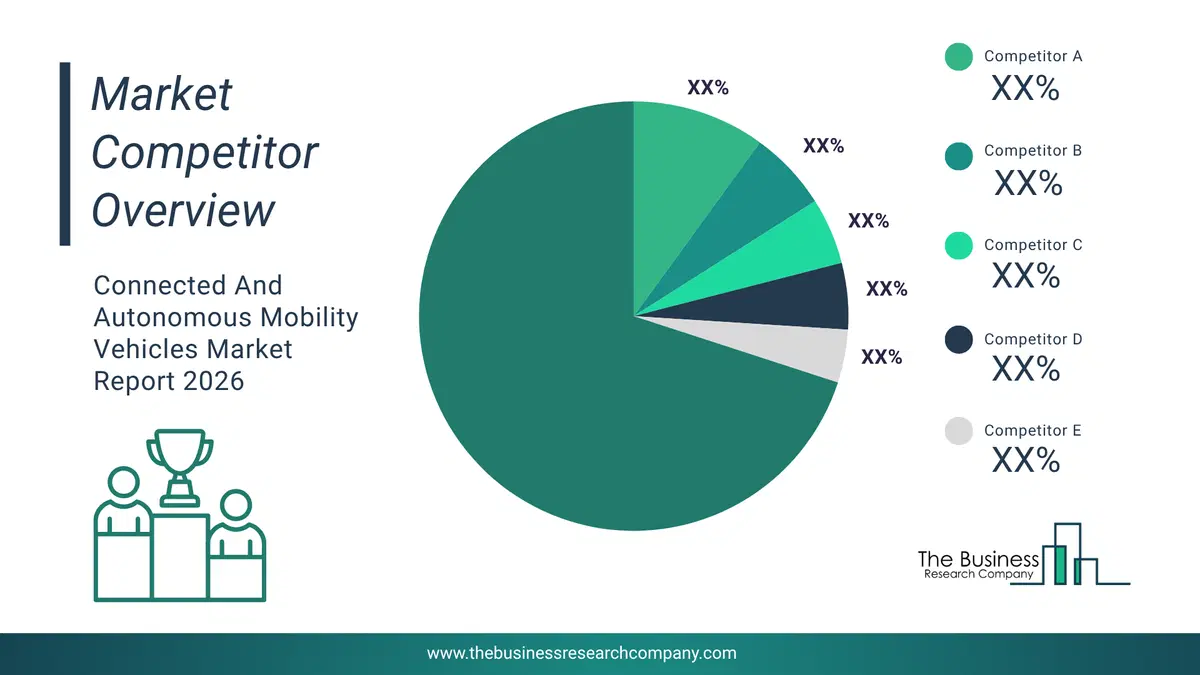
This chart is for illustrative purposes; the full report includes a detailed competitor analysis and comprehensive overview of the top 10 companies in the market.
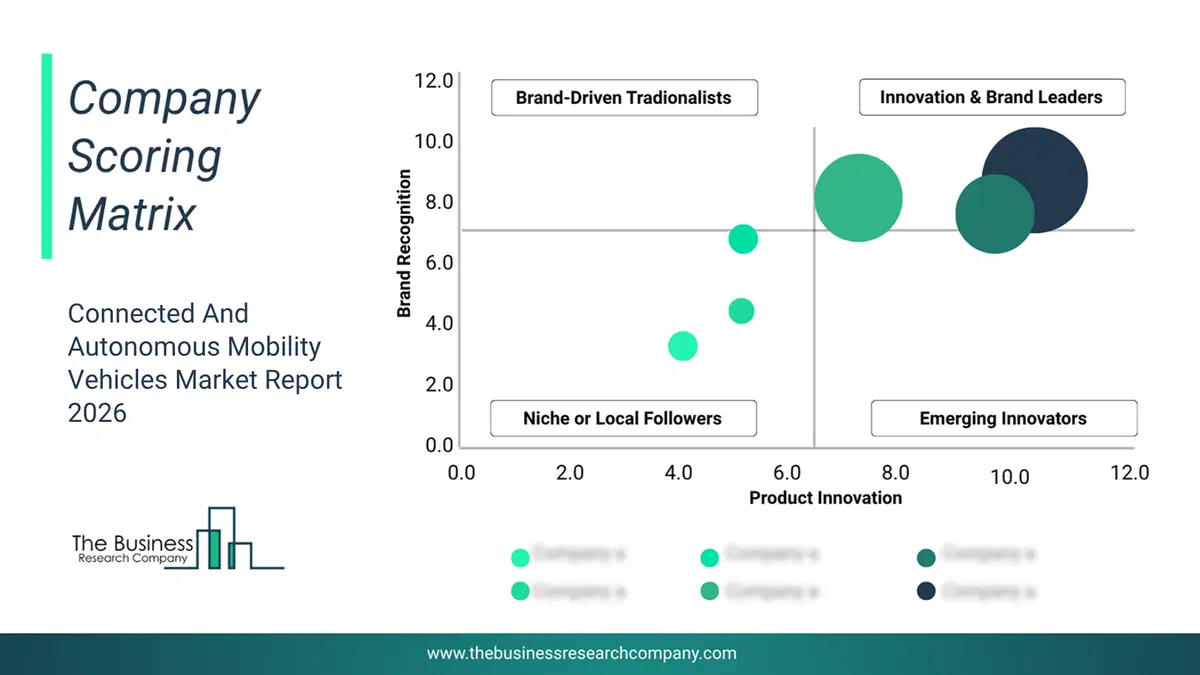
This chart maps companies by product innovation and brand strength, with bubble size indicating relative revenue, helping identify market leaders, challengers, and niche players. This is an illustrative chart; the full report provides a complete and accurate competitive analysis.
Global Connected And Autonomous Mobility Vehicles Market Trends and Insights
Major companies operating in the connected and autonomous mobility vehicle market are increasing their focus on introducing third-generation autonomous driving systems to gain a competitive edge. Third-generation autonomous driving systems refer to autonomous driving systems in which the vehicle can perform all aspects of driving autonomously under specific conditions and in a defined environment, such as highway driving. For instance, in March 2023, May Mobility, a US-based autonomous vehicle (AV) technology company, launched its third-generation autonomous driving system. This system is equipped with advanced sensors such as cameras, radars, and lidars, which help it detect objects in its surroundings more clearly and accurately than previous generations. It also has an improved communication system to collaborate with human operators to ensure vehicle and passenger safety in challenging situations. May Mobility's third-generation autonomous driving system includes its third-generation vision stack, next-generation pedestrian modeling, tele-assist, on-vehicle traffic light detection, and other enhancements that help the car move through various encounters and circumstances without incident.What Are Latest Mergers And Acquisitions In The Connected And Autonomous Mobility Vehicles Market?
In June 2025, NXP Semiconductors N.V., a Europe-based provider of automotive processing and networking solutions, acquired TTTech Auto GmbH for an undisclosed amount. This acquisition strengthens NXP’s position in software-defined vehicles, enhances its portfolio with safety-critical middleware and system software for connected and autonomous vehicles, and accelerates the company’s capabilities in developing next-generation automotive software architectures. TTTech Auto GmbH is an Austria-based company that specializes in providing safety-critical middleware, system software, and architectures for software-defined vehicles, enabling connected and autonomous mobility.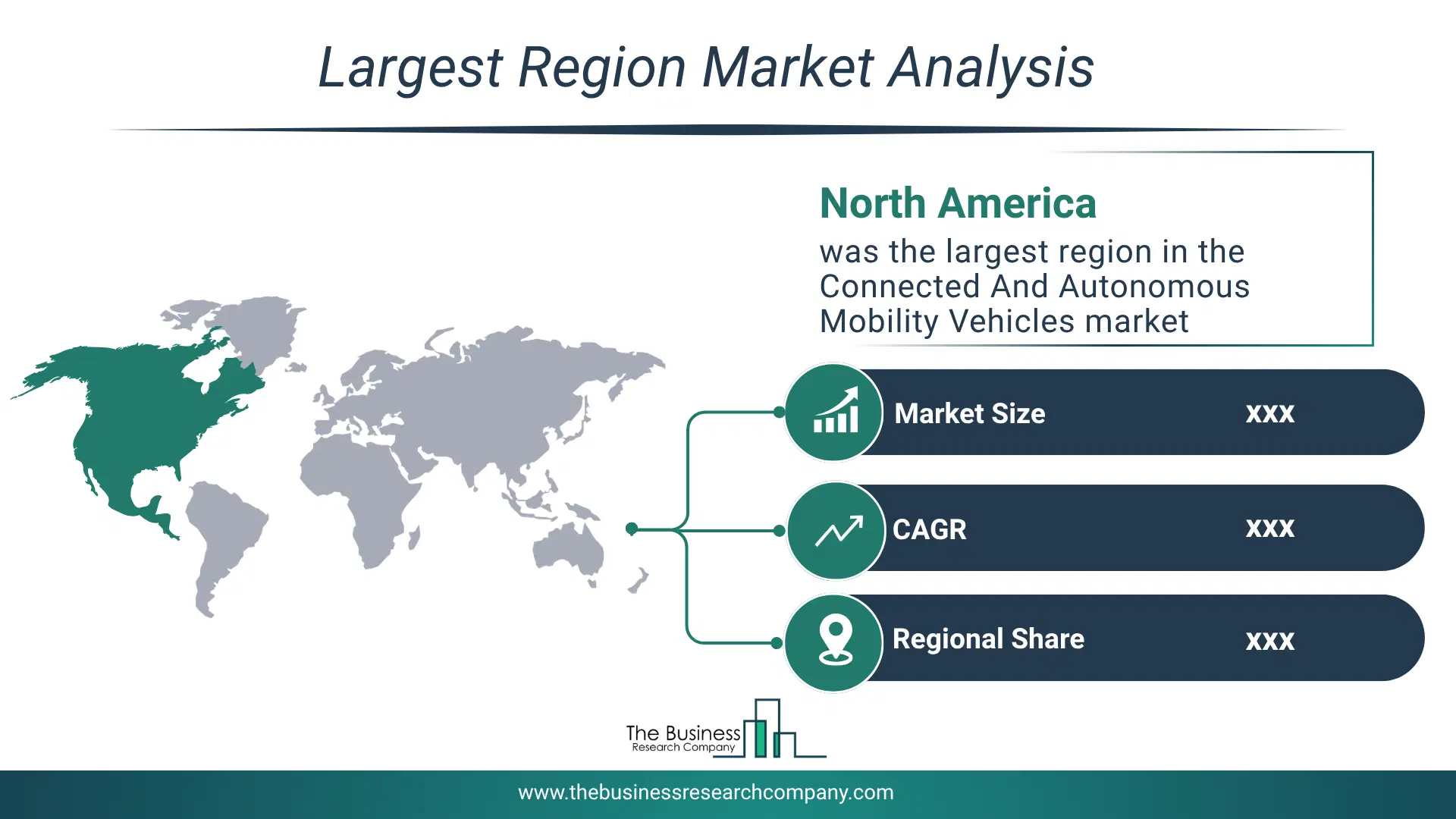
Regional Outlook
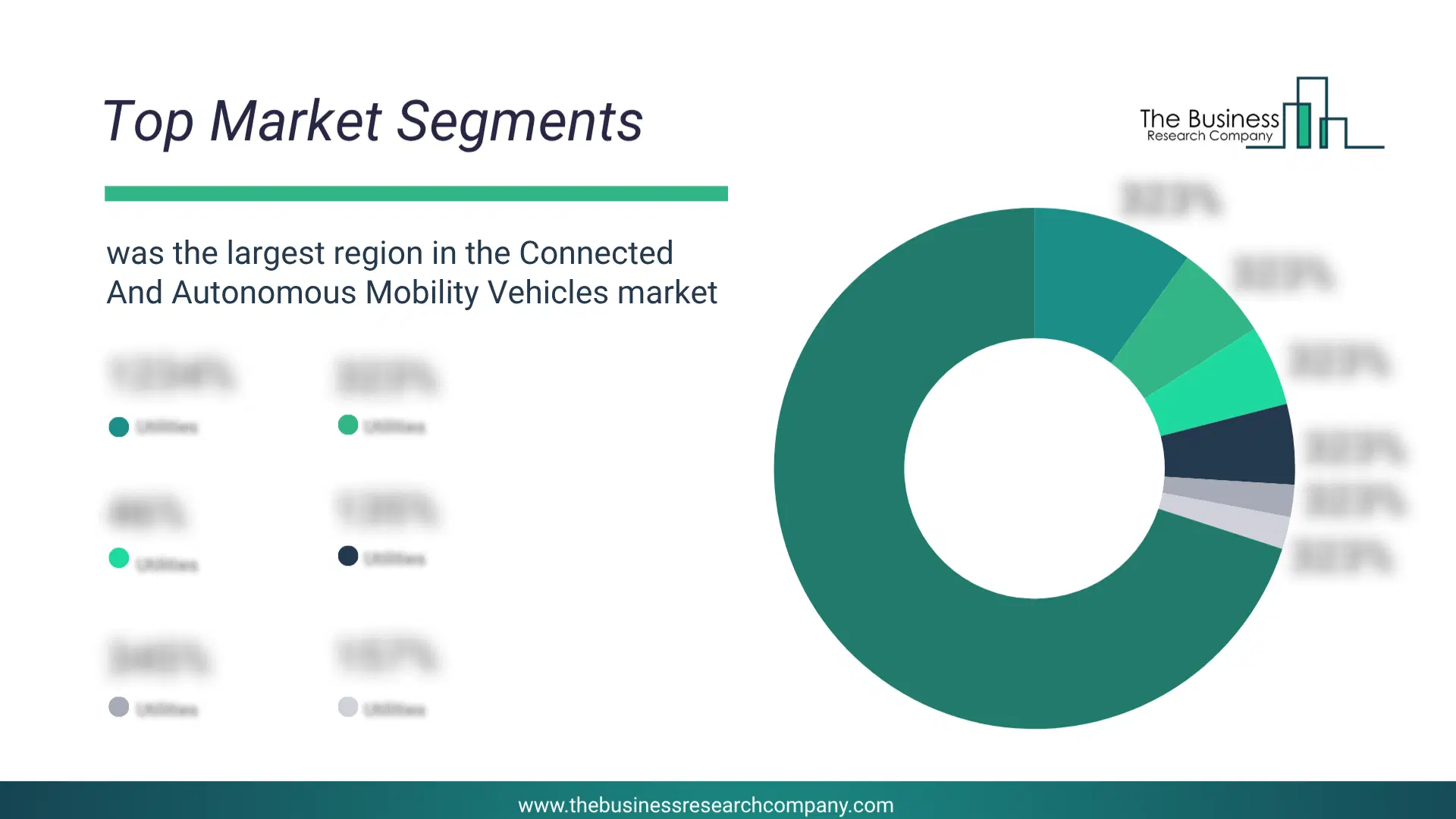
North America was the largest region in the connected and autonomous mobility vehicles market in 2025. The regions covered in this market report are Asia-Pacific, South East Asia, Western Europe, Eastern Europe, North America, South America, Middle East, Africa. The countries covered in this market report are Australia, Brazil, China, France, Germany, India, Indonesia, Japan, Taiwan, Russia, South Korea, UK, USA, Canada, Italy, Spain.What Defines the Connected And Autonomous Mobility Vehicles Market?
The connected and autonomous mobility vehicles market consists of revenues earned by entities by providing services such as traffic management, fleet management, safety, and personal mobility. The market value includes the value of related goods sold by the service provider or included within the service offering. The connected and autonomous mobility vehicles market consists of sales of navigation devices, light detection and ranging systems, cameras, and RADAR systems. Values in this market are ‘factory gate’ values, that is the value of goods sold by the manufacturers or creators of the goods, whether to other entities (including downstream manufacturers, wholesalers, distributors and retailers) or directly to end customers. The value of goods in this market includes related services sold by the creators of the goods.How is Market Value Defined and Measured?
The market value is defined as the revenues that enterprises gain from the sale of goods and/or services within the specified market and geography through sales, grants, or donations in terms of the currency (in USD unless otherwise specified). The revenues for a specified geography are consumption values that are revenues generated by organizations in the specified geography within the market, irrespective of where they are produced. It does not include revenues from resales along the supply chain, either further along the supply chain or as part of other products.
This chart presents market attractiveness based on a quantitative evaluation of growth, competition, strategic alignment, and risk, offering a clear view of opportunity areas for decision-making. This chart is for illustrative purposes; the full report contains the complete analysis.

This chart highlights the Total Addressable Market (TAM) by estimating the maximum revenue opportunity using an assumption-driven approach, supporting strategic planning and opportunity sizing across markets. The chart is illustrative; the full report provides a more comprehensive analysis.
What Key Data and Analysis Are Included in the Connected And Autonomous Mobility Vehicles Market Report 2026?
The connected and autonomous mobility vehicles market research report is one of a series of new reports from The Business Research Company that provides market statistics, including industry global market size, regional shares, competitors with the market share, detailed market segments, market trends and opportunities, and any further data you may need to thrive in the connected and autonomous mobility vehicles industry. The market research report delivers a complete perspective of everything you need, with an in-depth analysis of the current and future state of the industry.Connected And Autonomous Mobility Vehicles Market Report Forecast Analysis
| Report Attribute | Details |
|---|---|
| Market Size Value In 2026 | $408.41 billion |
| Revenue Forecast In 2030 | $1686.91 billion |
| Growth Rate | CAGR of 42.6% from 2026 to 2030 |
| Base Year For Estimation | 2025 |
| Actual Estimates/Historical Data | 2020-2025 |
| Forecast Period | 2026 - 2030 |
| Market Representation | Revenue in USD Billion and CAGR from 2026 to 2030 |
| Segments Covered | Propulsion Type, Vehicle Type, Application |
| Regional Scope | Asia-Pacific, Western Europe, Eastern Europe, North America, South America, Middle East, Africa |
| Country Scope | The countries covered in the report are Australia, Brazil, China, France, Germany, India, Indonesia, Japan, Taiwan, Russia, South Korea, UK, USA, Canada, Italy, Spain. |
| Key Companies Profiled | Microsoft Corporation, General Motors (GM), Mercedes-Benz Group AG, Ford Motor Company, Bayerische Motoren Werke AG (BMW), SAIC Motor Corp. Ltd., Tesla Inc., Nissan Motor Co. Ltd., Intel Corporation, BYD Co. Ltd., Groupe Renault, The Volvo Group, Magna International Inc., Uber Technologies Inc., ABB Ltd., Nvidia Corporation, Jaguar Land Rover Automotive PLC, Didi Chuxing Technology Co. Ltd., Baidu Inc., Aptiv plc, Porsche Automobil Holding SE, Lyft Inc., Motional, Aurora Innovation Inc., SAE International, Nuro Inc., Argo AI, AutoX Inc., Swift Navigation, Nauto |
| Customization Scope | Request for Customization |
| Pricing And Purchase Options | Explore Purchase Options |