
Connected Lighting Market Report 2026
Global Outlook – By Component (Hardware, Software, Services), By Sales Channel (Direct Sales, Distributors Or Wholesalers, Online Retail, Electrical Contractors Or Integrators, Original Equipment Manufacturer Channels), By Deployment Type (Wired Connected Lighting, Wireless Connected Lighting), By Application (Indoor Lighting, Outdoor Lighting), By End User Industry (Commercial And Enterprise, Industrial And Manufacturing, Residential, Municipal And Public Infrastructure, Healthcare, Education, Transportation And Logistics, Utilities And Energy) – Market Size, Trends, Strategies, and Forecast to 2030
Connected Lighting Market Overview
• Connected Lighting market size has reached to $10.45 billion in 2025 • Expected to grow to $21.41 billion in 2030 at a compound annual growth rate (CAGR) of 15.5% • Growth Driver: Surge In Smart Home System Penetration Fueling The Growth Of The Market Due To Increasing Demand For Convenience, Security, And Energy Efficiency • Market Trend: Integration Of Advanced Lighting Management Platforms Strengthening Efficiency • North America was the largest region in 2025 and Asia-Pacific is the fastest growing region.Market Gains By 2030 – Top Opportunities By Segment
Market Gain identifies the most promising market opportunities by highlighting the segments or products expected to generate the highest incremental revenue growth over the next five years.
What Is Covered Under Connected Lighting Market?
Connected lighting refers to a digitally networked lighting system that allows centralized or remote control of lighting through connected devices and software platforms. It improves energy management and user comfort by enabling automated and data-driven lighting adjustments. The main components of connected lighting include hardware, software, and services. Hardware refers to physical lighting devices such as smart LED fixtures, sensors, and control units that enable automated and connected lighting functionality. The different sales channels include direct sales, distributors or wholesalers, online retail, electrical contractors or integrators, and original equipment manufacturer channels. They deployment types include wired connected lighting and wireless connected lighting. The various applications involved are indoor lighting and outdoor lighting, and they are utilized by end users including commercial and enterprise, industrial and manufacturing, residential, municipal and public infrastructure, healthcare, education, transportation and logistics, and utilities and energy.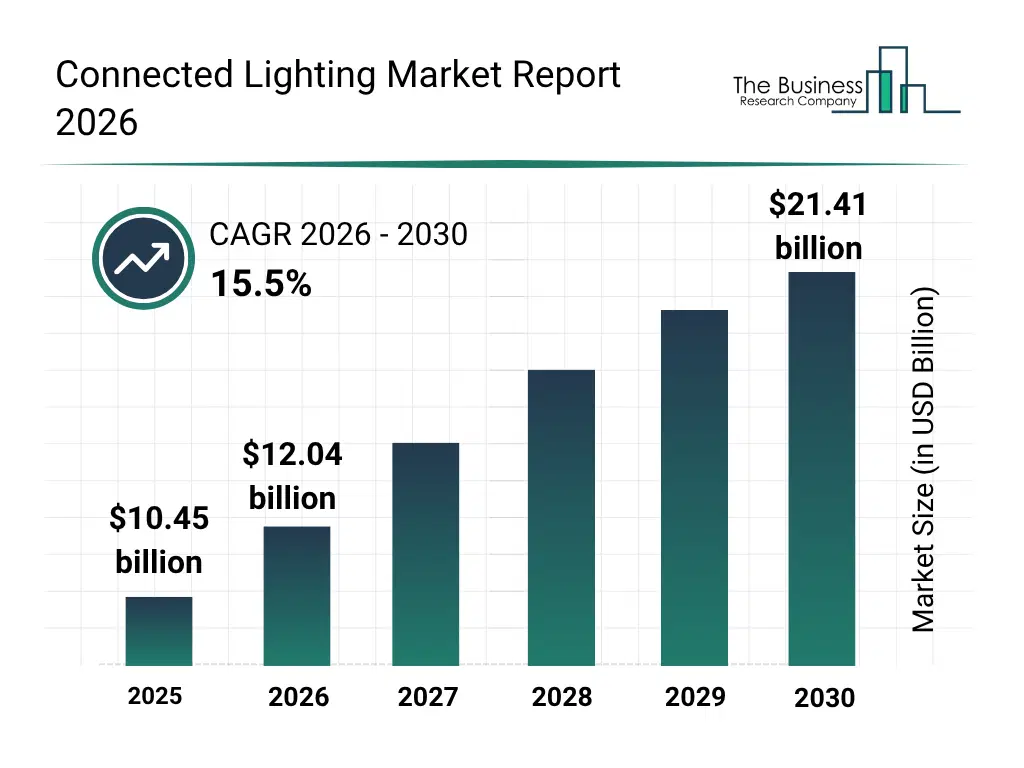
What Is The Connected Lighting Market Size and Share 2026?
The connected lighting market size has grown rapidly in recent years.It will grow from $10.45 billion in 2025 to $12.04 billion in 2026 at a compound annual growth rate (CAGR) of 15.2%. The growth in the historic period can be attributed to rising adoption of energy efficient lighting technologies, increasing urbanization and smart city development, growth in commercial construction activities, declining cost of led lighting systems, early adoption of building automation systems in developed regions.What Is The Connected Lighting Market Growth Forecast?
The connected lighting market size is expected to see rapid growth in the next few years.It will grow to $21.41 billion by 2030 at a compound annual growth rate (CAGR) of 15.5%. The growth in the forecast period can be attributed to increasing demand for net zero and green buildings, expansion of smart city infrastructure projects, rising integration of iot-enabled building systems, growing focus on energy optimization and carbon reduction targets, increasing adoption of ai-driven facility management systems.Major trends in the forecast period include increasing adoption of human-centric lighting systems for enhanced occupant well-being and productivity, rising deployment of energy-efficient smart lighting in commercial buildings to reduce operational costs, growing integration of lighting systems with building automation platforms for centralized control, expansion of wireless connected lighting solutions enabling flexible retrofitting in existing infrastructure, increasing use of occupancy and daylight sensors for adaptive lighting optimization.
Global Connected Lighting Market Segmentation
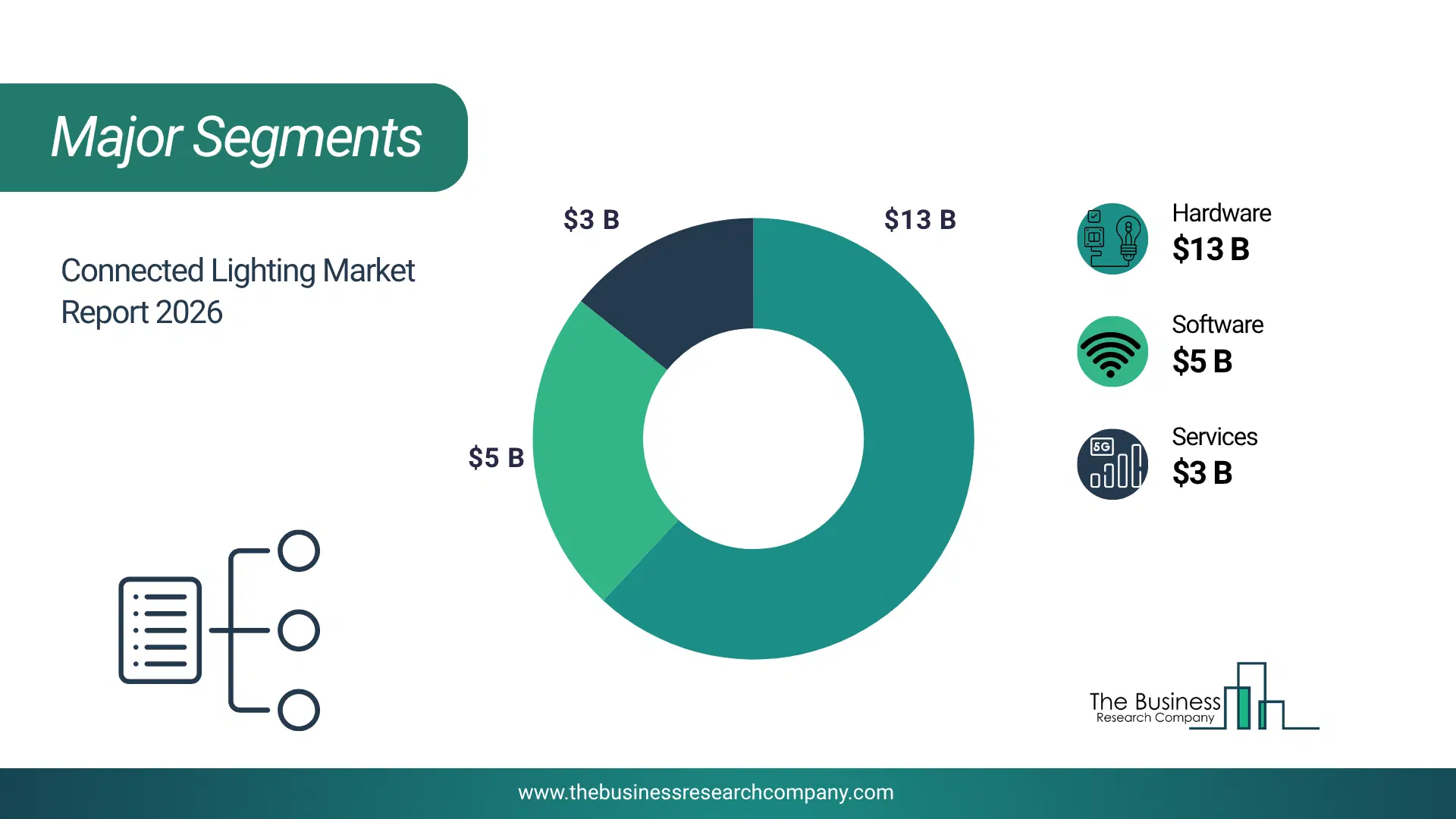
1) By Component: Hardware, Software, Services 2) By Sales Channel: Direct Sales, Distributors Or Wholesalers, Online Retail, Electrical Contractors Or Integrators, Original Equipment Manufacturer Channels 3) By Deployment Type: Wired Connected Lighting, Wireless Connected Lighting 4) By Application: Indoor Lighting, Outdoor Lighting 5) By End User Industry: Commercial And Enterprise, Industrial And Manufacturing, Residential, Municipal And Public Infrastructure, Healthcare, Education, Transportation And Logistics, Utilities And Energy Subsegments: 1) By Hardware: Smart Bulbs And Lamps, Control Modules And Switches, Gateways And Hubs 2) By Software: Lighting Control Platforms, Energy Management Software, Building Management Integration Software 3) By Services: Installation And Commissioning Services, Maintenance And Support Services, Consulting And System Design Services The top segments in the connected lighting market will be: • Hardware will reach $13.13 Billion by 2030. • Software will reach $4.86 Billion by 2030. • Services will reach $3.42 Billion by 2030.What Is The Driver Of The Connected Lighting Market?
The growing penetration of smart home systems is expected to propel the growth of the connected lighting industry going forward.A smart home system is a network of connected devices and appliances that can be remotely controlled and automated to improve convenience, security, and energy efficiency.Smart home systems are increasing mainly because they offer greater convenience, allowing users to control and automate household devices remotely, which saves time and simplifies daily routines.Connected lighting supports smart home systems by integrating with sensors and voice assistants to automatically adjust lighting based on occupancy, time of day, or user commands, improving comfort and energy savings.For instance, in August 2024, according to GreenMatch, a UK-based online services provider, as of 2023, around 5.3 million households in the UK, roughly 19.7% of all homes, utilize smart home products, and it is projected to increase sharply, with nearly all homes, 98.8%, expected to adopt smart devices by 2027.Therefore, the growing penetration of smart home systems is driving the growth of the connected lighting industry.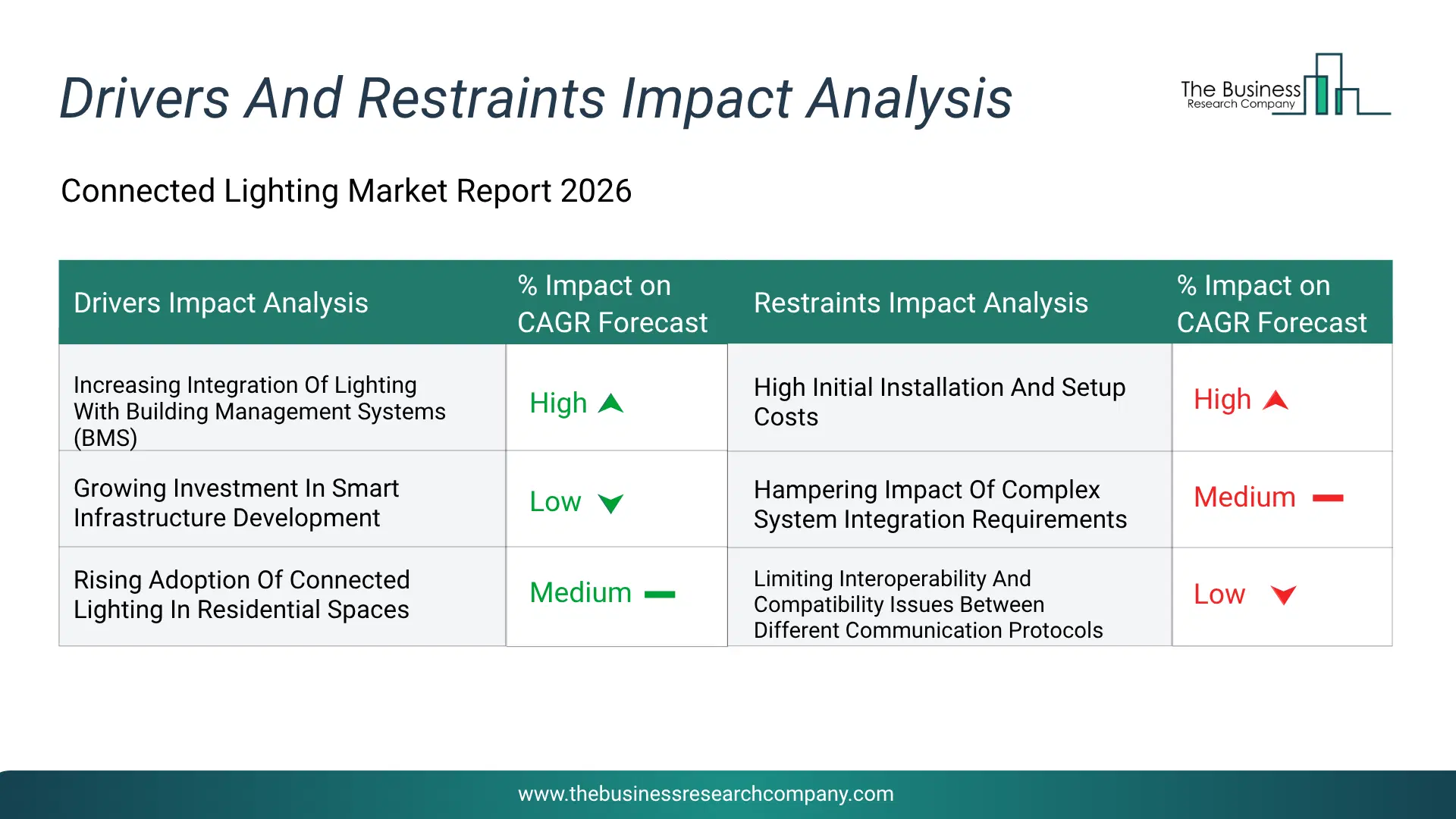
Infographic Chart Showing Key Market Drivers Analysis And Restraints For Connected Lighting Market
The chart presents an impact analysis of key drivers and restraints, quantifying their relative influence on the market's growth rate and helping assess the balance between growth enablers and limiting factors. This chart offers a high-level perspective; the full report contains more detailed insights.
How Will The Drivers Impact Growth In The Global Connected Lighting Market?
• Increasing Integration Of Lighting With Building Management Systems (BMS) (High) – During the forecast period, the increasing integration of lighting with building management systems (BMS) is expected to become a key growth driver for the connected lighting market by 2030. The convergence of lighting with centralized building control platforms enables seamless coordination of lighting with HVAC, security, and energy systems, improving overall operational efficiency. This integration supports real-time monitoring, automated control, and data-driven optimization of lighting usage across large facilities. As organizations focus on enhancing building intelligence and reducing operational complexity, demand for interoperable and connected lighting solutions continues to rise. Additionally, the need for centralized control systems in commercial and industrial buildings further accelerates adoption. • Growing Investment In Smart Infrastructure Development (Low) – During the forecast period, the growing investment in smart infrastructure development is expected to emerge as a major factor driving the expansion of the connected lighting market by 2030. Increasing investments in urban modernization projects and intelligent infrastructure are creating strong demand for advanced lighting systems with connectivity capabilities. Governments and private sector stakeholders are prioritizing infrastructure upgrades that incorporate digital technologies, including connected lighting for improved efficiency and functionality. These developments support large-scale deployment of intelligent lighting networks in public spaces, transportation systems, and commercial facilities. Furthermore, the shift toward digitally enabled infrastructure enhances the scalability and adaptability of lighting systems. • Rising Adoption Of Connected Lighting In Residential Spaces (Medium) – During the forecast period, the rising adoption of connected lighting in residential spaces is expected to act as a key growth catalyst for the connected lighting market by 2030. Increasing consumer interest in smart home technologies is driving the demand for connected lighting solutions that offer convenience, customization, and automation. Homeowners are increasingly adopting lighting systems that can be controlled remotely through mobile applications or voice-enabled platforms. This shift is supported by the growing availability of user-friendly and scalable connected lighting products designed for residential use. Additionally, the rising emphasis on energy efficiency and personalized lighting experiences further supports adoption across households. Consequently, the expansion of smart home ecosystems directly contributes to increased deployment of connected lighting systems.How Will The Restraints Impact Growth In The Global Connected Lighting Market?
• High Initial Installation And Setup Costs (High) – During the forecast period, the high upfront cost of connected lighting systems is the most significant restraint to market growth. These systems require smart luminaires, sensors, controllers, gateways, and networking infrastructure, which substantially increases capital expenditure compared to conventional lighting. Installation often involves retrofitting existing buildings, rewiring, and professional system configuration, further adding to costs. Small and medium-sized enterprises and residential users are particularly sensitive to these expenses. Although long-term energy savings are possible, the extended payback period discourages immediate adoption. Budget constraints in public infrastructure projects also limit large-scale deployments. As a result, cost remains a critical barrier, especially in price-sensitive regions. • Hampering Impact Of Complex System Integration Requirements (Low) – During the forecast period, connected lighting solutions must integrate seamlessly with building management systems, IoT platforms, HVAC systems, and security solutions, which adds technical complexity. Integration challenges increase deployment time and require skilled technicians, raising operational and implementation costs. Legacy infrastructure in older buildings often lacks compatibility with modern connected lighting architectures. Customization needs vary across commercial, industrial, and residential applications, complicating standardization. System failures or poor integration can disrupt operations and reduce user confidence. These complexities slow decision-making and delay large-scale rollouts. Consequently, integration challenges significantly restrain market expansion. • Limiting Interoperability And Compatibility Issues Between Different Communication Protocols (Medium) – During the forecast period, the presence of multiple communication standards such as Zigbee, Bluetooth, Wi-Fi, DALI, and proprietary protocols limits interoperability across devices. Products from different vendors often cannot communicate effectively, leading to vendor lock-in and reduced flexibility for end users. This creates uncertainty during procurement, especially for large commercial or smart city projects. Lack of universal standards increases system complexity and future upgrade risks. End users may hesitate to invest due to concerns about obsolescence or limited scalability. Interoperability challenges also increase maintenance and integration costs. As a result, compatibility issues remain a major adoption restraint.Key Players In The Global Connected Lighting Market
Major companies operating in the connected lighting market are Signify N. V., Schneider Electric SE, Acuity Inc., Legrand SA, Eaton Corporation plc, Lutron Electronics Co. Inc., Honeywell International Inc., Samsung Electronics Co. Ltd., Panasonic Holdings Corporation, Hubbell Incorporated, Delta Electronics Inc., Zumtobel Group AG, Fagerhult Group AB, Helvar Oy Ab, Trilliant Networks Inc., Bajaj Electricals Limited, Leviton Manufacturing Co. Inc., Havells India Limited, Wipro Lighting Limited, Syska LED Lights Pvt. Ltd., Ubicquia Inc., Enlighted Inc., Schréder S. A., Dimonoff Inc., Flashnet S. A., CIMCON Lighting Inc.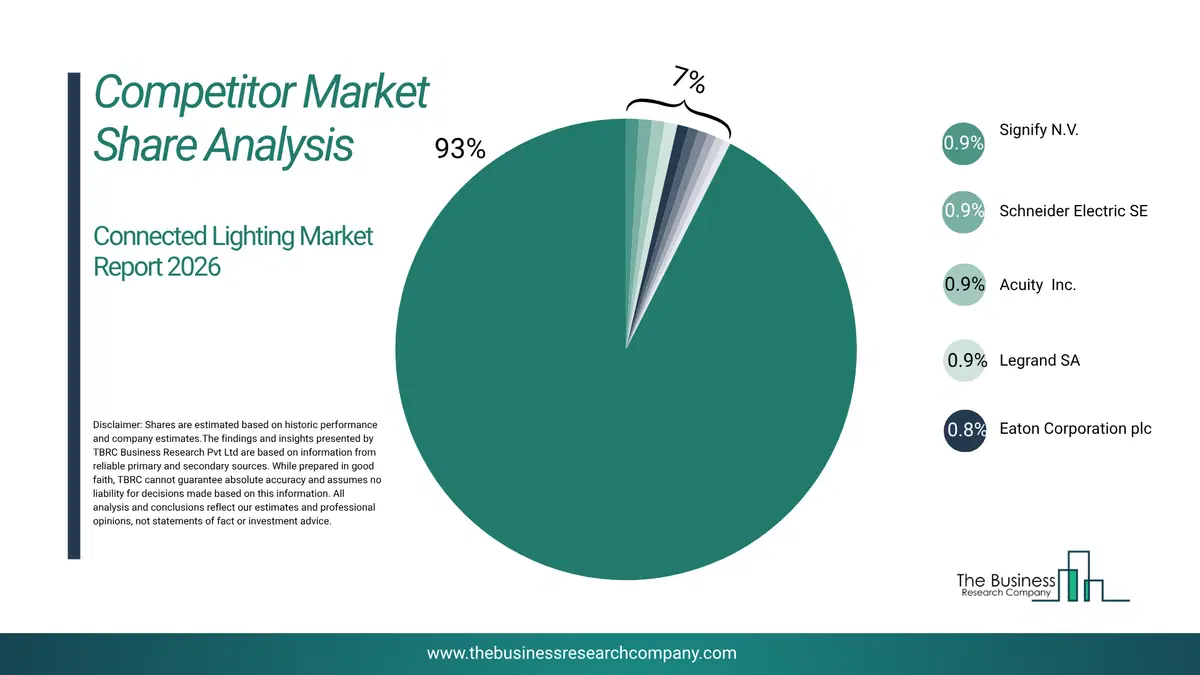
This chart is for illustrative purposes; the full report includes a detailed competitor analysis and comprehensive overview of the top 10 companies in the market.
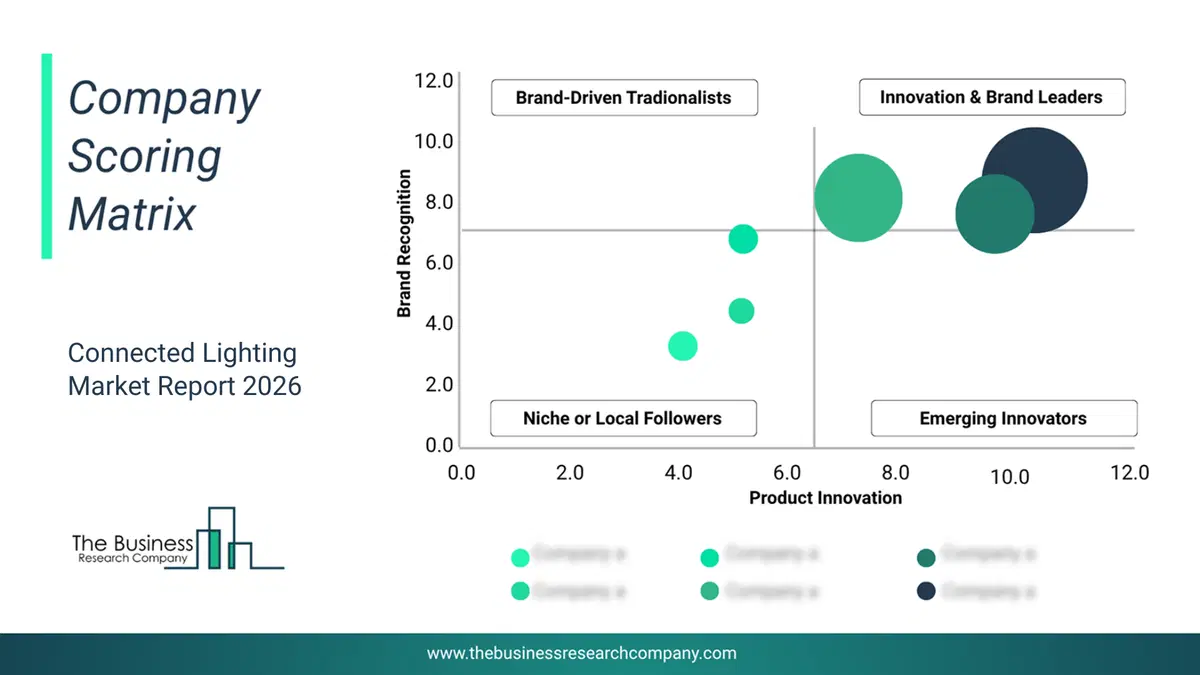
This chart maps companies by product innovation and brand strength, with bubble size indicating relative revenue, helping identify market leaders, challengers, and niche players. This is an illustrative chart; the full report provides a complete and accurate competitive analysis.
Global Connected Lighting Market Trends and Insights
Major companies operating in the connected lighting market are focusing on developing innovative solutions, such as cloud-based lighting management, to enable centralized control, monitoring, and automation of lighting systems to improve operational efficiency, safety, and regulatory compliance. Cloud-based lighting management is a system that uses cloud computing to remotely monitor, control, and optimize lighting networks through internet-connected devices and software platforms. For instance, in June 2025, Signify N. V., a Netherlands-based lighting company, launched the Interact emergency lighting system, a wireless solution that enables building managers to control, monitor, and test emergency lighting through a secure cloud-based dashboard. Integrated with the Interact building manager platform, the system automates function and duration testing, delivers health status alerts, and generates detailed compliance reports while supporting multiple testing schedules. These capabilities allow building operators to reduce manual intervention, minimize operational costs, enhance system reliability, and ensure adherence to safety regulations while enabling seamless management of both general and emergency lighting within a unified connected infrastructure.What Are Latest Mergers And Acquisitions In The Connected Lighting Market?
In March 2023, Signify N. V., a Netherlands-based lighting company, acquired Intelligent Lighting Controls Inc. (ILC) for an undisclosed amount. With this acquisition, Signify N. V. aimed to expand its connected lighting portfolio by strengthening its wired control systems offering, enhancing its energy-saving lighting solutions portfolio, and increasing opportunities to deliver efficient LED lighting products. Intelligent Lighting Controls Inc. (ILC) is a US-based manufacturing company that offers connected lighting solutions.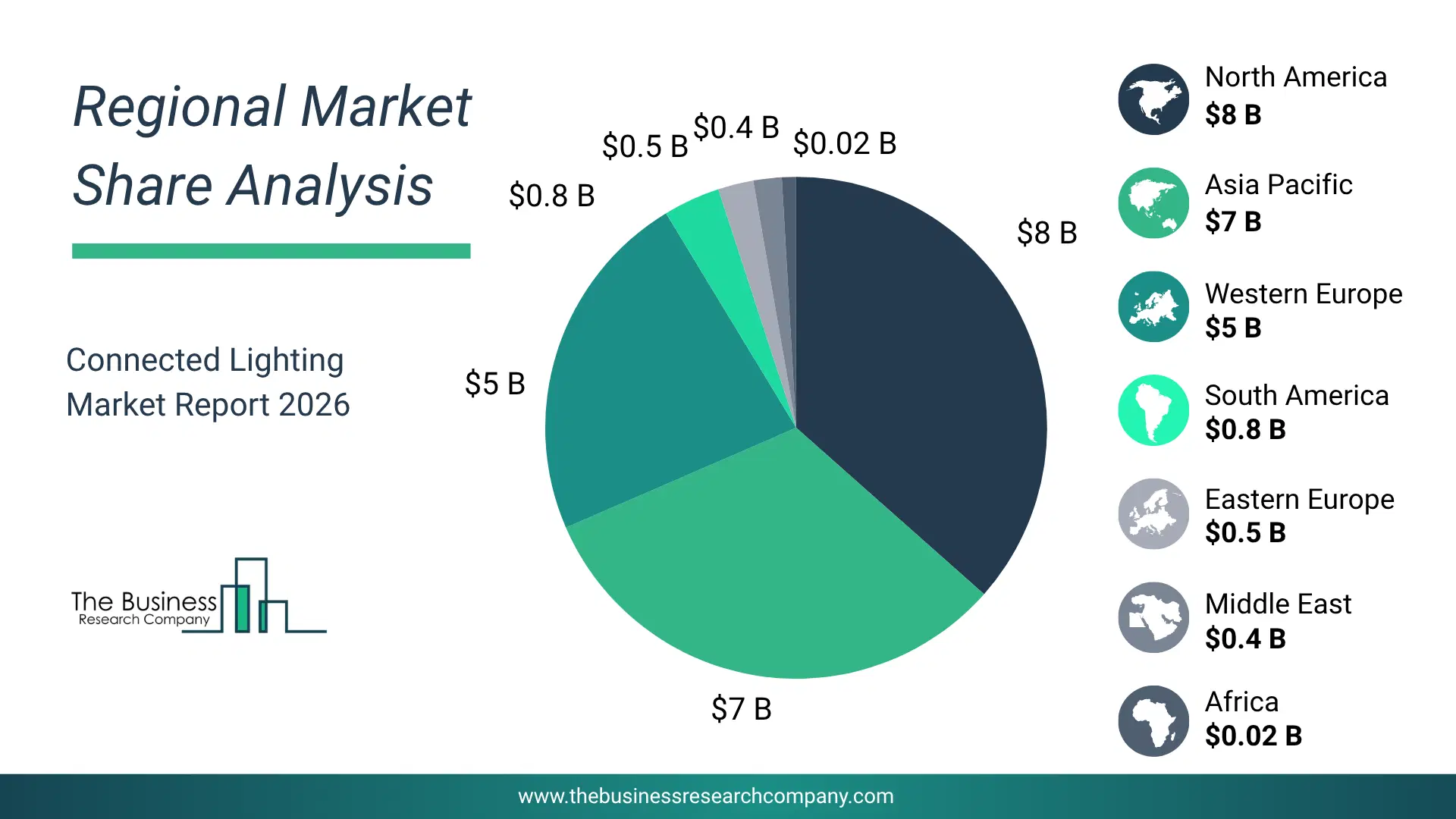
Regional Insights
North America was the largest region in the connected lighting market in 2025. Asia-Pacific is expected to be the fastest-growing region in the forecast period. The regions covered in this market report are Asia-Pacific, South East Asia, Western Europe, Eastern Europe, North America, South America, Middle East and Africa. The countries covered in this market report are Australia, Brazil, China, France, Germany, India, Indonesia, Japan, Taiwan, Russia, South Korea, UK, USA, Canada, Italy, Spain.What Defines the Connected Lighting Market?
The connected lighting market consists of revenues earned by entities by providing services such as energy usage tracking and optimization analytics, predictive maintenance and fault detection alerts, and remote lighting control and monitoring. The market value includes the value of related goods sold by the service provider or included within the service offering. The connected lighting market also includes sales of smart ceiling lights, lighting control hubs, and smart lamps. Values in this market are ‘factory gate’ values, that is, the value of goods sold by the manufacturers or creators of the goods, whether to other entities (including downstream manufacturers, wholesalers, distributors, and retailers) or directly to end customers. The value of goods in this market includes related services sold by the creators of the goods.What is the Market Assessment and Strategic Outlook for the Connected Lighting Industry?
The connected lighting market research report is one of a series of new reports from The Business Research Company that provides market statistics, including industry global market size, regional shares, competitors with the market share, detailed market segments, market trends and opportunities, and any further data you may need to thrive in the connected lighting industry. The market research report delivers a complete perspective of everything you need, with an in-depth analysis of the current and future state of the industry.
This chart presents market attractiveness based on a quantitative evaluation of growth, competition, strategic alignment, and risk, offering a clear view of opportunity areas for decision-making. This chart is for illustrative purposes; the full report contains the complete analysis.

This chart highlights the Total Addressable Market (TAM) by estimating the maximum revenue opportunity using an assumption-driven approach, supporting strategic planning and opportunity sizing across markets. The chart is illustrative; the full report provides a more comprehensive analysis.
What is the Market Assessment and Strategic Outlook for the Connected Lighting Market Report 2026?
The connected lighting market research report is one of a series of new reports from The Business Research Company that provides connected lighting market statistics, including connected lighting industry global market size, regional shares, competitors with a connected lighting market share, detailed connected lighting market segments, market trends and opportunities, and any further data you may need to thrive in the connected lighting industry. This connected lighting market research report delivers a complete perspective of everything you need, with an in-depth analysis of the current and future scenario of the industry.Connected Lighting Market Report Forecast Analysis
| Report Attribute | Details |
|---|---|
| Market Size Value In 2026 | $12.04 billion |
| Revenue Forecast In 2030 | $21.41 billion |
| Growth Rate | CAGR of 15.5% from 2026 to 2030 |
| Base Year For Estimation | 2025 |
| Actual Estimates/Historical Data | 2020-2025 |
| Forecast Period | 2026 - 2030 |
| Market Representation | Revenue in USD Billion and CAGR from 2026 to 2030 |
| Segments Covered | Component, Sales Channel, Deployment Type, Application, End User Industry |
| Regional Scope | Asia-Pacific, Western Europe, Eastern Europe, North America, South America, Middle East, Africa |
| Country Scope | The countries covered in the report are Australia, Brazil, China, France, Germany, India, Indonesia, Japan, Taiwan, Russia, South Korea, UK, USA, Canada, Italy, Spain. |
| Key Companies Profiled | Signify N. V., Schneider Electric SE, Acuity Inc., Legrand SA, Eaton Corporation plc, Lutron Electronics Co. Inc., Honeywell International Inc., Samsung Electronics Co. Ltd., Panasonic Holdings Corporation, Hubbell Incorporated, Delta Electronics Inc., Zumtobel Group AG, Fagerhult Group AB, Helvar Oy Ab, Trilliant Networks Inc., Bajaj Electricals Limited, Leviton Manufacturing Co. Inc., Havells India Limited, Wipro Lighting Limited, Syska LED Lights Pvt. Ltd., Ubicquia Inc., Enlighted Inc., Schréder S. A., Dimonoff Inc., Flashnet S. A., CIMCON Lighting Inc. |
| Customization Scope | Request for Customization |
| Pricing And Purchase Options | Explore Purchase Options |