
Connected Logistics Market Report 2026
Global Outlook – By Component (Hardware, Solutions, Services), By Transportation (Roadways, Railways, Airways, Maritime), By Application (Inventory Tracking, Optimized Warehousing, Real-Time Fleet Management, Predictive Maintenance, Cargo Integrity Monitoring, End-To-End Delivery Tracking, Other Applications), By End-Use Industries (Automotive, Healthcare And Pharmaceuticals, Oil And Gas, Food And Beverage, Aerospace And Defense, Manufacturing, Information Technology (IT) And Telecommunication, Retail And E-Commerce, Other End-Use Industries) – Market Size, Trends, Strategies, and Forecast to 2030
Connected Logistics Market Overview
• Connected Logistics market size has reached to $32.19 billion in 2025 • Expected to grow to $57.36 billion in 2030 at a compound annual growth rate (CAGR) of 11.8% • Growth Driver: Increasing IoT Devices Drive Growth In Connected Logistics Market • Market Trend: Cloud-Based Solutions Revolutionizing Connected Logistics to Streamline Global Supply Chains • North America was the largest region in 2025 and Asia-Pacific is the fastest growing region.What Is Covered Under Connected Logistics Market?
Connected logistics refers to the integration of various technologies such as IoT sensors, data analytics, and cloud computing to optimize and streamline the processes involved in the transportation, storage, and distribution of goods. It enables real-time tracking, predictive maintenance, and efficient resource management throughout the supply chain network. The main components of connected logistics are hardware, solutions, and services. Hardware-connected logistics refers to the integration of physical devices, such as sensors and trackers, into supply chain operations to enhance efficiency, visibility, and control over the movement of goods. The transportations include roadways, railways, airways, and maritime, for applications such as inventory tracking, optimized warehousing, real-time fleet management, predictive maintenance, cargo integrity monitoring, end-to-end delivery tracking, and others. The end-user industries include automotive, healthcare and pharmaceuticals, oil and gas, food and beverage, aerospace and defense, manufacturing, information technology (IT) and telecommunication, retail and e-commerce, and others.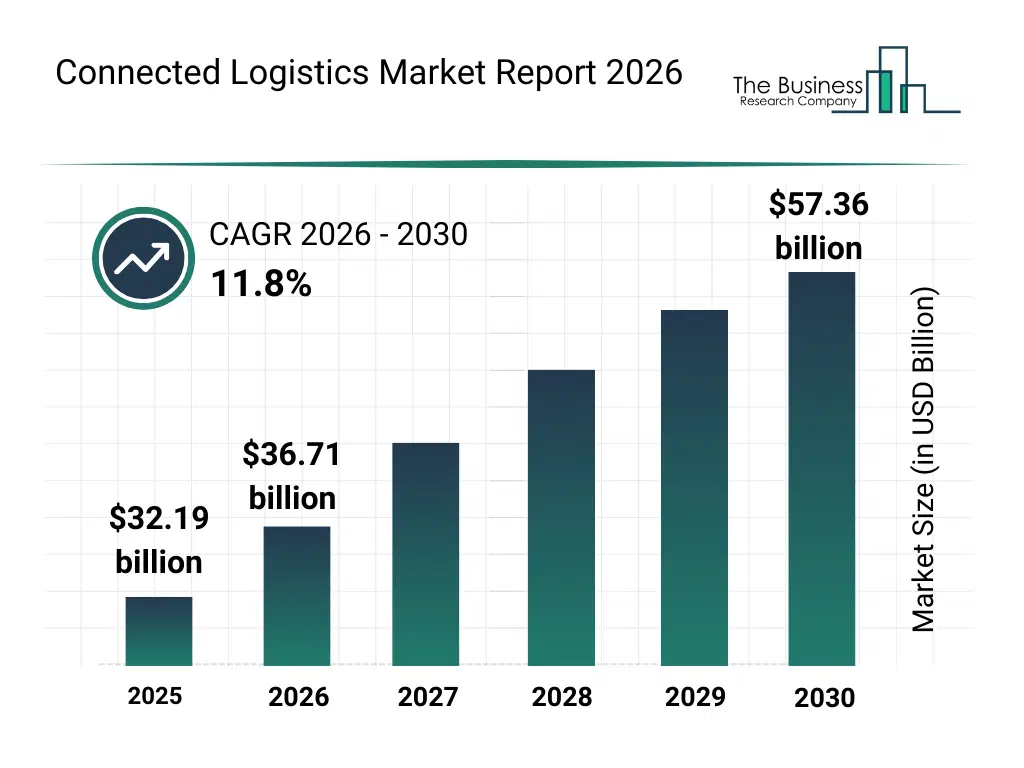
What Is The Connected Logistics Market Size and Share 2026?
The connected logistics market size has grown rapidly in recent years. It will grow from $32.19 billion in 2025 to $36.71 billion in 2026 at a compound annual growth rate (CAGR) of 14.0%. The growth in the historic period can be attributed to e-commerce growth, gps tracking adoption, warehouse automation, demand for delivery optimization, global trade expansion.What Is The Connected Logistics Market Growth Forecast?
The connected logistics market size is expected to see rapid growth in the next few years. It will grow to $57.36 billion in 2030 at a compound annual growth rate (CAGR) of 11.8%. The growth in the forecast period can be attributed to AI-driven logistics optimization, smart warehousing investments, sustainability-focused logistics, autonomous delivery systems, digital supply chains. Major trends in the forecast period include adoption of real-time supply chain visibility, growth of IoT-based fleet tracking, expansion of predictive analytics in logistics, demand for end-to-end transparency, integration of cloud logistics platforms.
Global Connected Logistics Market Segmentation
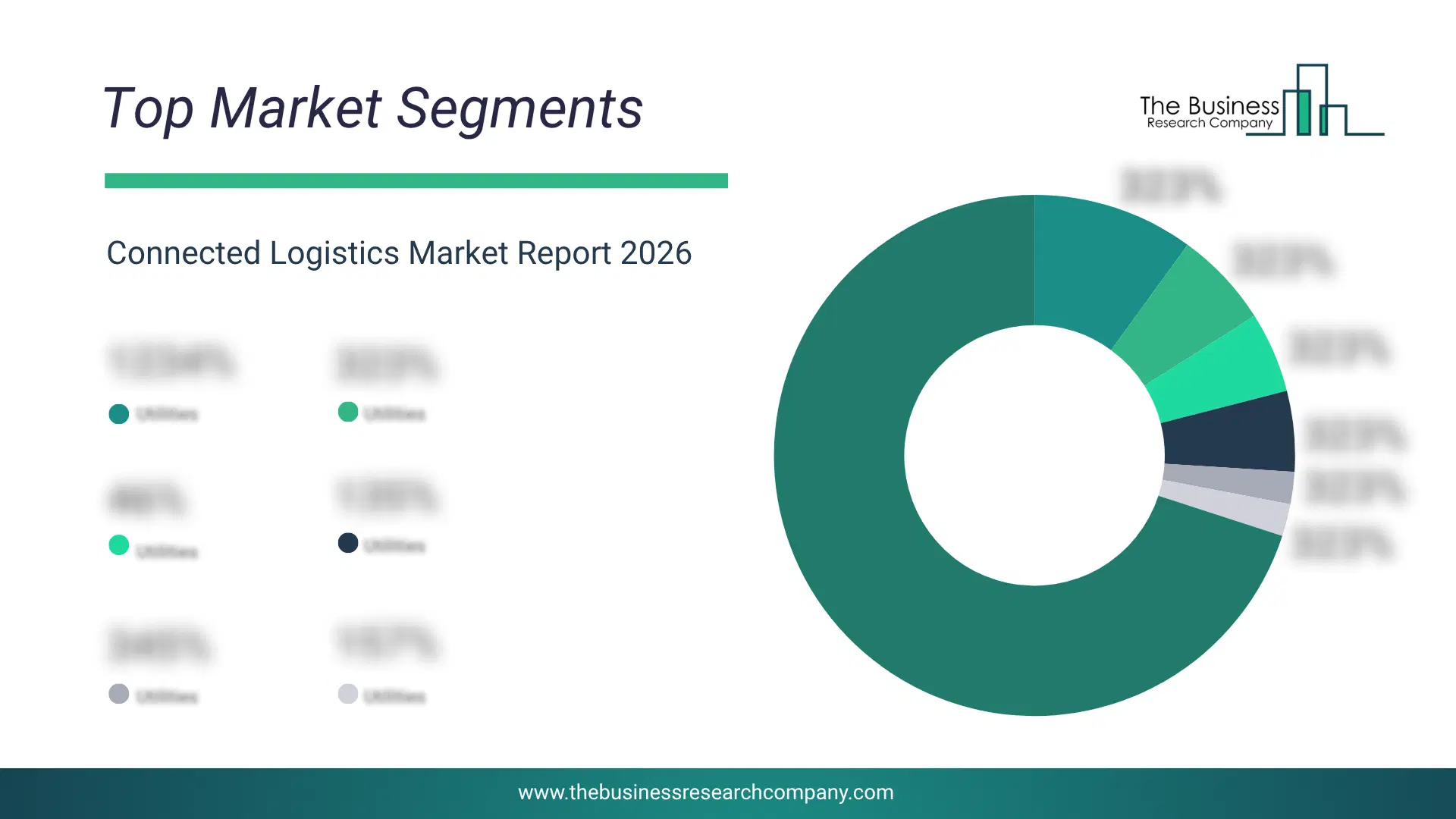
1) By Component: Hardware, Solutions, Services 2) By Transportation: Roadways, Railways, Airways, Maritime 3) By Application: Inventory Tracking, Optimized Warehousing, Real-Time Fleet Management, Predictive Maintenance, Cargo Integrity Monitoring, End-To-End Delivery Tracking, Other Applications 4) By End-Use Industries: Automotive, Healthcare And Pharmaceuticals, Oil And Gas, Food And Beverage, Aerospace And Defense, Manufacturing, Information Technology (IT) And Telecommunication, Retail And E-Commerce, Other End-Use Industries Subsegments: 1) By Hardware: Sensors, RFID Tags, GPS Devices, Communication Devices, Others (Drones, Cameras) 2) By Solutions: Fleet Management Software, Warehouse Management Systems (WMS), Supply Chain Visibility Platforms, Route Optimization Software, Inventory Management Solutions, Predictive Maintenance Solutions, Others 3) By Services: Integration Services, Consulting Services, Managed Services, Maintenance And Support Services, Data Analytics Services, Training And Support ServicesWhat Is The Driver Of The Connected Logistics Market?
The increasing exposure of IoT connecting devices is expected to propel the connected logistics market going forward. Internet of Things (IoT) refers to the network of interconnected devices that can communicate and exchange data over the Internet. It is driven by the growing demand for interconnectedness, efficiency, and automation across various industries and daily activities. IoT connecting logistics devices enable real-time shipment tracking, optimize route planning, monitor vehicle conditions, enhance inventory management, and streamline supply chain operations, leading to increased efficiency, reduced costs, and improved customer satisfaction. For instance, in October 2025, according to the IoT Analytics, a Germany-based, a leading global provider of market insights, the number of connected IoT devices is projected to grow by 14% in 2025, reaching 39 billion by 2030. Therefore, the increasing exposure of IoT connecting devices is driving the growth of the connected logistics industry.Key Players In The Global Connected Logistics Market
Major companies operating in the connected logistics market report include Microsoft Corporation, AT&T Inc, DHL International GmbH, Robert Bosch GmbH, FedEx Corporation, Huawei Technologies, Amazon Web Services, Siemens, Intel Corporation, Accenture, International Business Machines Corporation, Cisco System Inc., Oracle Corporation, Honeywell International Inc., SAP SE, TATA Consulting Services Ltd, NEC Corporation, Nippon Express Co. Ltd., Infosys Limited, HCL Technology Limited, Xpo Logistics Inc., Hexagon AB, Senko Group Holdings Co., Ltd, Yusen Logistics Co. Ltd., Trimble, Orbcomm, Eurotech Group, Freightgate Inc.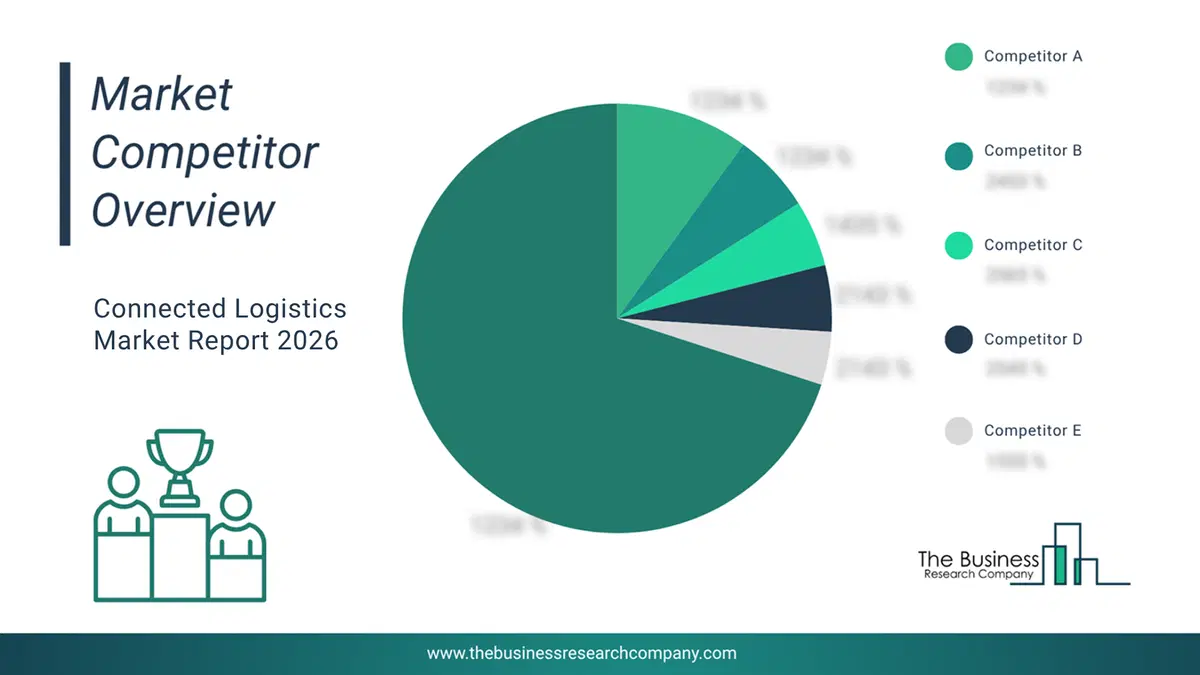
This chart is for illustrative purposes; the full report includes a detailed competitor analysis and comprehensive overview of the top 10 companies in the market.
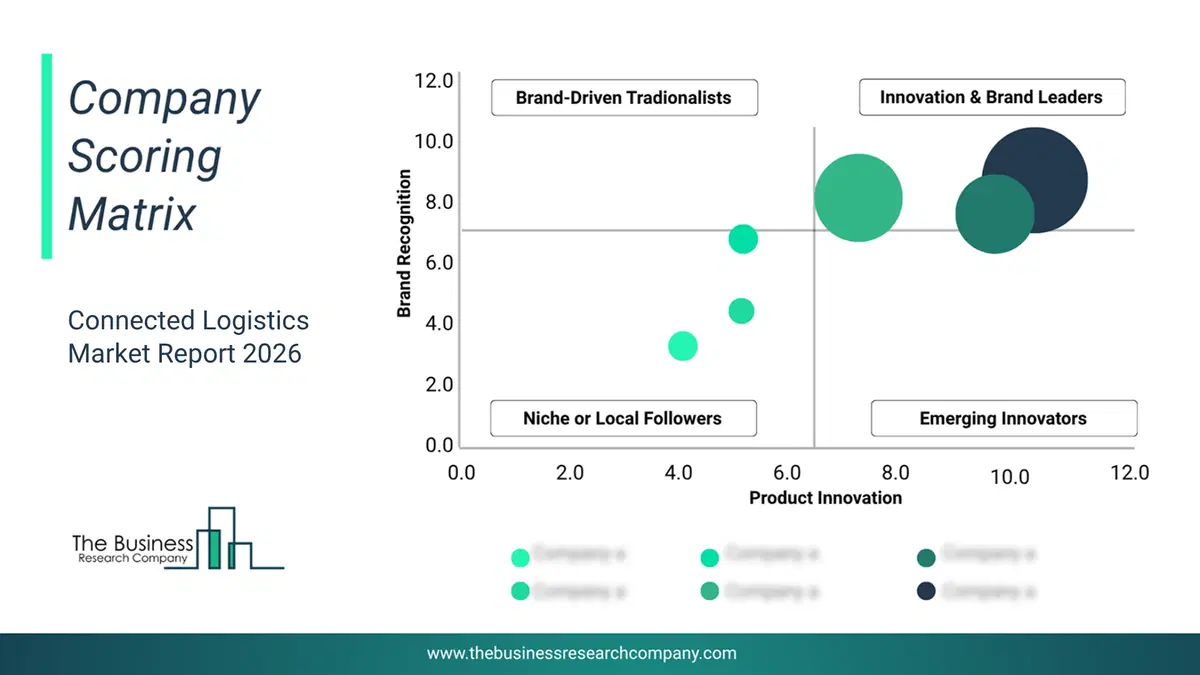
This chart maps companies by product innovation and brand strength, with bubble size indicating relative revenue, helping identify market leaders, challengers, and niche players. This is an illustrative chart; the full report provides a complete and accurate competitive analysis.
Global Connected Logistics Market Trends and Insights
Major companies operating in the connected logistics market are focused on developing advanced solutions such as cloud-based services, to enhance global supply chain efficiency. It plays a crucial role in connected logistics by providing scalable, accessible, and centralized platforms for data storage, processing, and analysis, facilitating real-time decision-making and collaboration across the supply chain. For instance, in December 2023, Fujitsu Limited, a Japan-based information and communications technology equipment and services provider, launched a cloud-based logistics data standardization and visualization service for shippers, logistics firms, and supply chain vendors, providing innovative tools to promote sustainability, tackle challenges such as driver shortages, carbon emissions reduction, and compliance with industry regulations. This service offers automated data conversion to comply with logistics information standard guidelines, functions to connect, transform, and store various logistics data, and visualization and analysis tools through logistics KPIs. The new service aims to facilitate inter-company collaboration, optimize the supply chain, and address challenges such as driver shortages and reducing energy consumption through shared vehicle use.What Are Latest Mergers And Acquisitions In The Connected Logistics Market?
In January 2023, A.P. Moller-Maersk (Maersk), a Denmark-based integrated container logistics company, acquired Martin Bencher Group for an undisclosed amount. This acquisition bolsters Maersk's capacity to provide project logistics services on a global scale, reinforces its integrator strategy, and seeks to deliver a more comprehensive range of services to diverse industries. The aim is to harness the combined strengths of both companies to facilitate smooth transitions and elevate logistics capabilities. Martin Bencher Group is a Denmark-based company that provides connected logistics services, including the design of end-to-end project logistics solutions.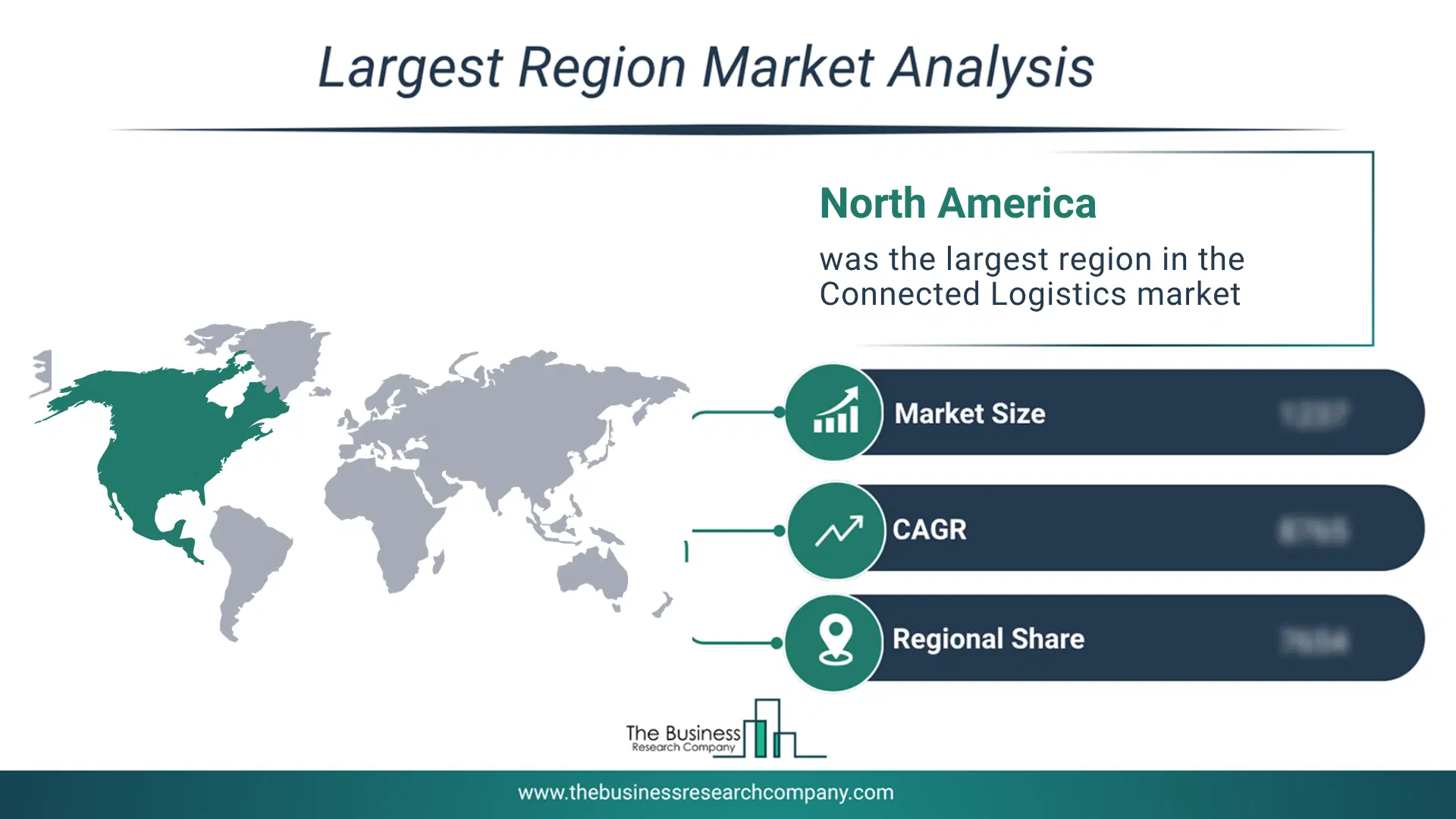
Regional Outlook
North America was the largest region in the connected logistics market in 2025. Asia-Pacific is expected to be the fastest-growing region in the forecast period. The regions covered in this market report include Asia-Pacific, South East Asia, Western Europe, Eastern Europe, North America, South America, Middle East, Africa. The countries covered in this market report include Australia, Brazil, China, France, Germany, India, Indonesia, Japan, Taiwan, Russia, South Korea, UK, USA, Canada, Italy, SpainWhat Defines the Connected Logistics Market?
The connected logistics market consists of revenues earned by entities by providing services such as warehouse management, fleet management, freight transportation management, and asset tracking and management. The market value includes the value of related goods sold by the service provider or included within the service offering. The connected logistics market also includes sales of vehicle telematics, data loggers, GPS tracking devices, and radio frequency identification (RFID) tags. Values in this market are ‘factory gate’ values, that is the value of goods sold by the manufacturers or creators of the goods, whether to other entities (including downstream manufacturers, wholesalers, distributors and retailers) or directly to end customers. The value of goods in this market includes related services sold by the creators of the goods.How is Market Value Defined and Measured?
The market value is defined as the revenues that enterprises gain from the sale of goods and/or services within the specified market and geography through sales, grants, or donations in terms of the currency (in USD unless otherwise specified). The revenues for a specified geography are consumption values that are revenues generated by organizations in the specified geography within the market, irrespective of where they are produced. It does not include revenues from resales along the supply chain, either further along the supply chain or as part of other products.
This chart presents market attractiveness based on a quantitative evaluation of growth, competition, strategic alignment, and risk, offering a clear view of opportunity areas for decision-making. This chart is for illustrative purposes; the full report contains the complete analysis.

This chart highlights the Total Addressable Market (TAM) by estimating the maximum revenue opportunity using an assumption-driven approach, supporting strategic planning and opportunity sizing across markets. The chart is illustrative; the full report provides a more comprehensive analysis.
What Key Data and Analysis Are Included in the Connected Logistics Market Report 2026?
The connected logistics market research report is one of a series of new reports from The Business Research Company that provides market statistics, including industry global market size, regional shares, competitors with the market share, detailed market segments, market trends and opportunities, and any further data you may need to thrive in the connected logistics industry. The market research report delivers a complete perspective of everything you need, with an in-depth analysis of the current and future state of the industry.Connected Logistics Market Report Forecast Analysis
| Report Attribute | Details |
|---|---|
| Market Size Value In 2026 | $36.71 billion |
| Revenue Forecast In 2030 | $57.36 billion |
| Growth Rate | CAGR of 14.0% from 2026 to 2030 |
| Base Year For Estimation | 2025 |
| Actual Estimates/Historical Data | 2020-2025 |
| Forecast Period | 2026 - 2030 - 2030 |
| Market Representation | Revenue in USD Billion and CAGR from 2026 to 2030 |
| Segments Covered | Component, Transportation, Application, End-Use Industries |
| Regional Scope | Asia-Pacific, Western Europe, Eastern Europe, North America, South America, Middle East, Africa |
| Country Scope | The countries covered in the report are Australia, Brazil, China, France, Germany, India, Indonesia, Japan, Taiwan, Russia, South Korea, UK, USA, Canada, Italy, Spain. |
| Key Companies Profiled | Microsoft Corporation, AT&T Inc, DHL International GmbH, Robert Bosch GmbH, FedEx Corporation, Huawei Technologies, Amazon Web Services, Siemens, Intel Corporation, Accenture, International Business Machines Corporation, Cisco System Inc., Oracle Corporation, Honeywell International Inc., SAP SE, TATA Consulting Services Ltd, NEC Corporation, Nippon Express Co. Ltd., Infosys Limited, HCL Technology Limited, Xpo Logistics Inc., Hexagon AB, Senko Group Holdings Co., Ltd, Yusen Logistics Co. Ltd., Trimble, Orbcomm, Eurotech Group, Freightgate Inc. |
| Customization Scope | Request for Customization |
| Pricing And Purchase Options | Explore Purchase Options |