

Connected Television (TV) Market Report 2026
Global Outlook – By Screen Type ( Curved, Flat), By Platform Type ( Android, Roku, Other Platforms), By Screen Size ( Less Than 30 Inches, 30 Inches To 50 Inches, 50 Inches To 70 Inches, Above 70 Inches), By Distribution Channel ( Company Owned Websites, Specialty Stores, Online Retailers, Other Channels), By End Use ( Residential, Commercial) – Market Size, Trends, Strategies, and Forecast to 2030
Connected Television (TV) Market Overview
• Connected Television (TV) market size has reached to $17.55 billion in 2025 • Expected to grow to $33.28 billion in 2030 at a compound annual growth rate (CAGR) of 13.6% • Growth Driver: Rising Demand for OTT Content Fuels Growth in Connected TV Market • Market Trend: Adoption Of AI-Powered Smart Televisions To Enhance Viewing Experience • Asia-Pacific was the largest region and fastest growing region.Market Gains By 2030 – Top Opportunities By Segment
Market Gain identifies the most promising market opportunities by highlighting the segments or products expected to generate the highest incremental revenue growth over the next five years.
What Is Covered Under Connected Television (TV) Market?
Connected television (TV) refers to televisions connected to the internet, allowing users to access a wide range of digital content beyond traditional broadcast or cable channels. These TVs typically utilize internet connectivity to stream video content from various online platforms. The main screen types of connected television (TV) are curved and flat. Curved televisions (TVs) are televisions with screens that are slightly curved outward, aiming to provide a more immersive viewing experience by enveloping the viewer in the content. They operate through various platforms such as Android, Roku, and others. They are available in a variety of screen sizes, including less than 30 inches, 30 inches to 50 inches, 50 inches to 70 inches, and above 70 inches by various distribution channels include company-owned websites, specialty stores, online retailers, and others for end uses such as residential and commercial.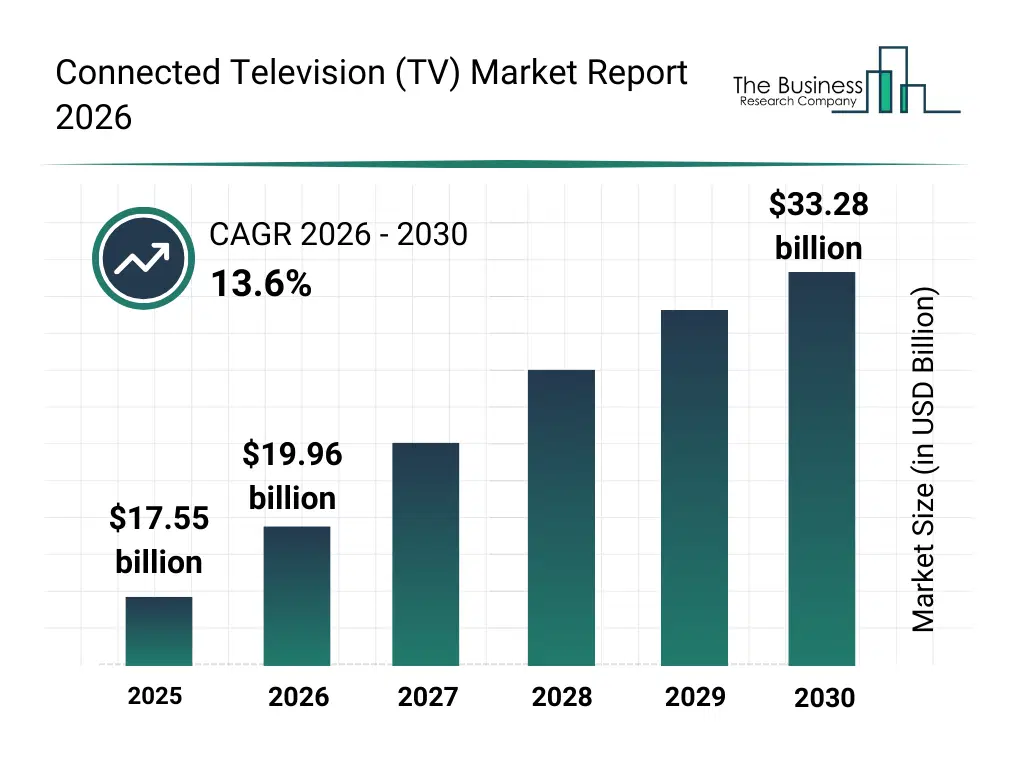
What Is The Connected Television (TV) Market Size 2026 And Growth Rate?
The connected television (tv) market size has grown rapidly in recent years. It will grow from $17.55 billion in 2025 to $19.96 billion in 2026 at a compound annual growth rate (CAGR) of 13.7%. The growth in the historic period can be attributed to rising penetration of broadband internet, growth in ott content consumption, decline in lcd and led panel prices, early smart tv platform integrations, increasing replacement of traditional cable tv.What Is The Connected Television (TV) Market Growth Forecast?
The connected television (tv) market size is expected to see rapid growth in the next few years. It will grow to $33.28 billion in 2030 at a compound annual growth rate (CAGR) of 13.6%. The growth in the forecast period can be attributed to expansion of 8k and advanced display technologies, growing popularity of ad supported streaming models, integration of voice assistants and AI discovery tools, increasing adoption of cross device content synchronization, rising demand for interactive and immersive viewing experiences. Major trends in the forecast period include growing adoption of connected tv advertising, increasing shift toward large screen smart tvs, rising integration of multi platform streaming ecosystems, growing demand for personalized content viewing, expansion of smart home entertainment integration.
Global Connected Television (TV) Market Segmentation
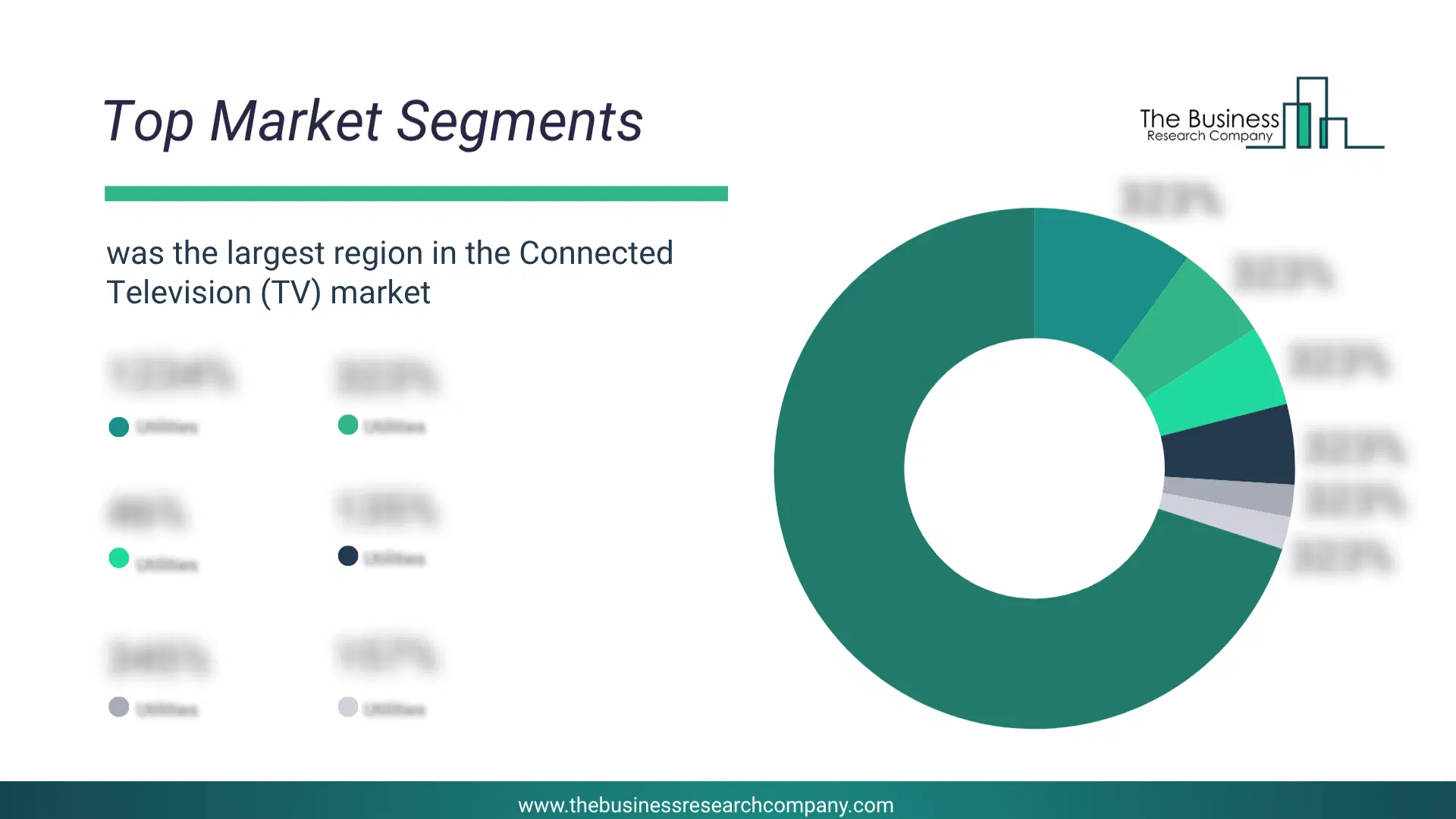
1) By Screen Type: Curved, Flat 2) By Platform Type: Android, Roku, Other Platforms 3) By Screen Size: Less Than 30 Inches, 30 Inches To 50 Inches, 50 Inches To 70 Inches, Above 70 Inches 4) By Distribution Channel: Company Owned Websites, Specialty Stores, Online Retailers, Other Channels 5) By End Use: Residential, Commercial Subsegments: 1) By Curved: 4K Curved TVs, 8K Curved TVs, LED Curved TVs, OLED Curved TVs 2) By Flat: 4K Flat TVs, 8K Flat TVs, LED Flat TVs, OLED Flat TVs The top segments in the connected television (tv) market will be: • Curved will reach $29.75 Billion by 2030. • Flat will reach $3.38 Billion by 2030.What Is The Driver Of The Connected Television (TV) Market?
The rising demand for over-the-top (OTT) content is expected to propel the growth of the connected TV market going forward. Over-the-top (OTT) content refers to audio, video, and other media content delivered directly to users, bypassing traditional distribution channels such as cable or satellite television providers. The demand for over-the-top (OTT) content is increasing due to consumer demand for flexibility and convenience, the proliferation of smart devices and high-speed internet, and the expansion of streaming platforms. Connected TV provides an integrated platform for accessing a wide range of streaming services and content without additional devices or subscriptions. For instance, according to Business of Apps, a UK-based prominent business-to-business media and information platform, Netflix (a subscription-based streaming service that offers a vast library of movies, TV shows, documentaries, and original programming) experienced a significant increase in subscribers, with the subscriber base growing from 220.6 million in 2022 to 238.3 million in 2023, reflecting an increase of approximately 8.04%. Therefore, the rising demand for an enhanced viewing experience of over-the-top (OTT) content is driving the growth of the connected television (TV) industry.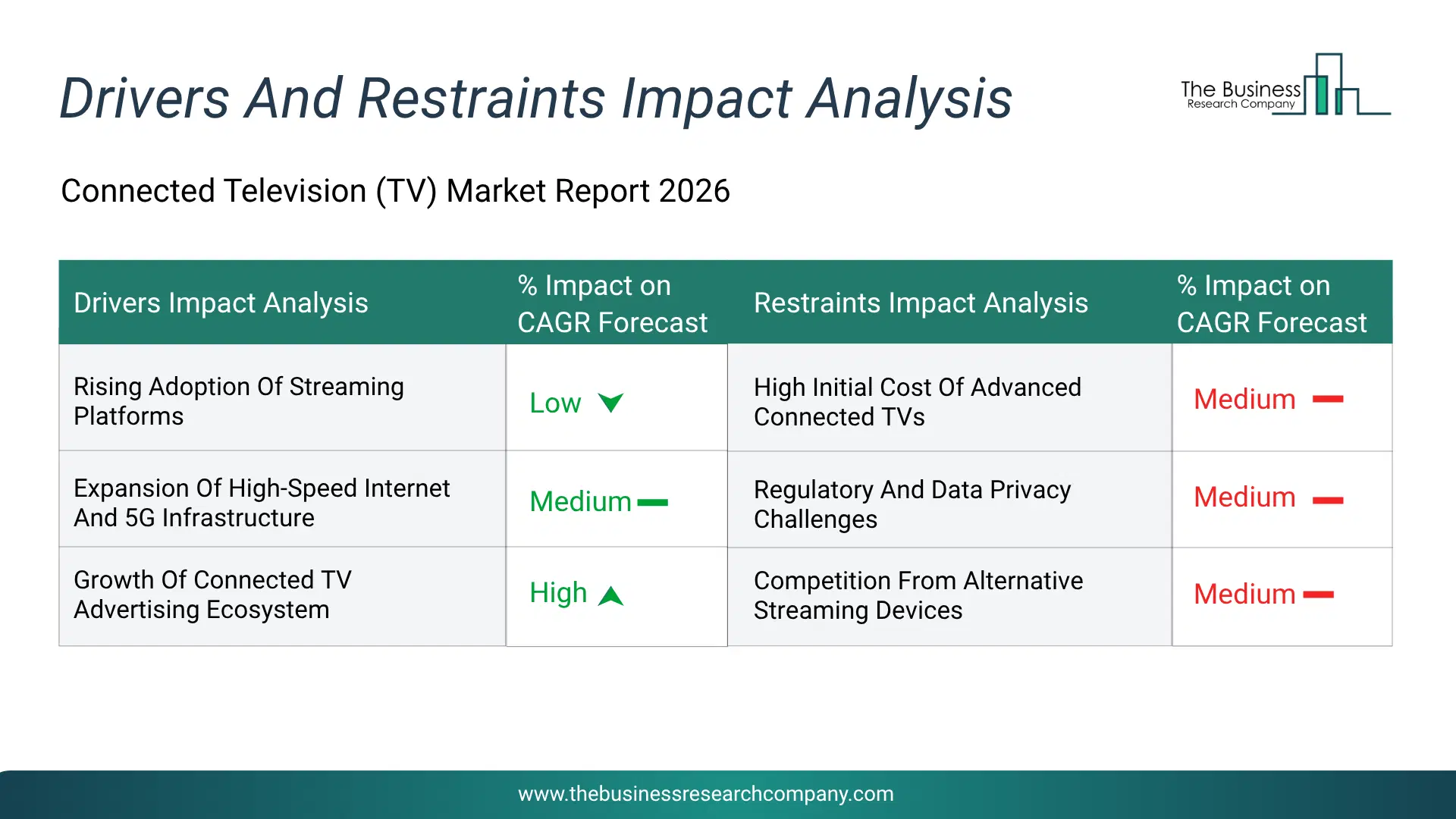
Infographic Chart Showing Key Market Drivers Analysis And Restraints For Connected Television (Tv) Market
The chart presents an impact analysis of key drivers and restraints, quantifying their relative influence on the market's growth rate and helping assess the balance between growth enablers and limiting factors. This chart offers a high-level perspective; the full report contains more detailed insights.
How Will The Drivers Impact Growth In The Global Connected Television (TV) Market?
• Rising Adoption Of Streaming Platforms (Low) – During the forecast period, the rising adoption of streaming platforms is expected to become a key growth driver for the connected television (TV) market by 2030. Consumers are increasingly shifting from traditional broadcast services to on-demand digital content, enabling greater flexibility, personalization, and multi-device access. Connected TVs serve as the primary interface for accessing subscription-based and ad-supported streaming services, thereby strengthening their role in home entertainment ecosystems. Content providers are expanding libraries with localized and original programming, further accelerating platform engagement. This evolution in content consumption behaviour is reinforcing strong demand for connected television devices globally. • Expansion Of High-Speed Internet And 5G Infrastructure (Medium) – During the forecast period, the expansion of high-speed internet and 5G infrastructure is expected to emerge as a major factor driving the expansion of the connected television (TV) market by 2030. Improved network capabilities are enabling seamless high-definition and ultra-high-definition content streaming with minimal latency and buffering. Enhanced connectivity is also supporting advanced features such as cloud gaming, real-time content synchronization, and interactive viewing experiences on connected TVs. Telecommunications providers are investing heavily in broadband penetration and next-generation network deployments, particularly in emerging markets. This widespread connectivity is accelerating consumer access to digital entertainment services. • Growth Of Connected TV Advertising Ecosystem (High) – During the forecast period, the growth of the connected TV advertising ecosystem is expected to act as a key growth catalyst for the connected television (TV) market by 2030. Advertisers are increasingly shifting budgets toward data-driven and targeted advertising formats enabled by connected TV platforms. Advanced analytics and audience segmentation capabilities allow brands to deliver personalized and measurable advertising experiences, enhancing return on investment. Integration with programmatic advertising platforms and real-time bidding systems is further transforming the digital advertising landscape. This shift toward addressable and performance-based advertising is increasing the value proposition of connected TVs for both content providers and advertisers.How Will The Restraints Impact Growth In The Global Connected Television (TV) Market?
• High Initial Cost Of Advanced Connected TVs (Low) – During the forecast period, high initial cost of advanced connected TVs is significantly restricting the growth of the connected television (TV) market. Premium pricing for smart TVs with advanced features such as AI integration, 4K/8K resolution, and enhanced processing capabilities is limiting adoption among price-sensitive consumers, particularly in emerging markets. • Regulatory And Data Privacy Challenges (Medium) – During the forecast period, regulatory and data privacy challenges are significantly restricting the growth of the connected television (TV) market. Increasing scrutiny over user data collection, content tracking, and targeted advertising is imposing compliance burdens on manufacturers and service providers, thereby limiting operational flexibility and innovation. • Competition From Alternative Streaming Devices (High) – During the forecast period, competition from alternative streaming devices is restricting the growth of the connected television (TV) market. The availability of low-cost streaming sticks, set-top boxes, and gaming consoles with streaming capabilities is reducing dependency on built-in smart TV platforms and intensifying competitive pressure on manufacturers.Key Players In The Global Connected Television (TV) Market
Major companies operating in the connected television (tv) market are Apple Inc., Samsung Electronics Co. Ltd., Sony Corporation, Hitachi Ltd., LG Electronics Inc., Panasonic Corporation, Haier Group, Xiaomi Corporation, Toshiba Corporation, Koninklijke Philips N.V., Sharp Corporation, TCL Technology Group Corporation, Westinghouse Electric Corporation, Hisense Visual Technology Co Ltd, Konka Group Co. Ltd., JVC Kenwood Corporation, Vizio Inc., OnePlus Technology (Shenzhen) Co. Ltd., Bang & Olufsen A/S, Skyworth Digital Holdings Limited, Element Electronics Corporation, Pioneer Corporation, Sansui Electric Co. Ltd., Leshi Internet Information & Technology Corp. Beijing
This chart is for illustrative purposes; the full report includes a detailed competitor analysis and comprehensive overview of the top 10 companies in the market.
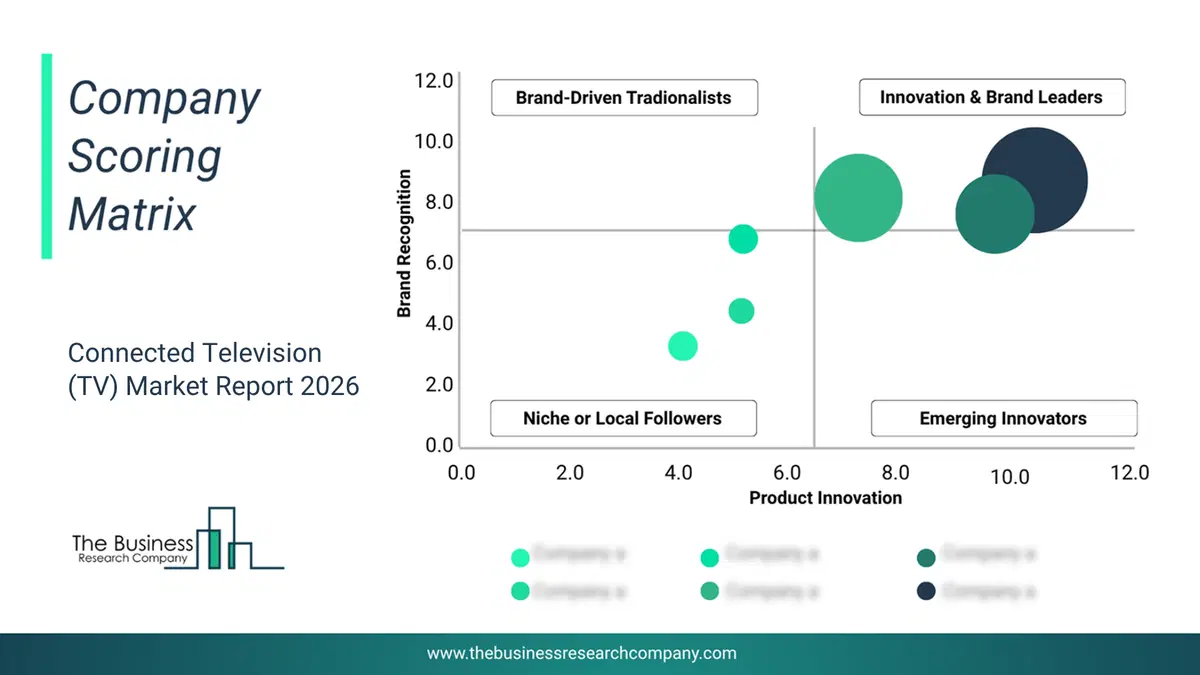
This chart maps companies by product innovation and brand strength, with bubble size indicating relative revenue, helping identify market leaders, challengers, and niche players. This is an illustrative chart; the full report provides a complete and accurate competitive analysis.
Global Connected Television (TV) Market Trends and Insights
Major companies are operating in the connected television market, focusing on developing technological advancements such as AI-powered display and content optimization systems to enhance picture quality, personalize content recommendations, and improve overall user experience. An AI-powered display and content optimization system uses machine learning algorithms to adjust brightness, contrast, color accuracy, and sound settings based on the content type and ambient environment, allowing smarter, more immersive viewing compared to traditional TVs that rely on fixed display settings. For instance, in July 2025, LG India, a South Korea–based electronics manufacturer, launched the 2025 OLED evo and QNED evo TV series featuring AI Picture Pro, AI Sound Pro, and AI Brightness Control technologies. The product offers 4K/8K resolution options, enhanced HDR performance, Dolby Vision and Atmos support, and intelligent voice and smart-home integration, providing a highly personalized and immersive viewing experience that surpasses conventional smart TVs.What Are Latest Mergers And Acquisitions In The Connected Television (TV) Market?
In February 2025, Mediaocean, a US-based provider of omnichannel advertising infrastructure, acquired Innovid for an undisclosed amount. This acquisition boosts the company's capabilities in connected television advertising, enhances service offerings for advertisers and agencies across digital, social, and linear TV, accelerates innovation in ad creation, delivery, and measurement, and positions it to seize market opportunities. Innovid is a US-based company that specializes in providing software platforms for the creation, delivery, measurement, and optimization of advertising across connected television.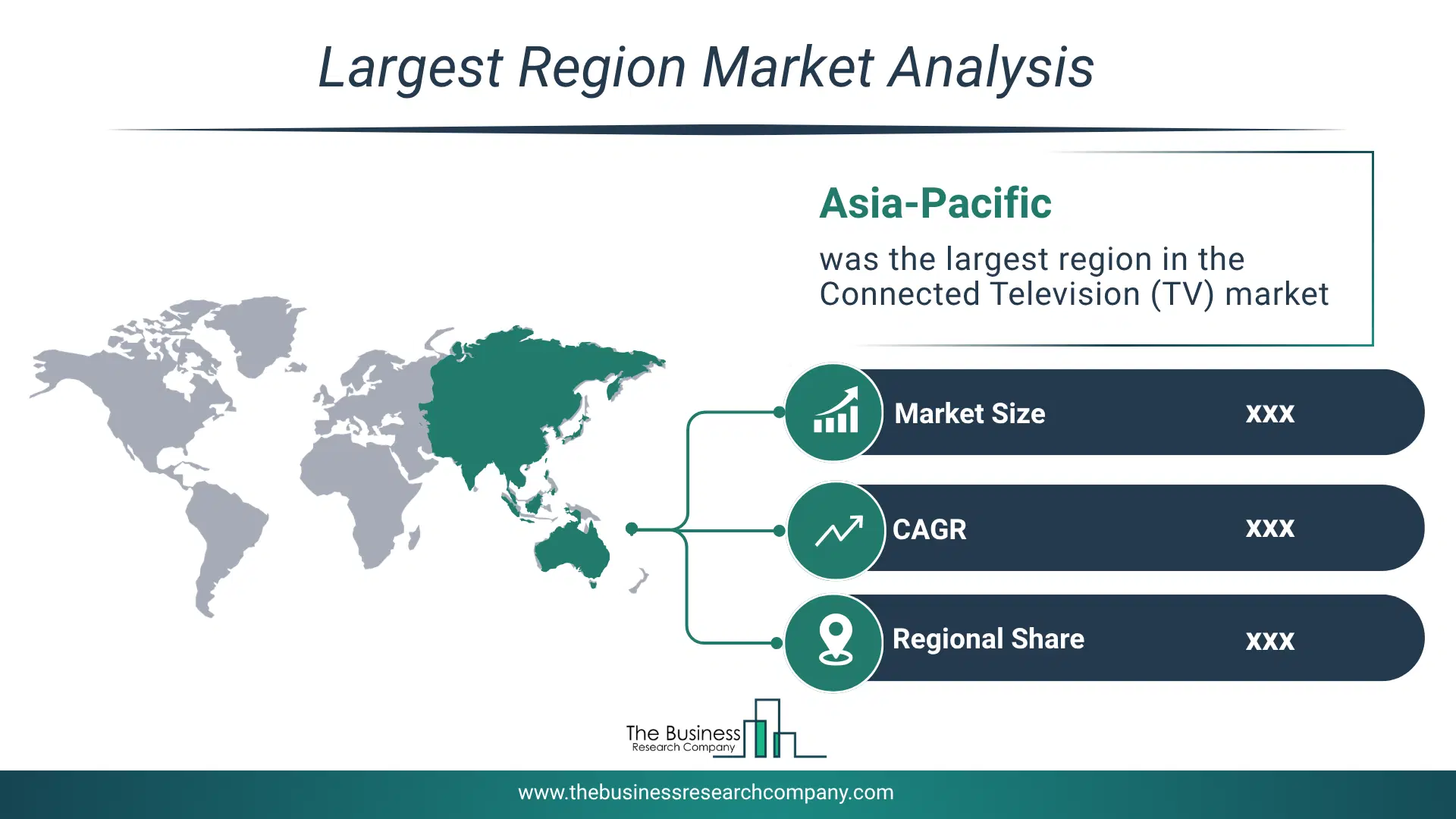
Regional Outlook
Asia-Pacific was the largest region in the connected television (TV) market in 2025. Asia-Pacific is expected to be the fastest-growing region in the forecast period. The regions covered in this market report are Asia-Pacific, South East Asia, Western Europe, Eastern Europe, North America, South America, Middle East, Africa. The countries covered in this market report are Australia, Brazil, China, France, Germany, India, Indonesia, Japan, Taiwan, Russia, South Korea, UK, USA, Canada, Italy, Spain.What Defines the Connected Television (TV) Market?
The connected television (TV) market consists of revenues earned by entities by providing services such as content streaming services, advertising services, content discovery and recommendation services and interactive TV services. The market value includes the value of related goods sold by the service provider or included within the service offering. The connected TV market also includes sales of processors, networking hardware, ethernet ports, Wi-Fi modules, and Bluetooth connectivity and audio hardware. Values in this market are ‘factory gate’ values, that is the value of goods sold by the manufacturers or creators of the goods, whether to other entities (including downstream manufacturers, wholesalers, distributors and retailers) or directly to end customers. The value of goods in this market includes related services sold by the creators of the goods.How is Market Value Defined and Measured?
The market value is defined as the revenues that enterprises gain from the sale of goods and/or services within the specified market and geography through sales, grants, or donations in terms of the currency (in USD unless otherwise specified). The revenues for a specified geography are consumption values that are revenues generated by organizations in the specified geography within the market, irrespective of where they are produced. It does not include revenues from resales along the supply chain, either further along the supply chain or as part of other products.
This chart presents market attractiveness based on a quantitative evaluation of growth, competition, strategic alignment, and risk, offering a clear view of opportunity areas for decision-making. This chart is for illustrative purposes; the full report contains the complete analysis.

This chart highlights the Total Addressable Market (TAM) by estimating the maximum revenue opportunity using an assumption-driven approach, supporting strategic planning and opportunity sizing across markets. The chart is illustrative; the full report provides a more comprehensive analysis.
What Key Data and Analysis Are Included in the Connected Television (TV) Market Report 2026?
The connected television (tv) market research report is one of a series of new reports from The Business Research Company that provides market statistics, including industry global market size, regional shares, competitors with the market share, detailed market segments, market trends and opportunities, and any further data you may need to thrive in the connected television (tv) industry. The market research report delivers a complete perspective of everything you need, with an in-depth analysis of the current and future state of the industry.Connected Television (TV) Market Report Forecast Analysis Market Report Forecast Analysis
| Report Attribute | Details |
|---|---|
| Market Size Value In 2026 | $19.96 billion |
| Revenue Forecast In 2030 | $33.28 billion |
| Growth Rate | CAGR of 13.7% from 2026 to 2030 |
| Base Year For Estimation | 2025 |
| Actual Estimates/Historical Data | 2020-2025 |
| Forecast Period | 2026 - 2030 |
| Market Representation | Revenue in USD Billion and CAGR from 2026 to 2030 |
| Segments Covered | Screen Type, Platform Type, Screen Size, Distribution Channel, End Use |
| Regional Scope | Asia-Pacific, Western Europe, Eastern Europe, North America, South America, Middle East, Africa |
| Country Scope | The countries covered in the report are Australia, Brazil, China, France, Germany, India, Indonesia, Japan, Taiwan, Russia, South Korea, UK, USA, Canada, Italy, Spain. |
| Key Companies Profiled | Apple Inc., Samsung Electronics Co. Ltd., Sony Corporation, Hitachi Ltd., LG Electronics Inc., Panasonic Corporation, Haier Group, Xiaomi Corporation, Toshiba Corporation, Koninklijke Philips N.V., Sharp Corporation, TCL Technology Group Corporation, Westinghouse Electric Corporation, Hisense Visual Technology Co Ltd, Konka Group Co. Ltd., JVC Kenwood Corporation, Vizio Inc., OnePlus Technology (Shenzhen) Co. Ltd., Bang & Olufsen A/S, Skyworth Digital Holdings Limited, Element Electronics Corporation, Pioneer Corporation, Sansui Electric Co. Ltd., Leshi Internet Information & Technology Corp. Beijing |
| Customization Scope | Request for Customization |
| Pricing And Purchase Options | Explore Purchase Options |