
Connected Vehicle Technology Market Report 2026
Global Outlook – By Component (Hardware, Software, Services), By Communication Type (Vehicle-To-Vehicle, Vehicle-To-Infrastructure, Vehicle-To-Pedestrian, Other Communication Types), By Vehicle Type (Passenger Cars, Commercial Vehicles), By Application (Telematics, Infotainment, Emergency Response, Navigation, Other Applications), By End Use (Original Equipment Manufacturer, Aftermarket) – Market Size, Trends, Strategies, and Forecast to 2030
Connected Vehicle Technology Market Overview
• Connected Vehicle Technology market size has reached to $45.99 billion in 2025 • Expected to grow to $84.54 billion in 2030 at a compound annual growth rate (CAGR) of 13% • Growth Driver: Surge In Urban Traffic Congestion Is Fueling The Market Due To Rapid Urbanization And Increasing Vehicle Usage • Market Trend: Advancements In Multi-Tier Digital Mobility Services Enhancing In-Vehicle Connectivity • North America was the largest region in 2025 and Asia-Pacific is the fastest growing region.Market Gains By 2030 – Top Opportunities By Segment
Market Gain identifies the most promising market opportunities by highlighting the segments or products expected to generate the highest incremental revenue growth over the next five years.
What Is Covered Under Connected Vehicle Technology Market?
Connected vehicle technology refers to advanced automotive systems that enable vehicles to communicate with external digital ecosystems through embedded connectivity, sensors, and software platforms. It integrates communication modules, telematics systems, and data-processing capabilities to support real-time information exchange, enhancing vehicle performance, monitoring, navigation, safety insights, and system diagnostics. The main components of connected vehicle technology include hardware, software, and services. Hardware refers to the physical systems such as sensors, onboard units, and communication modules that enable real-time data exchange between vehicles and surrounding infrastructure. These systems are categorized by communication type including vehicle-to-vehicle, vehicle-to-infrastructure, vehicle-to-pedestrian, and other communication types and are used across vehicle types such as passenger cars and commercial vehicles. The key applications of telematics, infotainment, emergency response, navigation, and others, while the end-use includes original equipment manufacturer and aftermarket.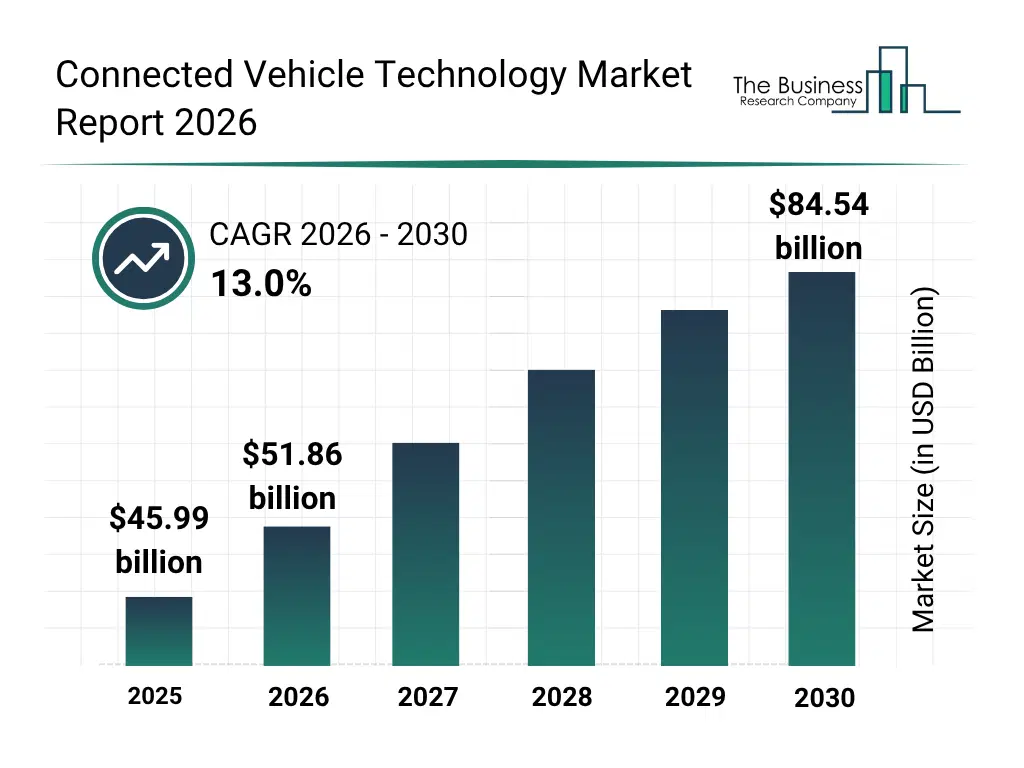
What Is The Connected Vehicle Technology Market Size and Share 2026?
The connected vehicle technology market size has grown rapidly in recent years. It will grow from $45.99 billion in 2025 to $51.86 billion in 2026 at a compound annual growth rate (CAGR) of 12.8%. The growth in the historic period can be attributed to limited in vehicle connectivity infrastructure across automotive markets, low adoption of telematics systems in passenger and commercial vehicles, dependence on standalone navigation and infotainment systems, weak integration between automotive hardware and cloud platforms, early stage development of vehicle to vehicle communication standards.What Is The Connected Vehicle Technology Market Growth Forecast?
The connected vehicle technology market size is expected to see rapid growth in the next few years. It will grow to $84.54 billion in 2030 at a compound annual growth rate (CAGR) of 13.0%. The growth in the forecast period can be attributed to rising penetration of electric and autonomous vehicles requiring advanced connectivity, increasing demand for real time vehicle diagnostics and predictive maintenance, expansion of smart city infrastructure supporting connected mobility ecosystems, growing adoption of 5G networks enabling ultra low latency communication, increasing focus on software defined vehicle architectures. Major trends in the forecast period include rising integration of vehicle-to-everything communication systems for real time data exchange, increasing adoption of embedded telematics control units for connected mobility services, growth of over the air software update capabilities in modern vehicles, expansion of AI based predictive diagnostics and vehicle health monitoring systems, increasing deployment of cloud based fleet management and connected vehicle platforms.
Global Connected Vehicle Technology Market Segmentation
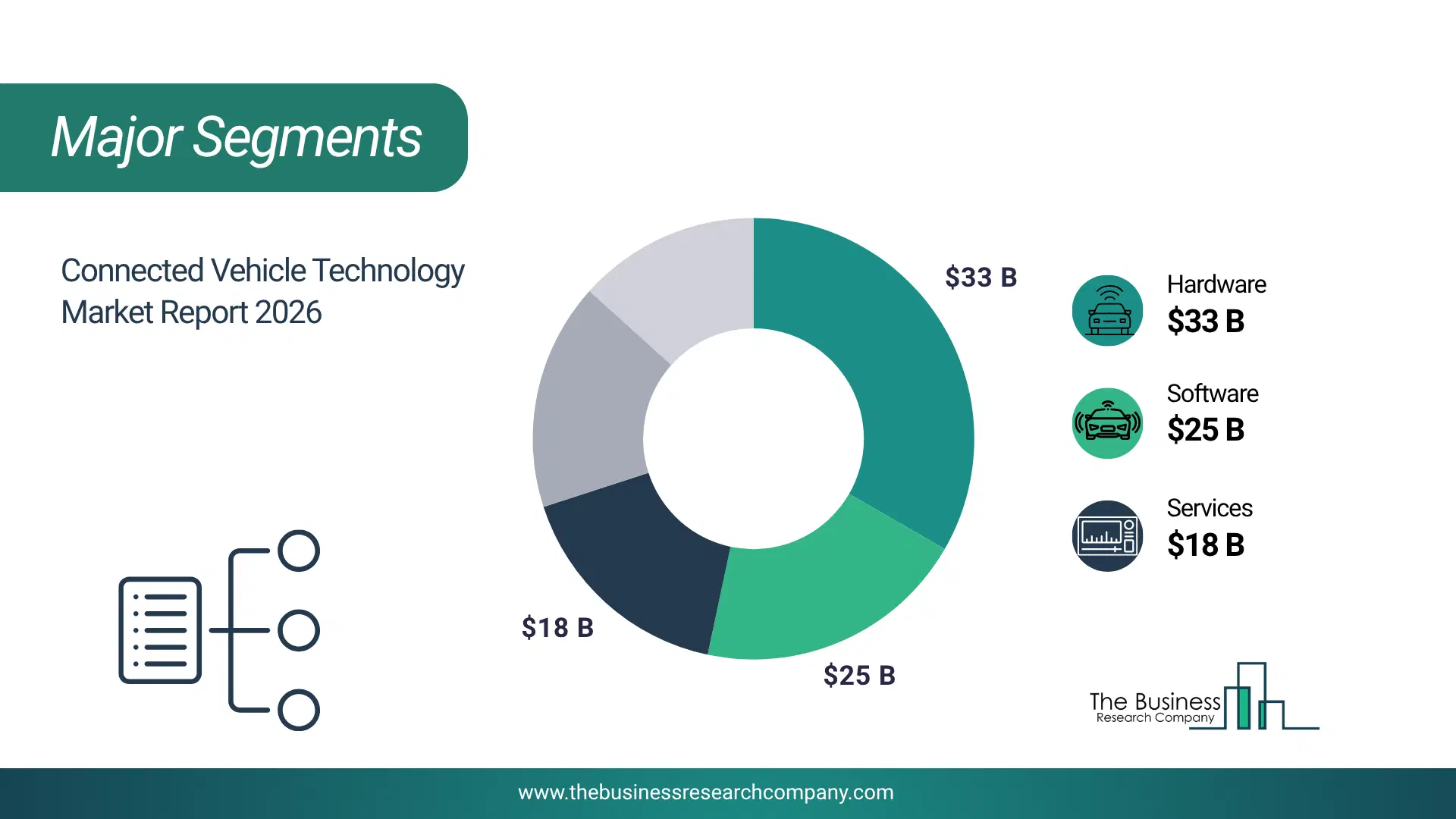
1) By Component: Hardware, Software, Services 2) By Communication Type: Vehicle-To-Vehicle, Vehicle-To-Infrastructure, Vehicle-To-Pedestrian, Other Communication Types 3) By Vehicle Type: Passenger Cars, Commercial Vehicles 4) By Application: Telematics, Infotainment, Emergency Response, Navigation, Other Applications 5) By End Use: Original Equipment Manufacturer, Aftermarket Subsegments: 1) By Hardware: Telematics Control Units, Sensors, On-Board Diagnostics Devices, Global Positioning System Modules, Vehicle-To-Everything Communication Modules, Infotainment Hardware Units 2) By Software: Fleet Management Software, Navigation And Mapping Software, Vehicle Diagnostics Software, Cybersecurity Software For Vehicles, Data Analytics And Artificial Intelligence Platforms, Over-The-Air Update Software 3) By Services: Managed Connectivity Services, Vehicle Maintenance And Support Services, Data Services And Cloud Integration, Consulting And System Integration Services, Mobility-As-A-Service Support Services, Subscription-Based Connected Services The top segments in the connected vehicle technology market will be: • Hardware will reach $33.34 Billion by 2030. • Software will reach $25.21 Billion by 2030. • Services will reach $17.94 Billion by 2030.What Is The Driver Of The Connected Vehicle Technology Market?
The rising urban traffic congestion is expected to propel growth of the connected vehicle technology market going forward. Urban traffic congestion refers to the condition in which the demand for road usage in urban areas exceeds the available road capacity, resulting in slower speeds, longer travel times, and increased vehicle queuing. Urban traffic congestion is growing due to rapid urbanization, as more people move into cities, increasing population density, vehicle ownership, and pressure on already limited road and public transport infrastructure. Connected vehicle technology helps reduce urban traffic congestion by enabling real-time communication between vehicles and infrastructure, improving traffic flow, optimizing route selection, and reducing delays through smarter and more coordinated transportation systems. For instance, in May 2024, according to the Department for Transport, a UK-based ministerial department, vehicles traveled a total of 330.8 billion miles on roads in Great Britain in 2023, marking a 2.2% increase from 2022. Therefore, the rising urban traffic congestion is driving growth of the connected vehicle technology industry.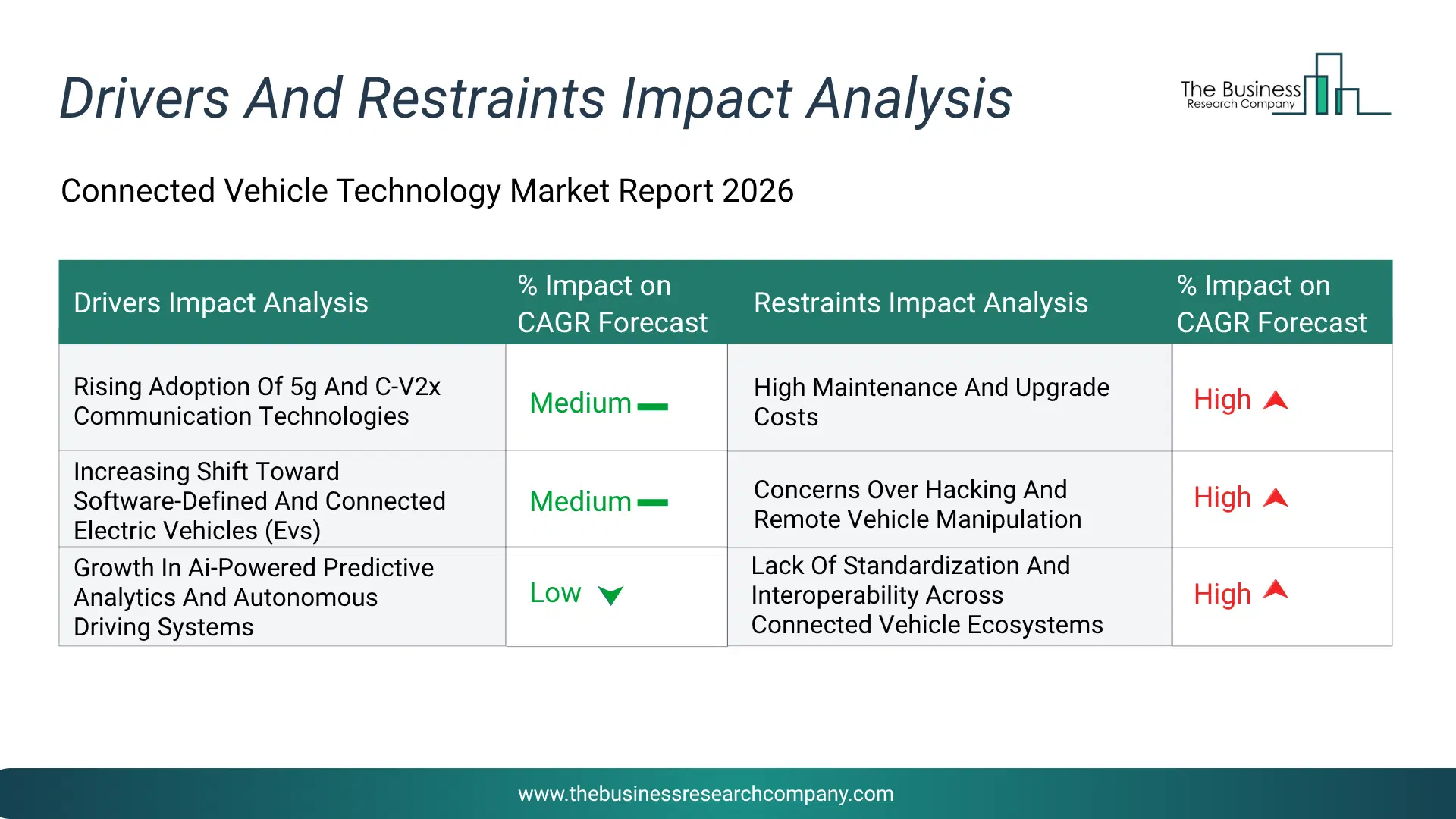
Infographic Chart Showing Key Market Drivers Analysis And Restraints For Connected Vehicle Technology Market
The chart presents an impact analysis of key drivers and restraints, quantifying their relative influence on the market's growth rate and helping assess the balance between growth enablers and limiting factors. This chart offers a high-level perspective; the full report contains more detailed insights.
How Will The Drivers Impact Growth In The Global Connected Vehicle Technology Market?
• Rising Adoption Of 5g And C-V2x Communication Technologies (Medium) – During the forecast period, the rising adoption of 5g and c-V2x communication technologies is expected to become a key growth driver for the connected vehicle technology market by 2030. The increasing deployment of 5G networks and Cellular Vehicle-to-Everything (C-V2X) communication technologies is a major driver of the connected vehicle technology market. These technologies provide high-speed, low-latency, and highly reliable connectivity, enabling vehicles to exchange data in real time with other vehicles, infrastructure, pedestrians, and cloud platforms. Enhanced communication capabilities support advanced applications such as real-time traffic updates, remote diagnostics, predictive maintenance, and over-the-air software updates. As automakers integrate 5G-enabled telematics and connectivity modules into vehicles, demand for connected vehicle platforms, communication hardware, and data services continues to rise. The ability of 5G and C-V2X to improve road safety, driving efficiency, and user experience is accelerating the adoption of connected vehicle technologies across passenger and commercial vehicle segments. • Increasing Shift Toward Software-Defined And Connected Electric Vehicles (Evs) (Medium) – During the forecast period, the increasing shift toward software-defined and connected electric vehicles (Evs) is expected to emerge as a major factor driving the expansion of the connected vehicle technology market by 2030. The growing transition toward software-defined vehicles and connected electric vehicles is significantly boosting the connected vehicle technology market. Modern EVs increasingly rely on software platforms to manage battery performance, vehicle functions, energy optimization, and user experiences. Connected technologies enable manufacturers to deliver remote software upgrades, monitor vehicle health, optimize charging operations, and introduce new features throughout a vehicle’s lifecycle. As EV adoption expands globally, automakers are embedding advanced connectivity systems and telematics solutions as standard features. This creates strong demand for onboard communication modules, cloud-based vehicle management systems, cybersecurity solutions, and connected mobility services. • Growth In Ai-Powered Predictive Analytics And Autonomous Driving Systems (Low) – During the forecast period, the growth in Ai-powered predictive analytics and autonomous driving systems is expected to act as a key growth catalyst for the connected vehicle technology market by 2030. The rapid advancement of artificial intelligence (AI) and autonomous driving technologies is creating substantial opportunities for the connected vehicle technology market. AI-powered predictive analytics processes vast amounts of data collected from connected vehicles to anticipate maintenance needs, optimize route planning, improve fuel efficiency, and enhance operational performance. Autonomous and semi-autonomous driving systems also depend heavily on continuous data exchange between vehicles, sensors, cloud platforms, and transportation infrastructure. Connected vehicle technologies provide the communication backbone required for these intelligent systems to function effectively. As automakers and fleet operators increasingly invest in AI-driven mobility solutions, the demand for advanced connectivity platforms, data-processing systems, and vehicle communication networks continues to grow.How Will The Restraints Impact Growth In The Global Connected Vehicle Technology Market?
• High Maintenance And Upgrade Costs (Medium) – During the forecast period, the high maintenance and upgrade costs act as a significant restraint in the connected vehicle technology market because connected vehicles rely on a complex combination of hardware, software, sensors, communication modules, and cloud-based platforms that require continuous monitoring and updates. Automakers and technology providers must regularly invest in software enhancements, cybersecurity patches, and over-the-air (OTA) update infrastructure to keep systems secure and functional. As connectivity standards, wireless technologies, and digital services evolve, existing vehicle systems often require upgrades to remain compatible with new applications and network environments. These recurring expenses increase the total cost of ownership for fleet operators and vehicle manufacturers. In addition, maintaining large volumes of vehicle-generated data requires substantial investments in cloud storage, analytics platforms, and data management systems. Repairing or replacing advanced connectivity components such as telematics control units, sensors, and infotainment systems can also be expensive compared to conventional vehicle parts. Smaller automotive manufacturers and fleet operators may face budget constraints that limit the adoption of connected vehicle solutions. The need for skilled technical personnel to manage software ecosystems and digital infrastructure further increases operational costs. As a result, high maintenance and upgrade expenditures can slow deployment rates, reduce profit margins, and discourage widespread adoption of connected vehicle technologies. • Concerns Over Hacking And Remote Vehicle Manipulation (Medium) – During the forecast period, the concerns regarding hacking and remote vehicle manipulation represent another major restraint for the connected vehicle technology market. Connected vehicles continuously exchange data with external networks, cloud platforms, mobile applications, and infrastructure systems, creating multiple potential entry points for cyberattacks. Unauthorized access to vehicle communication systems could allow attackers to interfere with critical vehicle functions, access sensitive user information, or disrupt navigation and telematics services. Such cybersecurity risks raise concerns among consumers, fleet operators, and regulatory authorities regarding the safety and reliability of connected vehicles. High-profile incidents involving vehicle hacking have increased public awareness of potential vulnerabilities, making customers more cautious about adopting advanced connected features. To address these threats, manufacturers must invest heavily in cybersecurity frameworks, encryption technologies, intrusion detection systems, and continuous security monitoring, which increases development and operational costs. Regulatory compliance requirements related to data protection and vehicle cybersecurity also add complexity to product development. Any successful cyberattack can damage brand reputation, reduce consumer trust, and lead to legal liabilities for manufacturers. The possibility of remote vehicle manipulation affecting passenger safety remains a critical concern that may delay purchasing decisions and hinder market growth. Consequently, cybersecurity challenges continue to be a key barrier to the broader adoption of connected vehicle technologies. • Lack Of Standardization And Interoperability Across Connected Vehicle Ecosystems (Low) – During the forecast period, the lack of standardization and interoperability across connected vehicle ecosystems is expected to restrain the growth of the connected vehicle technology market. Connected vehicle technologies rely on seamless communication between vehicles, cloud platforms, roadside infrastructure, mobile applications, and third-party service providers. However, the absence of universally accepted communication protocols, software standards, and interoperability frameworks creates integration challenges across different vehicle brands, technology vendors, and geographic regions. Variations in connectivity standards, operating systems, and data exchange formats can limit compatibility between connected services and reduce the effectiveness of vehicle-to-everything (V2X) communication. Automakers and solution providers often need to customize platforms for different markets, increasing development complexity, implementation time, and operational costs. In addition, inconsistent interoperability can hinder the deployment of smart transportation infrastructure and connected mobility services, slowing ecosystem development. Regulatory differences across countries further complicate standardization efforts and delay cross-border deployment of connected vehicle technologies. These challenges may discourage investments and reduce the pace of large-scale adoption. Consequently, the lack of standardization and interoperability remains a significant barrier to the widespread growth of the connected vehicle technology market.Key Players In The Global Connected Vehicle Technology Market
Major companies operating in the connected vehicle technology market are Amazon Web Services Inc. (AWS), Volkswagen AG, Google LLC, Toyota Motor Corporation, Microsoft Corporation, Ford Motor Company, General Motors Company, BMW Group, Mercedes-Benz Group AG, Honda Motor Co. Ltd., Hyundai Motor Company, Huawei Technologies Co. Ltd., Tesla Inc., Robert Bosch GmbH, Nissan Motor Co. Ltd., Kia Corporation, International Business Machines Corporation (IBM), NVIDIA Corporation, Cisco Systems Inc., Intel Corporation, Qualcomm Incorporated.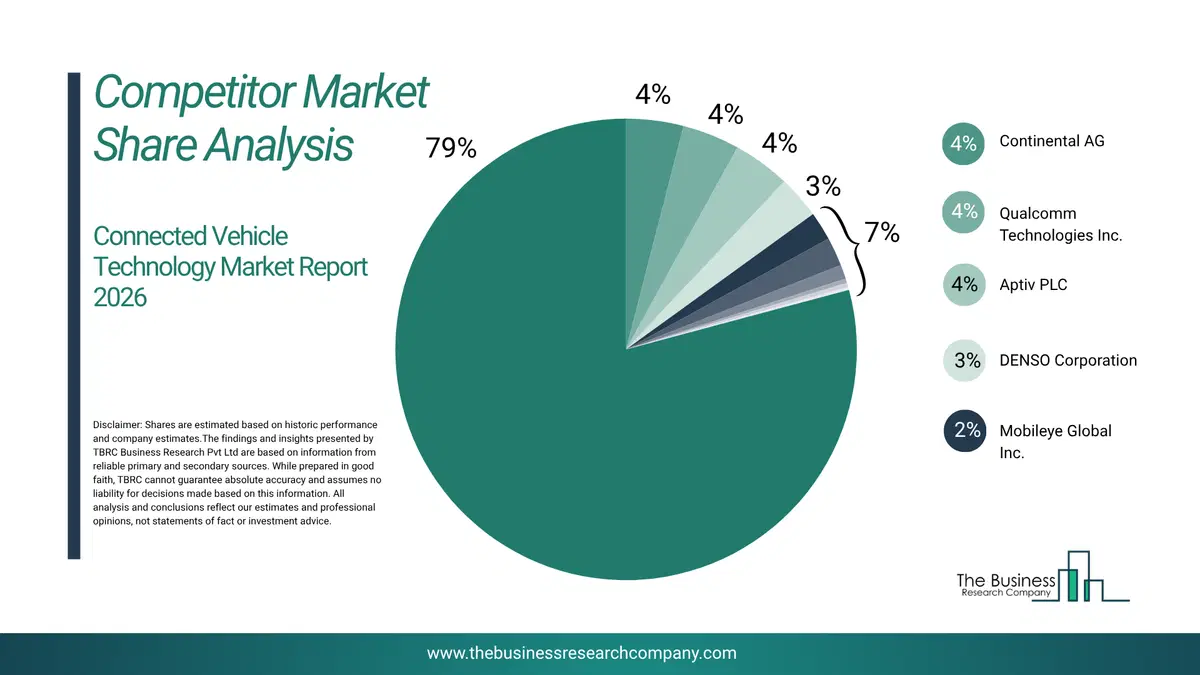
This chart is for illustrative purposes; the full report includes a detailed competitor analysis and comprehensive overview of the top 10 companies in the market.
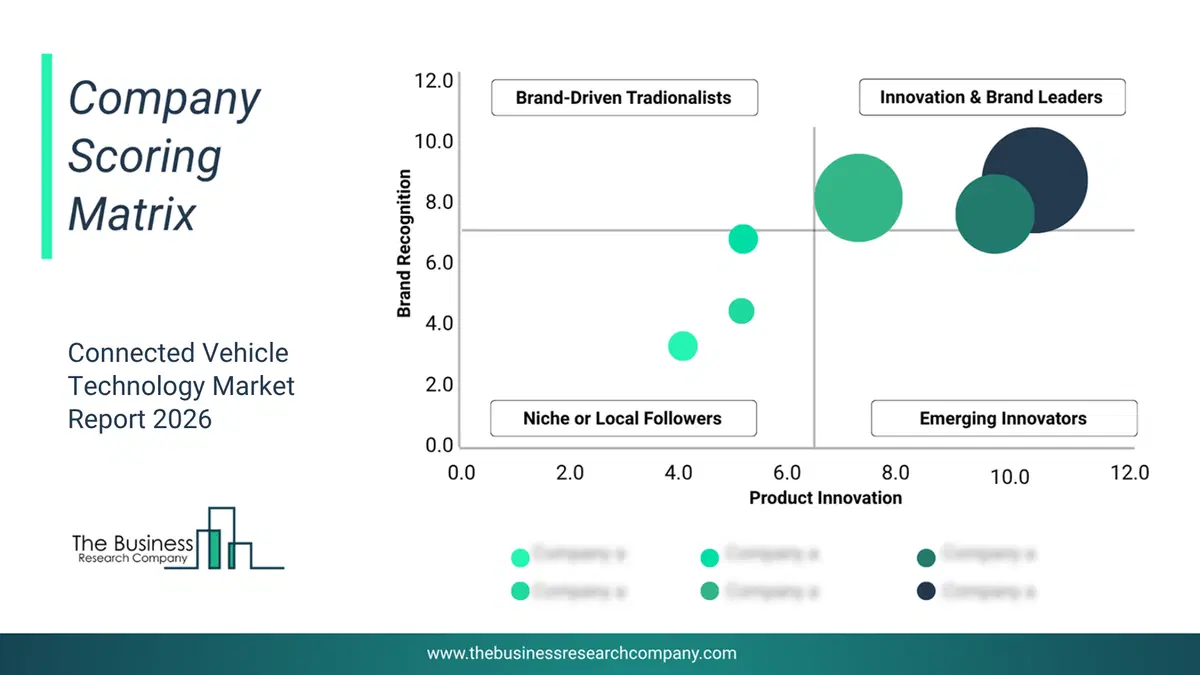
This chart maps companies by product innovation and brand strength, with bubble size indicating relative revenue, helping identify market leaders, challengers, and niche players. This is an illustrative chart; the full report provides a complete and accurate competitive analysis.
Global Connected Vehicle Technology Market Trends and Insights
Major companies operating in the connected vehicle technology market are focusing on developing innovative solutions, such as dual-tier connected services models to enhance user experience, improve service accessibility, and enable flexible monetization of in-vehicle digital features. Dual-tier connected services models are vehicle connectivity frameworks that provide basic digital features as standard and advanced services through subscription tiers, helping automakers enhance customer flexibility, enable scalable monetization of in-vehicle services, and improve user experience through customizable connectivity options. For instance, in April 2026, Stellantis N.V., a Netherlands-based automotive manufacturer, launched a two-tier connected vehicle offering designed to simplify and expand digital mobility services for customers. The base tier, Connect One, is included in the vehicle purchase price and provides essential services such as emergency assistance and remote charging management, while an upgraded subscription-based package offers additional advanced features and enhanced connectivity services. This structured approach enables scalable adoption of connected services across different vehicle segments while improving customer engagement through flexible digital feature access and continuous service upgrades.What Are Latest Mergers And Acquisitions In The Connected Vehicle Technology Market?
In December 2025, Element Fleet Management Corp., a Canada-based fleet management and automotive services company, acquired Car IQ Inc. for $80 million. With this acquisition, Element Fleet Management aims to accelerate the development of an integrated intelligent payments ecosystem by embedding vehicle-initiated transaction capabilities into its fleet management platform, enabling automated, secure, and seamless payments across mobility, fuel, maintenance, and service networks. Car IQ Inc. is a US-based financial technology company that specializes in providing connected vehicle technology.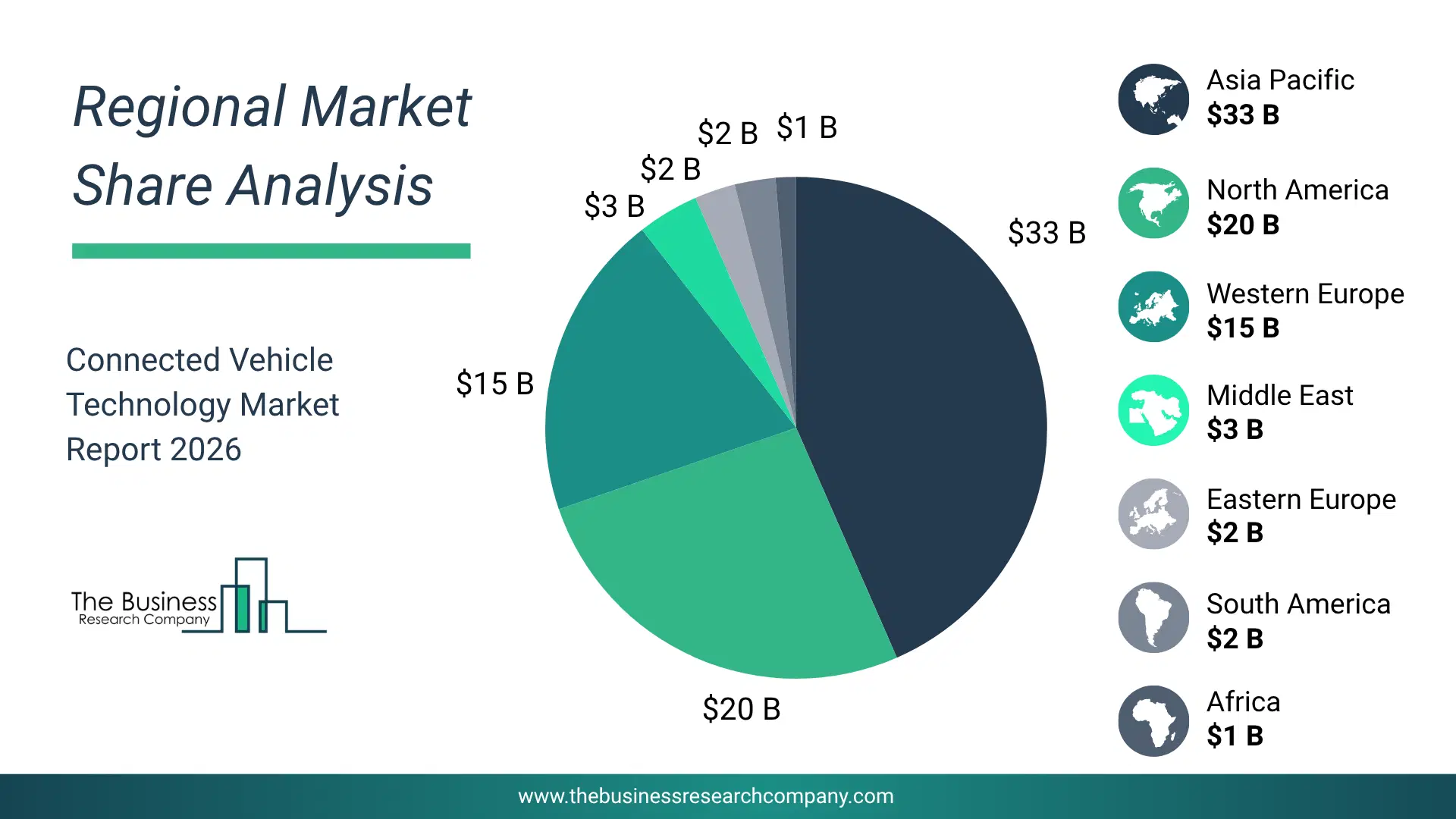
Regional Outlook/Insights
North America was the largest region in the connected vehicle technology market in 2025. Asia-Pacific is expected to be the fastest-growing region in the forecast period. The regions covered in this market report are Asia-Pacific, South East Asia, Western Europe, Eastern Europe, North America, South America, Middle East, Africa. The countries covered in this market report are Australia, Brazil, China, France, Germany, India, Indonesia, Japan, Taiwan, Russia, South Korea, UK, USA, Canada, Italy, Spain.What Defines the Connected Vehicle Technology Market?
The connected vehicle technology market consists of revenues earned by entities by providing services such as telematics services, fleet management solutions, over-the-air (OTA) software updates, infotainment and in-vehicle connectivity systems, remote diagnostics, predictive maintenance, navigation and location-based services, cybersecurity solutions, and mobility data analytics. The market value includes the value of related goods sold by the service provider or included within the service offering. The connected vehicle technology market also includes sales of telematics control units, onboard connectivity modules, sensors, infotainment hardware systems, and GPS devices. Values in this market are ‘factory gate’ values, that is, the value of goods sold by the manufacturers or creators of the goods, whether to other entities (including downstream manufacturers, wholesalers, distributors, and retailers) or directly to end customers. The value of goods in this market includes related services sold by the creators of the goods.How is Market Value Defined and Measured?
The market value is defined as the revenues that enterprises gain from the sale of goods and/or services within the specified market and geography through sales, grants, or donations in terms of the currency (in USD unless otherwise specified). The revenues for a specified geography are consumption values that are revenues generated by organizations in the specified geography within the market, irrespective of where they are produced. It does not include revenues from resales along the supply chain, either further along the supply chain or as part of other products.
This chart presents market attractiveness based on a quantitative evaluation of growth, competition, strategic alignment, and risk, offering a clear view of opportunity areas for decision-making. This chart is for illustrative purposes; the full report contains the complete analysis.

This chart highlights the Total Addressable Market (TAM) by estimating the maximum revenue opportunity using an assumption-driven approach, supporting strategic planning and opportunity sizing across markets. The chart is illustrative; the full report provides a more comprehensive analysis.
What Key Data and Analysis Are Included in the Connected Vehicle Technology Market Report 2026?
The connected vehicle technology market research report is one of a series of new reports from The Business Research Company that provides market statistics, including industry global market size, regional shares, competitors with the market share, detailed market segments, market trends and opportunities, and any further data you may need to thrive in the connected vehicle technology industry. The market research report delivers a complete perspective of everything you need, with an in-depth analysis of the current and future state of the industry.Connected Vehicle Technology Market Report Forecast Analysis
| Report Attribute | Details |
|---|---|
| Market Size Value In 2026 | $51.86 billion |
| Revenue Forecast In 2030 | $84.54 billion |
| Growth Rate | CAGR of 13.0% from 2026 to 2030 |
| Base Year For Estimation | 2025 |
| Actual Estimates/Historical Data | 2020-2025 |
| Forecast Period | 2026 - 2030 |
| Market Representation | Revenue in USD Billion and CAGR from 2026 to 2030 |
| Segments Covered | Component, Communication Type, Vehicle Type, Application, End Use |
| Regional Scope | Asia-Pacific, Western Europe, Eastern Europe, North America, South America, Middle East, Africa |
| Country Scope | The countries covered in the report are Australia, Brazil, China, France, Germany, India, Indonesia, Japan, Taiwan, Russia, South Korea, UK, USA, Canada, Italy, Spain. |
| Key Companies Profiled | Amazon Web Services Inc. (AWS), Volkswagen AG, Google LLC, Toyota Motor Corporation, Microsoft Corporation, Ford Motor Company, General Motors Company, BMW Group, Mercedes-Benz Group AG, Honda Motor Co. Ltd., Hyundai Motor Company, Huawei Technologies Co. Ltd., Tesla Inc., Robert Bosch GmbH, Nissan Motor Co. Ltd., Kia Corporation, International Business Machines Corporation (IBM), NVIDIA Corporation, Cisco Systems Inc., Intel Corporation, Qualcomm Incorporated. |
| Customization Scope | Request for Customization |
| Pricing And Purchase Options | Explore Purchase Options |