
Connected Work Zone Alerting Market Report 2026
Global Outlook – By Component (Hardware, Software, Services), By Deployment Mode (On-Premises, Cloud-Based), By Technology (Cellular Vehicle to Everything, Dedicated Short Range Communication, Internet of Things and Low Power Wide Area Networks, Fifth Generation Enabled Work Zone Communication, Cloud Based Real Time Alerting Systems), By Application (Traffic Management, Incident Detection, Worker Safety, Fleet Management, Other Applications), By End-User (Construction Companies, Government Agencies, Transportation Authorities, Other End-Users) – Market Size, Trends, Strategies, and Forecast to 2030
Connected Work Zone Alerting Market Overview
• Connected Work Zone Alerting market size has reached to $1.57 billion in 2025 • Expected to grow to $3.90 billion in 2030 at a compound annual growth rate (CAGR) of 19.9% • Growth Driver: Increasing Awareness Of Workplace Safety Fueling The Growth Of The Market Due To Reducing Workplace Injuries And Enhanced Operational Efficiency • Market Trend: Vertically Integrated Hazard Data Systems Boost Worker Protection • North America was the largest region in 2025 and Asia-Pacific is the fastest growing region.What Is Covered Under Connected Work Zone Alerting Market?
Connected work zone alerting is a technology-driven system that uses sensors, vehicle-to-everything (V2X) or cellular communications, and software to detect, monitor, and broadcast real-time warnings about temporary construction or maintenance zones to drivers, road workers, and fleet operators. Its purpose is to improve safety by reducing collisions and near-misses in and around work zones through timely alerts and speed or route advisories. It also aims to enhance traffic flow and operational efficiency by enabling faster incident response, better traffic management, and informed decision-making for road authorities and contractors. The main components of the connected work zone alerting market include hardware, software, and services. Hardware is the physical equipment and devices such as sensors, cameras, warning beacons, vehicle-to-infrastructure units, portable cabinets, power supplies, mounting poles, and communication gateways that are installed on roadsides, on vehicles, or on temporary work zone infrastructure to detect conditions, display alerts, and enable data flow between the field and control centers in real time. The various deployment modes include on-premises and cloud-based solutions, supporting different operational and scalability requirements. The key technologies used in these systems encompass cellular vehicle-to-everything (C-V2X), dedicated short-range communication (DSRC), Internet of Things (IoT) and low-power wide-area networks (LPWAN), 5G-enabled work zone communication platforms, and cloud-based real-time alerting systems, enabling reliable and low-latency information exchange. The multiple applications include traffic management, incident detection, worker safety, fleet management, and various other operational use cases aimed at improving roadway work zone efficiency and safety and are used by several end-users such as construction companies, government agencies, transportation authorities, and others.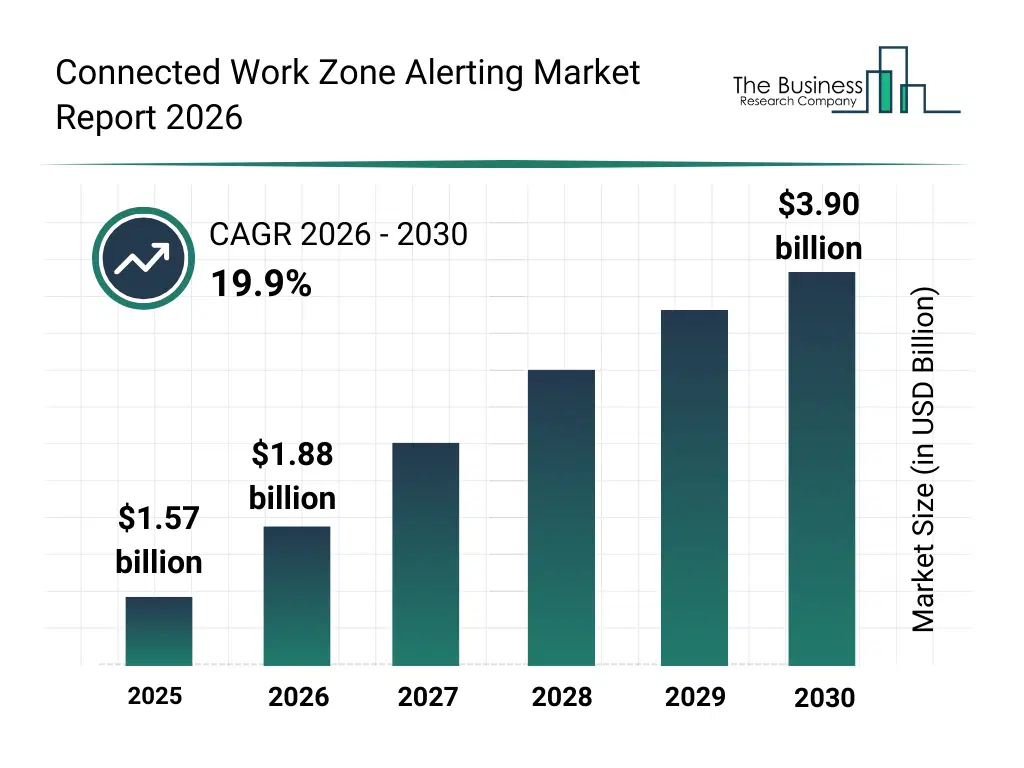
What Is The Connected Work Zone Alerting Market Size and Share 2026?
The connected work zone alerting market size has grown exponentially in recent years. It will grow from $1.57 billion in 2025 to $1.88 billion in 2026 at a compound annual growth rate (CAGR) of 20.2%. The growth in the historic period can be attributed to rising focus on worker safety and compliance, growing traffic volumes on major corridors, increasing regulatory requirements for temporary traffic control, rising public awareness of work zone hazards, and increasing numbers of incidents and near misses in work zones.What Is The Connected Work Zone Alerting Market Growth Forecast?
The connected work zone alerting market size is expected to see rapid growth in the next few years. It will grow to $3.90 billion in 2030 at a compound annual growth rate (CAGR) of 19.9%. The growth in the forecast period can be attributed to increasing investments in infrastructure renovation and modernization, rising government funding for road safety programs, growing emphasis on reducing work zone fatalities and serious injuries, increasing demand for real-time situational awareness by operators, and rising liability and insurance pressures on project owners. Major trends in the forecast period include wider adoption of cellular vehicle-to-everything communication for vehicle and infrastructure messaging, expansion of the internet of things and low-power wide-area networks for distributed sensing, deployment of fifth-generation-enabled work zone communication for high throughput and low latency services, advances in artificial intelligence-driven video analytics for automated incident detection, and development of vehicle-to-infrastructure cooperative systems for coordinated warnings.
Global Connected Work Zone Alerting Market Segmentation
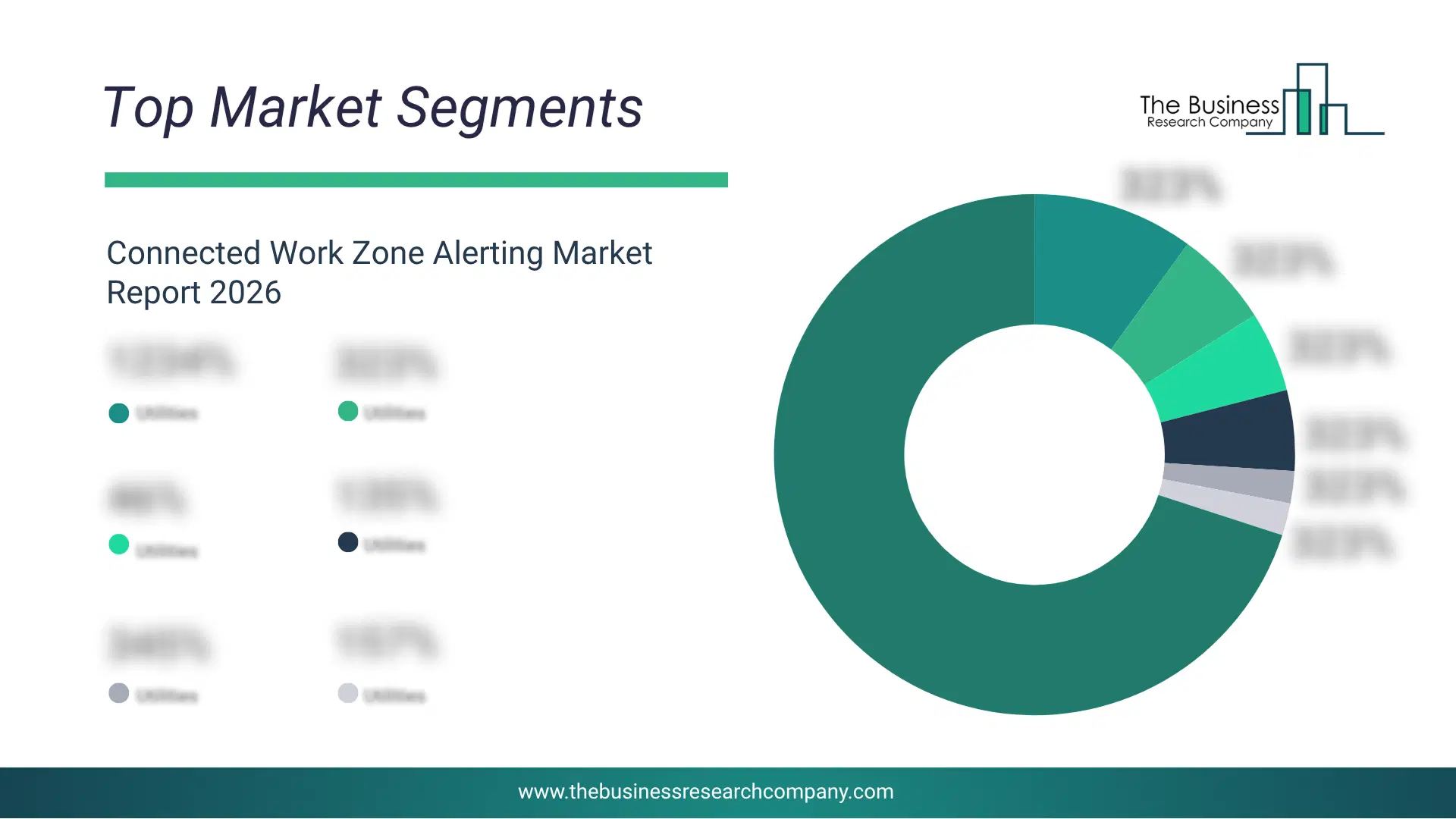
1) By Component: Hardware, Software, Services 2) By Deployment Mode: On-Premises, Cloud-Based 3) By Technology: Cellular Vehicle to Everything, Dedicated Short Range Communication, Internet of Things and Low Power Wide Area Networks, Fifth Generation Enabled Work Zone Communication, Cloud Based Real Time Alerting Systems 4) By Application: Traffic Management, Incident Detection, Worker Safety, Fleet Management, Other Applications 5) By End-User: Construction Companies, Government Agencies, Transportation Authorities, Other End-Users Subsegments: 1) By Hardware: Sensors And Detectors, Cameras And Video Systems, Warning Beacons And Dynamic Signage, Roadside Communication Units, Vehicle To Infrastructure Units, Portable Cabinets And Power Systems, Mounting Poles And Support Structures 2) By Software: Analytics And Incident Detection Software, Traffic Management Platform, Fleet Management Software, Mobile Applications For Field Staff, Video Management And Analytics Software, Geographic Information System Mapping Software, Predictive Analytics And Machine Learning Modules 3) By Services: Installation And Commissioning Services, System Design And Engineering Services, Maintenance And Technical Support Services, Remote Monitoring And Management Services, Training And Capacity Building Services, Consulting And Project Management Services, Data Hosting And Information Management ServicesWhat Is The Driver Of The Connected Work Zone Alerting Market?
The increasing awareness of workplace safety is expected to propel the growth of the connected work zone alerting market going forward. Workplace safety refers to the measures and protocols implemented to protect employees from injuries, illnesses, and hazards in the work environment. Awareness of workplace safety is increasing as companies recognize that maintaining a safe environment boosts employee productivity and reduces costs associated with workplace injuries. Connected work zone alerting enhances workplace safety by providing real-time digital warnings in construction and maintenance zones, making it easier for drivers and workers to avoid accidents. It reduces collision risks by enabling faster reactions and informed decision-making, improving overall operational safety and efficiency. For instance, in February 2025, according to Cross River Therapy, a US-based provider of applied behavior analysis, workplace illness rates significantly declined, with the incidence rate falling to 19.0 cases per 10,000 full-time equivalent (FTE) workers in 2023, down from 45.2 in 2022, reflecting the growing effectiveness of workplace safety initiatives. Therefore, the increasing awareness of workplace safety is driving the growth of the connected work zone alerting industry.Key Players In The Global Connected Work Zone Alerting Market
Major companies operating in the connected work zone alerting market are Robert Bosch GmbH, Qualcomm Incorporated, 3M Company, NXP Semiconductors N.V., Siemens Mobility GmbH, Kapsch TrafficCom AG, TransCore LP, Wanco Inc., Iteris Inc., Ouster Inc., Hill & Smith PLC, Commsignia Inc., Wavetronix LLC, Cohda Wireless Pty Ltd, Econolite Group Inc., Sensys Networks Inc., ClearObject Inc., Applied Information Inc., HAAS Alert Inc., Cubic Transportation Systems Inc.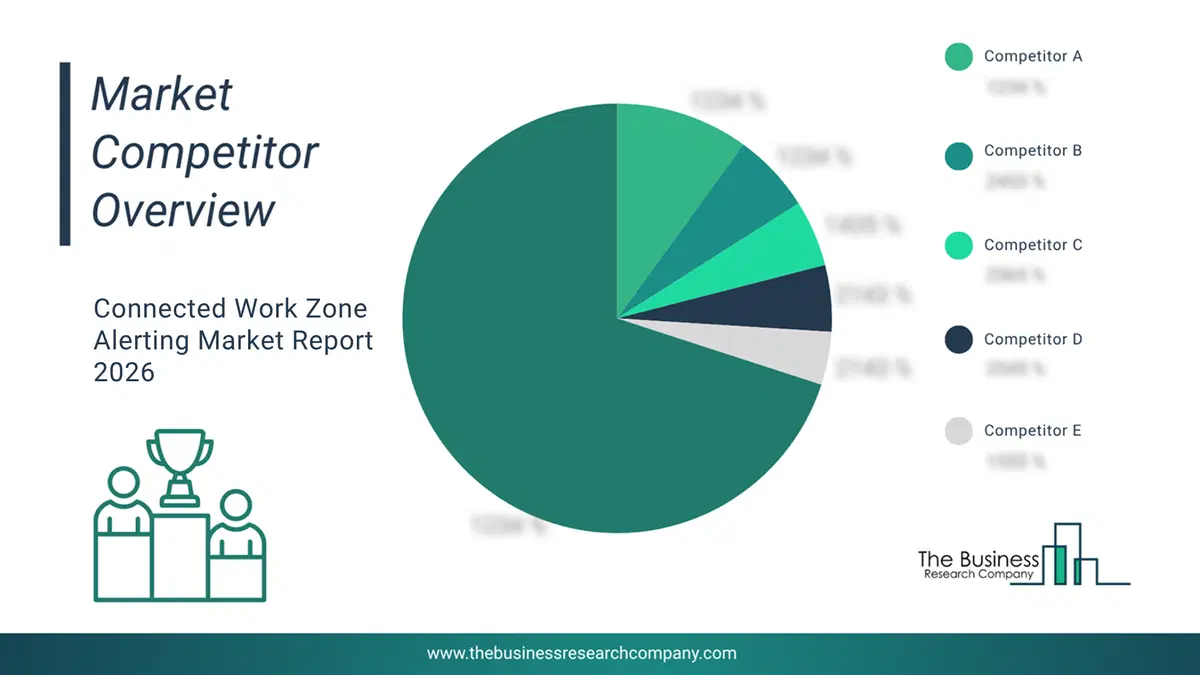
This chart is for illustrative purposes; the full report includes a detailed competitor analysis and comprehensive overview of the top 10 companies in the market.
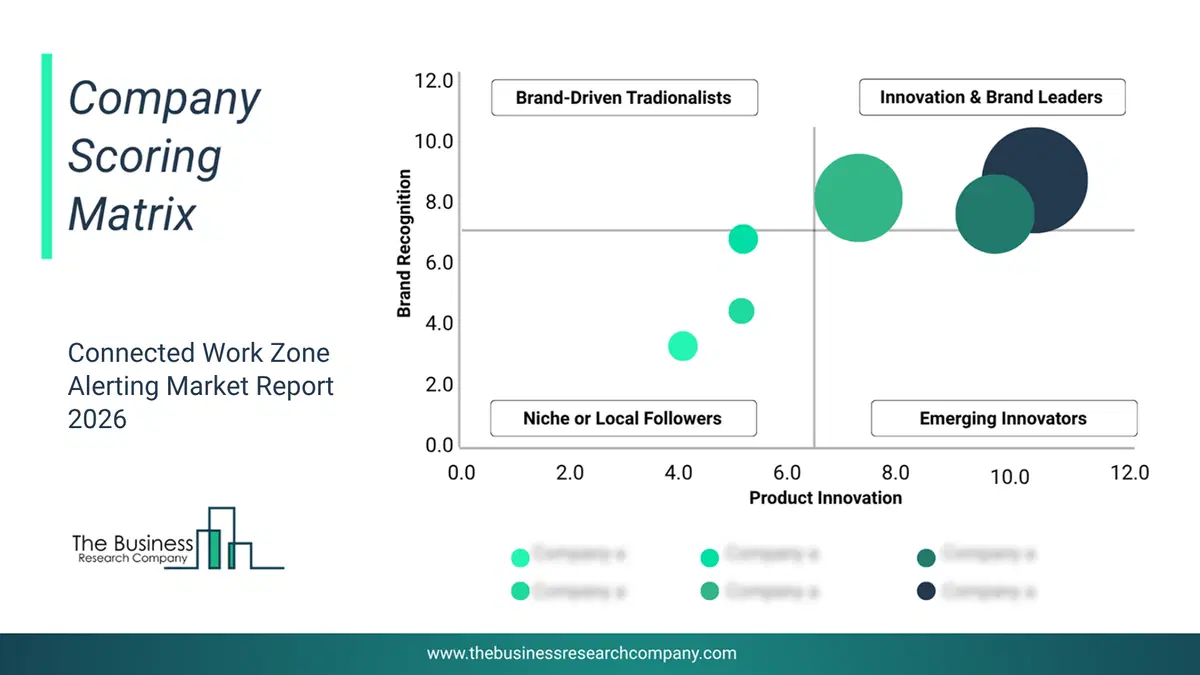
This chart maps companies by product innovation and brand strength, with bubble size indicating relative revenue, helping identify market leaders, challengers, and niche players. This is an illustrative chart; the full report provides a complete and accurate competitive analysis.
Global Connected Work Zone Alerting Market Trends and Insights
Major companies operating in the connected work zone alerting market are focusing on developing advanced products, such as vertically integrated real-time hazard data orchestration systems, to improve roadway worker protection, enhance vehicle-to-work-zone communication, and eliminate the limitations of legacy hazard notification methods. Vertically integrated real-time hazard data orchestration systems collect, algorithmically process, and distribute hazard intelligence across connected vehicles, work-zone equipment, fleet platforms, and emergency responders, enabling synchronized, high-speed alerts that traditional hazard lights or isolated connected systems cannot deliver. For instance, in May 2025, Emergency Safety Solutions (ESS), a US-based roadway safety technology company, launched its H.E.L.P. Alert Network, a next-generation hazard communication platform that links vehicles, roadway workers, fleets, and emergency response systems into one smart alerting network. This real-time hazard data orchestration system delivers algorithmically calculated hazard alerts to in-vehicle displays and navigation apps with exceptional accuracy and speed, providing real-time situational awareness that significantly strengthens work-zone safety and reduces collision risks for all road users.What Are Latest Mergers And Acquisitions In The Connected Work Zone Alerting Market?
In October 2023, Ver-Mac, a Canada-based manufacturer of portable traffic safety and lighting products, partnered with HAAS Alert. Through this partnership, they aim to enhance work-zone safety by integrating the safety cloud into Ver-Mac’s equipment so drivers approaching Ver-Mac-equipped work zones receive real-time digital alerts and collision warnings. HAAS Alert is a US-based provider of a connected-vehicle safety platform that delivers real-time digital alerts from work zones, emergency vehicles, fleets, and roadway infrastructure to nearby drivers.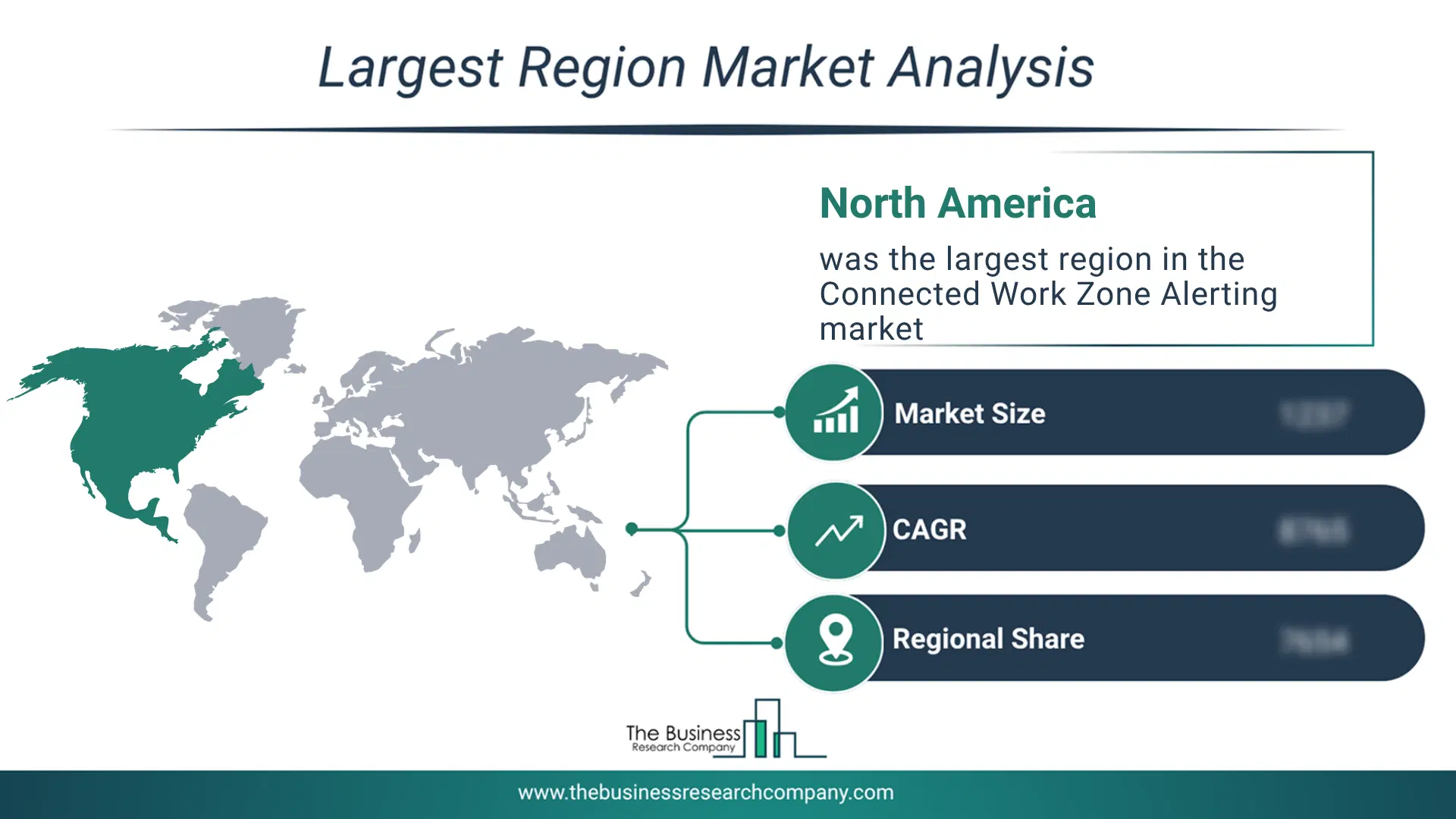
Regional Insights
North America was the largest region in the connected work zone alerting market in 2025. Asia-Pacific is expected to be the fastest-growing region in the forecast period. The regions covered in this market report are Asia-Pacific, South East Asia, Western Europe, Eastern Europe, North America, South America, Middle East, Africa. The countries covered in this market report are Australia, Brazil, China, France, Germany, India, Indonesia, Japan, Taiwan, Russia, South Korea, UK, USA, Canada, Italy, Spain.What Defines the Connected Work Zone Alerting Market?
The connected work zone alerting market consists of revenues earned by entities by providing services such as real-time work zone hazard detection, connected vehicle alert delivery, roadside sensor monitoring, cloud-based traffic data analytics, and automated incident notification services. The market value includes the value of related goods sold by the service provider or included within the service offering. The connected work zone alerting market also includes sales of roadside sensor units, connected safety beacons, vehicle-to-everything (V2X) communication devices, smart work zone control systems, and integrated alerting software platforms. Values in this market are ‘factory gate’ values, that is, the value of goods sold by the manufacturers or creators of the goods, whether to other entities (including downstream manufacturers, wholesalers, distributors, and retailers) or directly to end customers. The value of goods in this market includes related services sold by the creators of the goods.How is Market Value Defined and Measured?
The market value is defined as the revenues that enterprises gain from the sale of goods and/or services within the specified market and geography through sales, grants, or donations in terms of the currency (in USD unless otherwise specified). The revenues for a specified geography are consumption values that are revenues generated by organizations in the specified geography within the market, irrespective of where they are produced. It does not include revenues from resales along the supply chain, either further along the supply chain or as part of other products.
This chart presents market attractiveness based on a quantitative evaluation of growth, competition, strategic alignment, and risk, offering a clear view of opportunity areas for decision-making. This chart is for illustrative purposes; the full report contains the complete analysis.

This chart highlights the Total Addressable Market (TAM) by estimating the maximum revenue opportunity using an assumption-driven approach, supporting strategic planning and opportunity sizing across markets. The chart is illustrative; the full report provides a more comprehensive analysis.
What Key Data and Analysis Are Included in the Connected Work Zone Alerting Market Report 2026?
The connected work zone alerting market research report is one of a series of new reports from The Business Research Company that provides market statistics, including industry global market size, regional shares, competitors with the market share, detailed market segments, market trends and opportunities, and any further data you may need to thrive in the connected work zone alerting industry. The market research report delivers a complete perspective of everything you need, with an in-depth analysis of the current and future state of the industry.Connected Work Zone Alerting Market Report Forecast Analysis
| Report Attribute | Details |
|---|---|
| Market Size Value In 2026 | $1.88 billion |
| Revenue Forecast In 2030 | $3.90 billion |
| Growth Rate | CAGR of 20.2% from 2026 to 2030 |
| Base Year For Estimation | 2025 |
| Actual Estimates/Historical Data | 2020-2025 |
| Forecast Period | 2026 - 2030 - 2030 |
| Market Representation | Revenue in USD Billion and CAGR from 2026 to 2030 |
| Segments Covered | Component, Deployment Mode, Technology, Application, End-User |
| Regional Scope | Asia-Pacific, Western Europe, Eastern Europe, North America, South America, Middle East, Africa |
| Country Scope | The countries covered in the report are Australia, Brazil, China, France, Germany, India, Indonesia, Japan, Taiwan, Russia, South Korea, UK, USA, Canada, Italy, Spain. |
| Key Companies Profiled | Robert Bosch GmbH, Qualcomm Incorporated, 3M Company, NXP Semiconductors N.V., Siemens Mobility GmbH, Kapsch TrafficCom AG, TransCore LP, Wanco Inc., Iteris Inc., Ouster Inc., Hill & Smith PLC, Commsignia Inc., Wavetronix LLC, Cohda Wireless Pty Ltd, Econolite Group Inc., Sensys Networks Inc., ClearObject Inc., Applied Information Inc., HAAS Alert Inc., Cubic Transportation Systems Inc. |
| Customization Scope | Request for Customization |
| Pricing And Purchase Options | Explore Purchase Options |