

Constipation Treatment Market 2026
By Therapeutic Types (Laxatives, Chloride Channel Activators, Peripherally Acting Mu-Opioid Receptor Antagonists, GC-C (Guanylate Cyclase-C) Agonists, Other Therapeutics), By Disease Type (Chronic Idiopathic Constipation (CIC), Irritable Bowel Syndrome with Constipation (IBS-C), Opioid-Induced Constipation (OIC)), By Distribution Channel (Hospital Pharmacies, Retail Pharmacies, Online Pharmacies), And By Region, Opportunities And Strategies – Global Forecast To 2035
Constipation Treatment Market Definition
Constipation treatment refers to the range of medical, dietary and behavioral interventions used to relieve infrequent, difficult, or incomplete bowel movements. Treatments may include laxatives, stool softeners, fiber supplements, prokinetic agents, or osmotic solutions, as well as lifestyle modifications such as increased water intake, physical activity and dietary fiber consumption. The primary purpose of constipation treatment is to restore normal bowel function, improve digestive health and alleviate discomfort associated with hard or infrequent stools. The constipation treatment market consists of sales by entities (organizations, sole traders and partnerships) of constipation treatment products that encompasses a wide range of interventions used for individuals experiencing infrequent or difficult bowel movements, including those with chronic idiopathic constipation, irritable bowel syndrome with constipation (IBS-C), opioid-induced constipation and constipation related to aging, surgery, medication, or dietary habits. The target population includes adults, the elderly, postoperative patients and individuals with sedentary lifestyles or medical conditions affecting gastrointestinal motility.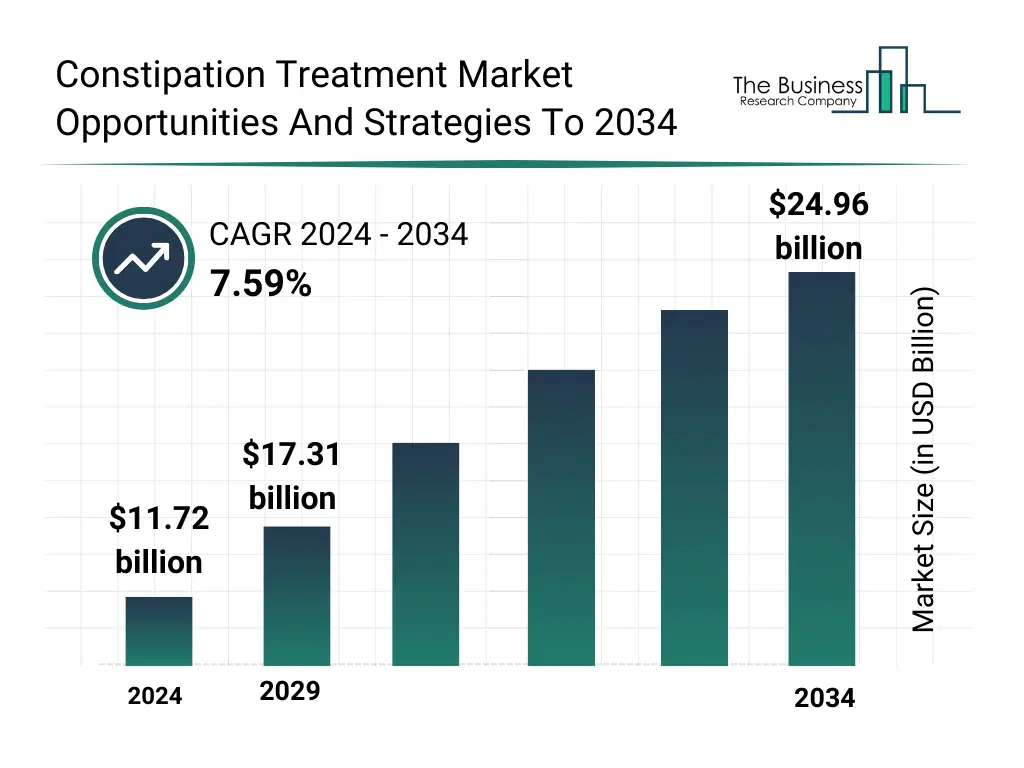
Constipation Treatment Market Size
The global constipation treatment market reached a value of nearly $11,724.44 million in 2024, having grown at a compound annual growth rate (CAGR) of 6.06% since 2019. The market is expected to grow from $11,724.44 million in 2024 to $17,313.37 million in 2029 at a rate of 8.11%. The market is then expected to grow at a CAGR of 7.59% from 2029 and reach $24,964.49 million in 2034. Growth in the historic period resulted from the changing dietary patterns, growth in preventive healthcare, growing awareness and self-medication trends and rising use of opioids. Factors that negatively affected growth in the historic period were consumer preference for natural remedies and low awareness. Going forward, the increasing aging population, rising prevalence of sedentary lifestyle, increasing prevalence of gastrointestinal (GI) disorders and rising demand for over-the-counter (OTC) laxatives will drive the growth. Factors that could hinder the growth of the constipation treatment market in the future include adverse side effects associated with long-term use, high cost of novel therapies and impact of trade war and tariff.Constipation Treatment Market Drivers
The key drivers of the constipation treatment market include: Increasing Aging Population During the forecast period, the rise in the ageing population will propel the growth of the constipation treatment market. The elderly population is more susceptible to chronic constipation due to age-related physiological changes such as slower intestinal transit, decreased physical activity, polypharmacy and reduced dietary fiber intake—all of which increase the need for effective constipation management solutions. Constipation treatments, including laxatives, prokinetics and lifestyle management programs, cater significantly to geriatric health needs by improving bowel function and overall quality of life. Moreover, as healthcare systems and pharmaceutical industries increasingly focus on elderly care and preventive gastrointestinal health, the demand for specialized and safer treatment options continues to grow. As the global proportion of people aged 65 years or older continues to expand, particularly in regions with rapidly ageing demographics such as Europe and Asia, the requirement for reliable and patient-friendly constipation therapies will substantially increase, thereby driving the growth of the constipation treatment market. The rise in the ageing population growth contribution during the forecast period in 2024 is 1.50%.Constipation Treatment Market Restraints
The key restraints on the constipation treatment market include: High Cost Of Novel Therapies In the forecast period, the high cost of novel therapies is restricting the growth of the constipation treatment market. Many advanced treatments, such as new pharmacologic agents and device-based bowel management technologies, come with premium pricing that limits access, especially in markets with constrained healthcare budgets or where insurance reimbursement is limited. These higher costs reduce affordability and may lead patients or payers to favor older, lower-cost alternatives or OTC products rather than switching to the latest options. Consequently, this cost barrier can slow uptake of innovative therapies, delay market penetration and dampen overall growth of the market segment focused on cutting-edge treatments. Growth affected by high cost of novel therapies across regions during the forecast period in 2024 is -1.60%.Constipation Treatment Market Trends
Major trends shaping the constipation treatment market include: Expansion Of Targeted Therapies To Address Opioid-Induced Constipation (OIC) Major players in the constipation treatment market are increasingly seeking regulatory approval and market access for novel therapies addressing opioid-induced constipation (OIC), a condition often overlooked despite its high prevalence. These efforts focus on enhancing patient quality of life (QOL) and filling gaps where standard treatments such as laxatives may be inadequate. For instance, in May 2025, Shionogi & Co., Ltd., a Japan-based global pharmaceutical firm, announced that a New Drug Application (NDA) for Naldemedine, a treatment for OIC, had been accepted in China. This application is intended to contribute to better constipation care by providing a dedicated pharmacologic option in a market where treatment was largely symptomatic and supportive. By advancing naldemedine into the Chinese regulatory pathway, Shionogi aims to advance its gastrointestinal portfolio and capitalise on the growing demand for targeted OIC therapies in Asia. Expansion Of Targeted Therapies To Address Opioid-Induced Constipation (OIC) Companies in the constipation treatment market are focusing on the advancement of diagnostic and assessment tools designed to better identify and stratify patients with chronic constipation and pelvic floor dyssynergia. These innovations emphasize improved differentiation of underlying dysfunctions, streamlined clinical workflows and enhanced treatment tailoring, while also enabling earlier intervention and broader service adoption across both hospital and outpatient settings. For instance, in December 2024, NeurAxis, Inc., a US-based medical-technology company specializing in neuromodulation and gastrointestinal care, announced that the RED (Rectal Expulsion Device) received US Food and Drug Administration (FDA) 510(k) clearance for use in the testing and evaluation of patients with chronic constipation due to pelvic-floor dyssynergia. By enabling the measurement of rectal-expulsion function without electronics or complex software, the device aims to empower clinicians with a focused diagnostic tool and support the development of more personalized constipation-treatment pathways.Opportunities And Recommendations In The Constipation Treatment Market
Opportunities – The top opportunities in the constipation treatment market segmented by therapeutic types will arise in the laxatives segment, which will gain $2,883.97 million of global annual sales by 2029. The top opportunities in the constipation treatment market segmented by disease type will arise in the opioid-induced constipation (OIC) segment, which will gain $2,340.73 million of global annual sales by 2029. The top opportunities in the constipation treatment market segmented by distribution channel will arise in the hospital pharmacies segment, which will gain $2,319.30 million of global annual sales by 2029. The constipation treatment market size will gain the most in the USA at $1,640.08 million. Recommendations- To take advantage of the opportunities, The Business Research Company recommends the constipation treatment companies to focus on expanding targeted therapies for opioid-induced constipation, focus on advancing diagnostic tools for chronic constipation, focus on launching enhanced treatments for chronic constipation, focus on introducing natural fibre-based formulations, focus on expanding pediatric treatment indications, focus on chloride channel activators as the fastest-growing segment, focus on opioid-induced constipation as the fastest-growing segment, expand in emerging markets, continue to focus on developed markets, provide competitively priced offerings, continue to use b2b promotions, focus on targeting end-users through online and retail pharmacies.
Constipation Treatment Market Segmentation
The constipation treatment market is segmented by therapeutic types, by disease type and distribution channel.By Therapeutic Types –
The constipation treatment market is segmented by therapeutic types into:
- a) Laxatives
- b) Chloride Channel Activators
- c) Peripherally Acting Mu-Opioid Receptor Antagonists
- d) Gc-C (Guanylate Cyclase-C) Agonists
- e) Other Therapeutics
By Disease Type –
The constipation treatment market is segmented by disease type into:
- a) Chronic Idiopathic Constipation (CIC)
- b) Irritable Bowel Syndrome With Constipation (IBS-C)
- c) Opioid-Induced Constipation
By Distribution Channel –
The constipation treatment market is segmented by distribution channel into:
- a) Hospital Pharmacies
- b) Retail Pharmacies
- c) Online Pharmacies
By Geography - The constipation treatment market is segmented by geography into:
- • China
- • India
- • Japan
- • Australia
- • Indonesia
- • South Korea
- • Bangladesh
- • Thailand
- • Vietnam
- • Malaysia
- • Singapore
- • Phillipines
- • Hong kong
- • New Zealand
- • USA
- • Canada
- • Mexico
- • Brazil
- • Argentina
- • Chile
- • Colombiia
- • Peru
- • France
- • Germany
- • UK
- • Italy
- • Spain
- • Austria
- • Belgium
- • Denmark
- • Finland
- • Ireland
- • Netherland
- • Norway
- • Portugal
- • Sweden
- • Switzerland
- • Russia
- • Czech Republic
- • Poland
- • Romania
- • Ukraine
- • Saudi Arabia
- • Israel
- • Iran
- • Turkey
- • UAE o Africa
- • Egypt
- • Nigeria
- • South Africa
-
o Asia Pacific